
Taiwan is the Kingdom of Butterflies-
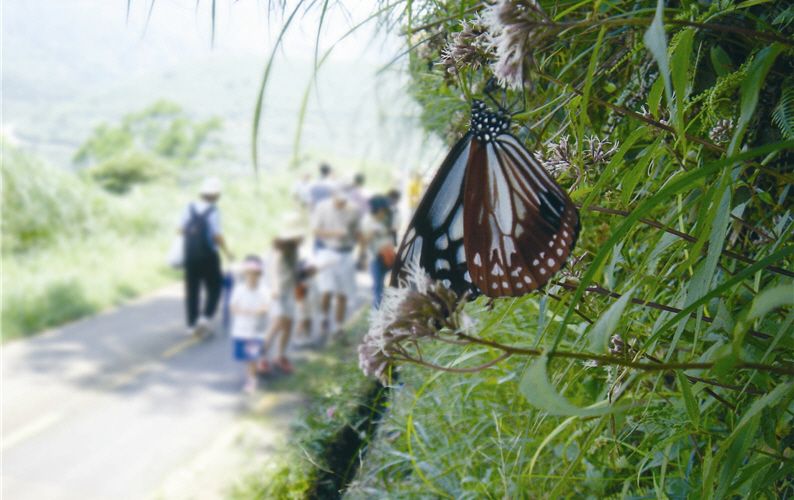
Taiwan was once called “Formosa”, and it has a reputation as a kingdom of butterflies. On this relatively small island, there are nearly 400 species of butterflies. It is fortunate that locals can enjoy the beauty of the butterfly world without traveling far, and the charm of butterflies used to make a contribution to Taiwan’s economy.
Taiwan is an island located between the Eurasian Plate and the Philippine Plate, and it boasts lush vegetation and biodiversity, with varied landscapes, climates, and natural resources. Despite Taiwan’s relatively small size, its diverse environment attracts an amazingly large variety and population of butterflies.
Chien-chih Chen, associate professor of Graduate Program of Environmental Education & Resources at Taipei Municipal University of Education states that national parks are the most accessible entrance to the beauty of the butterfly world. With the right timing, clouds of exquisite butterflies appear in enormous fluttering swarms in the park, creating a miraculous natural wonder.

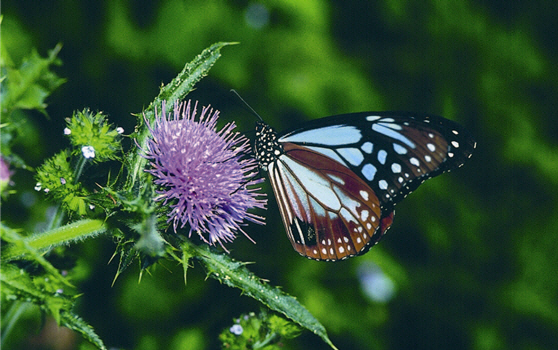
- upper:The Parantica sita niphonica are feeding on Eupatorium shimadai Hay on Mt. Yangming. / by Chien-chih Chen
- lower left:Chien-chih Chen thinks a lot of ecological damage is done because people lack knowledge of biodiversity.
- lower right:The Parantica sita niphonica has semi-transparent green color on their black wings. They prefer Compositae as their nectar resource. / by Bo-chang Lin
Text—Wan-ju Chiang Photographer—Peter Wang.Bo-chang Lin
Resource & Photo provider—Chien-chih Chen, Associate professor of Graduate Program of Environmental Education & Resources, Taipei Municipal University of Education
Yangmingshan National Park Parantica sita niphonica
The milkweed butterfly (Parantica sita niphonica ) has a distinguishing feature of semi-transparent green color on their wings. The major distinction between males and females is black spots on the back side the hind wings of males. They are frequent visitors in Yangmingshan National Park, especially in the area around Eupatorium shimadai Hay in Mt. Datun. From May to June, more than 100,000 butterflies gather in vast formations, filling the sky with awesome waves of fluttering colour.
The big occurrence of milkweed butterfly in Yangmingshan National Park has became an interesting issue for entomologists. As the ecological capacity of the national park is limited, some scholars assume the swarms of milkweed butterfly must originate elsewhere. After examining the freshness and fullness of sample butterflies, Chen infers they were are in the park, and when their population reaches environmental limits, they disperse to other habitats, such as medium to high altitude mountain areas in central and southern Taiwan. Some even follow the northwest winds to Japan.
Shei-Pa National Park Agehana maraho
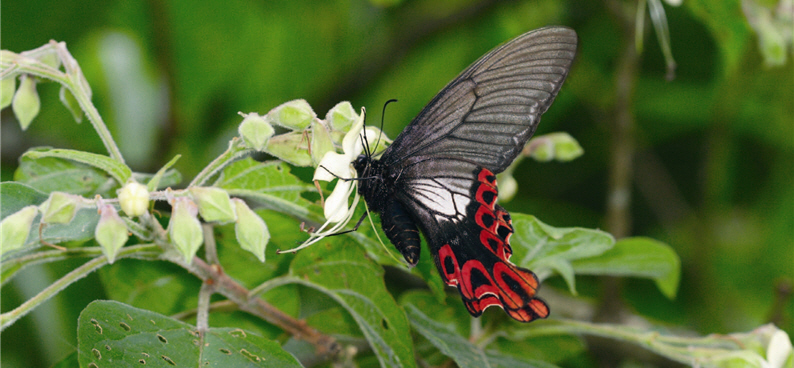
The broad-tailed swallowtail butterfly (Agehana maraho) is a nearly extinct species. Adults emerge between spring and summer and are usually seen in mid-altitude mountains from northern to central Taiwan, such as Taroko and southern Yushan. Their features include a relatively large size, hind wings which bear a large, white spot in the central discals, as well as two extraordinarily colourful veins running through the tail. As Taiwan Sassafras (Sassafras randaiensis) trees are host to the caterpillars of broad-tailed swallowtail butterfly, therefore the Taiwan Sassafras conservational area in Shei-Pa National Park is their biggest habitat, with the best watching period occurring from May to August.
Additionally, broad-tailed swallowtail butterfly origin and habitat can traced back to the glacial epoch in China’s mountain areas. As the sea level suddenly fell and the temperature dropped in high-altitude mountains, the broad-tailed swallowtail butterfly migrated to Taiwan through the point where the island was once connected with southeast mainland China. Later, when the sea level rose again, and Taiwan was geographically separated from the mainland, the remaining broad-tailed swallowtail butterfly moved to cooler mountain elevations, and evolved into an endemic specie. They are now treated as a national treasure of Taiwan.
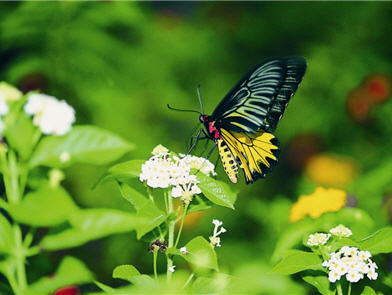
- upper: With spread wings, the Agehana maraho can reach 9-10cm. Their front wings have a linear pattern of crescent moons along the outer margins of the black background. / by Chien-chih Chen
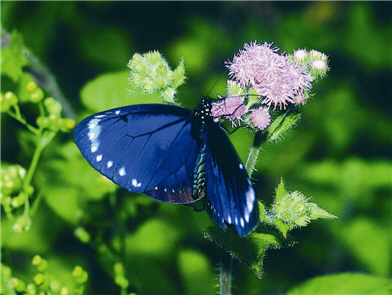
- lower left: The Euploea has purple color under their front wings. They breed in spring and summer all over Taiwan, and over winter in the south. / by Bo-chang Lin
- lower right: With spread wings, the Troides aeacus kaguya can reach 13-20cm. Imagos can be seen year round, and mainly is discovered from March to April, and September to October. / by Bo-chang Lin
Taroko National Park Atrophaneura horishana
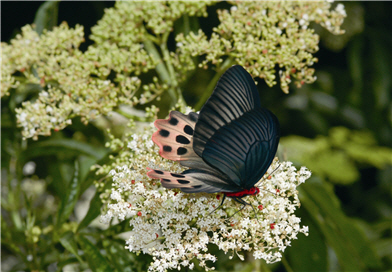
The highland red-bellied swallowtail butterfly (Atrophaneura horishana) is an endemic subspecies in Taiwan, as well as an endangered species. It is a large species in the Papilionidae family. The distinguishing features are the pink color with black spots on the back side of the outer ring of their hind wings. They are distributed primarily in mountains above 2,500 meters in elevation, and mostly seen in Cih-en, Bilyu Sacred Tree, Dayuling and Songcyuangang. July and August are the best timing to see clouds of exquisite butterflies appearing in enormous fluttering swarms in this area.
Though favouring mid-altitude mountains, where they feed on nectar of Sambucus chinensis, highland red-bellied swallowtail butterflies travel to lower elevations for other food resources when the temperature drops. It’s easy to spot them in Tiansiang area in Taroko National Park around the National Day in early October.
Dispersion of butterflies occurs due to factors like climate, food, and other environmental causes. The dispersion could be towards other suitable habitats. However, this behaviour is not a periodic or repeat phenomenon.
Resource:Chien-chih Chen


Chien-chih Chen
Ph.D. of Graduate Institute of Entomology, Insect Science Department, National Taiwan University.
Associate Professor of Graduate Program of Environmental Education & Resources, Director of Environmental Education & Resources Center, Taipei Municipal University of Education.
Former president of the Butterfly Conservation Society of Taiwan, Chief of the Butterfly Exhibition center of Taipei Zoo, Secretary-General of Taiwan Entomological Society
- upper left:Though favouring high altitude mountains, the Atrophaneura horishana travels to lower elevations for nectar esources. / by Bo-chang Lin
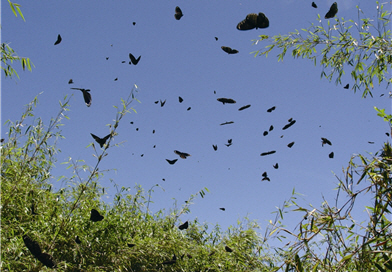
- upper right:The Euploea travels towards the south through Tataka Saddle in September. / by Chien-chih Chen


