
Appreciation for the Beauty of Life Bird Aficionado Chin-chung Sa-
Approximately 500 bird species have been recorded in Taiwan, of which about 160 are resident, while the others are migrating. The rich variety of bird species has fostered a bird watching trend. These days Taiwan's many bird-lovers know that, when faced with a species they can't distinguish, they can always go to Chin-chung Sa, who is respectfully nicknamed Doctor Bird.
「I believe everyone is gifted in some way, and for me, I have known since I was a little kid that I have a passion for biology.」 Sa is a well-known ornithologist who is currently working for the Interpretation & Education Section of Yangmingshan National Park. His two bird watching guide books are highly recommended by bird lovers as 「the Bible of bird watching」.
It didn't just happen that Sa acquired his abundant knowledge overnight. As mentioned, he discovered his passion at a very young age, and he has devoted vast amounts of energy to the world of birds. He recalls the teacher making a comment about him being an eccentric and unsociable child. Unlike most children, who play together, young Sa usually spent his spare time between classes alone, listening to birds.
The Beginning of Bird Watching
To further satisfiy his interests in birds, Sa bought his very first illustrated bird handbook when he was in junior high school. He soon realized it was not a very practical handbook to identify flying birds. Wanting more than the limited help from the handbook, Sa joined Taiwan Bird Watchers Group, spending weekends in the field with the club, with Guandu wetland as his most visited place. He also asked Kuo-fan Tseng, the former president of Wild Bird Society of Taipei (WBST), to be his mentor.
The shift of his focus
In 1982, at age 27, Sa invested two month's salary in his first pair of bird watching binoculars. Over the next 15 months, he commuted every weekend by bus from Yungho City all the way to Guandu wetland for bird watching. His diligent efforts on bird research eventually led to the completion of a regional bird survey. His enthusiasm caught the attention of Yushan National Park Headquarters, and they recruited him for educational interpretation and planning in 1985.
However, waterfowls had been his specialty. Sa didn't know much about high-altitude mountain birds when he started working for Yushan National Park. Nonetheless, he welcomed this new challenge, and after spending 2 years on self study and research, he compiled his work and published an illustrated book of mountain birds. This book has been honoured as a classic of mountain birds, and Sa truly established himself in ecology circles.

Brighter breeding plumage for the purposes of sexual display is referred to as alternate plumage. Usually, young birds don't grow alternate plumage.
Resource: Chin-chung Sa
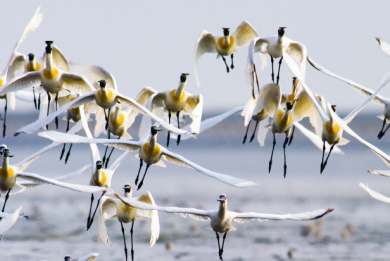
- upper left: Platalea minor transit to Cigu, Tainan County in October, and back to their Northeast Asia habitats the following March or April. / by Chun-hsien Huang
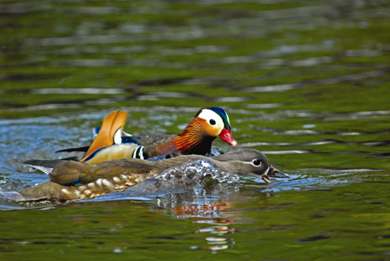
- upper right: The male of mandarin ducks have bright feather. / by Pei-yu Chang
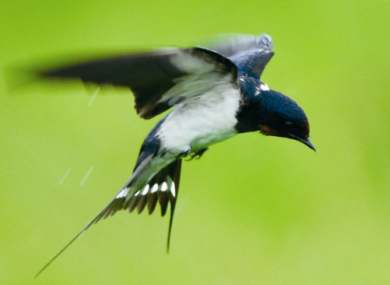
- lower left: Hirund rusticas are one of the most widely spread species in the world. They are typical migratory birds, and they tend to flock. Some of them stay in Taiwan. / by Pei-yu Chang
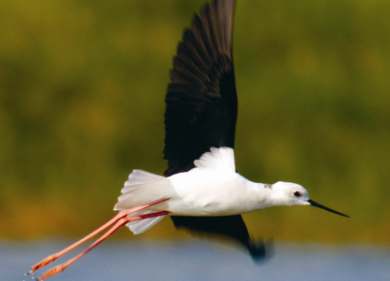
- lower right: Straight slender beaks, long pink legs, and bright feathers are distinguishing characteristics of Himantopus himantopus. / by Chun-hsien Huang
Text / Wan-ju Chiang
Photographer / Peter Wang.Cheng-chi Wang.Su-lan Lu Chiu
Photographer / Chun-hsien Huang.Pei-yu Chang
Resource / Chin-chung Sa, Interpretation & Education Section of Yangmingshan National Park
Common Myth about Birds
The passion Sa shows for bird research is beyond common understanding. When he is telling stories about birds, his slightly smiling expression and bright eyes distinguish him as a special person. He commands attention as he clarifies some common myth about birds.
For example, the belief that birds migrate in winter to escape severe cold is a common misunderstanding. In fact, it is because birds cannot find food resources on the snow-covered winter grounds of higher latitudes that they travel to the warmer south with abundant food supply. Additionally, migration routes are not always from north to south. The tendency of birds is to avoid passing over dangerous places, such as deserts or oceans. There are many bird species which migrate from northeast to southwest in China, and there are even birds migrating from England to China, a direction of west to east.
There are some interesting Chinese cultural myths about birds as well. Sa points out that Chinese usually use mandarin ducks or a pair of lovebirds as symbols of a happy couple. In the world of birds, romantic love is not involved, as most species choose their partners by appearance. A breeding male displays its alternate plumage during mating season, and a female responds to the male with the largest size and most beautiful appearance, indicating that physically attractive males win the mating privilege. Furthermore, bird species with more distinguishing plumage differences between male and female usually favour polygamous or polyandrous breeding, and the perceived monogamy of mandarin ducks only lasts for one breeding season.
Sa points out species, such as diurnal birds of prey flying in Kenting National Park in the fall, Phalacrocorax carbo in Kinmen National Park in the winter, and Platalea minor at the estuary of the Tsen-wen River are some of the special endemic birds of Taiwan.
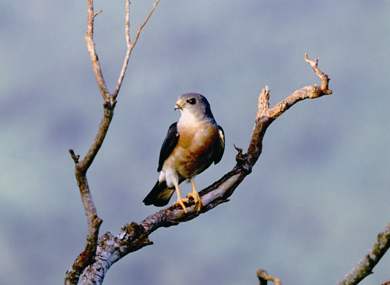
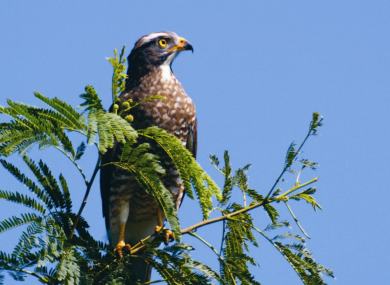
Every year, from mid-September to mid-October, large numbers of diurnal birds of prey transiting in Kenting National Park create a phenomenon in Taiwan. The geography of Taiwan island generates pocket environments. The tail of Taiwan's central mountain ranges extends to Hengchun Penisula, attracting transitory birds of prey ( Accipiter soloensis and Butastur indicus mainly ) to flock in Hengchun. These birds take advantage of ascending air streams to soar over Bashi Channel to the Philippines. The numbers of Accipiter soloensis flying over Taiwan approache 200,000 every year, and many bird watchers are attracted to this festival.
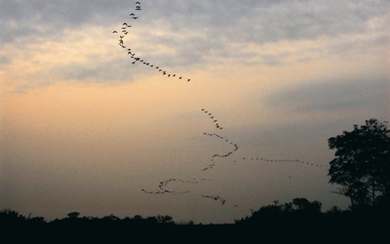
Phalacrocorax carbo is another highlight of migratory bird watching. Around 3 to 5 o』clock in the afternoon in the bird watching season, it's easy to see them flying in formation, as they take advantage of air-stream currents to reduce flying obstructions. Sa adds that Phalacrocorax carbo feeds on fish, and naturally the density of its bone marrow is higher than polyphagia ducks to shorten its diving time into the water. As a rare species, Platalea minor is a national treasure. There are only 1,700 left in their East Asia habitat, and half of this number transit at the estuary of the Tsen-wen River in winter.
Bird ecology is an interesting subject, and it's important to research information from bird watching to Sa. He enthuses that birds struggle to survive, flying long distances over land or ocean. In his bird watching experience, he has developed respect for all life.
Bird Watching Rules
- Don't wear red clothes. They display a spectrum which stimulates birds vision.
- Don't use any whistle, bell, or appliances with high frequency to drive birds away.
- For bird watching, binocular should have wide-angle lens, good brightness, and a maximum of 10x power. For a telescope, 25x power is suitable.
Resource: Chin-chung Sa

Graduated from China University of Technology, majored in finance. Currently working for Interpretation & Education Section of Yangmingshan National Park, prior service in Interpretation & Education Section of Yushan National Park.
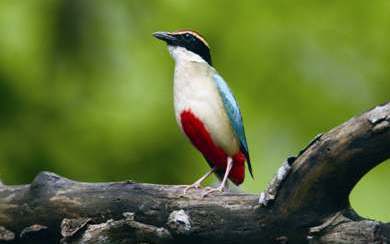
- upper left: The Pitta nympha is an endangered species distributed in Southeast Asia. (by Su-lan Lu Chiu)
- upper right: Phalacrocorax carbo are uncommon migratory birds. They tend to fly in formation, as they take advantage of air-stream currents to reduce flying obstructions. / by Pei-yu Chang
- lower left: The Accipiter soloensis flies over south Taiwan during September and October, then moves on to Southeast Asia for winter. / by Cheng-chi Wang
- lower right: Butastur indicus transit in Hengchun around the time of National Day in Taiwan in October. Therefore, they are also called 「the Bird of National Day」. / by Chun-hsien Huang


