Derict to middle content area:::

:::

A War-scarred Time Tunnel-Visiting Jhaishan Tunnel in Kinmen
With the efforts of the park administration,
Jhaishan Tunnel took off her mysterious veil,
And displayed her beauty to the world,
Recounting some age-old stories…
Walking through the tunnels in Kinmen, you can hear all those glorious and sad stories. 40 years could make young soldiers fade, but has made Jhaishan Tunnel shine. At the end of the brick trail stands a black stele inscribed with the disciplines of soldiers; beautiful sceneries spread under verdant hills while the dim tunnel yarns about histories.
A Time with Artillery Fires
During the August 23 Artillery War (also known as Kinmen Crisis) in 1958, the military tension across the Strait reached its height, and Kinmen was constructed as a mega military base with underground facilities. Underground tunnels became the most secure storage and shelter. The tunnels with a total length of 2500 m built underneath the township of Jincheng had provided shelter for civilians and become important supply channels during wartime.
Jhaishan Tunnel lies southwest of Gugang Lake, beneath a granite hill, and next to the coast villages. The construction began in 1963 and had lasted 3 years with nonstop digging.
The tunnel has a length of 458m and stretches from the land to the sea with an A-shaped waterway. Inside the tunnel, there is a dock where up to 42 dinghies could be anchored.
Jhaishan Tunnel took off her mysterious veil,
And displayed her beauty to the world,
Recounting some age-old stories…
Walking through the tunnels in Kinmen, you can hear all those glorious and sad stories. 40 years could make young soldiers fade, but has made Jhaishan Tunnel shine. At the end of the brick trail stands a black stele inscribed with the disciplines of soldiers; beautiful sceneries spread under verdant hills while the dim tunnel yarns about histories.
A Time with Artillery Fires
During the August 23 Artillery War (also known as Kinmen Crisis) in 1958, the military tension across the Strait reached its height, and Kinmen was constructed as a mega military base with underground facilities. Underground tunnels became the most secure storage and shelter. The tunnels with a total length of 2500 m built underneath the township of Jincheng had provided shelter for civilians and become important supply channels during wartime.
Jhaishan Tunnel lies southwest of Gugang Lake, beneath a granite hill, and next to the coast villages. The construction began in 1963 and had lasted 3 years with nonstop digging.
The tunnel has a length of 458m and stretches from the land to the sea with an A-shaped waterway. Inside the tunnel, there is a dock where up to 42 dinghies could be anchored.
After its construction, Jhaishan Tunnel was garrisoned by the 2nd Naval Beach Group; General Duo-nian Wang, the Commander of Kinmen Defense Command, was in charge of conducting its military operation. In the tunnel which was humid all year round, there were five soldier’s quarters. If the quilts were not sun dried during daytime, the soldiers would have to endure the long night sleeping in wet, cold quilts. One cannot help wondering: what kind of will power did it take for the soldiers to take this tough task of guarding their land in such harsh circumstances?
Because of the silt brought in by the tides, Jhaishan Tunnel has been gradually defunct since 1986. In 1995, the Kinmen National Park was established to preserve the islet’s historical and cultural resources, and the tunnel became the first wartime site open to the public in 1997.
With the efforts of the park administration, Jhaishan Tunnel took off her mysterious military veil and displayed her beauty to the world, recounting some age-old stories.
Spectacular Rock Walls
Strolling along the 101m-long trail, one can from time to time see the chisel traces on the granite walls. The pounding sound from pickaxes seems to be echoing between the damp walls still.
Jhaishan Tunnel was dug by the soldiers with helmet and goggles using pickaxes, shovels, washbasins and dustpans. Stroking the rugged rock wall, one can visualize the hard-working figures bitterly wielding axes with all their blood and sweat shed for their beloved land.
Because of the silt brought in by the tides, Jhaishan Tunnel has been gradually defunct since 1986. In 1995, the Kinmen National Park was established to preserve the islet’s historical and cultural resources, and the tunnel became the first wartime site open to the public in 1997.
With the efforts of the park administration, Jhaishan Tunnel took off her mysterious military veil and displayed her beauty to the world, recounting some age-old stories.
Spectacular Rock Walls
Strolling along the 101m-long trail, one can from time to time see the chisel traces on the granite walls. The pounding sound from pickaxes seems to be echoing between the damp walls still.
Jhaishan Tunnel was dug by the soldiers with helmet and goggles using pickaxes, shovels, washbasins and dustpans. Stroking the rugged rock wall, one can visualize the hard-working figures bitterly wielding axes with all their blood and sweat shed for their beloved land.
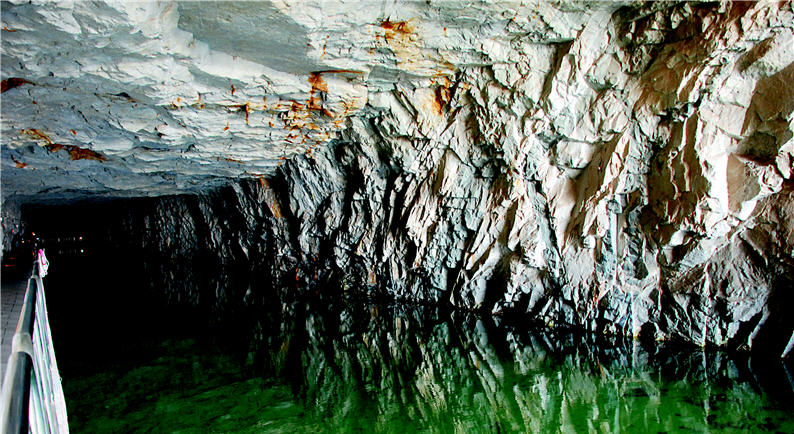
- upper: The water channel in winter is calm, clearly reflecting the rocks above it./ Photo taken by Long-sheng Chen
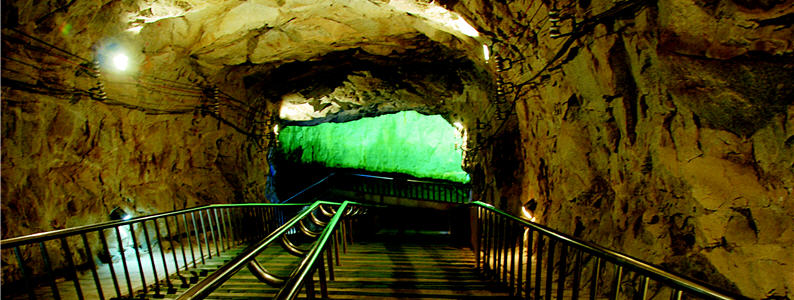
- lower: Following down the stairs, one can reach the water channel./ Photo taken by Long-sheng Chen
Interview & Text: Zih-yin Chen
Special thanks to: Chief Zih-jyuan Huang, Mr. Wun-wei Yang, and Mr. Long-sheng Chen of Kinmen National Park Headquarters, Chief Shao-liang Syu of Marine National Park
Translator: Chunyi Cheng
Photo provided by: Long-sheng Chen
Special thanks to: Chief Zih-jyuan Huang, Mr. Wun-wei Yang, and Mr. Long-sheng Chen of Kinmen National Park Headquarters, Chief Shao-liang Syu of Marine National Park
Translator: Chunyi Cheng
Photo provided by: Long-sheng Chen
The walkway was lit by the interlacing lights from both sides of the tunnel. Walking in the alternating light and darkness makes one think of the Dwarf’s kingdom, also mysterious and underground, in J.R.R.Tolkien’s The Lord of the Rings. At the end of the walkway is a steep rock staircase; going down the staircase one can glimpse the shimmer of the sea. A railed trail of about 2m wide follows after the staircase; the rail was reinstalled after being battered down along with the iron fence in 1999 by the typhoon Dan. Due to the damages brought by that typhoon and the flood tide, Jhaishan Tunnel was closed for a short time.
The Azure Shimmering Sea
On the other side of the rail is the broad waterway for dinghies. Because of the unique climate and landscape of Kinmen, it is cool but humid inside the tunnel during summer; water keeps dripping from the rock ceiling down to the sea. So for tourists who wish to see a calm, no-ripple, beautiful waterway reflection of the tunnel, Mr. Long-sheng Chen suggests winter as best time for viewing.
Originally both exits of the tunnel led to the sea, yet now they are closed. Jhaishan Tunnel was constructed to lessen the risk of the dinghies’ being cannoned by the communist army, who targeted their attack on the beach logistics during the August 23 Artillery War. Loading military and civilian supplies inside the tunnel had diminished losses during war time. Though the supply dinghies are no longer seen here, one can imagine the intensity of war they brought into the tunnel when speeding in seeking shelter from the artillery fires. Without these valiant soldiers, we may not be able to lean on the rail here and now, listening to the roar of waves outside the rock cave.
The waterway is now silted up, and no dinghy can sail in anymore, yet it becomes a paradise for fish. Oh if only there will be no more human wars.
The Azure Shimmering Sea
On the other side of the rail is the broad waterway for dinghies. Because of the unique climate and landscape of Kinmen, it is cool but humid inside the tunnel during summer; water keeps dripping from the rock ceiling down to the sea. So for tourists who wish to see a calm, no-ripple, beautiful waterway reflection of the tunnel, Mr. Long-sheng Chen suggests winter as best time for viewing.
Originally both exits of the tunnel led to the sea, yet now they are closed. Jhaishan Tunnel was constructed to lessen the risk of the dinghies’ being cannoned by the communist army, who targeted their attack on the beach logistics during the August 23 Artillery War. Loading military and civilian supplies inside the tunnel had diminished losses during war time. Though the supply dinghies are no longer seen here, one can imagine the intensity of war they brought into the tunnel when speeding in seeking shelter from the artillery fires. Without these valiant soldiers, we may not be able to lean on the rail here and now, listening to the roar of waves outside the rock cave.
The waterway is now silted up, and no dinghy can sail in anymore, yet it becomes a paradise for fish. Oh if only there will be no more human wars.
New Arts in the Tunnel
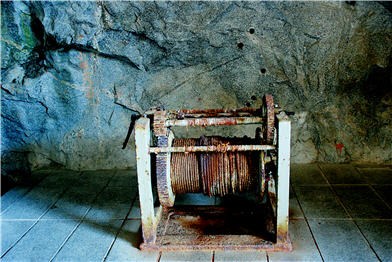
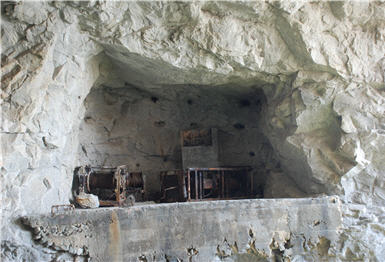
Some objects from the early days are preserved by the park administration and exhibited to the public. The rusty traction machine left in the tunnel, and the retired dinghies and warship artillery displayed on the square outside the tunnel all tell us about the turbulent past.
The value of Jhaishan Tunnel, however, is not restricted to historical narration and tourism, but also has its artistic dimension. For tourists to further appreciate the spectacular scenery of Jhaishan, the park has collaborated with artists in recently years to bring installation arts into the tunnel.
In October 2006, Kinmen Art Festival featured artist Bo-yan Ouyang in the “Fluorescent.Reflection” exhibition at Jaishan Tunnel and transformed the dark tunnel into a sparkling gallery. The writer-artist Ouyang has aspired to combine original art creation with local culture to enhance the value of merchandise in local businesses. Adding new aesthetic elements to historical war sites benefits tourism and local businesses, and people in Kinman are now proud of being a part of maintaining the historical monuments. Through the effort of locals and artists, the lifeless and dark space of military sites has obtained a new bright life.
Tourists visiting the tunnel can immerse themselves in its history and installation art. Just be advised to wear a helmet to protect you from stone chips that occasionally come off the granite–gneiss tunnel. Watch your steps as the ground is slippery during summer. Do not let young kids and elders walk alone. And keep your voice down.
The rumbling sounds of artillery fires had long faded away, while the Wind Lion God that symbolizes peace and blessing stands still in the chilly wind. And the stories of the tunnels still await people to listen and explore.
Some objects from the early days are preserved by the park administration and exhibited to the public. The rusty traction machine left in the tunnel, and the retired dinghies and warship artillery displayed on the square outside the tunnel all tell us about the turbulent past.
The value of Jhaishan Tunnel, however, is not restricted to historical narration and tourism, but also has its artistic dimension. For tourists to further appreciate the spectacular scenery of Jhaishan, the park has collaborated with artists in recently years to bring installation arts into the tunnel.
In October 2006, Kinmen Art Festival featured artist Bo-yan Ouyang in the “Fluorescent.Reflection” exhibition at Jaishan Tunnel and transformed the dark tunnel into a sparkling gallery. The writer-artist Ouyang has aspired to combine original art creation with local culture to enhance the value of merchandise in local businesses. Adding new aesthetic elements to historical war sites benefits tourism and local businesses, and people in Kinman are now proud of being a part of maintaining the historical monuments. Through the effort of locals and artists, the lifeless and dark space of military sites has obtained a new bright life.
Tourists visiting the tunnel can immerse themselves in its history and installation art. Just be advised to wear a helmet to protect you from stone chips that occasionally come off the granite–gneiss tunnel. Watch your steps as the ground is slippery during summer. Do not let young kids and elders walk alone. And keep your voice down.
The rumbling sounds of artillery fires had long faded away, while the Wind Lion God that symbolizes peace and blessing stands still in the chilly wind. And the stories of the tunnels still await people to listen and explore.
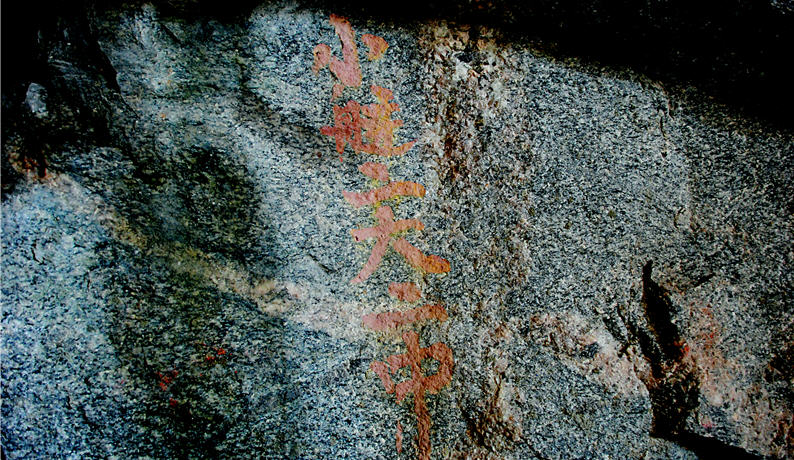
- upper: On the stone one can still see that it says the navy base./ Photo taken by Long-sheng Chen
- lower left: The winch on the right side of the water channel was utilized to elevate the iron water gate./ Photo taken by Long-sheng Chen
- lower right: The winch on the right side of the water channel was utilized to elevate the iron water gate./ Photo taken by Long-sheng Chen


