
Sweet Memory of the Southern Tip of the Land-An interview with Photographer Ching-hwa Wang
Who could possibly record all these?
Treading across Taiwan and capturing all the landscape through his lens, he once won the “Nippon Camera” Awards in 1982 and 1984 among the amazement of Japanese, and became the first-ever Taiwanese that snatched the Gold Award and Silver Award in that contest.
In 1986, commissioned by Kenting National Park (KNP), he co-worked with the contemporary literary master Kuang-chung Yu, and helped publish the “Photo and Poetry Album of Kenting National Park,” which presented a lively Kenting in print with all the magnificent poems and images, and brought forth a trend of publications combining literature and photography.
In 1987, he led the renowned Japanese musician Sojiro, who had composed “The Great Yellow River,” to Mt. Jade, and collaborated with him on an album named “A Dream Tour to the Secluded Mt. Jade.”
In 1988, when photography was yet to earn its due respect, he, as a locally-born and –bred Taiwanese, had his works exhibited in Taipei Fine Arts Museum with such landmark significance.
He is Ching-hwa Wang, a photographer from Hengchun Peninsula who had recorded numerous breathtaking scenic images of Taiwan, and had achieved remarkable success. Leading a seclusive life and savoring leisure and freedom with his beloved wife these days, he enjoys touching the earth with his bare feet, meditating in his peaceful backyard, and pressing the shutter once in a while over the subjects he loves.
Growing up at Guanshan in Kenting, Wang was purely a country boy.
For him, he never had to make an effort to get close to the nature because he lived right in it. With a strong interest in everything in the nature since childhood, he became a qualified guide of high mountains, and trod across all the famous mountains in Taiwan, and later plunged into the world of photography.
Despite his entry into photography as usual as those of many ecological photographers, Wang’s sincerity and passion had brought him unusual achievements. His vision was far beyond what he looked through from the little viewfinder as he maximized the possibility of photography by integrating it with other art genres and working with artists from other countries.
As Wang had quite a few acquaintances in the art circle, Kenting National Park Headquarters (KNPH) wanted this “Photo and Poetry Album of Kenting National Park,” to be an artistic presentation that blended multi-genres of arts including photography, literature, and calligraphy. So a wild idea struck Wang that it’d be wonderful if the celebrated calligrapher Ms. Yang-tze Tong could inscribe for the Album. Yet Tong’s handwritten inscription was too precious to be fetched even for a large fortune. Not so hopeful as then- unknown Wang could be, he managed to contact Tong through the help by Wo-tsun Fan, wife of Kuang-chung Yu.
“Ms. Tong knew about my intention and she didn’t reject me, but just asked about my capacity for liquor.” Later Wang went up north to visit Tong, and had a joyful drink and a hearty talk with Tong’s husband while Tong wrote with quick strokes of her writing brush, and the six Chinese characters that meant “Kenting National Park” looked alive on the paper with such elegance and splendor.

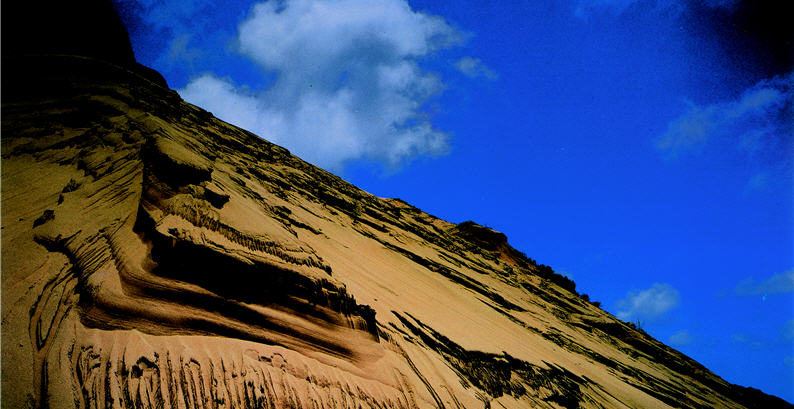
- upper: Viewed from down under, the sand cascade at Fongchueisha looks no longer like a smooth river but more like an imposing god guarding the clouds and sky up above. / Captions by Chiung-yao Lin
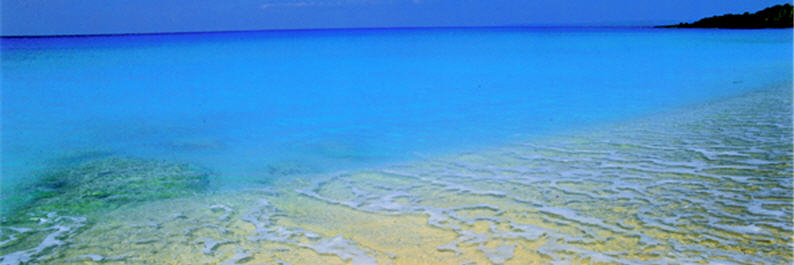
- lower: Without industrial pollution and turbid rivers, the pristine Sand Island (or Shadao) is a young maiden with no experience of the outside world. Without putting on any make-up, she has a stunning look./ Captions by Chiung-yao Lin
Interviewer / writer (Chinese): Wan-ching Lai
Translator (English): Kuanyu Ou
Photographer: Ching-hwa Wang
Special thanks to: Ms. Chiung-yao Lin, Instruction Section of Kenting National Park Headquarters
Close Friendship with Yu Boundless Tours to See Stars
Besides the anecdote of the request for inscription, this Album also contributed to the cordial friendship between Wang and the literary master Kuang-chung Yu. The duo had collaborated on a great many photo/poetry albums, and Yu had, in many of his books, talked about his friendly relations with Wang. When the sentimental Yu came back to Taiwan from Hong Kong and first settled down in Kaohsiung, he was led by Wang to lots of gorgeous sceneries in Taiwan and transcribed what he saw and felt into words.
“I had taken Director Yu to Tataka Anbu to overlook Mt. Jade in the distance, and to Kenting to look up at the stars or stroll along the soft seashell sand beach with our bare feet.” Wang’s passion and unaffectedness had influenced Master Yu, who once wrote: “Ching-hwa is a miraculous friend of mine.” Wang had not only brought Yu an abundance of life experience, but had also broadened that literary master’s vision, and helped Yu create works that depicted the beauty of Taiwan, such as Seashell Sand, All Those Lofty Mountains, etc.
Through Yu, Wang built a solid fellowship in the art circle. Yu’s wife Wo-tsun Fan, writer Ling Chung and others all learned from Wang about photography. During this interview, the name of the late master Max Liu was casually brought up, and it turned out that Liu was also a nodding acquaintance of Wang’s. Wang has always called himself a nobody, but many of his friends are quite somebody in the art circle, and people would address him as “teacher” out of respect.
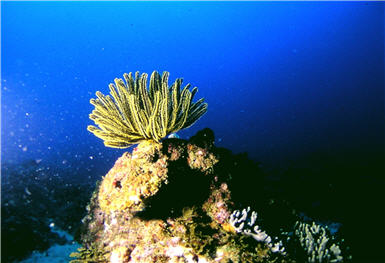
From a professional tour guide to a master photographer, Wang has never confined himself within only a few possibilities in his life. Daring but thoughtful, he, along with Yong-chuen Tsai, undertook a task commissioned by KNP to shoot a documentary titled The Beauty of Coral as they’d need to dive into Taiwan’s coastal waters to film the beautiful natural scenery of great biodiversity. It would be like a mission impossible unless one had the know-how about carrying heavy cameras and shooting underseas. Without any experience of shooting a 16mm film, Wang had to give it a first try under the sea. “A lot of our friends just waited to see us two embarrass ourselves. They just didn’t think we could get things done,” laughed Wang.
Be it a camera or a video camera, once Wang carried it, all he knew was go all out to finish the job. Not only did he complete the documentary, but the film was also nominated the best documentary in the 1999 Golden Horse Awards. “KNPH has been an indispensible partner in my career. Lots of my works were done under the cooperation and great chemistry between us.”
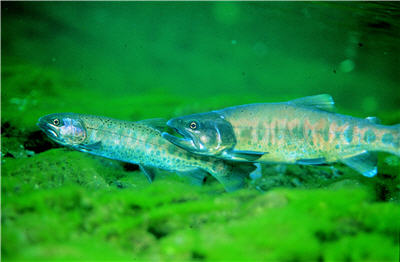
Also important to Wang’s career was Shei-pa National Park Headquarters (SNPH). Commissioned by SNPH, Wang was honored to be the first photographer to take pictures of Formosan Landlocked Salmon. Nobody knew better than him the coldness brought into the creeks by the first thawing snow of Mt. Syue as he worked there for over one year.
“In that darkish green stream, it’s difficult to just spot the fish, let alone take a picture of it. At first I could only capture some of it, and then I realized that in order to take pictures of those little cherry salmon, I’d got to let them swim around me free and undisturbed. So I trained myself to stand still in the near-0℃ water, and waited the fish to come closer and then I’d press the shutter.”
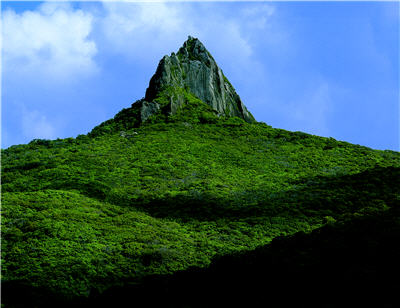
Always, a look upward finds you on high,
A look backward finds you against the sky.
Of all scenes Kenting Park is the last word.
And you are the last word of the park.
Spring may try her hardest to climb
Without hope of reaching your waist.
Howling winds and straying clouds
Are forced to detour for your sake.
A rock tower of such manly state
Deserves to be lifted by all eyes
To the very skies.
----“Dajianshan,” by Kuang-chung Yu
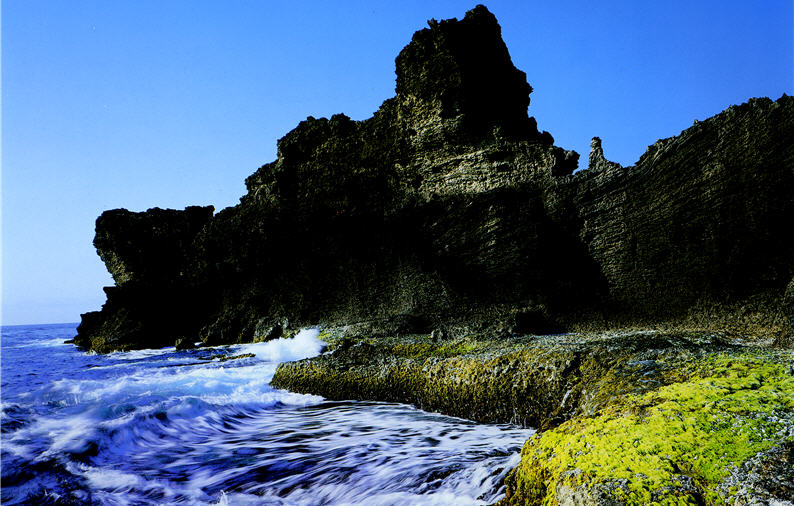
- upper: At the west cape of Taiwan’s southern tip is Maobitou (meaning cat’s nose tip), where there had been a gigantic reef coming off the coast rocks and crouching like a cat. The gigantic cat squats majestically among the waves of the Taiwan Strait and the Bashi Channel./ Captions by Chiung-yao Lin
- lower: Dajianshan
Love for Nature Heritage for Son
Wang’s enthusiasm for recording the land of Taiwan has been passed on to his children. Wang once climbed Mt. Syue with his second son, and they strode on the mountain paths and were amazed by the spectacular views around them at an altitude of 3000 meters. But all the beautiful scenery was ruined by the garbage littered by some mountain hikers along the paths, which also put all mountain-lovers in shame. On their way downhill, his son wanted to pick up as much garbage as he could and take it to the dump in the city. He just wished to do what he could to help the nature return to its pure and clean look.
“To record the beauty of natural scenery” has long been the only, the simplest, and the sincerest belief held by Ching-hwa Wang, someone from the southern tip of the land. By pressing the shutter he connected different forms of arts and presented natural scenery with diverse styles and in a ravishing way. Even though time may pass and scenery may change, those good old memories would be celebrated by people and last forever through a poem, a prose story, or just a photograph.
Ching-hwa Wang
He had won first place of the color photo division in the Nippon Camera Annual Awards in 1982, and second place of the color filmstrip division in the Nippon Camera Annual Awards in 1984.
He had joined group exhibitions with Japanese photographers at National Taiwan Normal University Fine Arts Museum (Taipei), Cultural Centers in Taichung, Tainan and Kaohsiung, and Pingtung Fine Arts Museum. With rich traveling experiences in Northern Africa, Europe and Southeast Asia, Wang has been a celebrated landscape photographer in Taiwan.
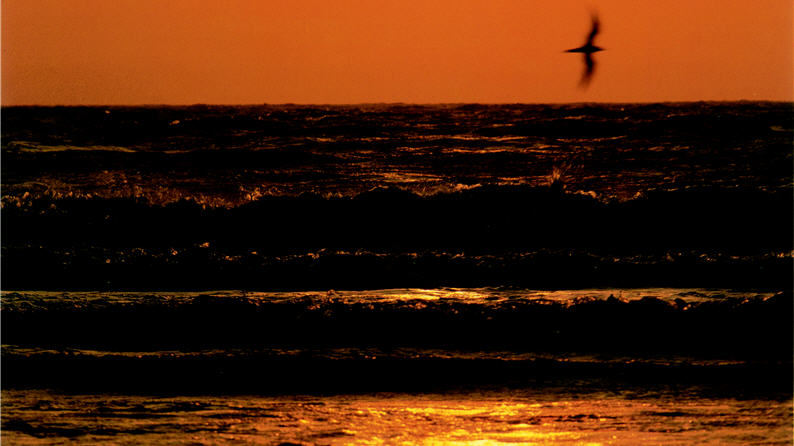
- upper: The sea gull is the loner on the sea. A pair of sturdy wings flies across the evening sky like a brush stroke. / Captions by Chiung-yao Lin
- center left: Commissioned by KNP: Wang was to shoot a documentary titled “The Beauty of Coral”
- center right: Commissioned by SNPH, Wang was fortunate and honored to be the first photographer to go into its mountains to take pictures of Oncorhynchus masou formosanus
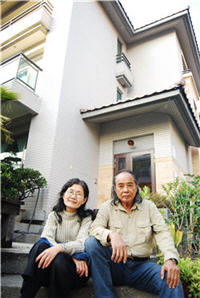
- lower: Ching-hwa Wang


