Derict to middle content area:::

:::

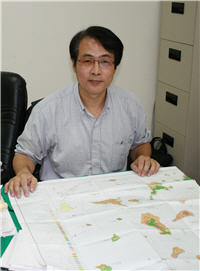
Professor Tze-Ying Chen
With an NTU Ph.D, Professor Chen is a full professor at the Department of Natural Resources, National Ilan University. Specializing in Vegetation ecology, dendrology and ecological conservation, he had participated in the “Plant Community Survey in the Datung Region and Yousheng River Basin”, and “National Vegetation Diversity Survey and Mapping Project.” His academic publications include “Vegetation Classification System in Lanyang River Valley Summary,” and “Two-step Forest Vegetation Analysis Based on Large Data Sets in Northeastern Taiwan.”
Protecting Ancient Beauty of Nature-A visit to a world-class wonder – Cilanshan’s cypress forest
The world has 6 species of cypress left. Cilanshan is home to 2 – Taiwan Red Cypress and Taiwan Yellow Cypress, and also the habitat for many living fossils, including Taiwania and Luanta Fir. Deep in the forest, they remain standing after thousands of years. Cilan – a potential site of natural heritage.
“It was winter, 1986. I was with my colleague in Cilanshan studying the cypress forest in the snow. As we finished up and stepped out of the woods, the sky suddenly cleared. Fog turned into wisps of mist lit by golden sunshine. It was as beautiful as an oil painting!” spoke Professor Tze-Ying Chen of his first encounter with the forest, vividly and enchantedly.
It is said that Cilan, meaning “orchid-growing” in Chinese, earned its name for the abundance of orchid that grows on the trees. Here stand many sky-reaching trees aged above 1,000 years. Cilan has become a rare cypress protected area.
Secret Garden, Precious Species
Cypress forests, once abundant millions of years ago, have succumbed to evolution, the Ice Age and a changing earth environment. Their population has shrunk and is now only seen in North America’s west coast, Japan and Taiwan. Studies show that cypress may have originated in North America and spread to Taiwan through Japan. Some thus see Taiwan Yellow Cypress as a variant of Japan Yellow Cypress. With insect/decay resistance, fragrance and elegant textures, cypress is always seen as precious forest resource.
“It was winter, 1986. I was with my colleague in Cilanshan studying the cypress forest in the snow. As we finished up and stepped out of the woods, the sky suddenly cleared. Fog turned into wisps of mist lit by golden sunshine. It was as beautiful as an oil painting!” spoke Professor Tze-Ying Chen of his first encounter with the forest, vividly and enchantedly.
It is said that Cilan, meaning “orchid-growing” in Chinese, earned its name for the abundance of orchid that grows on the trees. Here stand many sky-reaching trees aged above 1,000 years. Cilan has become a rare cypress protected area.
Secret Garden, Precious Species
Cypress forests, once abundant millions of years ago, have succumbed to evolution, the Ice Age and a changing earth environment. Their population has shrunk and is now only seen in North America’s west coast, Japan and Taiwan. Studies show that cypress may have originated in North America and spread to Taiwan through Japan. Some thus see Taiwan Yellow Cypress as a variant of Japan Yellow Cypress. With insect/decay resistance, fragrance and elegant textures, cypress is always seen as precious forest resource.
Taiwan has 2 cypress species – Chamaecyparis obtuse (yellow) and Chamaecyparis formosensis Matsum (red). Both grow mostly at altitudes between 1,200 and 2,600 m. The two species have similar growth ranges, but better resistance to infertile soil and humidity allows Red Cypress to grow mostly from 1,200 to 2,200 m in humid valleys, while Yellow Cypress finds home in steep mountains between 1,500 and 2,600 m. Cilanshan is home to both. They can be easily distinguished by their leaves: Red Cypress has more branches and pointed leaves, while Yellow Cypress has fewer branches and rounder leaves.
Besides photosynthesis, trees also secrete small amount of rare substances, from which fragrances are extracted and made into essential oils that are widely sold on the market. Cypress gives off an aroma that alleviates fatigue and brings refreshment. Hinokitiol found in cypress protects it from decay and termites.
Ancient Stories, Biodiversity
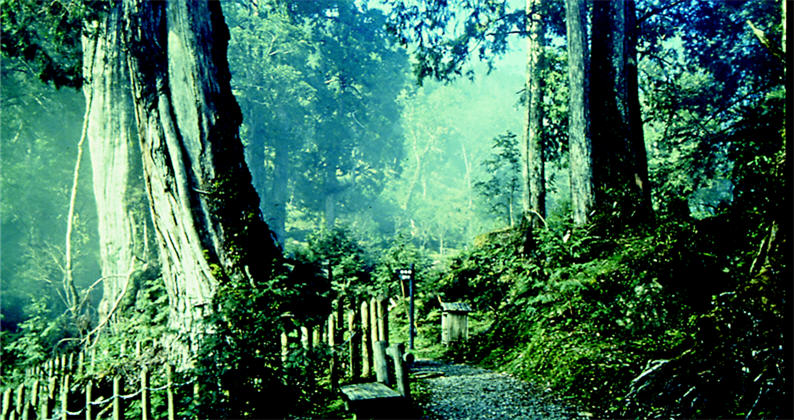
At the end of the gravel path stands an endless cypress forest. These thousand-year-old trees crouch or wind around each other, or simply stand straight, peering at people as ages go by. Located by the Route 100 of Forest Road at an altitude of 1,760m, the “Cilan Divine Trees Zone” is one of the major tourist attractions in Cilanshan. The Forest Conservation and Management Administration (FCMA) has named all the giant trees after famous historical figures according to the age of each tree.
Besides photosynthesis, trees also secrete small amount of rare substances, from which fragrances are extracted and made into essential oils that are widely sold on the market. Cypress gives off an aroma that alleviates fatigue and brings refreshment. Hinokitiol found in cypress protects it from decay and termites.
Ancient Stories, Biodiversity
At the end of the gravel path stands an endless cypress forest. These thousand-year-old trees crouch or wind around each other, or simply stand straight, peering at people as ages go by. Located by the Route 100 of Forest Road at an altitude of 1,760m, the “Cilan Divine Trees Zone” is one of the major tourist attractions in Cilanshan. The Forest Conservation and Management Administration (FCMA) has named all the giant trees after famous historical figures according to the age of each tree.
- upper: The Chilan Divine Trees Zone, located on Route 100 of Forest Road at an altitude of 1,760 m, is the major tourist attraction in the Chilanshan cypress forests./ Photo provided by Tze-Ying Chen
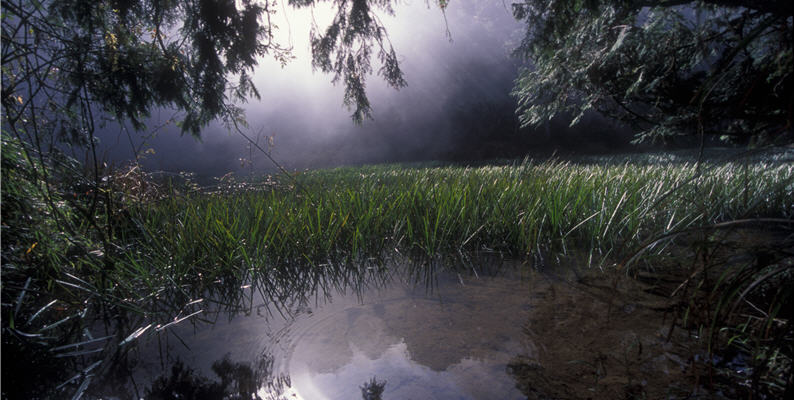
- lower: Sparganium fallax Graedner are very rare plants could found beside the Yuanyang Lake./ by De-hong Chen
Interview & Text/ Hsin-hua Lian
Translator/ Teresa Huang
Special Thanks to/ Professor Tze-Ying Chen (Department of Natural Resources, National Ilan University) & Jun-ming Chen (Section Chief, Forest Conservation and Management Administration, VAC, Executive Yuan)
Photos provided by/ Professor Tze-Ying Chen
Professor Chen said that divine trees normally grow very slowly. An increase of 20 to 30 cm in diameter could take 4 or 5 decades. Their age is determined by radioactive isotope, soft X-ray or growth cone, which is most widely used. It is done by sticking a cone into the trunk, taking a sample and counting its growth rings.
Tall as these tall trees stand, it is hard to tell exactly how old and precious they are. In a tree protection plan started in 1990, the government prioritized trees of higher age, of greater diameter or of cultural and historical uniqueness, and trees aged above 100 years old were labeled as old trees. Internationally, “giant trees” are defined by tree diameter and height.Taiwan’s aborigines, long in awe of Mother Nature, have worshiped old-age giant trees as “divine trees” to show their respect for superior beings.
In addition to the precious cypress forest, Cilanshan is also inhabited by many protected species, such as Sassafras randaiens, Pleione formosana Hayata, and Taiwania cryptomerioides Hayata. Taiwan Sassafras spreads between 900 and 2,400 m. Growing in the broadleaf/conifer-mixed areas in Cilanshan, the plant is one of Taiwan’s rarest species and has only 3 sub-species globally. It is also the only host plant for the broad-tailed swallowtail butterfly– an endangered species deemed as national treasure.
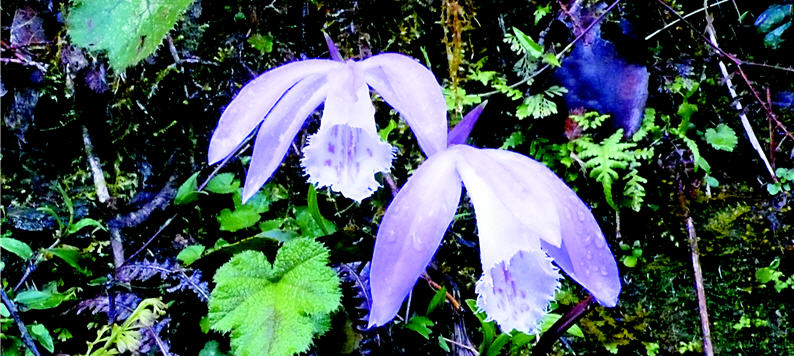
Pleione formosana Hayata is a native orchid in Taiwan. It is not easily raised on low-altitude areas, rarely seen in the wild, and is a unique part of Cilanshan’s beauty.
Taiwa and is listed along with ginkgo and Giant Sequoia as the world’s most representative living fossils. Visiting Japanese scholars even rated Taiwania as equally qualified for a world heritage status as cypress.
Tall as these tall trees stand, it is hard to tell exactly how old and precious they are. In a tree protection plan started in 1990, the government prioritized trees of higher age, of greater diameter or of cultural and historical uniqueness, and trees aged above 100 years old were labeled as old trees. Internationally, “giant trees” are defined by tree diameter and height.Taiwan’s aborigines, long in awe of Mother Nature, have worshiped old-age giant trees as “divine trees” to show their respect for superior beings.
In addition to the precious cypress forest, Cilanshan is also inhabited by many protected species, such as Sassafras randaiens, Pleione formosana Hayata, and Taiwania cryptomerioides Hayata. Taiwan Sassafras spreads between 900 and 2,400 m. Growing in the broadleaf/conifer-mixed areas in Cilanshan, the plant is one of Taiwan’s rarest species and has only 3 sub-species globally. It is also the only host plant for the broad-tailed swallowtail butterfly– an endangered species deemed as national treasure.
Pleione formosana Hayata is a native orchid in Taiwan. It is not easily raised on low-altitude areas, rarely seen in the wild, and is a unique part of Cilanshan’s beauty.
Taiwa and is listed along with ginkgo and Giant Sequoia as the world’s most representative living fossils. Visiting Japanese scholars even rated Taiwania as equally qualified for a world heritage status as cypress.
Consensus in Forest Conservation
Cypress wood is fragrant, corrosion - resistant, and beautiful. Before Japan’s colonization, Taiwan’s cypress forests were never logged. The Japanese found Taiwan’s cypress of excellent quality and thus used all means to exploit it.ANr
In 1912, Japanese began heavy logging in Taiwan’s 3 largest cypress forests – Alishan, Taipingshan and Pahsienshan, and logs were shipped back to Japan. Later came the Kuomingtang, who continued massive logging. Today’s rail stations such as Chichi and Checheng and Baoan are all cypress buildings of historic value.
As the economy stabilized, people noticed the dwindling forests, and the government outlawed cypress logging in 1990 and the logging of all natural forests in 1991. The government and the public have strived to protect cypress for its ecological and economic value.
“Although all the public, private and aboriginal agencies have different ideas on how to conserve Cilanshan’s forest, their views on the preservation are similar,” said Chen. “After years of work, most of us have reached a rough consensus on eco-conservation, though arguments still break out at times. Even the U.S National Park and Forestry authorities argue because of differing laws and land management methods. But efficient coordination and execution by higher levels is the key to the sustainability of valuable forests.”
On the conservation of Cilanshan’s forest, the Forest Nursing Concern Administration (FNCA) now focuses on the planning of entire ecosystem, and integrates tourism, interpretation education and ecological research to tourists to marvel at the forest and learn of its value.
Cypress wood is fragrant, corrosion - resistant, and beautiful. Before Japan’s colonization, Taiwan’s cypress forests were never logged. The Japanese found Taiwan’s cypress of excellent quality and thus used all means to exploit it.ANr
In 1912, Japanese began heavy logging in Taiwan’s 3 largest cypress forests – Alishan, Taipingshan and Pahsienshan, and logs were shipped back to Japan. Later came the Kuomingtang, who continued massive logging. Today’s rail stations such as Chichi and Checheng and Baoan are all cypress buildings of historic value.
As the economy stabilized, people noticed the dwindling forests, and the government outlawed cypress logging in 1990 and the logging of all natural forests in 1991. The government and the public have strived to protect cypress for its ecological and economic value.
“Although all the public, private and aboriginal agencies have different ideas on how to conserve Cilanshan’s forest, their views on the preservation are similar,” said Chen. “After years of work, most of us have reached a rough consensus on eco-conservation, though arguments still break out at times. Even the U.S National Park and Forestry authorities argue because of differing laws and land management methods. But efficient coordination and execution by higher levels is the key to the sustainability of valuable forests.”
On the conservation of Cilanshan’s forest, the Forest Nursing Concern Administration (FNCA) now focuses on the planning of entire ecosystem, and integrates tourism, interpretation education and ecological research to tourists to marvel at the forest and learn of its value.
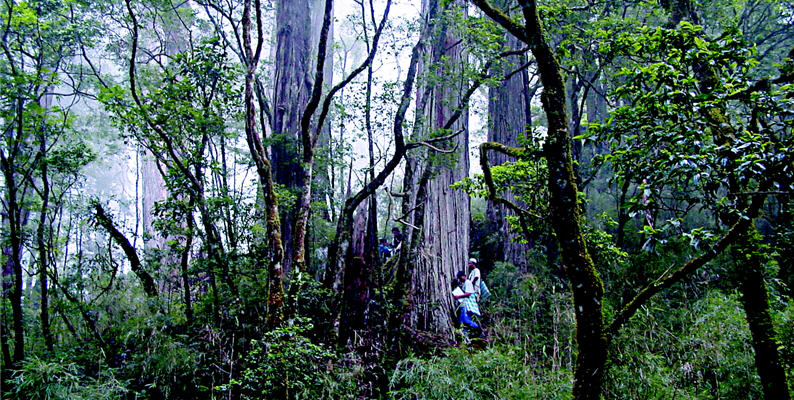
- upper: Taiwan Yellow Cypress forest in Mt. Bu Plngan and a sky-reaching giant tree that has seen thousands of years of history./ Photo provided by Tze-Ying Chen
- lower: Pleione formosana Hayata is a native orchid in the mountains of Taiwan./ Photo provided by Tze-Ying Chen
Reasonable Use, Proper Preservation
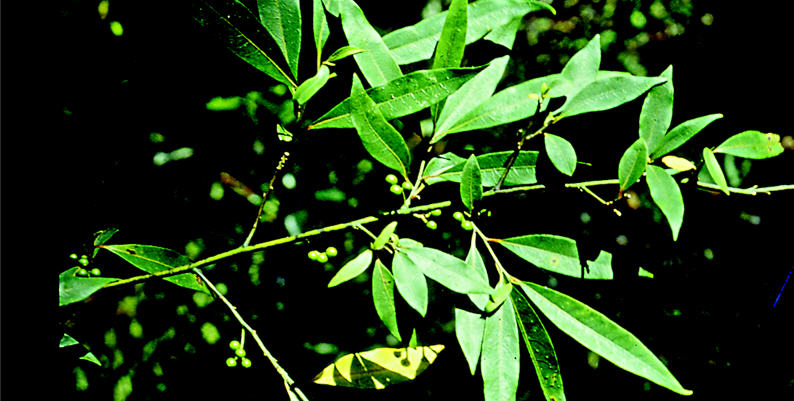
Litsea cubeba is abundant on Cilanshan. The Atayal tribe calls it “Makauy” and thus also calls Cilanshan “Makauyshan.” Makauy usually grows in summer and is used as seasoning. It can be preserved for one year canned. Since it is rarely found near settlements, when a tribesman finds one he shares it with everyone. For the Atayal, Makauy is shared treasure and a spiritual symbol that brings the tribe closer together.
Hopefully, the remaining cypress forest can be listed as World Heritage and show the beauty of Taiwan’s natural scenery to the world.Now the FNCA focuses on the planning of entire ecosystem in the area and forestry agencies also stress the sustainable development and conservation of the forest ecosystem and have marked the area as an important habitat for animals.
Litsea cubeba is abundant on Cilanshan. The Atayal tribe calls it “Makauy” and thus also calls Cilanshan “Makauyshan.” Makauy usually grows in summer and is used as seasoning. It can be preserved for one year canned. Since it is rarely found near settlements, when a tribesman finds one he shares it with everyone. For the Atayal, Makauy is shared treasure and a spiritual symbol that brings the tribe closer together.
Hopefully, the remaining cypress forest can be listed as World Heritage and show the beauty of Taiwan’s natural scenery to the world.Now the FNCA focuses on the planning of entire ecosystem in the area and forestry agencies also stress the sustainable development and conservation of the forest ecosystem and have marked the area as an important habitat for animals.
The Construction and Planning Agency (CPA) has listened to opinions from all sectors and formulated a “Makauy National Park” management plan which focuses on industries, planning, organization and systems. The agencies will soon find the best practice for land use and resource conservation to meet expectations of current generations and preserve these assets for future generations.
“Reasonable usage and proper preservation ensure the sustainability of natural resources,” says Chen. To protect natural resources, we can’t just shut them from the outside world. What’s also important is to maximize the value of each usable bit of them.
“Reasonable usage and proper preservation ensure the sustainability of natural resources,” says Chen. To protect natural resources, we can’t just shut them from the outside world. What’s also important is to maximize the value of each usable bit of them.
Professor Tze-Ying Chen
With an NTU Ph.D, Professor Chen is a full professor at the Department of Natural Resources, National Ilan University. Specializing in Vegetation ecology, dendrology and ecological conservation, he had participated in the “Plant Community Survey in the Datung Region and Yousheng River Basin”, and “National Vegetation Diversity Survey and Mapping Project.” His academic publications include “Vegetation Classification System in Lanyang River Valley Summary,” and “Two-step Forest Vegetation Analysis Based on Large Data Sets in Northeastern Taiwan.”
- upper: Litsea cubeba Lour , or “Magau” as the Atayal tribe calls it, is an important part of the Atayal tribe's diet and also a spiritual symbol that brings the tribe closer together./ Photo provided by Tze-Ying Chen
- lower: Professor Tze-Ying Chen


