Derict to middle content area:::

:::

Profile of Professor Lien-siang Chou
Lien-siang Chou
Professor of NTU Graduate Institute of Ecology and Evolutionary Biology and person in charge of the NTU Cetacean Research Laboratory
Graduating from University of California, Davis, in 1989 and shocked by the international coverage on the dolphin massacre in Penghu, Taiwan, she started to promote conservation of cetaceans. In 1996, she allied with many related institutions and founded the “Taiwan Cetacean Stranding Network”.
In light of the importance of cetacean conservation education, she later established the “Cetacean Committee” under Society of Wildlife and Nature in 1997, and “Taiwan Cetacean Society” in 1998, devoting herself to promoting public knowledge about cetaceans and conservation, as well as public concerns on the marine environment of Taiwan.
Sousa chinensis in Taiwan Strait-Something more charming than “Ponyo”
“Sousa chinensis are worse than humans when it comes to bearing children,” said Prof. Lien-siang Chou pitifully. “With a life expectancy of only 30 to 40 years, it takes them 10 to 12 years to reach maturity. A pregnancy lasts 1 year and requires 2 to 3 years of rest before another one. Each female Sousa chinensis may only have 5 to 6 births in its life. Unlike humans with sound medical care, though, only half of the newborns could live. How can we not treasure them?”
You may have seen Sousa chinensis in news about conservation and heard about some scientists and groups devoting themselves to this cause. However, conservation is not just a few minutes of news clips. For these dolphin lovers, their work never stops, with or without news coverage.
“Sousa chinensis are often nicknamed by conservationists as ‘Matsu’s (goddess of the sea) Fish’ because they appear around the birthday of Matsu in Xiamen. However, Taiwanese fishermen call them ‘white dolphins,’” explained Prof. Chou. Conservationists hope to communicate the importance of protecting the dolphin by giving them nicknames. The ultimate goal is to arouse people’s love toward them.
You may have seen Sousa chinensis in news about conservation and heard about some scientists and groups devoting themselves to this cause. However, conservation is not just a few minutes of news clips. For these dolphin lovers, their work never stops, with or without news coverage.
“Sousa chinensis are often nicknamed by conservationists as ‘Matsu’s (goddess of the sea) Fish’ because they appear around the birthday of Matsu in Xiamen. However, Taiwanese fishermen call them ‘white dolphins,’” explained Prof. Chou. Conservationists hope to communicate the importance of protecting the dolphin by giving them nicknames. The ultimate goal is to arouse people’s love toward them.
A “Dolphin” in the Sea Takes Hours to Find
Study on Sousa chinensis ecology began in 1992. The preliminary survey spearheaded by Prof. Chou and others defined habitats along the coasts in Changhua, Penghu, and Kinmen. A second survey in between 1994 and 1995 also resulted in some findings in Xiamen but only reported records of stranded dolphins in Kinmen. Dr. John Y. Wang of the FormosaCetus Research & Conservation Group spotted Sousa chinensis in 2002 and confirmed more habitats in coastal Miaoli, Taichung, and Changhua. Authorized by the Council of Agriculture, Prof. Chou hence started a 3-year research on Sousa chinensis in 2005.
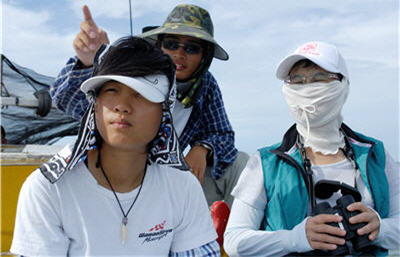
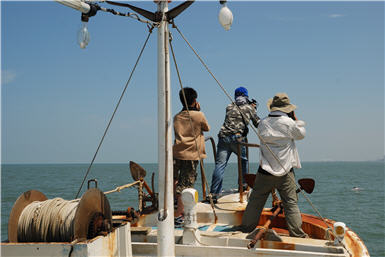
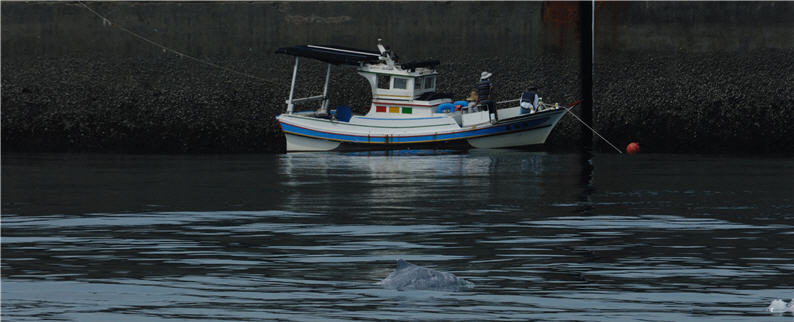
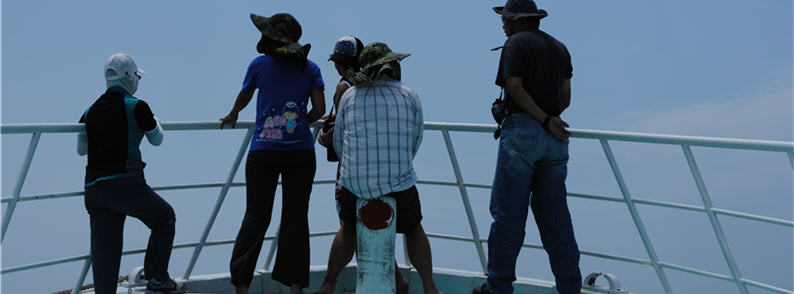
“It was difficult to find a dolphin in the sea.” Prof. Chou showed pictures of their expeditions. One has to admire her for the discomforts she had to put up with and the passion scientists and conservationists have toward Sousa chinensis. Each adventure required nearly 5 hours of exposure to the sultry sun to spot the precious creature.
Study on Sousa chinensis ecology began in 1992. The preliminary survey spearheaded by Prof. Chou and others defined habitats along the coasts in Changhua, Penghu, and Kinmen. A second survey in between 1994 and 1995 also resulted in some findings in Xiamen but only reported records of stranded dolphins in Kinmen. Dr. John Y. Wang of the FormosaCetus Research & Conservation Group spotted Sousa chinensis in 2002 and confirmed more habitats in coastal Miaoli, Taichung, and Changhua. Authorized by the Council of Agriculture, Prof. Chou hence started a 3-year research on Sousa chinensis in 2005.
“It was difficult to find a dolphin in the sea.” Prof. Chou showed pictures of their expeditions. One has to admire her for the discomforts she had to put up with and the passion scientists and conservationists have toward Sousa chinensis. Each adventure required nearly 5 hours of exposure to the sultry sun to spot the precious creature.
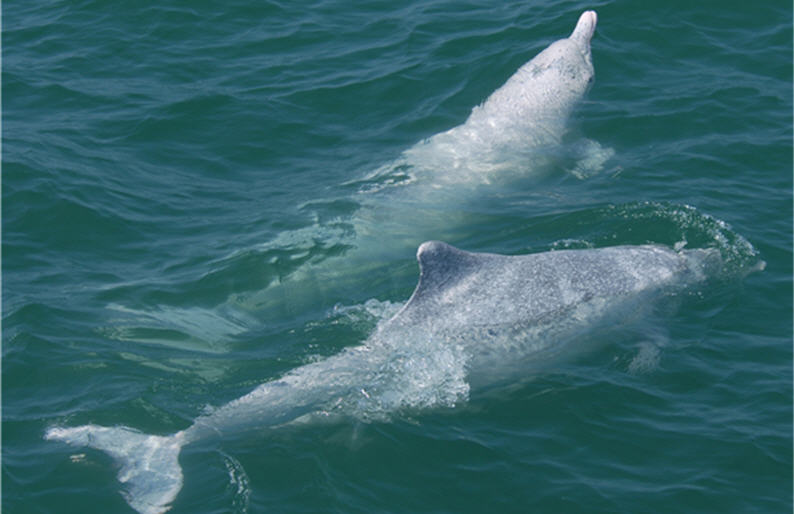
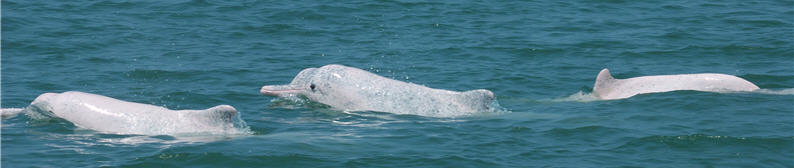
- upper: People have joined hands in conservation and succeeded./ Photo provided by Utmost Culture
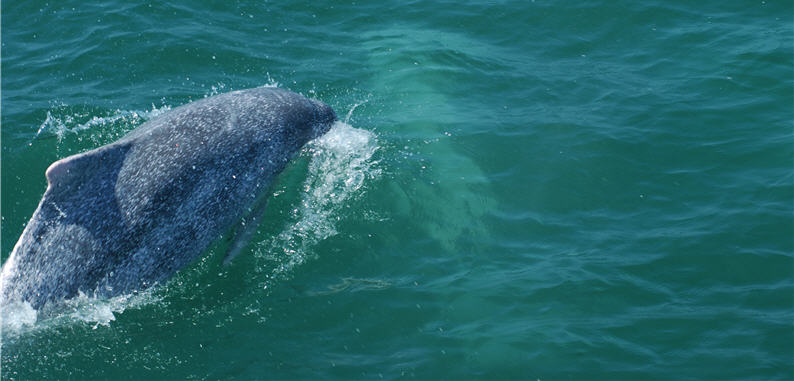
- lower: The scientific “mug shot” of Sousa chinensis primarily shows the clear dorsal fin rays used to identify each dolphin./ Photo provided by Utmost Culture
Interview & Text/ Wan-ching Lai‧Hsin-hua Lian
Translator/ James Chang
Photo provider/ Mr. Wun-ji Lin, Utmost Culture
Speacial thanks to/ Prof. Lian-siang Jhou, Dept. of Life Science, National Taiwan ‧Mr.Wun-ji Lin, Utmost Culture‧Mrs.Yi-jyuan of Forestry Bureau
“Compared to study on land, the work was much tougher. Each trip cost lots of manpower and money. The research team was working seriously and studiously just to catch sight of more dolphins and observe them.”
The first-year study in 2005 was not successful. “We set the dolphin activity range at a radius of 3 nautical miles and hardly found any. In Year 2, we cut down the range to 1 nautical mile and found that they clustered along the west coast of Taiwan, mostly in ports, river mouths and Waisanding Sand Bar with around 1 to 5 dolphins in each school. The encounter rate was 40% to 50%.”
The success in the second year inspired the research team with 20 more trips in 2007, which confirmed more nursing habitats of Sousa chinensis that include the coastal areas off Chiayi Waisanding Sand Bar, Dajia River, and Dadu River.
“Mug Shots” Taken under Hardship
The scientific “mug shot” of Sousa chinensis primarily shows the clear dorsal fin rays used to identify each dolphin. “The accumulated number of located dolphins that stops increasing after a certain number of trips is the total population. There are around 103 Sousa chinensis from Taichung to Chiayi and the number in Miaoli is still being investigated,” explained Prof. Chou.
The first-year study in 2005 was not successful. “We set the dolphin activity range at a radius of 3 nautical miles and hardly found any. In Year 2, we cut down the range to 1 nautical mile and found that they clustered along the west coast of Taiwan, mostly in ports, river mouths and Waisanding Sand Bar with around 1 to 5 dolphins in each school. The encounter rate was 40% to 50%.”
The success in the second year inspired the research team with 20 more trips in 2007, which confirmed more nursing habitats of Sousa chinensis that include the coastal areas off Chiayi Waisanding Sand Bar, Dajia River, and Dadu River.
“Mug Shots” Taken under Hardship
The scientific “mug shot” of Sousa chinensis primarily shows the clear dorsal fin rays used to identify each dolphin. “The accumulated number of located dolphins that stops increasing after a certain number of trips is the total population. There are around 103 Sousa chinensis from Taichung to Chiayi and the number in Miaoli is still being investigated,” explained Prof. Chou.
The dizziness caused by the wind and waves is nothing compared to the appearance of long-waited dolphins. The research team documents passing dolphins with photo- identification. Like me, you may think that they all look the same and how will the photos help? “The dorsal fin rays are like human fingerprints and zebra stripes. The white spots on each Sousa chinensis are different and enable us to distinguish them,” explained Prof. Chou with patience. “What we do is wait on the boat until they show up and keep pressing the camera shutter before verifying them against laboratory pictures. It was often that we could do nothing with out-of-focus photos.”
The Closest to Us, the Worst Hurt by Us
The discovery of the truth that Sousa chinensis mainly live in coastal waters no deeper than 20 meters explains the difficulties facing them.
Their habitats are in the waters with the most frequent human activities and endangered by environmental pollution and the fishing industry. Can the concerns and efforts of scholars, experts and conservationists hit home?
“Imagine that, there is no much edible food. The water is always polluted and the noise never stops. There are even propellers constantly rotating overhead. These are the discomforts felt by Sousa chinensis.”
The Closest to Us, the Worst Hurt by Us
The discovery of the truth that Sousa chinensis mainly live in coastal waters no deeper than 20 meters explains the difficulties facing them.
Their habitats are in the waters with the most frequent human activities and endangered by environmental pollution and the fishing industry. Can the concerns and efforts of scholars, experts and conservationists hit home?
“Imagine that, there is no much edible food. The water is always polluted and the noise never stops. There are even propellers constantly rotating overhead. These are the discomforts felt by Sousa chinensis.”
- upper: The scientific “mug shot” of Sousa chinensis primarily shows the clear dorsal fin rays used to identify each dolphin./ Photo provided by Utmost Culture
- lower left: It was difficult to find a dolphin in the sea./ Photo provided by Utmost Culture
- kower right: It was difficult to find a dolphin in the sea./ Photo provided by Utmost Culture
Development of heavy industries and coastal land reclamation have undermined the food resources available to the dolphins. The quantity of edible small fish or cephalopods has decreased. And boats often result in injuries. A 2004 survey found that 10.7% of Sousa chinensis were allegedly hurt by boat propellers or fishing nets. Waste water and noise are major interferences to their life, too.
Prof. Chou pointed out that it is impossible for the negative impacts of industrial development to be corrected shortly. Changes can be made to minimize the damage and protect Sousa chinensis. “The construction time, range, or route can be changed or shortened. The navigation speed of boats can be restricted or other measures can be taken to cut down the noise level. Thinking for the dolphins is helping.”
Join Hands in Conservation and Succeed
Marine researchers are often caught in the embarrassment of failures. Investigating marine life is no easy work compared to studying static mountains or historical sites. But this does not discourage scholars and conservationists from sharing findings at home and abroad.
For the past nearly 10 years, 7 Sousa chinensis reserves have been established in Hong Kong and China, including A 1200-hectare coastal park in HK in 1996, national reserves in Jhuhai and Xiamen, and at least 4 municipal reserves and 1 provincial reserve in Guangdong.
Prof. Chou pointed out that it is impossible for the negative impacts of industrial development to be corrected shortly. Changes can be made to minimize the damage and protect Sousa chinensis. “The construction time, range, or route can be changed or shortened. The navigation speed of boats can be restricted or other measures can be taken to cut down the noise level. Thinking for the dolphins is helping.”
Join Hands in Conservation and Succeed
Marine researchers are often caught in the embarrassment of failures. Investigating marine life is no easy work compared to studying static mountains or historical sites. But this does not discourage scholars and conservationists from sharing findings at home and abroad.
For the past nearly 10 years, 7 Sousa chinensis reserves have been established in Hong Kong and China, including A 1200-hectare coastal park in HK in 1996, national reserves in Jhuhai and Xiamen, and at least 4 municipal reserves and 1 provincial reserve in Guangdong.
The rigidity of conservation regulations is compatible with that of police system in national parks, complete with strict control over boats, configuration of headquarters and directors.
“15 years ago, I visited China with my student. They were obviously lagging in software and hardware in studying the dolphin. However, things changed. In a seminar I participated recently, their young people were professional and the equipment was advanced. In contrast, Taiwan really should work harder.”
Like parents with different views on education, despite the shared goodwill, different voices appear among government agencies, academic groups, and NGOs, which is inevitable. For the disagreements or conflicts, Prof. Chou has learned to be understanding.
“What touches me is the true love they all have toward Sousa chinensis in disparate voices. Isn’t it our ultimate goal to stimulate more proactive action by decision makers to protect Sousa chinensis through different stances?” said Prof. Chou.
Cetaceans are such intellectual and charming creatures that their gracious physique and marvelous jumps touch numerous people. At the end of this interview, Prof. Chou reminded all Taiwanese of not just adhering to the “seafood culture” but striving to protect marine resources and sustain the “marine culture” and blue oceans.
“15 years ago, I visited China with my student. They were obviously lagging in software and hardware in studying the dolphin. However, things changed. In a seminar I participated recently, their young people were professional and the equipment was advanced. In contrast, Taiwan really should work harder.”
Like parents with different views on education, despite the shared goodwill, different voices appear among government agencies, academic groups, and NGOs, which is inevitable. For the disagreements or conflicts, Prof. Chou has learned to be understanding.
“What touches me is the true love they all have toward Sousa chinensis in disparate voices. Isn’t it our ultimate goal to stimulate more proactive action by decision makers to protect Sousa chinensis through different stances?” said Prof. Chou.
Cetaceans are such intellectual and charming creatures that their gracious physique and marvelous jumps touch numerous people. At the end of this interview, Prof. Chou reminded all Taiwanese of not just adhering to the “seafood culture” but striving to protect marine resources and sustain the “marine culture” and blue oceans.
Profile of Professor Lien-siang Chou
Lien-siang Chou
Professor of NTU Graduate Institute of Ecology and Evolutionary Biology and person in charge of the NTU Cetacean Research Laboratory
Graduating from University of California, Davis, in 1989 and shocked by the international coverage on the dolphin massacre in Penghu, Taiwan, she started to promote conservation of cetaceans. In 1996, she allied with many related institutions and founded the “Taiwan Cetacean Stranding Network”.
In light of the importance of cetacean conservation education, she later established the “Cetacean Committee” under Society of Wildlife and Nature in 1997, and “Taiwan Cetacean Society” in 1998, devoting herself to promoting public knowledge about cetaceans and conservation, as well as public concerns on the marine environment of Taiwan.
- upper: Beautiful cetaceans are supposed to have pleasant encounters with humans./ Photo provided by Utmost Culture
- center: Each adventure required nearly 5 hours of exposure to the sultry sun to spot the precious creature./ Photo provided by Utmost Culture
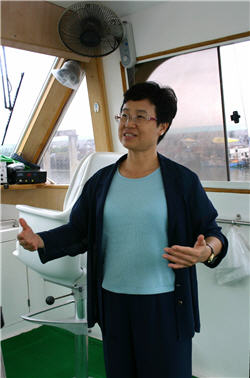
- lower: Profile of Professor Lien-siang Chou


