
Looking up at the Immortal Guardian-Visiting Sequoia and Kings Canyon National Parks (SKCNP)
An ex-volunteer of Yangmingshan National Park, Wan led us into the mysterious woods with this quote from the conservation pioneer.
Sequoia National Park was established as the second national park in the United States in 1890, with the purpose to preserve the Giant Forest, while the Kings Canyon was mandated as a national park in 1940, absorbing General Grant National Park. Sequoia and Kings Canyon were later merged, taking up more than 800,000 acres.
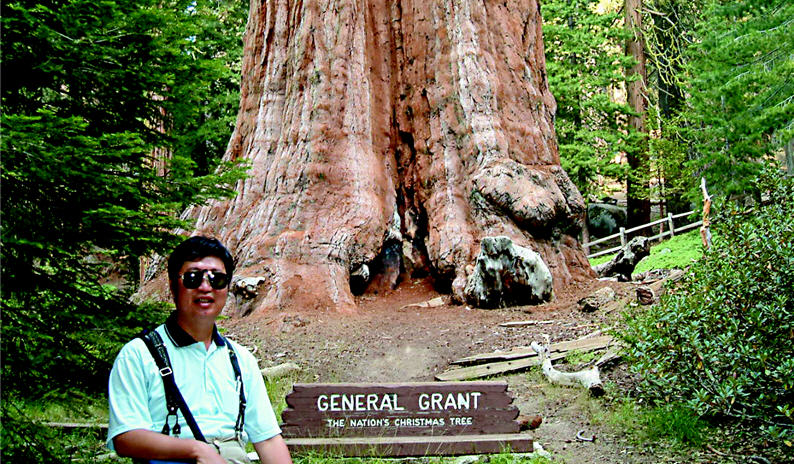
With forests, mountains, and canyon, SKCNP displays Nature’s versatile craftsmanship. Driving through the park, one will be feasted with diverse landscapes and scenery. If you enter the parks from the north heading eastward, you will pass the Giant Forest and the celebrated General Grant Tree. Going into the mountains, you will first encounter desert thickets; some rapid river will then pop up as a visual surprise. Along the Generals Highway you’ll enjoy an eyeful of giant forest scenery.
And explorers must not miss the minor paths that lead to great views such as the limestone Crystal Cave and Mono Rock. If your time allows, go head into the Sierra Nevada Mountains to experience the magnificence of high mountains.
The best-known view in SKCNP is the Giant Sequoias. Whether it’s driving through the forests or standing under and looking up at the colossal trees with broad trunks, one cannot help feeling the humbleness of human before the great Nature. Bathing in the coarse wildness of this primitive forest is truly special to residents of a sub-tropical island like us.
Though not the tallest, Giant Sequoia is yet among the world’s largest trees in terms of total volume. They grow on the west slope of the Sierra Nevada, and the largest among them and in the world is General Sherman, with a height of a 26-story building, an age ranging between 2300 and 2700, the diameter of its largest limb approaching 2 m, and the base of its columnar trunk wider than a city street. This giant tree has survived long droughts and numerous fires. It keeps on growing, serving as the guardian of this forest.
John Muir once noted that most of the sierra trees die of diseases, fungi, etc., but nothing hurts the Big Tree. Barring accidents, it seems to be immortal, Wan cited. The anti-bacterial and insect-resistant chemical in the bark and wood of sequoias make them longevous. It is said that in the Big Stump Basin of the Grant Grove, masses of saw dust left a century ago have not decomposed yet. The oldest known sequoia is more than 3200 years old.
However, sequoias still have an Achilles’ heel: toppling. They have a shallow root system with no taproots. Loss of soil and moisture, root damage, and strong winds can all lead to their toppling.
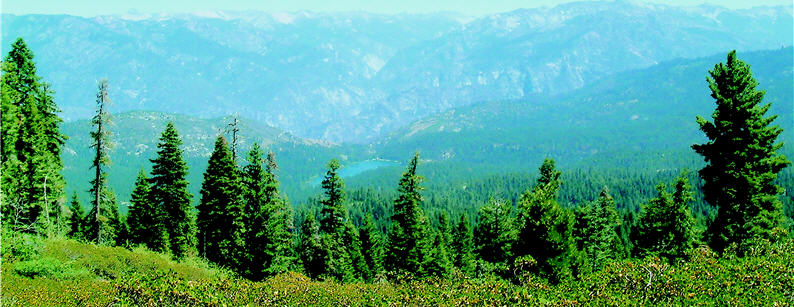

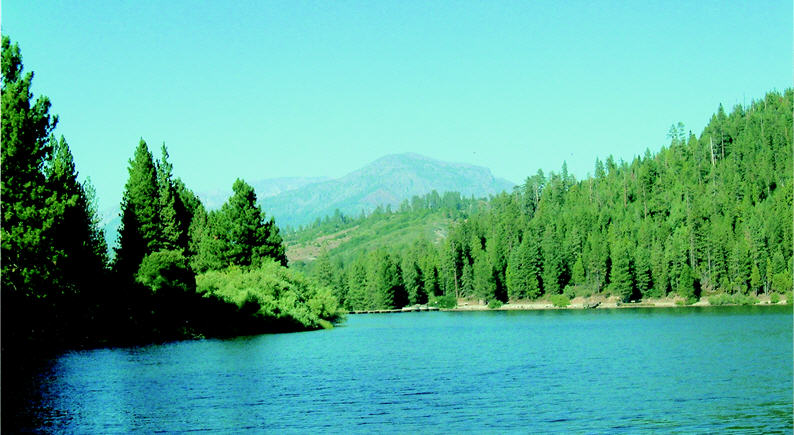
- upper: The Hume Lake in Sequoia National Park was originally used as a mill pond to supply water for a flume that floated rough-cut sequoia lumber from Converse Basin to the mill at Sanger, 87 km away. During the summer, it is a place for fishing, swimming, boating and camping. / by Wan
- lower: The panoramic point at the Grant Grove with the grand mountain views; Mt. Goddard can be seen from here./ by Wan
Special thanks to /Wan
Photographer/Wan
Translator/Chunyi Cheng
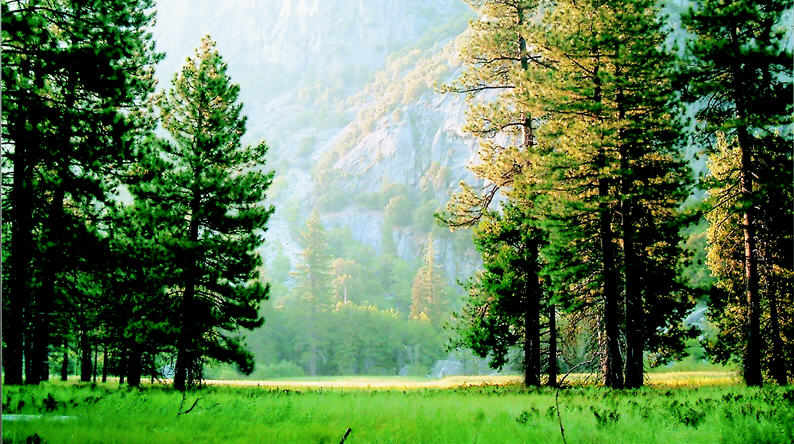
Two other noteworthy landscapes in SKCNP are the mountain peaks and deep canyons. Between the contiguous Sierra Nevada Mountains, Mt. Whitney, the highest peak in the U.S., and the snowy peaks that form divides are the spectacular and unique canyons carved out by the Great Nature.
The most famous Kings Canyon is actually a glacial valley where the South Fork and middle forks of the Kings River converge 2,500 m below the towering Spanish Peak; it is even deeper than the Grand Canyon. Tall cliffs, a meandering river, green meadows and beautiful waterfalls make the park a fairytale-like kingdom.
Wan recommends that one take Kings Canyon Highway and drive to its end (closed from Nov. 1 to May 1 due to weather conditions), and then stand at a flat of the glacial valley, and stare up at the steep canyon walls to experience the overwhelming magnificence.
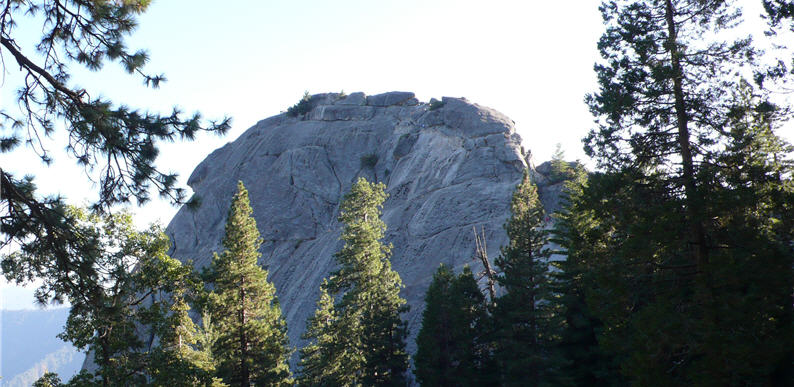
If looking up from the bottom of the valley makes one feel diminished, he can climb up to Mono Rock and look down at the beautiful land.
After reaching the summit through the staircases alongside the rock wall, one will definitely have the sense of achievement of overlooking the mountain. The panoramic vistas of the grand mountains make Mono Rock one of the must-visits in the park.
The wild lives in SKCNP are as abundant, which include mule deer, pine marten, fisher, wolverine, black bear, marmot, pika, etc. Recent fish plantings introduced non-native brown, brook, golden and cutthroat trout; also being restored are rainbow trout and Little Kern golden trout, native to the Sierra streams.
“In summer 2004 at Crystal Cave, I was so touched by a scene in which a large crowd of tourists watched in the distance a mother bear with her two cubs. I revisited the site in 2005, and lodged at Cedar Grove Village. In the morning, I saw some mule deer looking for food nearby, and squirrels and birds were everywhere.” Wan suggests that early morning and late afternoon are best for wildlife viewing.
It is these close interactions with wild lives that leave Wan, who visited the park several times, the deepest impression. “It is something hard to imagine in Taiwan. I could sit at the corner quietly seeing woodchucks standing on hind legs looking around, making sounds, and playing with each other for an hour and feel not a bit of boredom. I’d also taken pictures of mule deer from less than 10 m away, and they didn’t fear me at all. If people saw bears, they spread the news with excitement and stopped the cars to take a good look. But the park rangers would also ask us to keep the distance and leave some room for wild lives.” Wan said that this human-wild harmony in a national park is what touches people most.
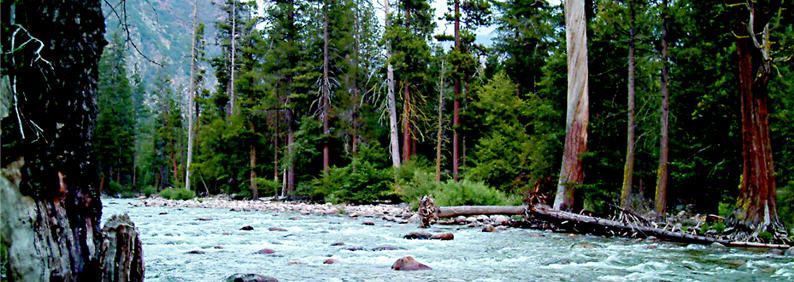
- upper: Zumwalt Meadow is one of the most beautiful spots in Kings Canyon. With its lush meadow and towering trees around it, it is like a wonderland. A 1.5-mile trail is built around the meadow./ by Wan
- lower: The South Fork of Kings River taken near the Cedar Grove Village./ by Wan
Once they get used to human contact and lose the abilities to live in the wilderness, they may trespass into our lives. Some black bears were once killed because of this. Feeding wild animals could indirectly lead to their death.
Following the Rules of Nature
The five visitor centers in SKCNP: Cedar Grove, Giant Grove, Foothills, Lodgepole, and Mineral King are located in different areas, providing services to tourists nearby. Among them, Foothills is the headquarters, the only place where admissions to the Crystal Cave are sold (only same-day admissions, available until 15:45) and not at the Crystal Cave.
The Giant Forest Museum, 26 km away from the park’s entrance at Hwy 198, provides in-depth info of giant sequoias with books and maps for sale. It is worth visiting for those who want to learn more about the ecology of the tree or the park.
Wan suggests tourists rent a car for touring the park, and take their time to appreciate the beauty of the nature. It’d be even better to lodge inside the park, saving more time and energy for exploring the park.
Besides driving, hiking is also recommended for park exploration. Consult with the visitor centers to pick trails that fit you and your schedule.
A Model for Taiwan
Wan thinks that our national parks are no less beautiful than those abroad. Yet we do need to learn from them.
In the national parks of the U.S., wild animals are everywhere; this is where we fall short. In the U.S., concepts of conservation are rooted deep and wide in its citizens’ mind, and are commonly seen in and out its national parks. In contrast, people in Taiwan tend to seize natural land rather than protect it. The wild lives most frequently seen here are insects, and then birds and reptiles. Large wild animals live only in remote mountains. Protection laws and regulations should be made for the wild lives to prosper.
SKCNP offers sound lodging and recreational facilities that are integrated with the natural environment. This is less-achieved in Taiwan’s national parks. How to make human constructions non-intrusive to the Nature and reach a balance between recreation and ecology will still be something demanding our efforts in order to the beautiful scenery truly immortal.
- upper: If looking up from the bottom of the valley makes one feel diminished, he can climb up to Mono Rock and look down upon the beautiful land/ Photo provided by Lili
- lower: Wan before the General Grant Tree. It is the third biggest tree in the world, the States' Nation's Christmas Tree,and a national shrine, commemorating those Americans who lost their lives in war./ photo provided by Wan


