
Literature – A Long Journey through Mountains and Waters-An Interview with Contemporary Writer Shiao-feng Chang
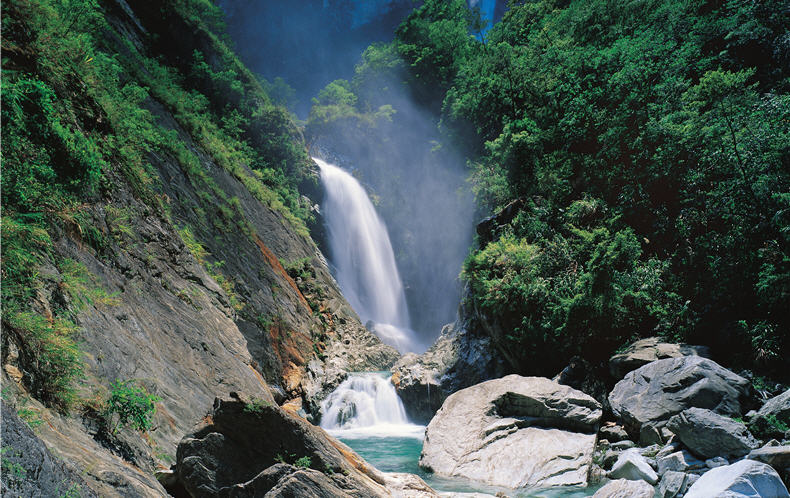
A good national park interpreter makes a tour lively and enchanting. He or she also needs to describe beautiful scenes and geological wonders as genuinely as possible. That, indeed, is also a form of literature...
What stands for eternity?
Giant mountains that rise from the plains? Skyreaching peaks? Bottomless valleys? Or the endless ocean? But, mountains are deformed by quakes; peaks are flattened as they lose soil; streaks change route as the plates move; even the ocean may dry up as climate change worsens…
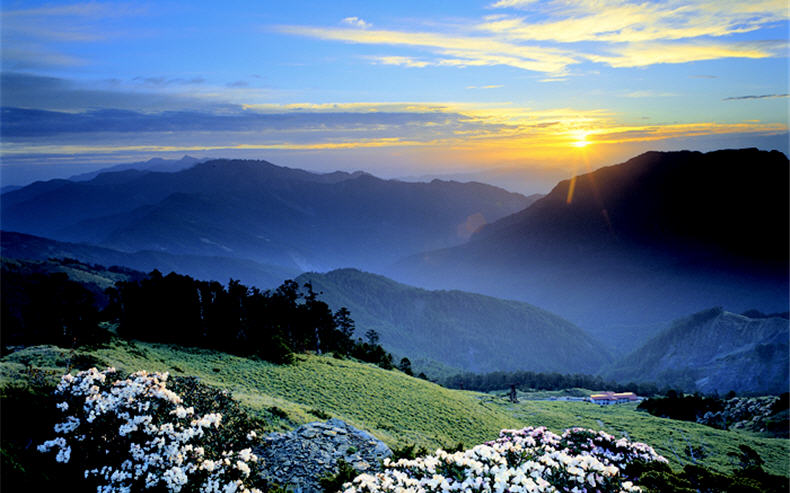
Only words capture and store the crystal of the millenniums, re-presenting the beauty of nature as time go by.
Throughout the history of Taiwan's national parks,art, literature, and aesthetics play a significant role. The 80s saw the rise in literature and art creation. Shiaofong Chang, along with other littérateurs, began adding natural landscapes to their work on the request of the major national parks.
Chang, who has worked extensively for the promotion of national parks, took time out of her schedule for this talk.“ Let's go to Yangmingshan. Since we'll talk about national parks, what place is better than a real one?”
As the busy tourist season had ended, Yangmingshan did not enjoy solitude for too long. Batches of cherry blossoms unfolded on the trees along the roadside. Passing by the Lin Yutang House, Chang recalled her last visit, when she was given some gardener- made Sakura wine. The taste is still fresh in her memory.
Drizzling rain cleared the forests of dirt. Along the way, we saw a few Formosan Blue Magpies shuttling through the woods. “These birds bear the image of Taiwan. Spotting them with ease makes us feel great about the fact that our conservation has been well-done.”
Fond of nature and a simple green life style, Chang had an early encounter with national parks. “How literature and nature could be linked depended on the park authorities. That year, Director Shu of the Taroko National Park invited me, Muren Hsi and Hsun Chiang to savor the mountains, and then several of our works were published.” She added, “The idea was simple. We wanted to show Taiwan's beauty through art and literature. Then other artists followed suit. They came, inspired, and described nature's marvel through their expertise.”
- upper: Literature is all about mood. National park is about landscape. If the two complement each other, how wonderful will that be? / Photo provided by TNPH, taken by Wen-yu Huang
Interview & Text / Chih-hao Huang & Wan-ching Lai
Photographor/ Chieh-yang Su
Translator/ Teresa Huang
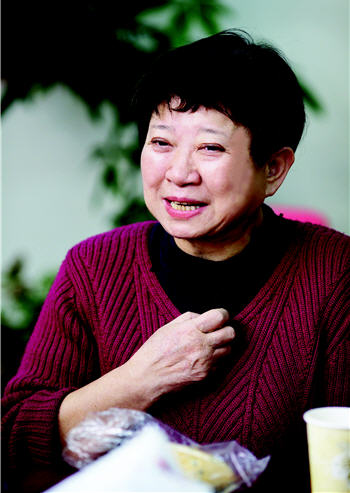
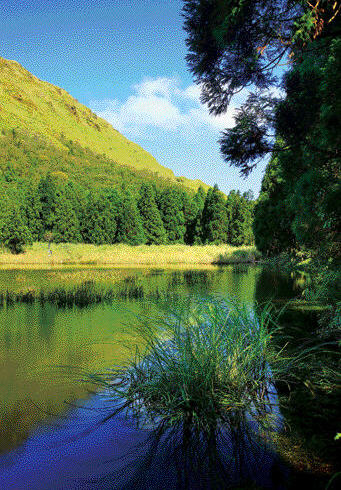
Besides the book Hsi Shan Ching , in which the beauty of Taroko are collected by Chang and others, she also wrote with vivid descriptions about the Taroko and Yangmingshan in an essay entitled From Your Beautiful River Basin . She also joined the making of The Photo and Poetry Album of Kenting National Park where she gave a poetic account of Hengchun Peninsula's oceanic landscape. Her words are truly extraordinary – colorful but unexaggerated, actualizing abstract beauty.
“....full of Chenlan is the lake's surface, each standing straight, resembling jade needles. But what's truly spectacular is the quillwort , which quietly goes through birth and death under the water. Some say they came from Northeast China, where migratory birds gave their seeds a free ride down south....”
Quoted from Shiao-fong Chang's “From Your
Beautiful River Basin ”
The wonders of Yangmingshan's quillwort are known to its visitors. But unlike the textbook-sounding description on the travel guide, Chang's writing brings out poetic elegance. It triggers readers' curiosity not only about the lake, but about the whole quillwort ecology.
Interpreting – A Literary Genre Also
National park literature is not limited to pure description; it could take on broader meanings and multiplicity. “A good national park interpreter makes a tour lively and enchanting. He or she needs to describe scenery and geological wonders as genuinely as possible. That is also a form of literature. They should be better trained to have these qualities. After all, for tourists, face-to-face talking is usually more powerful than words.”
Such interpretations, Chang said, could be even more special than pure literature. Using local aboriginal stories and legends, they could arouse visitors' curiosity and environmental awareness. “It's a pity that in the parks, stories told in aboriginal languages are not many. Surviving elders who can still share stories are rare. But those legends are true treasure. Shouldn't they be protected like endangered species?”
Taiwan's national parks need this type of historical recognition – to create the kind of promotion Kenting enjoys with the film Cape No.7 . Parks should be more open and active in offering a “convenient and troublefree” place for the creation of art and literature. It will be a plus for both the artists and the parks.
But what is “convenient and trouble-free”? She recalled a visit years ago invited by Ying-tai Lung, the then head of the Cultural Affairs Department, to Yangmingshan's ancient Japanese buildings to plan an art district. “A quiet old place is great for creation. But mountains are remote. Life up there isn't easy. Artists mayneed to walk for hours to get supplies. That will disrupt their creative thinking,” said Chang.
- upper left: Fond of nature and a simple green life style, Chang had an early encounter
with national parks. / by Chieh-yang Su - upper right: Unlike the textbook-sounding description on the travel guide, Chang's writing
brings out poetic elegance. / by Jin-yuan Dai
Passion Keeps Literature Alive
Chang thinks that words are different from images. In writing, you describe cause and effect, or you may confuse your readers. “Young artists rely on technology. With easy access to information, their writing becomes ‘lazy.' Let's say a person goes hiking. There is often a starting point of emotion. He may be in a good mood, or try to get rid of his blues. These ‘emotional starts' connect the story with its readers. You an't only use shallow expressions and forget all about the emotional links.”
Readers' habits have changed, dealing a heavy blow to publishers. Many books are deemed unprofitable soon after publication and returned to publishers in a week to make room for profitable ones. “Profitability must not be the only priority. There must be a start, such as some art events, to let the young know there is true art apart from the virtual world. And young people must be stimulated to strive for refined culture. Artists must be brought back into themountains where they'll put the beauty of nature in words.”
Chang spoke softly. But deep inside, she is full of passion – often the one who “starts the first fire.” She has given speeches on literature. With relentless efforts, she finally persuaded the Council for Cultural Affairs to buy legendary Da-gang Yu's works from a publisher and re-published them on a seminar marking Yu's 100th birthday. She is now promoting Yen Hsi's Shih Yuan Suo Chi. She did all this not for herself, but out of love for literature.
of classical Chinese to promote popular literature. He was impressed by Hsi-ning Chu's Wolf and gave it full-page, which brought fame to Chu. Sun was a clairvoyant, bold to enter uncharted waters – a true pioneer in literature.
“Sun broke rules and opened up Taiwan's literature. A new path rolled out from CDNS. Can national park literature be the next?” Literature is all about mood. National park is about
landscape. If the two complement each other, how wonderful will that be? Taiwan's artists move on with their art creation. What drives them is their conviction and belief. With nature and culture, national parks provide artists with endless inspiration. “One day, literature that will remain told and read for centuries may be borne in Taiwan's national parks.”

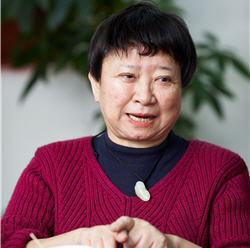
Shiao-fong, Chang
Chang had received multiple awards, including National Top 10 Outstanding Youth Award. She is currently teaching at Yang Ming University. Her works cover a wide range of literary genres; her prose had been praised for its “conciseness, clarity and descriptive beauty.” She strives to combine prose with aesthetic qualities.
- upper: Only words could capture and preserve the splendor millenniums ago, re-presenting the beauty of nature as time go by. / Photo provided by TNPH,taken by Jin-yuan Dai


