
Esthetics Has to be learned-An Interview with the Honorary Curator of Museum of World Religions (MWR), Mr.Pao-teh Han
While seeking beauty, man found truth, the foundation of science.
The quest for beautiful of human figure leads to human body science; while the quest for beauty of nature opens up the horizon for natural science, thus beauty is the ultimate goal of civilization betterment.
Extract from Dr Han talks abou the art
Over the years, national parks have strived to promote environmental protection, while the beautiful sceneries of national parks attracted photographers and artists alike. Yet, since national parks are neither art galleries nor museums, is there still a need to talk about esthetics?
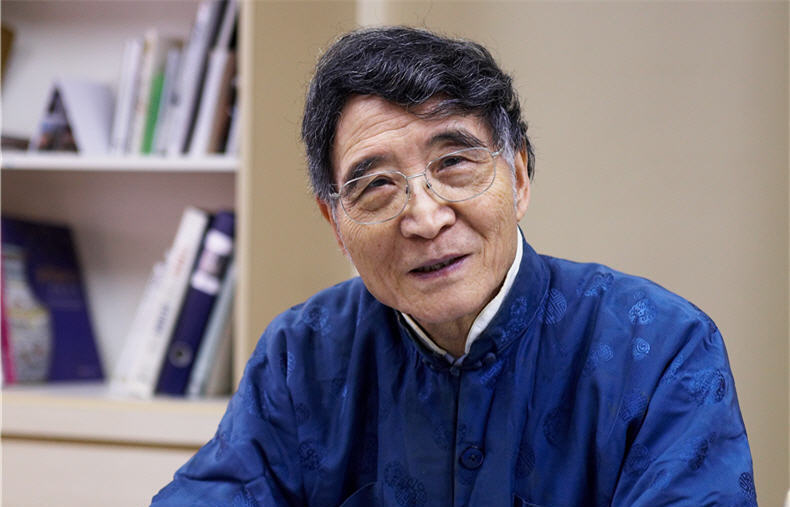
- upper: Mr.Pao-teh Han
Interview & Text / Wan-ching Lai, Hsin-hua Lian
Compiler: Ziyin Chen
Translator: Teresa Huang
Photographer: Chieh-yang Su, Jin-yuan Dai
Special thanks to: Miss Hui-jia Cai of MWR, Professor Yueh-wen Huang of Dept. of Tourism, Shih Hsin University.
Review National Parks Go Beauteous Sense of Beauty Is to be Cultivated.
Professor Yue-Wen Hunang (henceforth Q):
Q:As a master of esthetics and arts education, do you think national parks are conducive to aesthetic education?
A:Professor Han (henceforth A): Certainly. Beauty grows naturally, just like you are not taught to look at pretty girls, beautiful flowers or clouds. Beauty derives from nature. Transferring natural beauty to manmade artifacts is civilization. In that sense, natural beauty existed earlier than human civilization; hence national parks can promote aesthetic education. The question thus lies not in yes or no, but how and by who?
Q: You classify beauty into five levels such as stylistic beauty and functional beauty. In addition to the former, what other types of beauty can national parks display?
A: I do that because in the ancient Confucian or Taoist China, people put too much focus on morals but ignored stylistic beauty. Moral is above everything and restrains people’s desire. However, the thing is that the creation of beauty has to do with desire. Boys go after pretty girls, which is all about desire. So in a culture where desires are restrained, where do people find satisfaction? They do that on a different level, through poetry. That is why in ancient China’s cultural history, we only see scholars but no artists. And national parks exhibit all five levels of beauty, for the existence of beauty has to be appreciated by someone with thoughts, someone who feels it and can write about it. It’s all about levels, which is also what makes the Chinese culture so special.text text text text text text
A: National parks lay stress on ecological conservation, so the spirit should be remaining their original look. Mother Nature is beautiful and so is the ecosystem, which thus also contains quality of beauty. That’s my first point. Second, there are inevitably some killings and survivals in the ecosystem that you may consider ugly. But they become beautiful behind the lens of photographers, meaning that we could see beauty through the eyes of who know how to appreciate it. The beauty of nature has to do with the unique ecosystem and the power of nature. And too much artificiality simply loses beauty. Take stalactite, it has its unusualness and its beauty. You have to tell people about its formation and explain to them its beauty at the same time. That’s how the two aspects are combined; otherwise only the former is shown. Some beautiful scenes are not easily identified, so we need people who can find them and map out routes to highlight them. Some people don’t think highly national parks because they just go there and breathe fresh air but don't see beautiful spots, which should be identified. This is key.
Q: How should national parks conserve the aboriginal tribes and artifacts?
A: Conservation is important to national parks. If it is an exhibition hall, don’t make it too big or eye-catching. Rather, the architecture should be in harmony with the environment. In fact national parks should be treated as the combination of a science museum and an art gallery, so that it can be both educational, like displaying background knowledge, and aesthetic, like explaining what makes a scene so special and beautiful. As for the display of the artifacts, we can keep the original like the aborigines do, and this approach is called eco-display, where artifacts can be treated like works of art. If possible, use the best lighting to highlight them.
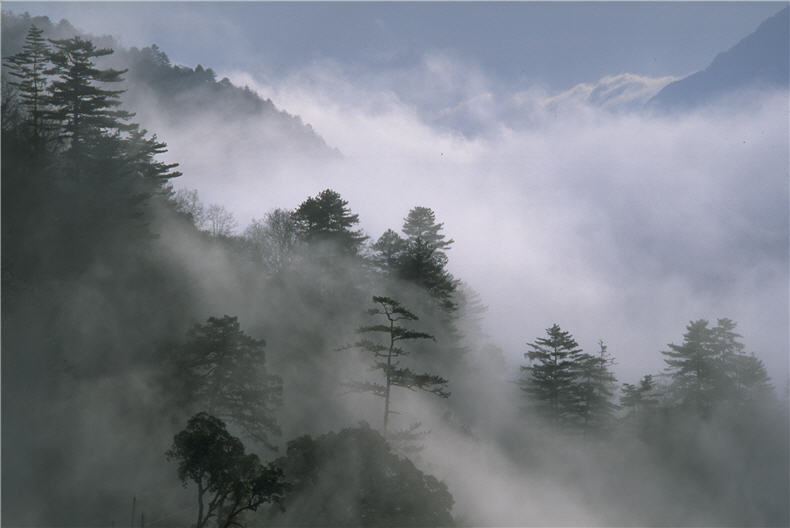
- upper: The artistic element lies in the environment. The picture shows the clouds and mists in TNP. / by Hsin-tsang Cheng
Narrators also as Esthetics Educators
Q: How do we make the narrators understand the sense of beauty so that they can guide and inspire the tourists?
A: It’s a longstanding education issue. Teachers must be cultivated. Suppose that national parks are museums and the sceneries are the displays. Have those who appreciate the beauty walk around, take notes and give guidance to the interpreters, who can then educate tourists.
Q: You were President of Tainan National College of Arts and curators of many museums, and you are expert in arts administration. Since national parks have been cultivating interpreters only, how should the parks train some specialists in aesthetic education?
A: Arts education is a type of education, and education is a process. Arts museums are a place to give aesthetic education, but I feel that arts museums nowadays do a poor job in educating people. Visitors come and go and don’t learn much. They are only attracted to peculiar things. The same applies to national parks. Without aesthetic education, what people see are just natural wonders.
Though natural wonders are not in conflict with aesthetics, but aesthetics has to be cultivated, while seeing natural wonders does not. Education allows us to appreciate beauty, thus the need for aesthetic education is justified. Both museums and art galleries share this goal, but when everyone is in denial, arts education would just fail.
The problem with arts education is that not everyone is taught about aesthetics. In Taiwan students learn not aesthetics but arts, thus leading to a serious problem—people simply don’t have the sense of beauty. If they did, the presence of art galleries is just a matter of course.
National parks may not have much allowance for such designs, but parks in general can. We should provide all citizens with a beautiful environment to cultivate their
sense of beauty.
Appreciating Beauty Through the Eyes of Who Truly Know It
Q: How do we influence policymakers so that they can attach more importance to aesthetic education?
A: You can’t expect to meet a policymaker who truly possess or value the sense of beauty. You only hope that he listens to others and that his subordinates covey this idea to him, and he delegates the work to them.
Professor Han’s remarks are humble and yet to the point, allowing one to grasp the meaning behind aesthetics and arts. In fact, beauty is always around us —let us just feel it and appreciate it.
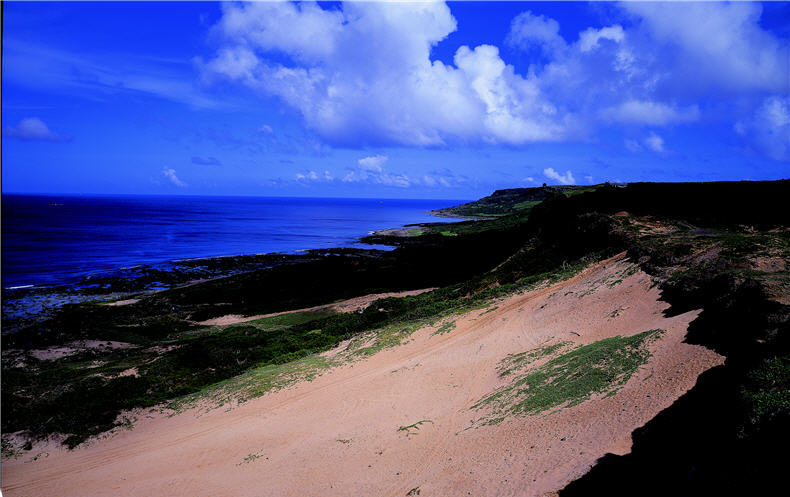
- upper: Beauty is everywhere, so long as one knows how to appreciate it. The picture shows the Fengchui dune in Kenting. / by Ching-hwa Wang


