
The Fun of Frog-Watching in Taiwan-
There are over 4000 species of frogs in the world, mostly in the tropics and the subtropical areas. Of the 32 species found in Taiwan, 8 are endemic species that include, with the exception of Bufo bankorensis, 7 of the cute-looking family Rhacophoridae (tree frog). Though not many in number of species, the total population is great and entitles Taiwan the “frogs’ paradise”. Taiwan is privileged with the humid and rainy habitats favorable for frogs, and the profuse rain providing the frogs a long reproduction stage makes Taiwan one of the best places for frog-watching.
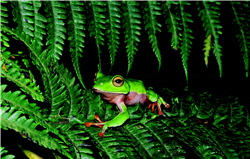
According to Yi-ju Yang, Chairman of GIEEE of NHLUE, tree frogs in Taiwan used to be migrants from southern China during ice age. When the ice recedes, Taiwan and China are separated by the strait, and the tree frogs have evolved into island endemic species. The number of certain frog species drops when their habitats suffer inevitable damages, as in the case of Rhacophorus arvalis found only in Yunlin, Chiayi and Tainan counties that becomes the target of desperate rescue by the ecological circle lately. However, there are also endangered species that celebrate increasing recovery, as in the case of Rhacophorus anarantiventris.
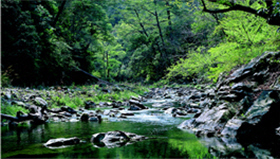
Frogs generally stay in warm and humid regions of low and medium altitude as well as plains. Breathing through their skin, they are very sensitive to the temperature and humidity of their surroundings, and so are prone to be endangered by the deteriorated environment. With wellpreserved habitats for frogs, the national parks in Taiwan are the best places for frog-watching. While Yangmingshan has the most diversity of frog species, the Kinmen and Dongsha are less favored by frogs. According to their physical appearance and skeleton structure, frogs in Taiwan can be sorted into 5 families:
- Family Raniidae
As the most populated frog family in Taiwan, they have long hind legs and hence good at hopping. They are active on land and so their skin color is usually green with a brown part. Besides toads, frogs of family Raniidae are easily accessible and observable by human, and they can be found anywhere in the city, residential area, rice field, plain and woodland. - Family Rhacophoridae
They live in the mountains, in trees, bushes and on leaves of the giant elephant’s ear as well as any hidden place on land. Active only at night, the tree frogs move during reproduction stage to ponds, gutters, rice field and streams and start a spectacular mating call. They are characteristic with cupuled toes to hold onto tree branches. Since tree frogs have protective camouflage, their only strategy when encountering enemies is staying unresponsive. They are prone to evolve into new species caused by geographic insulation due to their limited sphere of activity and inept migration. - Family Microhylidae
An excellent hole-digger, it resembles a sumo athlete for its small head, small mouth, plump body and short limbs. Microhylidae frogs are nicknamed “rain frogs” because they often call after a rain. - Family Hylidae
They look like tree frogs but have a skeleton structure similar to that of toads. Hylachinensisis the only species of this family found in Taiwan. - Family Bufonidae
Frogs of family Bufonidae have lumps all over their poisonous skin, as venom concentrates in these lumps and the protrusive parotid glands. When irritated or defensive, a Bufonidae toad would blow its body into a ball by inhaling air, lift its body as if doing pushups and make hiss sounds, but that’s all bluffing. Only when captured it would secrete venom from the glands to make the enemy let go of it. In fact, Family Bufonidae are best insect-killing helpers in the rice field.


Yi-ju Yang
- Doctor of the Graduate Institute of Zoology, National Taiwan University.
- Incumbent Chairman of Graduate Institute of Ecology and Environmental Education of NHLUE; Director of National Park Association in Taiwan.
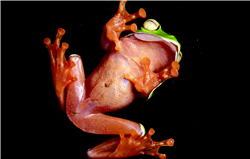
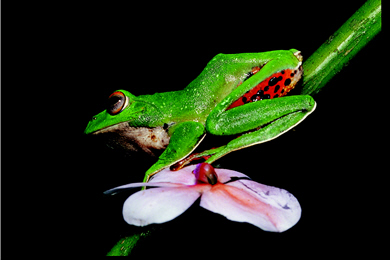
- uppper left: Rhacophorus aurant i vent r is has the striking orange abdomen. / by Peng-shiang Li
- upper center: Frogs generally stay in humid and warm regions of low and medium altitude, such as Cijiawan Creek in SPNP. / by Jeng-hao Yu, provided by SPNP
- upper right: Rhacophorus aurantiventris like living in hidden place. / by Pengshiang Li)
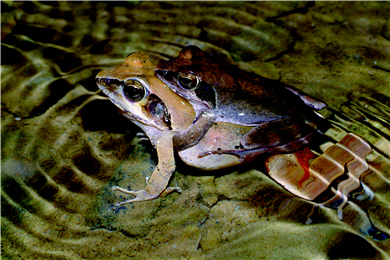
- lower left: Mating of Pseudoamolops sauteri. / by Peng-shiang Li
- lower right: Rhacophorus moltrechti reveals the red str iped underpants. / by Pe ngshiang Li
Shiou-mei Lai
Photographer / Peng-shiang Li.Yung Hsueh.Yu-ting Huang.Jeng-hao Yu
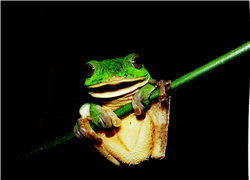
Also called Taipei green tree frogs, these small- and middle-sized tree frogs have a body 4 to 6 cm in length, with green back, white belly, and yellow in inner thighs with black specks. They are endemic and protected animals.
Being the first species discovered and named by Taiwan scholars, the Taipei green tree frogs are initially found in Shulin Town of Taipei County but popular in mid and low altitude area and plains in northern Taiwan. They sleep in summer, reproduce in winter from about October to next March. Usually they live in the tree or bottom woodland, but during reproduction stage the male move to still water area near the woods. They dig holes beneath the leaves, grass by the water and crack between rocks, and call from inside to attract the female. They have an interesting way of digging holes by turning their bodies around the ground. Their low and long mating calls are the only frog calls heard in the winter in YMSNP.
It is interesting that as the female frogs favor large males with low calls, those young or small males would save the effort of digging and crawl directly into the holes dug by the other espoused males to share the same female. It is a mating strategy of the disadvantaged male frogs.
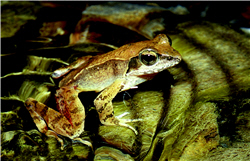
It has a body 4 to 6 cm in length, with a black diamond stripe around the ears like an eye-mask, brown or taupe in the back and a wedge-shaped small black spot.
They are the alpine frogs that live in the expansive places 200 to 3,000m above sea level. Propagating in streams, they have developed a surviving skill of “adhesiveness”, with toes swollen into cupules, roe grouped into sticky balls, and abdomen with cupules. Their call is weak and often overpowered by the babbling stream water, so the male attract the female by searching instead of calling for, and many funny scenes are made this way. For example, with the number of female frogs so few and the poor eyesight of the male, sometimes a male is seen to be mounted by a group of fighting males. It is only when this innocent male calls out with a “gay” sound that indicates “I am also a male”, the others split and try to look for the next objective.
Frogs of Pseudoamolops sauteri family mate between late autumn to early spring. Every year from September to next March or April, especially in late September, the sound of 100 to 200 frogs’ calls can be heard even during the day. It is also the reproduction time of Oncorhynchus masou formosanum that feed on the frogs’ roe. If you visit SPNP at this time, you will witness a grand occasion participated in by the salmon feeding and the frogs mating.
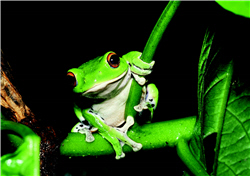
Its middle-sized body length ranges from 4 to 6 cm. Featured with red iris in the eye and the inner red thighs covered with black dots, it is an endemic and protected species of Taiwan.
Rhacophorus moltrechti is the most widespread species of tree frogs in Taiwan from low elevation to mountains over 2,000m high. Their reproduction period varies in different places, usually in spring and summer in the north and northeast, summer and autumn in the central and south, and winter to spring in the east. Every year from October to next March and April, they can be found around Buluo Bay, Shakadang Stream and Tianhsiang Visitor Center in TNP. It is most ideal to visit in spring to appreciate the lilies in bloom and frogs in celebration.
The red inner thighs with black dots of Rhacophorus moltrechti are described by Professor Yang as “red striped underpants”, which are not intended for showof f but protection. It would stretch its legs to display the dazzling red thighs to scare the enemies away. The abdomen and lateral parts of its body are covered with black spots that increase with ages. Its serial calls resemble the quacking of a turkey.
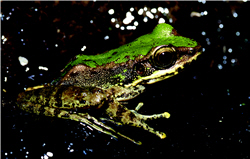
This large-sized frog has a body length between 6 and 10 cm. The color of its back varies from green to brown or a beautiful mixture of both. Its body is slender, and the toes grow into cupules, too.
This large-sized frog has a body length between 6 and 10 cm. The color of its back varies from green to brown or a beautiful mixture of both. Its body is slender, and the toes grow into cupules, too.
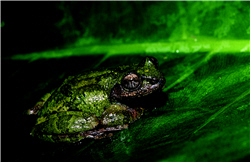
With a size 3 to 5 cm long, its body color varies from light brown to green, with Xor H-shaped dark brown spots.
Kurixalus eiffingeri are most particular with their nursing behavior. After mating, the male will stay in the bamboo or tree hollow to help keep the moisture of the roe to avoid mold growth, and the female will return regularly to spawn to feed the growing tadpoles with. They are found in low- and mid-elevated mountains, with reproduction period from March to September in the west and September to next March in the east. They are easily spotted in the vicinity of Sanjianwu by Shakadang Stream where many fences are established.
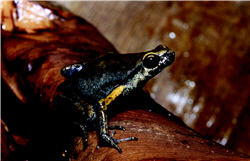
Micryletta steinegeri has a body more slender than the other species in the same family. They are found in low-elevated tropical regions including southern Taiwan and Taitung in the East. Every May and June you can spot them in KTNP in a limestone cave or forest bottom when it rains. You need to be patient in observing them, for their special insect-like chirping calls disappear as soon as the rain stops.
Micryletta steinegeri has a body more slender than the other species in the same family. They are found in low-elevated tropical regions including southern Taiwan and Taitung in the East. Every May and June you can spot them in KTNP in a limestone cave or forest bottom when it rains. You need to be patient in observing them, for their special insect-like chirping calls disappear as soon as the rain stops.
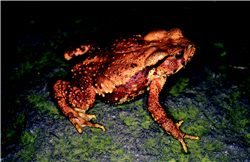
Their size varies from 6 to 10 cm, while the skin colors and patterns range from red to brown and dark brown. It is a Taiwan endemic species.
An authentic endemic species in Taiwan, Bufo bankorensis is distributed all around from the plain to 3000-m-high mountains except in KMNP. Its proliferating period runs from September to next February. The male gather around the water and compete fiercely, and embracing a male by mistake happens occasionally. Opposite to cute-looking frogs, toads give us an ugly impression. But actually they are harmless and friendly, as long as you don’t eat them. Try to observe it carefully when you see one.


