Derict to middle content area:::

:::


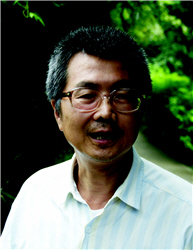
Te-chang Wang
Graduated from China Medical University and Graduate School of Natural Resource Management, National Dong Hua University.
Now head of Albe Farm. He was pharmacist and owner of Ching Hua Art Center.
《The Farm》Albe Farm of Shihmen-
Walking in the Albe Fram of Shihmen Township, Taipei County, is like a historical journey to a primitive Taiwan village of early years. No traffic noise or excessive articial facilities, everything is like a symphony of birds chirping and river googling. Established on the ideal of “a time deposit of the Nature,” Albe Farm delivers the message of environmental conservation through a simple and pure ecotourism mode.
Nowadays what we have mostly is second-hand or even third-hand information except firrst-hand experience. Albe Farm wishes to offer a hands-on experience of touching, listening and watching,” Te-chang Wang, owner of Albe Fram says. In the farm there are six types of ecosystems, including wetland, stream, grassland, pond, forest and farmland. Visitors can experience the beauty in person without damaging or disturbing the natural life.
Sustainable Wild Landscape
Thanks to a group of friends who love their homeland, the beauty and eco-resources of Albe Farm are able to be preserved. Back in 1997, Wang proposed to raise a fund for purchasing and rehabilitation of the land. According to his original plan, each of 1,000 families needs to sponsor NT$200,000, though in the end the total cost of NT$80 million was shared by only 60 participating families plus a shareholder’s generous contribution. Nevertheless, the land purchase is completed and the next step is to fulfil the ideal of “ a time deposit of the Nature”.
Nowadays what we have mostly is second-hand or even third-hand information except firrst-hand experience. Albe Farm wishes to offer a hands-on experience of touching, listening and watching,” Te-chang Wang, owner of Albe Fram says. In the farm there are six types of ecosystems, including wetland, stream, grassland, pond, forest and farmland. Visitors can experience the beauty in person without damaging or disturbing the natural life.
Sustainable Wild Landscape
Thanks to a group of friends who love their homeland, the beauty and eco-resources of Albe Farm are able to be preserved. Back in 1997, Wang proposed to raise a fund for purchasing and rehabilitation of the land. According to his original plan, each of 1,000 families needs to sponsor NT$200,000, though in the end the total cost of NT$80 million was shared by only 60 participating families plus a shareholder’s generous contribution. Nevertheless, the land purchase is completed and the next step is to fulfil the ideal of “ a time deposit of the Nature”.
Located by the Albe Creek of Shihmen Township at an elevation of 130m, the 11 hectares’ land of Albe Farm is variable in altitude and diverse in ecological landscapes. Wang says that Shihmen used to be famous for black tea and during its heyday the exported tea is sold US$50 per kg. The tea masters were even invited to Japan for knowledge exchange with Mikado. The Shihmen black tea was so popular that more than a dozen of tea gardens were in operation around Albe.
After WWII, tea export industry declined. With the establishment of the first nuclear power plant in Shihmen starting 1971, tea gardens became history one by one, leaving only terraced elds and irrigating systems in the old place. The decades of oblivion has helped with the formation of today’s beautiful wilderness. In addition, the lack of factories and inhabitants in this lowly-developed neighborhood are necessary for eco-preservation, which is exactly the reason why Wang and his friends choose this place.
Ecotourism: an Education in Entertainment
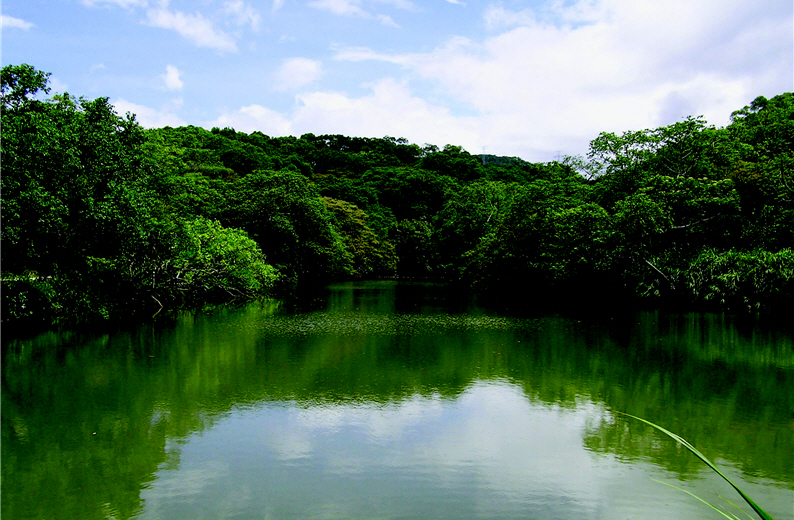
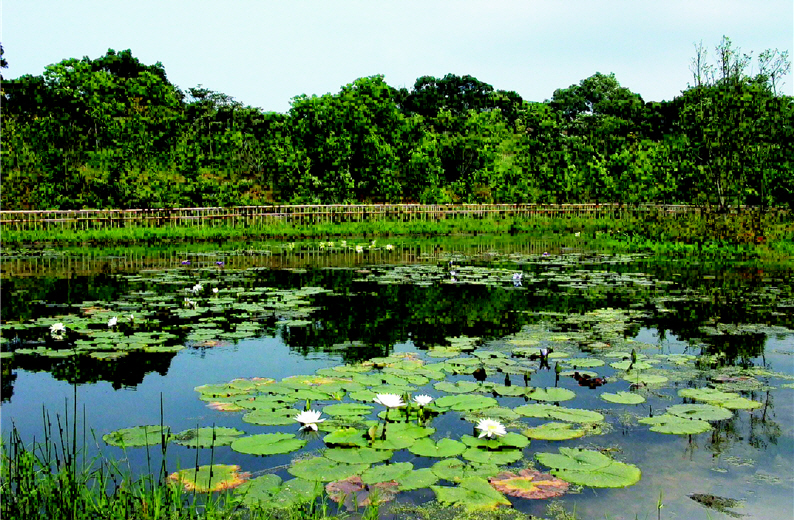
“Albe Farm is situated between two ridgelines like a narrow valley. There are 7 natural ponds and 6 different ecosystems with abundant natural miracles.” Wang mentions that Albe Farm has been fallow for over 20 years and is the most northern habitat in Taiwan. Records show that more than 100 species of butterflies, 70 of dragonflies, 19 of frogs and many rare and protected wildlife are found here.
After WWII, tea export industry declined. With the establishment of the first nuclear power plant in Shihmen starting 1971, tea gardens became history one by one, leaving only terraced elds and irrigating systems in the old place. The decades of oblivion has helped with the formation of today’s beautiful wilderness. In addition, the lack of factories and inhabitants in this lowly-developed neighborhood are necessary for eco-preservation, which is exactly the reason why Wang and his friends choose this place.
Ecotourism: an Education in Entertainment
“Albe Farm is situated between two ridgelines like a narrow valley. There are 7 natural ponds and 6 different ecosystems with abundant natural miracles.” Wang mentions that Albe Farm has been fallow for over 20 years and is the most northern habitat in Taiwan. Records show that more than 100 species of butterflies, 70 of dragonflies, 19 of frogs and many rare and protected wildlife are found here.
- upper: The natural lakes on the farm provide many ecological resources. (provided by Albe Farm)
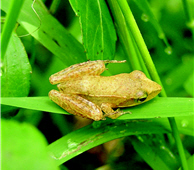
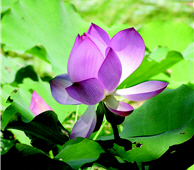
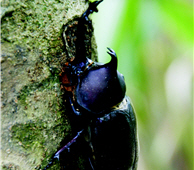
- left to right(lower):
。Chondracris rosea (provided by Albe Farm)
。Pseudoamolops sauteri (provided by Albe Farm)
。Lotus (provided by Albe Farm)
。Allomyrina dichotoma (by Ta-chung Lu)
Text/ Wan-Ju Chiang
Photographer/ Ta-chung Lu
Photo provider/ Albe Farm
Currently Albe Farm adopts two approaches to promote the ecotourism: management by zones and carrying capacity monitoring, with conservation as priority supported by education. Over 10 volunteers are responsible for guided tours, maintenance and meal services. The tour programs include a one-day trip, a night trip and a two-day trip. A learning list is designed for visitors, and with the help of self-guided trails and explanatory boards, so that they can feel and enjoy the wonder of the Nature.
The Community-Based Program
Wang emphasizes that ecotourism must be supported by well-planned management. The mission of Albe Farm should put conservation in mind as a priority with the profit to the community coming in second, so that visitors may acquire environmental education through interactive recreation.
Though a private operation, Albe Farm now focus more and more on the importance of “community collaboration” part in ecotourism.
The Community-Based Program
Wang emphasizes that ecotourism must be supported by well-planned management. The mission of Albe Farm should put conservation in mind as a priority with the profit to the community coming in second, so that visitors may acquire environmental education through interactive recreation.
Though a private operation, Albe Farm now focus more and more on the importance of “community collaboration” part in ecotourism.
As visitors increase with the help from volunteers, the farm starts to hire local residents from Shihmen and Sanji Townships for meal services and purchase local food to enhancing the economic effects on communities.
Albe Farm also works with the township office and farmers’ association to promote tourism at local scenic spots. In the future, it also plans to offer land adoption to city residents who come to experience farmworks at leisure while local people will help to conduct organic farming, and the resources and profit will be shared by all.
“A self-helped social welfare” is the concept Wang tries to promote. He believes that through public force in a bottom-up approach the people will be motivated to devote themselves to sustainable operation. “There is no need to rush, but everything must proceed forward,” This is Wang’s expectation of ecotourism.
Albe Farm also works with the township office and farmers’ association to promote tourism at local scenic spots. In the future, it also plans to offer land adoption to city residents who come to experience farmworks at leisure while local people will help to conduct organic farming, and the resources and profit will be shared by all.
“A self-helped social welfare” is the concept Wang tries to promote. He believes that through public force in a bottom-up approach the people will be motivated to devote themselves to sustainable operation. “There is no need to rush, but everything must proceed forward,” This is Wang’s expectation of ecotourism.
Te-chang Wang
Graduated from China Medical University and Graduate School of Natural Resource Management, National Dong Hua University.
Now head of Albe Farm. He was pharmacist and owner of Ching Hua Art Center.
- upper: The Ecological Ponds


