
Vanishing Lady's Slipper-Taiwan-Bred Cypripediums
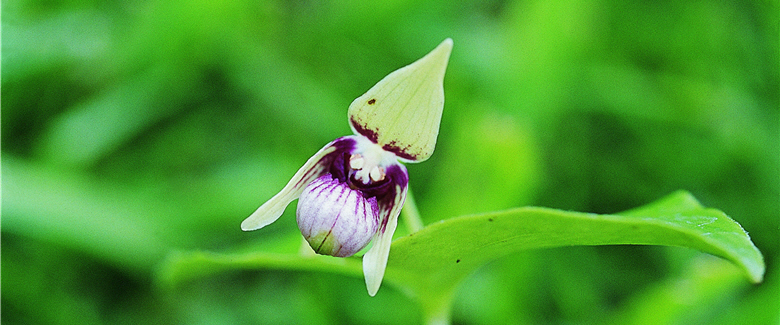
Beauty in the Nature is often shadowed by potential destructions. Cypripedium formosanum Hayata, which used to be found only in high-altitude areas on the Hehuan mountain range, were recently discovered in the lowland. To prevent illegal picking and destruction, Taroko National Park rangers have increased the security level to protect these endangered orchid species.
Mr. Shih-wen Chung of the Botanical Garden Division of Taiwan Forest Research Institute (TFRI) explains the background of the plant. Cypripediums are Orchidaceaes with pouch-shaped petals that resemble a fairy's slipper so it is dubbed Paphiopedilum or Lady's Slipper. There are about fifty species, of which mostly grow in north tropic zones such as North America, Europe, Northeast Asia, Guatemala and Mexico. The four genuses of Lady's Slipper, in a broader sense, include Selenipedium, Phragmipedium, Cypripedium and Paphiopedilum, among which the latter two are more commonly seen.
Wild Orchidaceaes Protected by International Convention
Of the near 4,000 vascular plants in the world, nearly 370 have been published in Taiwan, representing about 10% of the botanical periodical contents. All Orchidaceaes have now been listed in the plant category in the Convention on International Trade in Endangered Species (CITES) to prevent international trading.
The four genuses of Cypripedium in Taiwan are Cypr ipedium formosanum Hayata, Cypr ipedium macranthum Sw, Cypripedium segawai Masam and Cypripedium debile Reichb.f. The plain yellow colored Cypripedium segawai Masam only grows on the rocky hills with an altitude of 1,500 to 2,500 m in northern Hualien, making it particularly precious and a hot target of illegal picking. Chung expresses his worry about this crisis; that if this species is not well protected then it may soon only be found in the encyclopedia of wild Orchidaceae in libraries.
Cypripedium Species Native to Taiwan
Cypripedium formosanum Hayata, looks very similar to Cypripedium japonicum in Japan, but it was announced a native species to Taiwan by a researcher named Bunzõ Hayata because of the .
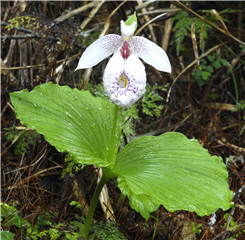
Cypripedium formosanum Hayata is also called the Red Dot Orchid, which has rhizomes. Its leaves are like a pair of fans facing each other. They have no stalks but have veins on the surface, with a diameter of 10 to 15 cm. Its rhizome grows laterally from the “eyes” (undeveloped buds), and the flower can grow in large groups. Between April and May, a pink flower between 6 and 10 cm in diameter with a red dot grows from the middle of the leave.
The Red Dot Orchid has four sepals with pouchshape petals, which attract bees and butterflies with its nectar and provide shelter for insects in winters, forming a mutually beneficial community. They mainly grow in forests above 2,000 m in altitude across Central Mountain Range. the upstream. Despite their widespread habitats, the population has been decreasing due to exploitation. Chung urges people not to pick them shall they be lucky enough to meet these precious plants because once the orchids leave their original habitats, it will be difficult for them to reproduce and grow.
Queen of Taiwan-Bred Cypripediums
Cypripedium macranthum Sw., also known as Alpine Pouch-Lipped Orchid, is herb vegetation that grows on open fields with plenty of sunlight, It can reach between 15 and 25 cm in height, and has three to six oval plicate leaves with fibrils on the edge. Its flowering season is between May and June. It has single apical flowers, with a diameter of 5 to 7 cm, growing from the apex of the main stem. The flowers are either baby pink, bright red or purple in color with dark dots or stripes. Their pouches are sophisticated and bear a resemblance to a slipper.
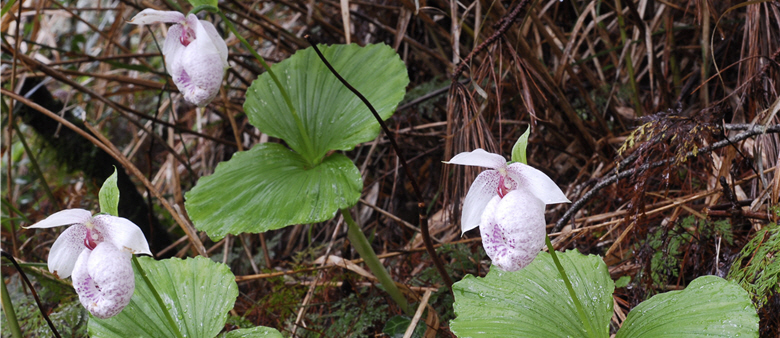
- upper: The budding flowers of Cypripedium formosanum Hayata are yellowish green and dainty.(The photo was taken on 2006. 5. 27)
- lower: Cypripedium formosanum Hayata are found mainly in humid forests at the Central Mountain Range over 2,000 meters in altitude.
Interview and Text/ Jane Chiu
Translator/ Ellie Hsu
Special thanks to/ Mr. Shih-Wen Chung of the Botanical Garden Division of Taiwan Forest Research Institute (TFRI)
Photo provided/ Shih-Wen Chung
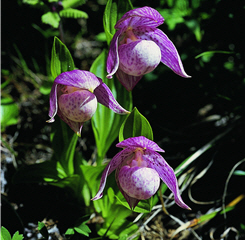
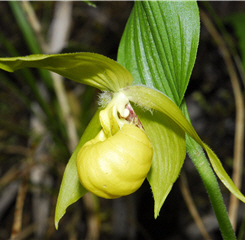
Furthermore, tightly wrapped around by its sepals and petals in an exquisite shape, it has won the title “the most beautiful Lady's Slipper in Taiwan.” It's mostly found on high-altitude plains and talus (above 3,400 m) at Mt. Nanhu, Mt. Zhongyangjian and Qilai N. Peak in the Taroko National Park. Because its flowers are big and colorful, Chung says, the orchid tends to be picked by hikers and thus on the decrease.
The One that Grows Deep in the Forests
Cypripedium debile Reichb.f., also dubbed “the Tiger Cub Seven,” is a hibernal terrestrial orchid that grows in forests with rich soil. It is about 10 cm tall with a pair of symmetrical stalkless oval leaves 2 to 4 cm in length. The yellowish green flowers blossom between May and June, and measure only about 2 cm in diameter with maroon-colored patches at the base of the pouch. They grow mainly in coniferous forests at an altitude between 2,500 to 3,000 meters.
Chung explains that with its petite size the Tiger Cub Seven is not as endangered as the other Cypripediums. However, it is small in population and still requires stringent protection.
Chung reckons the threats to the survival of Taiwan-bred Cypripediums come mainly from the loss, destruction and deterioration of their natural habitats, as well as the picking by humans. Their aesthetic and medical values have put themselves in grave danger. While Taiwan is world famous for breeding species, certain breeds, such as Cypripedium segawai Masam, are rare and difficult to reproduce; therefore, the best strategy is to focus on protecting the original vegetation from human disturbance.


Profile of Mr. Shih-Wen Chung
With a Ph.D. degree in Forestry at National Chung Hsing University, Chung currently works at the Botanical Garden Division for TFRI. He specializes in the taxonomy of flowering plants and has in recent years started researching into the genus relations and taxonomy of Orchidaceae. In 2005 he was invited by Tsukuba Botanical Garden (Japan) to exhibit his wild orchids photographic works. He has many published works such as “Trees of Taiwan – Spring, Summer, Autumn and Winter” and photographs for “A user's guide to tree planting in Taiwan.” He also publishes new discoveries on, or documentation relating to Orchidaceae.
- upper left: Cypripedium formosanum Hayata have leaves like a pair of fans facing each other.
- upper center: Cypripedium macranthum Sw. have large flowers with bold colors and dark patches.
- upper right: The yellow flowers of Cypripedium segawai Masam have no patch or pattern.


