
Water Invariably Returns to Where It Passed-
Namasia means the water on Yushan overflowed and became Namasia......
The aborigines in Taiwan have learned to live and thrive with mountains and waters. It's just that we overlooked their wisdom......
Typhoon Morakot's strike didn't start in Southern Taiwan. In fact, as early as Aug. 5th, some of the industrial roads in Jianshih Township of Hsinchu had been swept away. Having finished the second day of my lecture in Judung Township, I learned that the course for the next day was suspended due to Morakot.
Later we were relieved at the departure of the typhoon. However, to our surprise, disasters started to come one after another. A few days later, helicopters flew to the affected areas to rescue the victims. Temporary shelters scattered across Southern Taiwan and the scene was like the 921 Earthquake that we experienced a decade ago, only that the losses this time are much greater.
I talked to some of my friends who were affected by the typhoon on the phone and felt I needed to do something, so I embarked on a field survey in the affected areas starting from Sep. 5th.
Bukun, a Bunun tribesman living in the Namasia Township mentioned the following saying by the Bunun ancestors in his book Laisnigas buan tu asik, “Water invariably returns to where it passed.” Bukun said, “Namasia means the water on Yushan overflowed and became Namasia.”
The Bunun people originally lived on the hillside but were displaced many times by the country. Some villagers then lived by the Namasia river bed. Unfortunately, the Minzu Village was struck by a debris flow, in which the dead and the missing amounted to 26 but only 9 bodies were dug out.
Hai Shu Erh, who lives in Meilan Village, is an elementary school teacher. As we talked outside the office of the Southern Tribe Alliance for Reconstruction (STAR), he looked somewhat fatigued, perhaps still bothered by the Cross- Border Channeling a few years ago, or was worn out after having travelled between shelters. When asked about water, he came again to himself and said, “The ancient Bunun refer to water as babas, meaning it's poisonous. Tamapima, a Bunun writer, also said that the tribe is afraid of water and believes that evil spirits reside in paddy fields. Also, the Bunun people stay away from water or places in proximity to water. We choose water that does not derive from the river but elsewhere.”
I was taken by surprise by the idea that “water is poisonous,” but what the Bunun people actually mean is that small as we are, we need to be awed by water--- just as a Chinese saying which goes: “The water that bears the boat is the same that swallows it.”
As we learned that the entire Hao-Cha village was buried by the mudslide, we must treat water with reverence and awe. A Rukai tribe writer Auvinnie Kadresengane said when he was in the Sanhe village gazing the misty relics of the Hao- Cha village, “an ethnic group is no longer beautiful once it loses its culture.” He is one of those few who still return to the relics of Hao-Cha village.
When living in less desirable places, we Atayal people humbly call ourselves “the waterside dwellers.” In fact, the aborigines in Taiwan have learned to live and thrive with mountains and waters. It's just that we overlooked their wisdom. Now, many villages have been displaced to areas close to rivers and the villagers truly became the waterside dwellers who are prone to disasters.

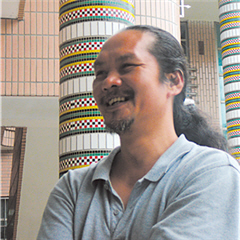
Profile of Mr. Walis Norgan
He is also know by his Chinese name, Jun-jie Wu. Graduated from Taichung Teacher’ s College, Walis didn’t start trying his hand at literature until he went to college. At the age of 16, his free verse was tossed in the bin by the editor-in-chief of the school magazine, Huixiong Lin, who later became sworn brothers with him. Walis now teaches at his alma mater, Tuz-Yu Elementary School. He ran the publication “Hunting Culture” and “Taiwan Indigenous Peoples Research Center”.
Text/ Walis Norgan
Translator/ Teresa Huang


