
The Great Mission of Protecting Habitats-On the Importance of Habitat Conservation
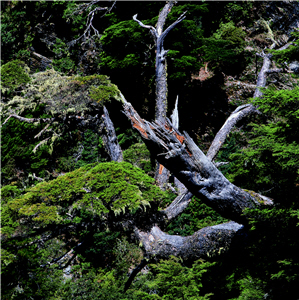
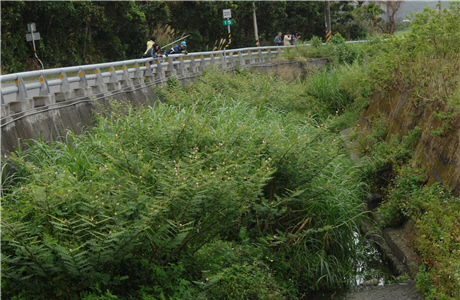
When Typhoon Morakot ravaged through Southern Taiwan, the lagoons and wetlands in Cigu and Sihcao contributed to effective flood prevention and lowered the risks of flood in the neighboring regions. It appears that Taijiang National Park, which consists predominantly of wetlands, bears unshirkable responsibility of habitat conservation and maintenance.
National parks retain rich and varied natural landscapes, native species and distinctive ecosystems, making them duty-bound to preserve these precious natural resources and species.
However, natural disasters and man-made calamities always strike against human civilizations in an unexpected way. That is why the idea of“ retaining one's roots” has been implied in the story of Noah's Ark. And now the whole world is engaging in research on species preservation, indicating that humans have been learning to respect, treasure and conserve Nature as they interact with it.
It is generally accepted that biodiversity is lost due to climate change, the invasion of alien species and pollutions. However, in 1994 and 2004 the World Conservation Union, a.k.a. IUCN, singled out “the loss of habitats” as the major factor resulting in the diminishing biodiversity. In its red list of threatened species, the IUCN stated that nearly 86% of birds and mammals, 90% of freshwater fish and over 30% of marine life are facing extinction due to the loss of their habitats. Thus habitat conservation is a prerequisite of ecological conservation.
The Invasion of Alien Species: A Disaster
The story below shows the importance of habitat protection.
Mimosa pigra L. is a species native to South America. It has hairs and spikes and secrets growth-suppressing mimosine to obstruct the growth of other native plants. The plant grows at a whopping 9,000 seeds per square meter and is rapidly spreading in the tropical Asia of Sumatra, Java and Papua New Guinea.
The plant once nearly caused the swamps in Thailand to dry up, thus galvanizing the whole nation into eradicating it. After some painstaking efforts, the people falsely assumed that the species had been eliminated. They celebrated the triumph, only to find in the next year that the plant flourished again..
“Now Mimosa pigra L. has been spotted in riverbeds, roadsides and costal silted land in Taitung County, Pingtung County and Kaohsiung City. If it makes its way into Taijiang National Park, the results can be disastrous.” said Professor Tzen-yuh Chiang of the Department of Life Sciences of NCKU.
Habi tat Protect ion Star ts Wi th Bet ter Understanding
Habitats in Taiwan's national parks are well preserved, but numerous species within them make management rather difficult. Hence the research on species and the establishment of a databank are crucial.
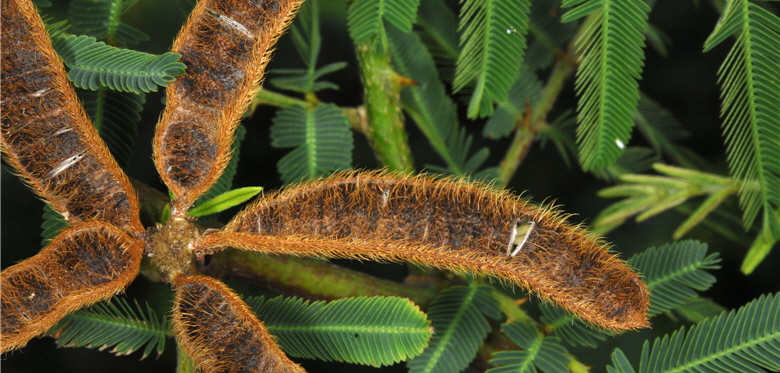
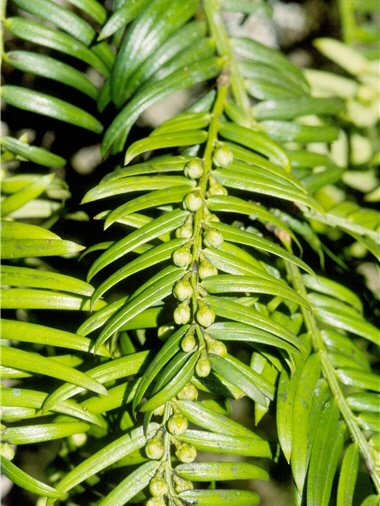
- upper left: Extract of Taxus sumatrana (Miq.) de Laub is used to contain some malignant tumors./ Photo provided by Tzen-yuh Chiang
- upper right: Mimosa pigra L grows at 9,000 seeds per square meter./ Photo provided by Tzen-yuh Chiang
- lower: It has been spotted in riverbeds, roadsides and costal silted land in Taitung County, Pingtung County and Kaohsiung City./ Photo provided by Tzen-yuh Chiang
Interview & Text/ Yi-zhou Lian
Hsin-hua Lian
Special thanks to/ Professor Tzen-yuh Chiang of the Department of Life Sciences of NCKU
Mr. Zhi-feng Su and Ms. Zhen-yu Chen of Yushan National Park
Mr. Xuan-wu Chen of Kenting Naitonal Park
Director-general Dah-jiang Liu and Division Chief Sheng-zhong Huang of the Agricultural Research Institute (ARI), Council of Agriculture
Translator/ Teresa Huang
Providing accurate and fast technical analyses of species conservation and genetic diversity, the fingerprinting technique has been employed by Chiang for species conservation. The technique enables one to research on the DNA of the species and it can “identify whether the plants in one's house are homegrown or stolen,” joked Chiang.
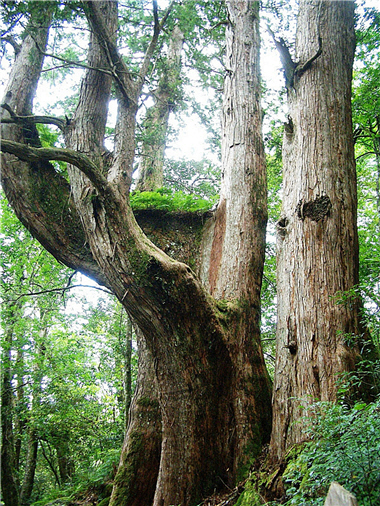
Habitat protection should not just end up a slogan. We need to fully understand its ultimate goal as well as how to do it. Chamaecyparis formosensis Matsumura, for instance, is of good quality and is enduring, making it a perfect building material; extract of Taxus sumatrana (Miq.) de Laub is used to contain some malignant tumors; the grandeur of Tsuga chinensis (Franchet) Pritz. ex Diels var.formosana (Hayata) Li & Keng makes it one of the iconic trees representing national parks. These species bear economic, medical and recreational significance, and habitat conservation can be effective only when the purpose of species protection is well appreciated.
Habitat conservation is more than preserving places where certain species reproduce and inhabit. The entire population and the ecological history of the species, and the different requirements and conditions during each stage of the species' growth must be considered. Take migratory birds, a thorough protection of their habitats includes the ponds they occupy, the wetlands along their.
migratory path and their breeding place in the north. Habitat protection is an uphill fight requiring the implementation of environmental policies, academic research and cooperation from the public.
Conservation Should Reflect Changes in Time
The key to successful habitat conservation lies in “humans” and “the environment of the habitat.”
In fact, the idea of“ protection area” which takes account of ecological, social and economic aspects and manages habitats in a sustainable manner has come to the forefront. Such an idea has also been adopted by the management of the National Park.
But is no disturbance at all the best way of protecting a primitive habitat?
Judging from the downfalls of some traditional cultures, the idea of conservation should be kept abreast of the times. Cherishing ecological resources doesn't mean leaving them intact. The high grass in the Midwest, for instance, is also a habitat that the U.S. is keen to protect, and yet the country's no disturbance policy resulted in the near-extinction of the native species there. It was the later human intervention that helped the native species survive.
Chiang said that we are well aware that life is precious, and we should treat habitats with the very same attitude. National Parks have always been an exceptional model for the conservation of habitats, and now is the time for everyone to share his/her responsibility to conserve habitats and provide all the species on earth a better living environment.


Profile of Prof. Tzen-Yu Chiang
Professor at Department of Life Sciences, National Cheng Kung University; specialized in plant classification, species evolution, and population genetics; winner of 2007 Outstanding Research Award from National Science Council, 2007 Annual Plant Research Periodical Award in Japan, and 2004 membership of U.S. AAAS.
- upper left: Extract of Taxus sumatrana (Miq.) de Laub is used to contain some malignant tumors./ Photo provided by Tzen-yuh Chiang
- upper right: Highly durable, Chamaecyparis formosensis Matsumura is regarded as high quality building materials and thus is coveted by illegal loggers./ by anching Lai
The liberalization of the international trade expanded the market for cash crops. As the market demands rise, more land is required to grow crops. As lands intended for plowing get restrained because of habitat conservation, protests will inevitably break out. Therefore, mounting pressure and clashes have always remained the greatest challenge facing habitat conservationists.
In this issue, the NPQ interviewed Mr. Dah-jiang Liu, Director-general of the ARI, who drew the analogy between seeds conservation and the conservation effort undertaken by national parks. The ARI's “National Seed Bank” aims to preserve the DNA of many local crops and extend the differences in crop breeding for improvement in crops and cultivation techniques. Improved species and techniques may better adapt to the natural environment and lessen the damage to habitats.
The 100-Million-Year-Old Native Crop of Taiwan
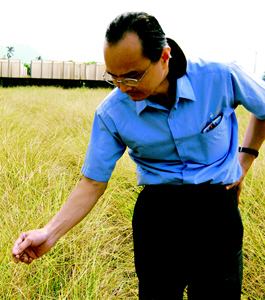
The ARI cultivated many plants native to Taiwan, with “Taiwan Wild Rice” being one of them. Liu and Shengzhong Huang, Chief of Plant Germplasm Division, ARI, introduced the rice to us. At first glance, it would normally be mistaken for weeds, but a closer look reveals that the size of this rice is only 1/3 that of normal rice. Small as it may seem, its thin and long chaff is highly resistant to diseases and pests and its high vitality has enabled it to propagate for over 100 million years.
Cross-Continental Cooperation
In Feb. 2008, funded by the Norwegian government and under the auspices of the Nordic Genetic Resource Center (NordGen), the Svalbard Global Seed Vault (SGSV) was established. In Feb. 2009, the ARI signed the SGSV agreement with the NordGen and would abide by the agreement to provide about 12,000 seed samples to the SGSV for preservation in the future. The ARI's joining SGSV signifies a new page for Taiwan's agricultural collaboration with the international community.
Seed Preservation: A Common Goal
Huang said that “in situ preservation” is one of the objectives behind the establishment of national parks, while the ARI plays the complementary role of “ex situ preservation.” If species in national parks were damaged due to natural and artificial forces, the ARI could bring its species preservation technique into play and contribute to the restoration and maintenance of the biodiversity in Nature.
Liu solemnly wondered how many out of Taiwan's 50,000 species were wiped out following the August 8 Flood. But no matter how helpless we feel, we should respect the natural growth of the plants and try our best to preserve them so that they will not be lost for good. This is actually what national park conservation groups and ARI have been striving to achieve.
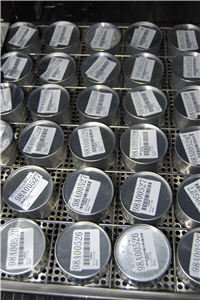

- lower left: The ARI's joining SGSV signifies a new page for Taiwan's agricultural collaboration with the international community./ by Chih-hao Huang
- lower center: Mr. Chiu-kai Wey of the Agricultural Research Institute (ARI) pointed at the only wild rice field in Taiwan that has been existing for over 100 million years./ by Chih-hao Huang
- lower right: Director Sheng-chung Huang hoped that through techniques related to gene conservation, the ARI can make more contributions to habitat conservation./ by Chih-hao Huang


