
Two Decades of Guarding the Mountains-An Interview with Buya and Nobu, Park Rangers of Taroko National Park Headquarter
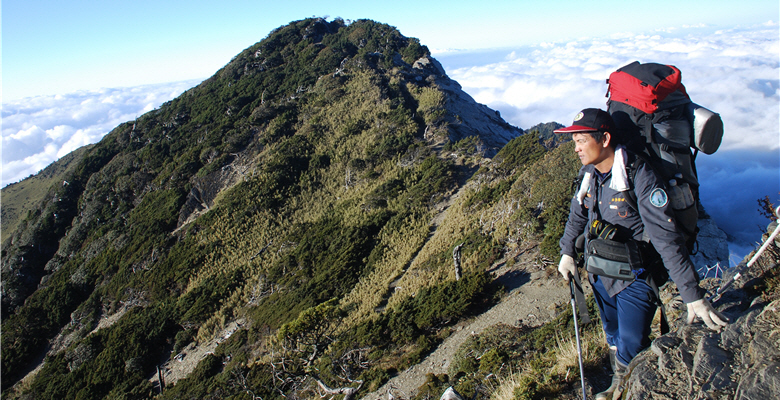
As Typhoon Morakot rampaged through Taiwan, Taroko National Park (TNP), with its well-preserved forests, fortunately only suffered minimal damages. In the aftermath of the disaster, ecological conservation and sustainability have been under serious discussion, and people have noticed areas conserved by national parks all survived the natural disaster thanks to the well-maintained water and soil conservation.
TNP has been a must-visit attraction for both local and foreign tourists since it officially became the fourth national park in Taiwan in 1986. It is never easy to maintain this spacious forest. Despite the advancement in technology and information, there is still some work on this extensive land that cannot be done by machines but by hands.
To manage this vast land, TNP must count on park rangers who have to walk along the allies with heavy bags day after day, and guard the Park with their stamina, perseverance and strong will.
“Who doesn't want to have an easy, well-paid job that is also close to home? But the job as a ranger is demanding and humbly-paid, and requires us to be in the mountains away from home.”
As a Truku, Buya had worked in the city far away from home when he was 18, but he never liked the life in the busy city jungle. Later, his love for and knowledge about mountains brought him back to Taroko. He had participated in the Forestry Bureau (FB)'s deforestation and cultivation project since 1979, an era when the government had not forbid logging, until he went into the army for military service.
From a Logger to a Park Ranger
Once one of the economic arteries, logging industry had earned considerable foreign reserves for Taiwan at the expense of numerous giant trees guarding the land for millenniums. Those logging days were against Buya's nature and will as an aborigine, which respect the Nature.“ We hunt but we never do it in breeding seasons; we log but we only cut the branches for building houses and never for profit.”
The roots of al l the fel led Taiwan Red Cypress (Chamaecyparis formosensis Matsumura ) and Taiwan Yew (Texus chinensis ) were able to hold the soil at first, said Buya. “But now after 30 years, the roots had all rotted away, which might be the cause of recent mudslides.”
Luckily, as concepts of conservation began to sprout, logging has been prohibited in the 80's in Taiwan, and the all-year-long sawing sounds in the mountains finally subsided.
At the time Buya left the army, TNP was recruiting park rangers, and he became one of the first rangers in the Park, and had since helped train more talented successors.
Nobu, 5 years younger than Buya, also once worked for FB with missions for afforestation rather than deforestation. Nobu said laughingly that he was not as endurant as Buya. It was quite funny how he became a park ranger. “I didn't have a slightest clue about what a ranger does. I thought I would be doing gardening work or trimming the trees in the national park and that would be easy since I had green fingers, sort of.”
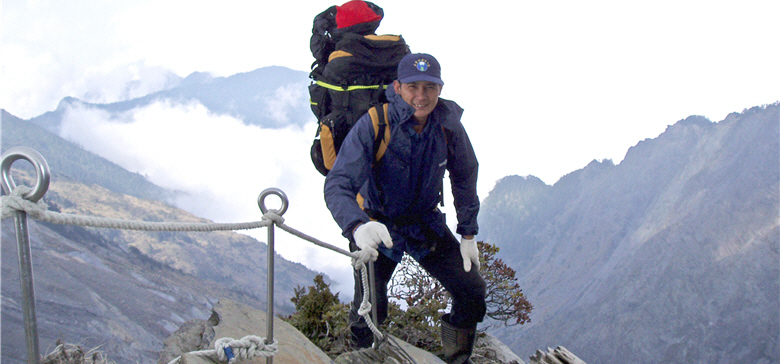
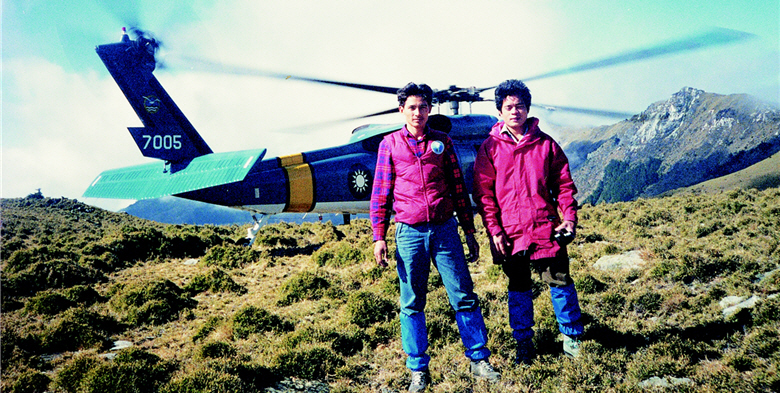
- upper: Park rangers'“office” is right in high mountains at an altitude of more than 3000 meters./ by Yung-hsien Lin
- lower: Strenuous trainings develop the park rangers' ability to provide emergency relief./ Photo provided by Buya
Interview & Text/ Wan-ching Lai
Photographer/ Chien-yi Lu, Yung-hsien Lin
Special thanks to/ Mao-yao Lin of Interpretation & Education Section,
Yung-hsien Lin of Recreation Services Section, Taroko National Park Headquarters (TNP)
Translator/ Wendy Cheng
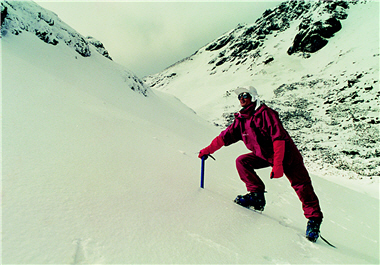
But Nobu was wrong. In addition to paper tests, contestants had to carry 30-kg sand bags and to walk up to Huoran Pavilion in Tianxiang, from 1,000 meters in altitude, within 1.5 hours.
The long stairway trail in front of the Pavilion was intimidating. Most of the contestants just put down the aluminum pack frame, emptied the sand bags and then left half way.
Nobu completed the test with his innate aboriginal strength and stubbornness, and became a junior ranger to Buya. “A park ranger needs to know the mountains well and also be able to walk in the mountains with heavy loads. The test may be hard but it shows that only someone with outstanding perseverance, stamina and will power could be qualified for such difficult patrolling work.”
Tough Tasks Require Tough Guys
To more perfectly fulfill mountain- patrolling missions, TNP should train more “Buya and Nobu.” So far only 6 out of the 15 rangers in TNP are Han Chinese, the rest are all aborigines. But the Park is such a vast land with heavy workload and the patrolling is dangerous. Shortage of hands is really a big problem now.
Buya, in his late 40s now, worried that the new rangers would not be ready to take charge when the experienced ones are retiring. Though the Executive Yuan unveiled plans promoting instant employment, the newcomers, despite their sincerity, just didn't have the strength to even go through the training.
As contract employees without full insurance and welfare, park rangers have to risk their lives in the mountains for a humble monthly salary less than NT$30,000. “Unless driven by a strong sense of duty to the Nature, no one will want to stay on this job.”
Buya and Nobu are often seen in the 92,000-acre mountains and forests as there are not enough rangers.
While they can handle physical fatigue, the toughest challenge comes from their relationship with the tribe people. The Truku traditional culture and the ancestors had taught Buya and Nobu the survival rules in the mountains. But the aboriginal ways were often in conflict with national park laws. A couple times when they went home after removing some hunting traps in the mountains, their tribe people called them “traitors.”
Buya and Nobu valued their families the most so it hurt to be misunderstood by their tribe people. But the conflicts were gradually resolved after continuous communication.
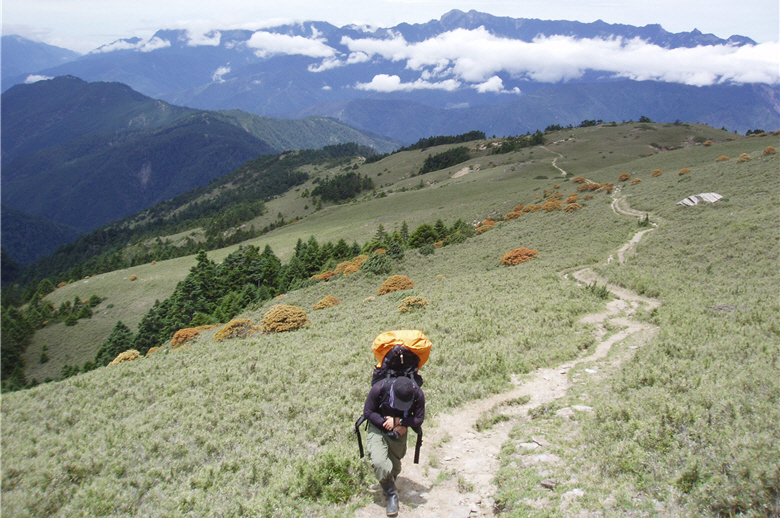
- upper left: Park rangers always have to carry heavy equipment, but the responsibility on their shoulders is even greater./ by Yunghsien Lin
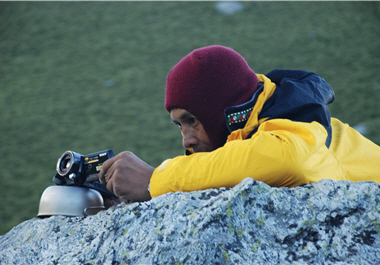
- upper right: Park rangers record changes in the mountain ecology. Many researchers need the assistance from park rangers for their research./ by Yung-hsien Lin
- lower: Gentle breeze, beautiful clouds and spectacular views accompany the park rangers / by Buya
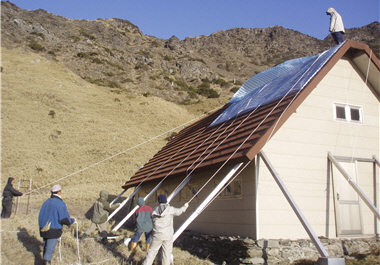
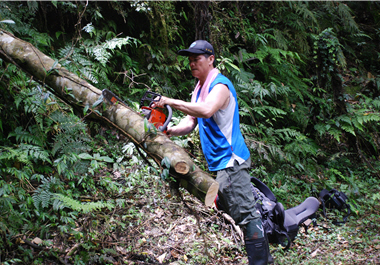
Nobu said that they had removed countless hunting traps and sometimes had to, totally unarmed, deal with the illegal loggers.
“When the buying stops, the killing will, too. So the government should focus on cracking down those who sell precious lumber and mountain products,” Buya said from the bottom of his heart.
The innate abilities Buya and Nobu were born with as aborigines have enabled them to face the challenge pose by the Nature at any time.
One day while patrolling with the officers of TNP, they found the only water source, Heishuitang, near the campsite was just tainted by the Formosan Sambar (Cervus unicolor swinhoei ) with their stamping and feces. The water was like black coffee, and just couldn't look or smell any worse! Buya soon decided to look for another one. It took him 20 minutes to go down the valley and then over an hour to carry the clean water up to the campsite.
As the interviewer, I couldn't help wondering how Buya knew where another water source was. “It is my understanding of the mountains over my aboriginal instinct. We have been working in this 92,000-acre ‘office' for over 20 years. We know about everything here. Even a Han Chinese will be able to do just that with heart and proper training”
An Ultimate Rescue in Snow Right Before Wedding
Mountain patrolling is not just tough but also takes a fearless spirit of braving any danger. Taking risks is just part of the rangers' daily lives.
In Feb. 2004, a graduate student surnamed Kuo was once reported missing during his research of the Formosan Sambar in Mt. Qilai when a cold air mass hit. Walking for 5 days in the snow blizzard, the rescue team assembled by TNP eventually brought Kuo back safe and sound. It was the first in-snow rescue. Besides Buya and Nobu, members of the rescue team were the elite mountaineers in Taiwan, such as Tai- sheng O'young, Yu-long Wu, and Youshui Fang.
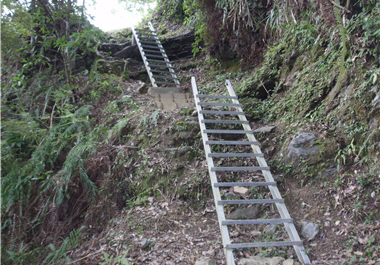
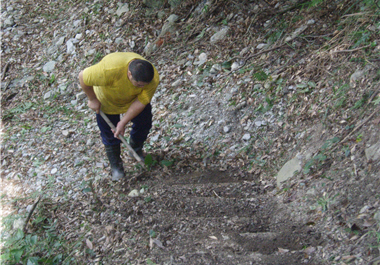
- Park rangers repair mountain cabins, set up road signs, remove fallen tress, set up aluminum ladders, and clear paths./ by Buya
“At worst I'll just rush to my wedding with all my gears on. But I'll be there in time. No problem!” Buya joked. About to celebrate his 43rd birthday, Buya had to part with his family and came to the rescue in a chilly low temperature.
With their understanding of the mountains, Buya and Nobu operated the rescue in the snowy and slippery Mt. Cilai. Any mistake on their steps would have caused them to fall into the valley and break into pieces or even get pierced through by the arrow bamboos. The difficulty of surviving in the snow was hard to imagine unless one had actually been there.
The aborigines were not made of iron; they were just good at using their basic instinct of survival. Buya ended up the only person who didn't get wet. He did so with just some big double-layered plastic bags and his alertness as he saved himself and his teammates. After the mission was completed, Buya was so exhausted that he headed straight to bed and forgot all about his birthday party. And another happy ending of the rescue was that Nobu made it to his wedding in time.
Supplies Are Better than Appreciation
Each task seems like a story we only see in a movie. But to those hard-working park rangers like Buya and Nobu, it is reality.
As by rule the Seagull Helicopter did not transport corpse or the rescue crew, Buya and Nobu had to carry decaying corpses down the mountains by walking for 5 days. Also they had to walk down the mountains with heavy gears after their exhausting mission while the rescued hikers were flown away by the helicopter.
“Carrying corpse sounds creepy but we still do this kind of unpleasant task because we believe it is what god wants us to do,” said Nobu and Buya with one accord. Some would describe national park's rangers as guardians to national parks and the natural environment. Without them, conservation would be nothing but words. The tasks in national parks are not just some routine office work; they cannot get done just by listening to briefings or reading through some official documents.
- Park rangers feel relieved after having carried the wounded onto a helicopter. Then they carry heavy backpacks on their back and climb down the mountains. In the photo are Buya (left) and Nobu (right)./ Photo provided by Buya
20 years of patrolling have made Buya and Nobu realized that how people's selfishness could damage the Nature.
Taiwan is an island full of mountains and mountain climbers. However, some climbers just don't respect and care about the Nature. They discard the indecomposable plastic bags and bottles in the mountains only to unburden themselves, which increases the burden of the park rangers. What's even more frustrating is some climbers' disrespect toward parks' rules.
“We as park rangers are not national park police, who can prosecute the lawbreakers. We can only advise climbers. Dealing with those who disregard the regulations, advice, or our duties is sometimes even more exhausting than carrying tons of trash down the mountains,” said Buya and Nobu helplessly.
Buya and Nobu seldom speak up for themselves. But as time goes by, they will grow old and weak and who will continue the guardian work? Can we take any chance to leave the mountains unguarded just because of shortage of manpower?
Several years ago, the TV serial “The Starlight of Shengling,” whose main theme was about park rangers in high mountains, did appeal to the younger generations to be rangers. However, after knowing more about the work, few were willing to stay for the job.
There are a lot more people who love and respect the mountains just as Buya and Nobu. They, too, have worked hard to guard the environments.
Who, then, will succeed them? and who can promote better welfare of the job and make it more appealing to more people?
Whi le people nowadays have been widely discussing about sustainability, perhaps the sustainable development of park rangers should deserve more thorough pondering, too.

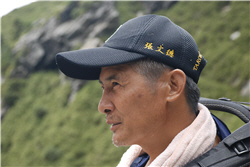
Profile of Mr. Buya
Buya, Chinese name Wende Zhang, is a Truku. As the first generation of the park rangers of the TNPH, Buya has dedicated to the patrolling work of the TNP for over 20 years. He worked away from his hometown after he left the army but eventually returned to the mountains and work as a park ranger.
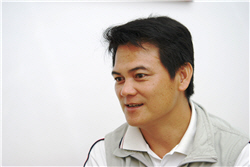
Profile of Mr. Nobu
Nobu, Chinese name Yongchun Wang, is a Truku. He is the second generation of the TNPH park rangers and a junior of Buya. When he was young he worked with his.
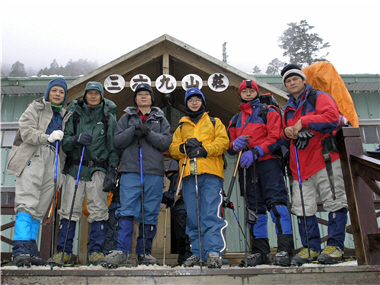
- upper left: Capacity control aims to ensure the safety of the visitors. Each visitor should respect the duty of park rangers./ Photo privided by Yung-hsien Lin
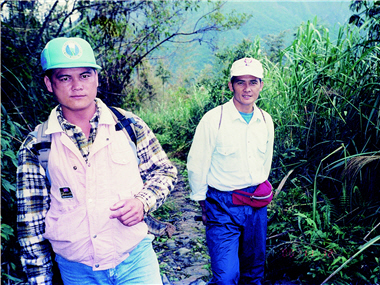
- upper right: As the mainstays of the Taroko National Park Headquarters, Nobu (left) and Buya have risked their lives together patrolling the mountains. They look forward to newcomers to join the ranks of park rangers. / Photo provided by Buya


