
Ten Years of Effort Glory of Taijiang-A Brief Historical Retrospect on the Establishment of Taijiang National Park
2009 saw the advent of the eighth national park in Taiwan. As the wheel of modernization moves on, the new park offers a sanctuary that preserves the local culture and ecosystem. As the first national park initiated by a local government, Taijiang National Park was established after ten years of effort. Or perhaps we could say, After a long period from 17th to 21st century finally came the revival of Taijiang.
Imagine that Taijiang Inland Sea was once between Provintia (now called Chihkan Tower) and Zeelandia(Anping Fort)and had these two colonial buildings facing each other across the water in the 17th century. Ever since Zheng Chenggong landed at Lermen in Taiwan in 1661, the history of Taiwan's development turned a new page. Valuable historical tracks preserve that development now in Tainan.
A Lasting History and a “Newborn” Land
The so-called “Taijiang Inland Sea” was a lagoon on the southwest coast. Since mid Ching Dynasty, the lagoon had gradually transformed into a sandbank and connected to the land. Now, people can only trace the existence of the Taijiang Inland Sea in the historical remains of Sihcao Lake and Kunshen Lake. The wetland is not only evidence of Taiwan's history, but also an important wildlife habitat.
Today, one can hardly picture that Tainan was once a prosperous port; however, names of ancient cities still show the traces of such history; for example, Zhozaiwei (the end of a sandbank) and Yanhang (salt industry) were names for what has become Yongkang City. New Port (a port for Tai-Chiang) is now called Shinshr Township.
The saying “Time brings great changes to the world” best describes the way Taijiang evolved.
Though the development has never stopped on this newborn land, the migrant birds, hidden channels in the deep mangrove, the crystal salt in the salt field, and the mysterious Hei Shueigou should not disappear over time.
Hardship during Preparation Processes
At first, Tain-tsai Hsu, the then Tainan City mayor, urged the central government to establish Taijiang National Park. With the support of the Tainan County Magistrate Huan-chih Su, the Black-Faced Spoonbill Conservation in Cigu was also incorporated with the national park. And Taijiang was officially pronounced as the eighth national park of Taiwan on Oct. 15th, 2009.
The north of the Park reaches the southern tip of Chingshan Fishing Port and the south reaches the south bank of the Yanshuei River. The Guosheng Port Lighthouse, which is the westernmost point of Taiwan, lies in the Park, too. The Park covers an area of 39,310 hectares, including 4,905 hectares of land and 34,405 hectares of sea.
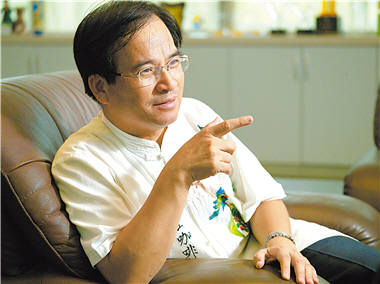
Mayor Hsu and Magistrate Su, both of whom contributed to the establishment of the Park, have strong feelings towards it.
While serving as a lawmaker, Hsu played an important role in designating the Sihcao Wildlife Refuge in Nov. 1994, the beginning of the Park's establishment. In 2001, to realize his mayoral campaign promises, Hsu suggested bringing more undeveloped wetland into a larger reserved area, as well as redeveloping the Nanliao Salt Village into the Yen-Tien Ecology Culture Village. The proposal for building the National Park was then based on the importance of Sihcao Wildlife Refuge.
All of the work was not easy for Hsu; he lost votes during the Tainan mayoral campaign and hardly won his re-election. When talking about why he insisted on doing so, he said that to look after both the tourism industry and the ecosystem was the best way for the sustainable development of the land.
The Sihcao Wildlife Refuge and the Yen-Tien Ecology Culture Village are the core of the Park. The surrounding flora and fauna are protected by the Park; the historical remains of the Inland Sea diversify the Park. Hsu also pointed out that an integrated management system can prevent damage to the Park from human development.
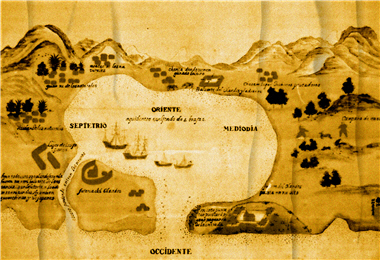
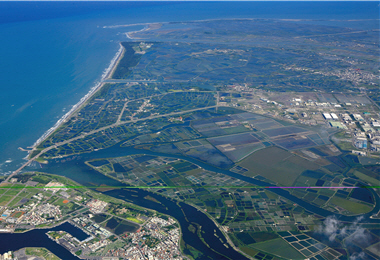
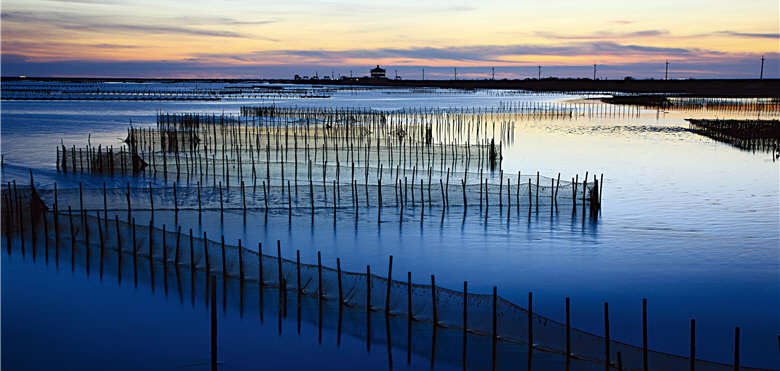
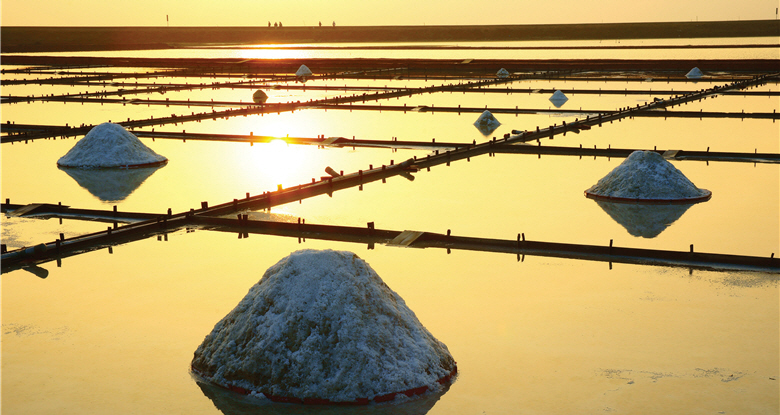
- upper: Aquaculture industry supports the economic development of the southwest coast and creates the habitat for migatory birds, both of which highly valued by Taijiang National Park. Here people can enjoy the views of fish ponds, migatory birds, and beautiful sunset. / by Levison
- lower left: The ancient map hand-drawn by the Dutch collected in a museum in Taiwan shows the landscape of Taijiang Inland Sea./ by Wan-ching Lai.
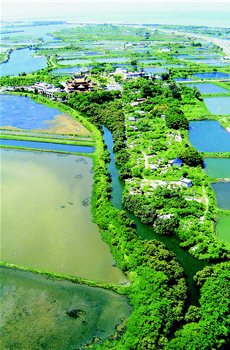
- lower right: To overlook the Taijiang National Park from the air./by Po-Lin Chi
Text/ Wan-ching Lai
Photographer/ Liang-wei Huang
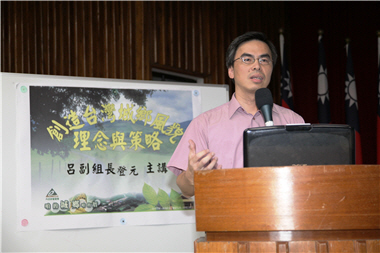
Special thanks to/ Director Deng-Yuan Lu Tainan mayor Tain-Tsai Hsu
Tainan Magistrate Huan-Chih Su
Ming-Qin Lin and Yin-Xiu Wu from the Yen-Tien Ecology Culture Village
Translator/ Teresa Huang
Taking Drastic Actions to Include Cigu
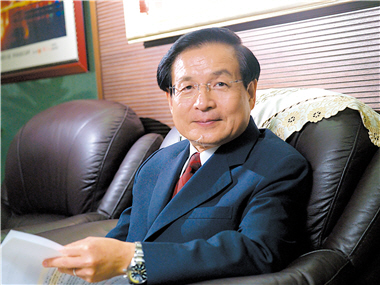
In 2008, when the CPAMI was reviewing the Park's establishment, Su agreed to include Dachaogou and the Hailiao mangroves within the territory of the Park.
Su also said that the sandbanks and lagoons in Cigu have always been the habitats for Black-Faced Spoonbill herons. It is also an important place to the Siraya Pingpu tribe. To include these areas in the Park would create valuable cultural assets that everyone can share.
Bitterly opposed to the Binnan Industrial Park building scheme, making efforts to preserve the Cigu lagoon and bringing attention to Black-Faced Spoonbill conservation, Su has set a good example of protecting the environment. In addition, the Chingshan sandbank、 Wangzailiao sandbank、DingTou-e Sandbank and Dachaogou have all been successfully drawn into the range of the Park.
It is not easy to strike a balance between economic development and ecological conservation, said Su. The local population and the environmental activists are in a conflict of interests. In fact, it is hard not to take account of humans when it comes to the environment. In order to develop in a sustainable manner, humans should learn to coexist with Nature and take their share in preserving Nature.
Beauty of the Land and New Ways of Thinking
The scenery of Taijiang National Park is very different from that of the other national parks. Apart from the way it was established, it has an innovative management system. Deng-yuan Lu, director of the Park's preparatory office, has already mapped out a plan to make the Park a model for national parks.
Lu said that if we see 30 years as one generation, it will be a new generation for Taiwan's national parks and we can learn the experiences from national parks' “previous generation.” Initiated by a local government and taken over by the central government, the starting point of Taijiang National Park is unique. The slogan “Being the Starting Point of the Second Generation of National Parks” signifies that people will not only learn from the past, but also be innovative in managing the Park for the future.
Lu also mentioned that everyone in Tainan has a vision and great expectation for this park. People are looking forward to seeing their hometown improve and that is why the Park should be managed thoughtfully.
- upper left: Tain-tsai Hsu, the mayor of Tainan City had started planning for the establishment of Taijiang National Park in 1999 and finally succeeded./ by Wan-ching Lai.
- upper right: Tainan County Magistrate Huan-chih Su included the Black-Faced Spoonbill Conservation Area in Cigu among Taijiang National Park and has a global vision for wetland conservations./ by Liang-wei Huang.
- lower: The salt industry along coastal Tainan has declined, but it still bears significnat cultural value. In the future, Tai-chiang National Park will represent the salt manufacturing technique employed by the ancestors. The picture is a scene of the Chigu salt field./ by Sunshine
He pointed out that people want to know how it is going to affect local economic development. While constructions inside the Park are not allowed, tourism can surely bloom on the privately-owned land right outside the Park.
For example, Annan and Cigu are areas of low development, but they both are important ecological conservation areas; if they are overdeveloped, they will soon lose their value. To retain the Park's original look, to promote in-depth tours and to create “green economy” will be ways to bring the most benefits to the local communities.
In the past decade, cultural landscape has been an indispensable part of the Convention Concerning the Protection of the World Cultural and Natural Heritage. It could be set as a long term goal for Taijiang National Park to be listed in the Convention for its precious cultural assets.
The value of the Park lies in contributing to and shaping the beauty of national land. Take Kenting National Park as an example, it did not suffer serious damage in the aftermath of Typhoon Morakot because of its lowdevelopment and well-constructed system of water and soil conservation. This is when the beauty of the land can be appreciated.
Guarding the Homeland Tracing Its Origin
It is important for local communities to be involved in order to preserve cultural assets. The idea of “Guarding the Homeland” is to divide the Park into 10 “areas” throughout Taijiang National Park to implement “Cross Areas Management,” which means that the area to be guarded is not limited to the Park per se. It is every resident's responsibility to look after and manage the basic unit of the town so that the ecosystem and the history of Taijiang can be fully persevered and sustained.
- left: Once a sea of dancing waves in the 17th century, Taijiang witnessed the land formation there as time changed almost everything. / by Cha-lin Zhao
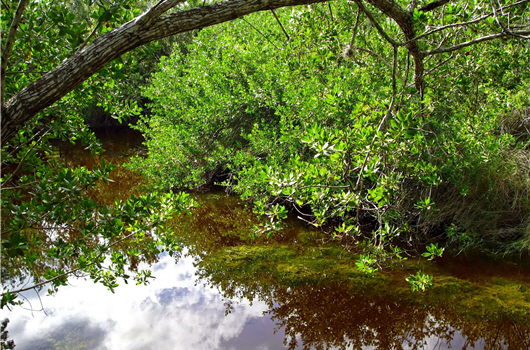
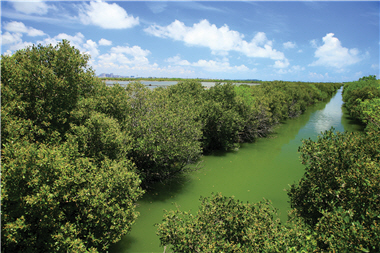
- right: This is neither the Amazon River nor Venice, but Taijiang National Park./ by Wan-Ching Lai.
Moreover, professional knowledge in different areas is required to manage a national park. Talented and skilled people should be recruited from other fields of expertise to form an ideal management.
The essence of “Guarding the Homeland” is to treat the Park as a community, and then the park can be the medium to connect the ten areas in the future.
Born and raised in southern Taiwan, Director Lu is deeply attached to the Taijiang National Park. “Building a national park is not erecting a barrier between humans and the ecosystem,” Lu said. “The ecosystem will last as will the human history. Taijiang is the origin of Taiwan's culture, and little by little, Taijiang National Park tells the story of Taiwan.”
Surging Heishuigou with Abundant Resources Lu said that the most troublesome part of building the Park is the Property Rights of the Fishery, which concerns the local residents the most.
“Since the local government has to examine the rights of the fishery, we are discussing with the local government and trying to strike a win-win situation for both the government and the residents.”
“The fishery and salt industry are both parts of Taijiang's culture, and these industries brought economic prosperity to the locals in the past. Therefore, the traditional fishery will remain, as it has long been closely linked to the ecological balance of the area,” Lu added.
The range of Taijiang National Park covers the “Heishuigou”(black ditch)—the Taiwan Strait. “One of the sea areas is the 20-meter isobaths along the Park. And the other is the Heishuigou, which is 5 km in width and 54 km in length from Luermen to the Tongi Island, Penghu.
These two sea areas are not like the sea area of Kenting, which has precious coral reefs, but they have been brought into the range of the Park in order to better interpret the history of Taijiang.
- left: Director Lu introduced a brand-new management idea for Taijiang National Park. / Photo provided by Deng-yuan Lu.
- right: Taijiang National Park is the first of its kind featuring wetlands in Taiwan. The water plants spreading over the area protect the land from tidal erosions and form many beautiful waterways./ by Zhi-xue Wu
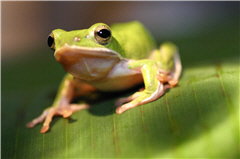
Appendix II – Biological Resources in Taijiang National Park
Marine Biological Resources Table
TYPE # OF SPECIES DESCRIPTIONTerrestrial Animals
TYPE # OF SPECIES DESCRIPTIONThere are 21 protected species of birds including Black-faced Spoonbills, and their main habitats cover Zeng-wen estuary, Qigu estuary, Qigu salt field, Jiang-jun estuary, Beimen salt field, Ji-shui estuary, and Ba-zhang estuary.
The number of species of common migratory birds, which inhabit here in winter, is more than 140, including snipes/charadriidaes, eagles/vultures, Laridae, Ardeidae, and ibises.
/Reptiles
Invertebrates
Terrestrial Plants
LOCATIONS DESCRIPTIONand Salt fields
Windbreaks
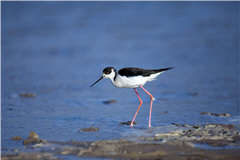
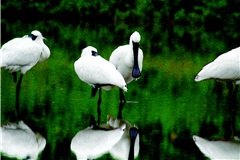
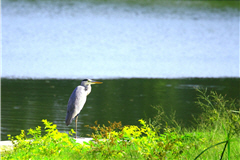
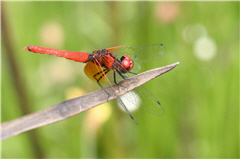
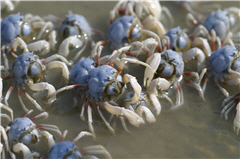
- Covering from the Zengwun River estuary to the Yanshuei River estuary, Taijiang ational Park encompasses abundant wetland animals, making it a perfect place for research and observation. From left to right: Red Dragonfly, Soldier Crabs, Black-winged Stilts (the above photos taken by De-hong Chen), Black-winged, Gray Herons, and Black-faced Spoonbills (the above photos provided by the CPAMI).
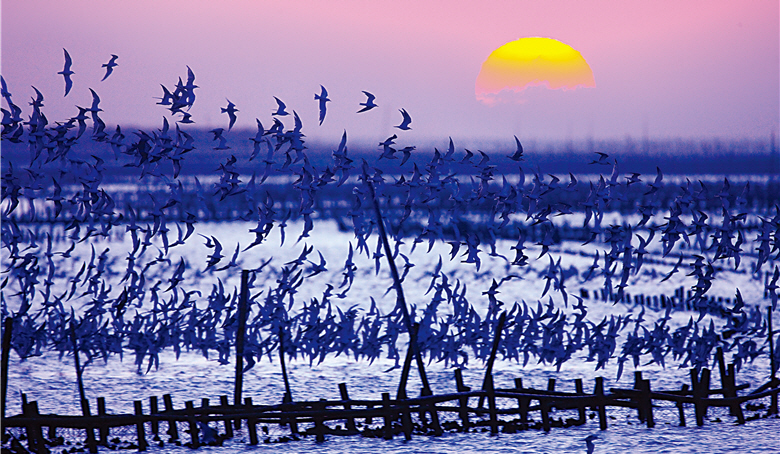
This national park has also set some conservation bases along the coast to protect the wildlife. Taijiang National Park may not have the grandeur of Yushan National Park or Shei-pa National Park, but there are plenty of native animals and plants on its shore. For example, the variety of organisms in the mangroves symbolizes the origin of the culture.
After Typhoon Morakot, people finally realized the importance of environmental protection. With the help of the local government and ten years of preparation, the establishment of the Taijiang National Park has a profound meaning. It also signifies that Taiwan has made another stride forward in wildlife conservation and land protection.
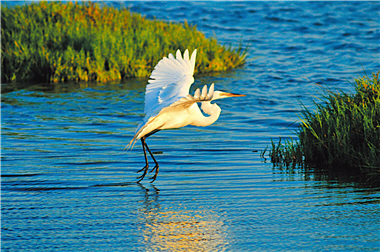
- upper: The lagoons in Tainan and the endless circle of life there are now protected by Taijiang National Park. They are the most valuable assests shared by all Taiwanese./ by Jin-yuan Dai
- lower right: Taijiang National Park is the paradise for birds. The picture shows an Egret gracefully spreading its wings by the water./ by Kevin
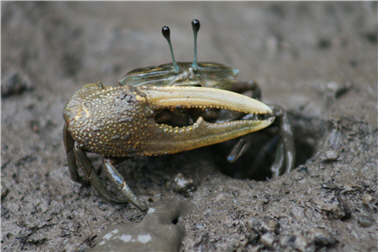
- lower left: The lovely fiddler crabs can be spotted everywhere in Tai-chiang National Park./ By Wan-ching Lai.


