
Old Wisdom New Human-Nature Relationship-Chie-peng Chen on Culture and Ecological Engineering
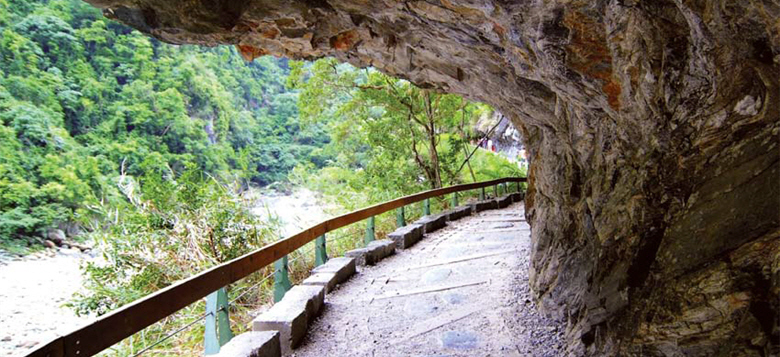
Ecological engineering has well become one of the hottest topics in the 21st century.
Multi-level seminars, grand exhibitions, and site visits regarding ecological engineering have been constantly held internationally. This hot trend suggests widespread attention and urgency on the sustainability of natural environment. Yet, it is still a path that requires exploration, experiment, and experience.
By looking somewhere closer, one may revive the original purpose of ecological engineering from the more closely related local cases. In searching a harmonious coexistence between man and Nature, one must remember to ask the big question: what is the place for “humans” in all this?
Century-old Techniques by Hands
Ancestors in Taiwan had developed the wisdom of ecological engineering since 300 years ago, when they used only hands to collect, select, process and pile natural materials such as pebbles and logs, accomplishing the most primitive and environment-friendly ecological engineering.
Till this day these old wisdoms are still embraced by modern societies, and even more highly valued in a time of overexploitation and conflicts as Nature has started warning humans.
“Speaking of ecology, most people think of the natural one, but often forget about ‘people,' the ecology of people,” said Asso. Prof. Chie-peng Chen of Dept. of Interior Design, CYCU, and chief consultant for Environment & Landscape at National Parks (formerly) and at Taoyuan County (currently). Having participated in cases of community development, Chen suggested that people find a closer relationship between natural and human ecologies, and initiate a most eco-friendly engineering from human-Nature harmony.
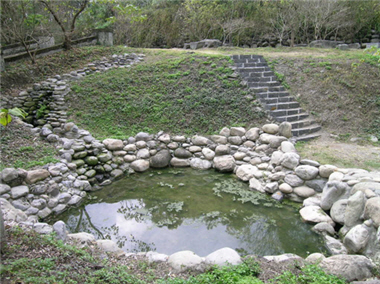
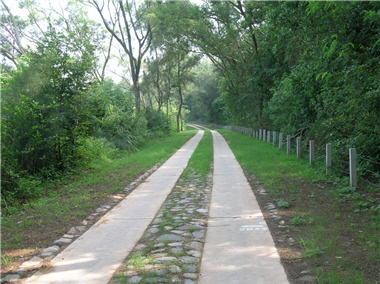
- upper left: Ecological engineering, which can be seen everywhere in Taiwan's national parks, manifests and demonstrates care to the land./ by Jia-yi Lu
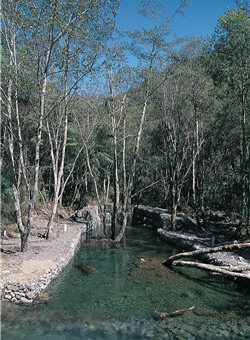
- lower left: The ecological pond at Meishan Visitor Center in Yushan National Park./ Photo provided by Chie-peng Chen
- lower right: Lieyu Biking Trail in Kinmen National Park. With a design that promotes closeness to the Nature, the Trail allows tourists to enjoy the beauty of Lieyu and at the same time protects the land and preserves the characteristic landform.
Interview & Text/ Ming-zhen Jiang
Special thanks to/ Prof. Chie-peng Chen, Chief Consultant for Environment & andscape, Taoyuan County
Photo provided by/ Chie-peng Chen
Translator/ Shiow-wen Tsai
Eco-engineering Pioneer: National Parks
“Using native and natural materials with the technique of stone-piling to create porous space is helpful for botanic restoration and its rapid integration into the landscape, and prevents large areas of concrete structures from breaking the balance of eco-system.” This principle of ecological engineering has been the major concern and emphasis of national parks since 2000.
In regulating Shihniu River in Kenting National Park, in order to protect its banks' sandy soil and the nearby farms and ranches, eco-engineering techniques such as multi-section gabions, bank-protective vegetation, stone-piling, etc. were applied while local native arbors and shrubs were introduced to lessen the torrent speed and prevent large amounts of sand and stones from being washed away. All the considerations and inspections of the entire project were much more complicated and required more caution than usual.
In setting up Yongchuan Pond in Shei-Pa National Park as the conservation watercourse for Formosan Landlocked Salmon, silt in the Pond was cleaned up and riverbanks at the convergence of the canal and Cijiawan Creek were strengthened. Ladder-like multi-section watercourse made by piled stones would allow the salmons to retreat for shelter.
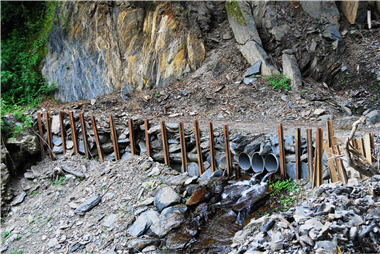
In renovating the famous attraction Shakadang Trail in Taroko National Park, the project did not cause damage to the original landscape and eco-environment, and took the road allowance of intensity into account, requiring all the materials and staff must be transported by men or small light trucks. Gutters and ditches were carefully designed and built to protect the mountain walls and direct the rain water into the valleys. All these are part of ecological engineering.
Up-close Manifestation of Eco-engineering
Such ecological engineering, in fact, can be found right around the corner and in nearby lanes and alleys.
- left: The practice of ecotechnology in National Park, regenerated human ecological nteraction through the maintenance and management of communities./ by De-hong Chen
- right: Yongchuan Pond in Shei-Pa National Park serves as the conservation shelter for Formosan Landlocked Salmon. / Photo provided by SPNP; taken by Cheng-hao Yu
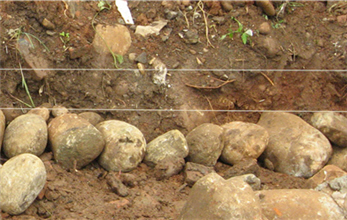
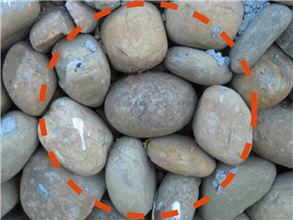
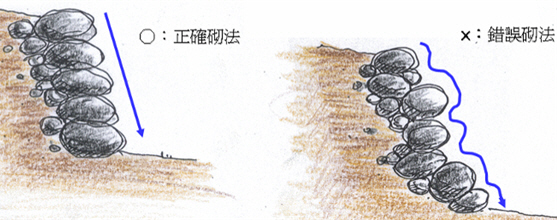
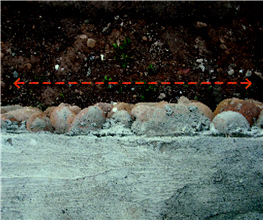
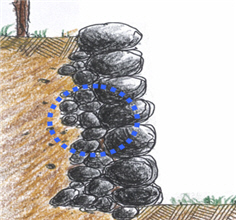
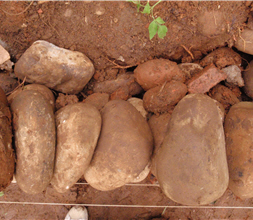
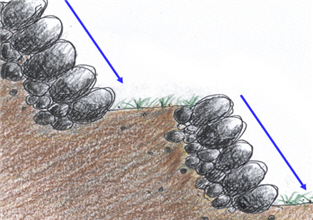
A Look at Ecological Engineering from Ancestors' Wisdom The Cobbll. laging Technique
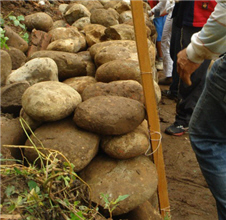
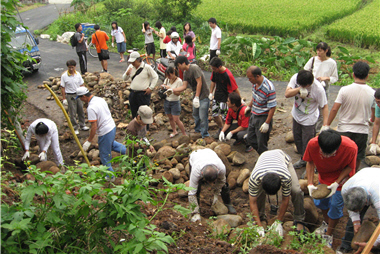
The Hakka ancestors employed a fixed set of methods for the collection, processing, selection and piling of pebbles. Theses methods represent the wisdom of the local community and were formed through numerous trials and errors and improvements.


Profile of Prof. Chie-peng Chen
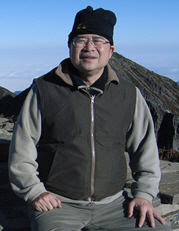
Asso. Prof., Department of Interior Design, Chung-Yuan Christian University; Member of National Park Committee, Ministry of the Interior; Member of the Cultural Heritage Committee, Taoyuan County. Under Chen's leadership, the space reconstruction project in Xinwu Township, Taoyuan County, was recently awarded the first prize in Creating Urban and Rural Landscape Plan by Construction and Planning Agency, Ministry of the Interior (CPAMI).
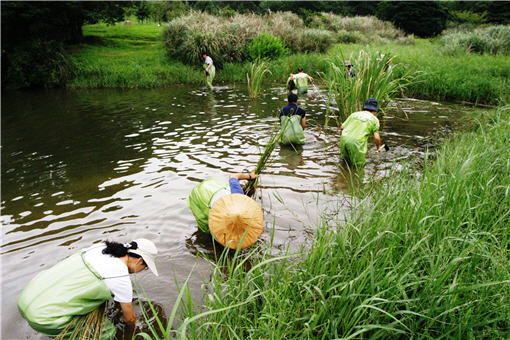
- upper left: Students are sweating while learning with master craftsman the Lei Stone technique, thus passing on the “body memories.”
- upper right: Dalu Forest Road in SPNP is being repaired as efficiently as possible by maintaining the original gravel surface that allows tourist to pass./by Wan-ching Lai


