
Empathy: Essence of Ecological Engineering-Monica Kuo on Ecological Oriented Green Infrastructure
In 2009, the 10th anniversary of the 921 Earthquake, Nature gave Taiwan another lesson as typhoons hit hard. Besides the notorious 8/8 Flood, even Yilan, renowned for its eco-friendliness, was flooded by the downpour brought by Typhoon Parma, and some of its residents were forced to evacuate.
This has had ecological engineering, once again, brought up, discussed, or even criticized.
Ecological Engineer ing Not Equal to Greening Construction
First, the term “ecological engineering” is misleading. Ecological engineering is often misunderstood as a construction method or technology. People tend to judge its effect partially from a failed part of it, and miss the focus on the multi-dimensional thinking in ecological engineering.
“For example, some people applied improper techniques and called them ecological engineering, but only to criticize it upon its failure. This is ridiculous!” said Professor Monica Kuo, Dean of the College of Environmental Design, CCU, pointing out public tendency in Taiwan to make judgments through half-truths and draw conclusions from trivia or simply by part of the result.
In fact, ecological thinking is essential in any engineering method and construction project, such as national land planning, city planning, transportation, etc. The techniques, as the final stage of the process, could only exert limited influence when the thinking – the initial stage – has failed or gone wrong.
A systematic and holistic thinking in taking ecology into consideration for each stage and every part is the first step to straighten out the problem.
Understand the Land with a Locally-oriented Mindset
National parks are a good counter example. Kuo, longtime Technical Specialist of National Parks Division, CPAMI, pointed out that in national land planning, national parks follow the ecological principle and categorize the land into a protected zone, buffer zone (including special sightseeing zone and general controlled zone), leisure zone, etc. So the damage will be minimal even if a typhoon passes through. Even landslides are not a “disaster” but a natural phenomenon.
Also, “what defines a disaster? Is it a disaster when a bear or a macaque is killed by falling rocks?” It is so only when humans' interest is in conflict with Nature and when humans suffer from losses. When we understand the land, plan proper use of it, and avoid conducting human activities in environmentally sensitive areas, then the probabilities of occurrences of disasters will surely be diminished.
When talking about dual concern of sightseeing and ecological conservation in national parks, Kuo pointed out that in many countries around the world, when the overall capacity is under control, people are no longer excluded and are allowed to enter a national park, being a part of ecology. Educating the public, of course, is an essential requirement that makes this concept applicable.
For instance, the acceptance of the beauty of the ecological plantation is an obvious aspect.
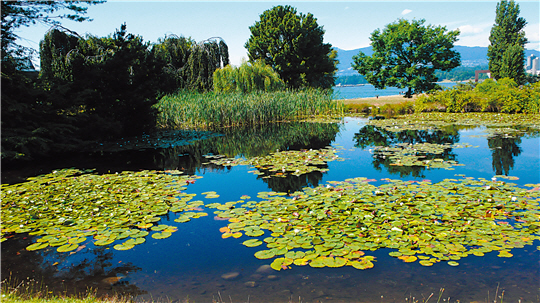
- left: Ecological thinking and living is everywhere in our life,each project and construction method should incorporate ecological thinking./photo provided by Monica Kuo
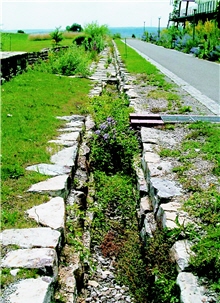
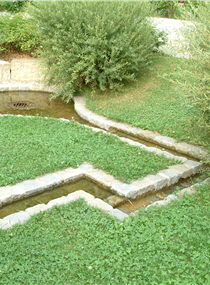
- right: Drily piled stones function as gutters in accordance with the intensity of rainfall, and may present as green belts during dry seasons.
Interview & Text/ Mingzhen Jiang
Special thanks to/ Professor Monica C. Kuo Qiongying,
Dean of the College of Environmental Design.
Photo provided/ Monica C. Kuo
Translator/ Herbert Chen
“It is a long process to construct an ecological scene, and is different from traditional methods of planting green plants, which shows immediate effect.” Ecology is diverse and complicated, not just pursuing superficial coverage of greens. This mindset of“ numbers build beauty” has resulted in improper choice of plants and large consumption of water and energy. Even when people plant perennial woody plants, they choose foreign species over native ones, which has low ecological benefits. Terminalia boivinii Tul is a good example.
Many people would lament that there is nothing to see in a piece of well-preserved wetland, where frogs and birds abound. People always think neat and ordered places with obvious gardening as places with something to see. It needs a long time to educate people to appreciate natural beauty – often times something disordered or messy.
Being There for an Up-close Look at Nature
“Taiwan needs a group of planners that really understand the operation of the ecosystem. They need to go oudiv>
In training planners, it doesn't make sense not making them be there. It is the same for the government officials.
“Every decision maker has a duty to understand the environment.” Kuo strongly disagrees with the officials' supervising trips, which are mostly superficial. She mentioned that “former Director-general Lung-sheng Chang and other officials in that era, instead, knew very well how to do it in person and on the scene.” For the construction of a new Cross- Island Highway, he would invite 5 ministers without portfolio to examine the site with him together. “They take a muddy trip, and they will know whether it can be built.”
In planning the establishment of Yushan National Park years ago, Director-general Yeh had visited all the major ridges and valleys in person. Without his feeling it at the front line, such wisdom of building national parks could not have possibly been cultivated.
Fix it upon Damage Use it with Proper Choice
Ecological engineering has no fixed method of construction, a myth and misunderstanding held by the public.
Professionals must know how to do the planning from a macro view and employ value engineering to achieve sustainability and environment-friendly, recyclable and longlasting ecological functions. Therefore, there is no such thing that we must use natural materials only, or cement is an evil material. This is only paradoxical, partial thinking.
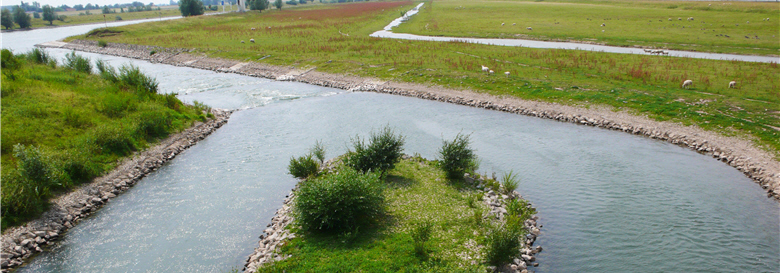
- upper: To manage a flood plain, sandbanks in the river should be maintained and high riverbanks should be minimally used through ecological engineering.
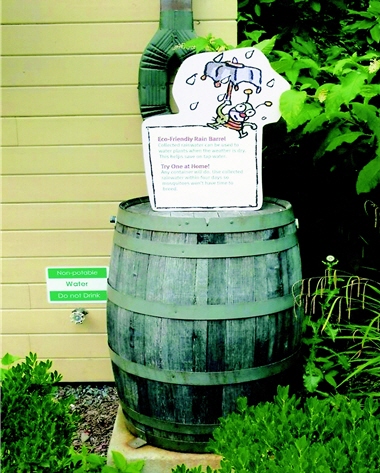
- lower left & lower right: Inside the eco-toilets are dry and wet compartments while outside the toilets rain collected from the rooftop is recycled for flushing. They serve the functions of environmental protection and education.
For example, when choosing materials for building a bridge, with common understanding of ecological engineering, wood is a more “natural” choice, but actually steel is a better choice because its strength allows pillars with larger span, minimizing the impact on the flow of the river. But it may be the opposite at another site. The government once needed to build a bridge with steel at a mountain area that just suffered landslides after a typhoon, but the road would be too narrow for transport the steel and the cost would be too expensive. So the aborigines suggested using local Makino bamboo as material, which would be easy and much cheaper to build and fix upon damage. In this case, bamboo is a more eco-friendly choice.
This case also reminds us that there is no such construction project that can be done once and for all.
In the olden days, people filled gabions with stones to stop the flood, and fixed them when they were damaged by floods. Or people would choose not to confront with floods, but shun them by moving away. This traditional type of ecological calculation by ancestors was far wiser than those of today's professionals.
Each Reconstruction is an Opportunity for Sustainable Ecology
As typhoons frequent Taiwan every year, reconstruction become a must in the aftermath of typhoons, and it's important that government officials be equipped with ecological thinking.
It is somewhat frustrating to see some executive chiefs give orders like: “restore the original look at the same place in a few hundred days.” Every reconstruction project means an opportunity for a safe and sustainable ecology. But this opportunity would simply be missed if we hurry to make promises without pursuing better, more beautiful and more eco-friendly improvement.
“Too often, in Taiwan, politics still comes first while ecology is not on the list.” Government officials can squeeze time for Hakka lessons but they have never thought of getting some on ecology.
Perhaps decision makers are not necessary to understand professional knowledge thoroughly. But they need sound knowledge in many things. And their think tank should have people with macro views, including scholars with profound studies of the ecology as core people. They should encourage newer, better, and more creative ecological engineering to build a better environment.
With systematic thinking and the emphasis made by chief administrators, reconstruction projects in Taiwan may have a chance to step forward or at least there'd not be just “construction” as the only answer.


Profile of Professor Monica C. Kuo
Dean of College of Environmental Design, and Chair of Institute and Department of Landscape Design, Chinese Cultural University Specialties:
Environmental planning, green land planning, ecological landscape, design of river landscape
A person with administrative experience in the government, with teaching experience in the academy, and professional experience in the business. Setting out from the perspective of ecology with concerns for humanity, she dedicates herself to rebuilding Taiwan's environment.
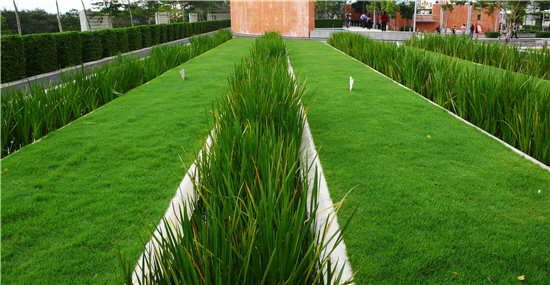
- upper left: In roof greening, besides green roof engineering techniques being applied, strips of wetlands many also be built for rainwater retention to construct rooftop biotopes.
- upper right: Directed by terrain gravity, the retained rainwater can be recycled and reused. The retention construction may be part of the courtyard landscape.


