
Withering and Flourshing Destruction and Regeneration of the Land-Dr. Pao-chang Kuo Looks at Natural Disaster from the Perspective of Nature
Rich in all sorts of domestic products, Taiwan has never been short of natural disasters, too. Due to its location and landform, Taiwan has constantly been challenged by quakes, typhoons and heavy rains. Mountainous terrains, torrential rivers and fragile geology have contributed to the occurrences of landslides, floods and mudslides. The severe damage caused by Typhoon Morakot proved once again this is something Taiwanese cannot turn away from.
Except the tragic loss in lives and properties inflicted by nature's blows, is there a deeper meaning hidden in all this? The answer is positive but requires humans to think as a member of all life forms and from a perspective of the Nature. In this article, Dr. Pao-chang Kuo, NTU Professor Emeritus of forestry, taking forests as an example, helped readers rethink the nature of typhoons and other disasters as well as human behaviors towards the Nature from a macro view.
Eternal Laws of Nature
Why forests? Because it is the largest and the most complex ecosystem on land, and shows the clearest picture of laws of Nature – natural selection, energy transfer, and nutrient cycling. In order to survive, life must adapt to environmental changes and evolve into a stronger species for its reproduction through natural selection. Aging and death are inevitable to all life forms. Only by elimination and degeneration of older generations will newer ones be able to grow on this habitat of the Earth, whose resources are limited.
Just like water that manifests in various forms, such as rain, fog, snow, surface water, groundwater, etc., and shows an ever-going cycling, life functions in the same way, too. This is the marvelous mechanism of Nature. Life passes on its seeds on the basis of replacing the old with the new. Behind the temporary disappearance of individual lives is the everlasting existence of the entire species. New energy keeps flowing into the Earth to make its resources sustainable.
Spurs for Metabolism of Nature
Offering a more detailed illustration on the effects of typhoons, Kuo estimated that every old and dying tree felled by a typhoon would clear out an area of 30 to 50 square meters that allows seedlings and young trees to grow. Also, the sunlight will be able to fall upon the ground to facilitate the forming of grassland, which attracts herbivores and in turn carnivores. Due to the mechanism of the food chain, a new ecosystem will be generated.
Strong wind of typhoons not just takes seeds to places afar to broaden life possibilities of plants, but also brings new plants and animals. Fallen trees, despite the termination of their own lives, provide essential space for other life forms to feed and live. Trees that fall beside a creek would create ponds and puddles as great habitats for fish and insects. Fallen trees and leaves would also become organic matter in the soil, providing nutrients for younger trees, whose potent photosynthesis is crucial to carbon reduction for the Earth's ecology.
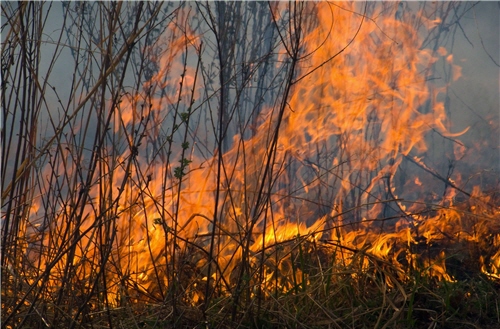
In addition to typhoons, forests also face the challenge of fire, another stimulus that boosts the regeneration of forests. As the fire burns up a thick layer of ground surface, it's easier for plants' seeds to get to and settle in the soil, and these new lives are ready to form a new generation of the forest. This is true to any species of tree itself, too.
The test of disasters brings forests a better and healthier growth and development and a stronger ability to resist diseases, pests and climate change. Natural disasters create opportunities of reconstruction and regeneration while changing the environment. Without these disturbance and stimulation, today's ecosystem wouldn't demonstrate such biodiversity.
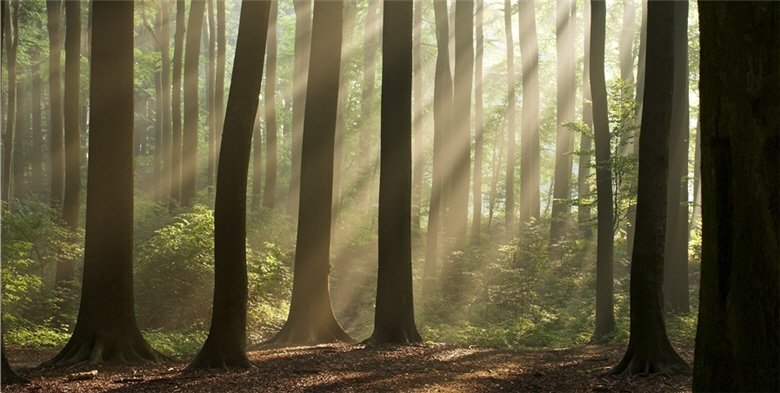
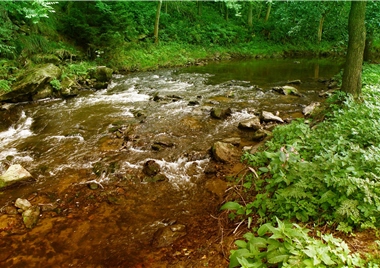
- upper: Withering and flourishing represents the Earth's circle of life.photo was taken by SPNP pass through the footpath of Tao Shan waterfall./ Zhi-ping Chen
- lower left: Ashes derived from wild fires provide the best source of nutrients for the forests./ by Valeriy
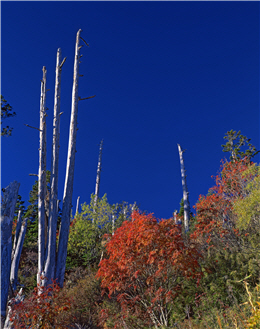
- lower right: Forests full of green is the gift from typhoons, fires and mudslides. / by Rongchin Yu
Interview & Text/ Jia-jun Lan
Translator/ Kuan-yu Ou
How Forests Help Fight Against Disasters
Although natural disasters have positive effects on ecosystem, all creatures are instinctively inclined to shun them. Forests provide the best shelter to most creatures including humans, and play a pivotal role in fighting against wind, fire, tides, floods, in conserving water and soil, and in moderating climate. For example, the intertwining roots of trees would extend deep into the rock stratum, hold firm the ground and protect the soil, which prevents many possible mudslides. Besides, the porous topsoil may facilitate the permeation, purification and storage of water. “Under forests, from topsoil to rock stratum, hides a natural reservoir that eases the washing torrents of surface water and prolong the use of groundwater,” said Kuo.
Today, energy saving and carbon reduction are the hottest issues in environmental protection. As photosynthesis of green plants consumes carbon dioxide, forests make considerable contributions to countering greenhouse effect. Despite its importance in ecology, forests, such as rainforests, have been diminishing because of humans' selfish needs. At the end all life forms must suffer from the tragic results of excessive logging and land exploitation. “Global desertification, global warming and climate change all have to do with the gradual disappearance of forests,” said Kuo.
Conservation and Education Much Needed
Indeed, natural disasters are part of the laws of Nature. But when their frequency and severity far exceed the long-term averages, the damage will be too much for all creatures and land. Exploitation, destruction, overuse of natural resources and energy by humans are proved to have indirectly resulted in climate abnormalities and frequent disasters.
The areas of exploited forests are increasing in staggering numbers. In fact, as humans are the cause of weaker functions of forests, they also become the victim of more and severer natural disasters.
Today, forests take up only 30% of the land on Earth. Kuo believed people must protect and conserve this special natural resource to ensure a stable ecology and a safe environment. In Taiwan, forests cover 50% of the land. All Taiwanese and the government should feel fortunate but at the same time ask: have all these forests been well cherished? Or will there still be more and more roads, bridges and tourist attractions to come at the expense of the forests? Kuo recommended Japan, which highly values forests, as a model for Taiwan to learn how to conserve and protect forests.
Kuo solemnly reminded readers that Nature is so powerful that humans must discard the idea that man can conquer it no matter what. Any form of land use must consider all the environmental constraints lest Nature would deal heavier blows. Unpredictable disasters, especially those caused by El Nino, not only make human lives become insignificant, but also force humans to realize the importance of environmental protection. It requires mankind to coexist with Nature in a humble manner to ensure long-lasting survival.


Profile of Dr. Pao-chang Kuo
Born in 1925, Kuo obtained a M.S degree in forestry at Univ. of Michigan (U.S.A) and a Ph.D. in agriculture at Kyushu University (Japan), and had worked for Taiwan's Forestry Bureau for a year. He had worked as T.A, Lecturer, Asst. Prof., and Prof at National Taiwan Univ. since 1948 for over 48 years, and is currently an emeritus professor of School of Forestry and Resource Conservation at NTU.
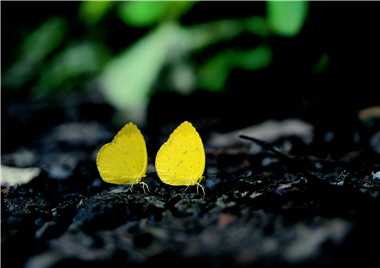
- upper left: Forests full of green is the gift from typhoons, fires and mudslides. The picture above is Eurema blanda ar sakia (Fruhstorfer)./ by Zhi-ping Chen
- upper right: Minimizing human interference and maintaining good water and soil conservation are keys to the sustainable development of our national land. / by Zhi-ping Chen


