
Face the Truth and Make a Difference-Lung-sheng Chang on Taiwan's Environmental Conservation from Cases Abroad
Thomas Friedman pointed out in his book Hot, Flat and Crowded that the green revolution happening right now around the world will decide, in the next 50 years, for a nation its economic status, environment health, energy protection and national security, as well as the viability of individuals and businesses. What has been Taiwan's preparation for it?
According to the World Bank, Taiwan has the highest rate of alternate occurrences of floods, droughts, and earthquakes. "Taiwan is located in an active tectonic zone and where typhoons are sure to pass through. These are the island's natural conditions; yet they are also the reason why Taiwan is so beautiful," Prof. Lung-sheng Chang said slowly.
"Earthquakes and typhoons have been regarded as disasters because they cost people's lives and property damages. In a natural environment with no residents, typhoons bring rain, mudslides unearth fertile soil, and earthquakes and landslides result in beaches and plains. They are the requirements of Nature's regeneration, but become disasters when happening in areas where humans live."
As former director-general of CPAMI and current chairman of Chien-Chen Sustainable Development Foundation, Chang stated that climate anomalies are not a condemnation from the nature. The Little Ice Age (LIA) in the mid 15th century caused glaciers and lagoons in Canada, North America, and Europe. Records show that the LIA's severe weathers in those regions cost significant decrease of harvests and fish catch volumes, and Europe and the North Atlantic coast were frequently hit by storms and floods.
"The earth's temperature change is a natural cycle, but the world's population was small then, and people could move to habitable places. Now with dense population worldwide, migration has become truly difficult. Some experts even predicted that the climate issue might even lead to wars." Such a scientific viewpoint is depressing as if it is useless for people to make efforts to change the fate. Yet, Chang also said that, compared to medieval period, modern advancement in information and technologies can reduce the impact of disasters. "People need to learn how to avoid dangers not just to ensure the safety of lives and property but also to understand the relationship among buildings, crops and the land. People then can use science and technology to slow down global warming and learn to think from the perspective of Nature, rather than enforcing changes from human's view.
Nat ional Parks : Sanctuar ies for Life Sustainability
Due to climate-induced disasters in recent years, international communities finally dumped their selfish egocentric, arrogant attitude toward nature and became humble to coexist with Nature.
During the 1960s and 1970s in Taiwan, the government planned the Ten Major Construction Projects to upgrade the industry and the development of the country. It was hard to promote environmental sustainability and conservation when all the massive building projects were in progress. With the enormous efforts of environmental protection groups, the first national park in Taiwan, Kenting NP, was established in 1984. Since then, the island has had 7 NPs, and the 8th one, Taijiang NP, will be set up recently. Terrestrial area of all NPs is about 8.65% of Taiwan's land.
"26 years ago no one talked about climate change or cared about mudslides or environmental conservation. Eco-activist groups were seen as roadblocks to economic development, and the establishment of NPs was hard. Now the Earth's conditions have severely changed and people suffer greatly from climate-induced disasters. Therefore, Taiwan's national parks, with their preserved mountains and natural environment, have become the most precious green resources and the final hope for the sustainability of national land.
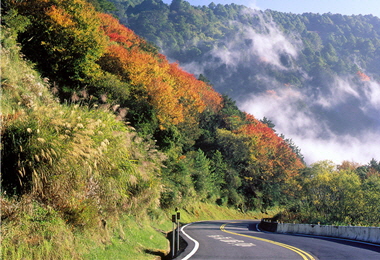
To include precious natural resources into NPs with comprehensive protection, Chang had disgruntled business groups, and negotiated with the forestry/agriculture agencies as he stopped them from putting a weather radar on the top of Mt. Cising, from building the New Central Cross-Island Highway which would have cut through the wildlife paradise, from mining inside the NPs, and from building a power plant at Liwu River. His relentless efforts won him the title "the father of Taiwan's National Parks," which Chang has been humble about.
"I'm truly flattered. My involvement in promoting Taiwan's national parks was just extending my love for mountains and forests since childhood in Dongshih to a greater scale.”
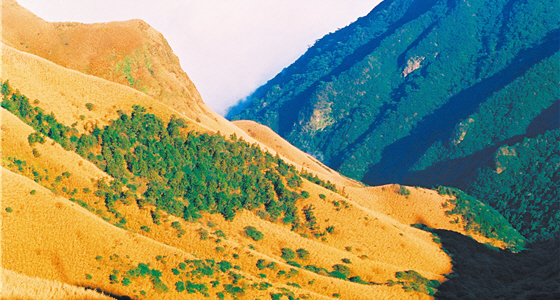
- left: What provides sustainability for life is neither industrial development nor high technology, but forestation and soil retention. / Photo provided by YMSNP, taken by Dong-qin Cai
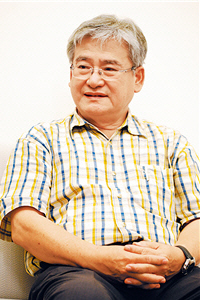
- right: Chang stated that facing climate change, people need to learn how to avoid dangers and understand the human-Nature relationship. / by Chi-hao Huang
Interview & Text/ Wan-ching Lai
Special thanks to/ Miss.Mei-li Liao of Chien-Chen Sustainable evelopment Foundation
Translator/ Shiow-wen Tsai
Better Life Better Economy?
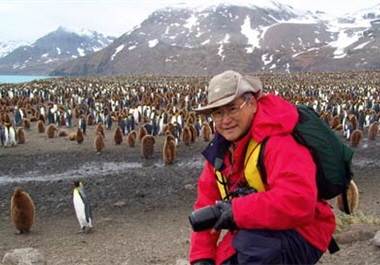
Chang had traveled around the world and visited the South Pole twice and the North Pole three times. With his camera, he brought precious scenery in the polar regions back to Taiwan.
He was earnest to ask: what exactly does the socalled "good life" means? Does it mean living in expensive mansions and driving luxury cars? Economic development is only temporary. That people can live in peace forever is the eternal goal for humans. Chang used Iceland and Bhutan as examples for his point.
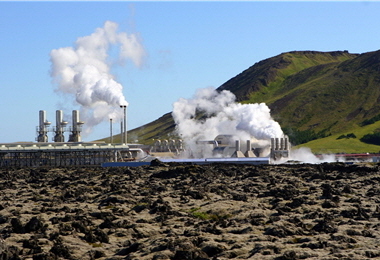
Iceland, once hailed as a paradise on earth, has glaciers, tundra, active volcanoes, geysers, and lava deserts throughout the island. Ice and fire coexist to form a natural classroom itself. This unique environment gives Icelanders fisheries, tourism industry, and abundant geothermal resources for clean and affordable energy. Its per capita income was US$60,000; people were highly educated with high-quality social welfare and living environment. The affluence and longevity of their life were truly enviable. However, Iceland was hit hard by the global economic crisis in 2008. The paradise was gone; three largest banks were taken over by the government. Their combined debts reached 9 times the nation's GDP of 14 billion Euros. On the verge of bankruptcy, Iceland turned to the low-cost geothermal as a lifesaver to attract the Americans to build numerous aluminum factories on the island, which ignited great controversy. Some scholars worried that the country will be wrecked by the aluminum industry besides the economic collapse. Residents also fear that the factories will destroy the natural environment and Iceland became a victim of aluminum industry.
Compared to Iceland, Bhutan faced a totally different type of challenge. As a tiny country, Bhutan had said no to the intrusion of civilization while imposing no smoking and no plastic bags regulations nation-wide with free heath care and education. Bhutan had not lavishly exploited its meager natural resources; the forest coverage rate reached 72%, the highest in Asia, and the area of its national parks was 26%. Bhutan also was the world's last country to introduce TV while it did not allow the setup of the Internet until 2000.
Interestingly, Bhutan proposed the idea of Gross National Happiness (GNH) to replace Gross National Product (GNP) as the indicator of people's well-being. Even thought its per capita income was US$1,400 only, Bhutan was known as the happiest poor country in the world.
Bhutan had insisted on maintaining pure national land and had not eagerly developed its trade and economy. Only until recently have entries of tourists been allowed. Even thought tourism accounts for the nation's second largest revenue, the government had required each tourist pay US$200 per day with only certain areas allowed for visits in order to strengthen national identity and cultural and natural heritage. The Bhutanese had been living such a simple life.
However, changes began to emerge in this peaceful Shangri-La under the impact of foreign cultures — more traffic, air pollution, and people's disputes on business profits, posting a big challenge about whether this land could maintain its happiness in the process of modernization.
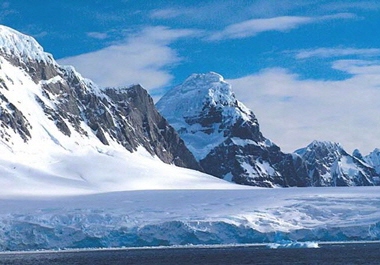
- left: Iceland boasts It can be assumed from the glacier remains that changes in the Earth's temperature has been a natural cycle, but the human population explosion and pollutions have aggravated such changes. The photo was taken in Newmyer Channel. / by Lung-sheng Chang
- right: Chang, former Director-general of CPAMI, paid numerous visits to the South Pole and the North Pole. He is particularly concerned about the impact of global warming. / Photo provided by Lung-sheng Chang
"With climate changing abruptly and human lives and properties threatened, people are looking for antidotes and their Shangri-La. The above international examples may cause us to ponder: once the mother nature is destroyed, nothing can make up for the loss. What is the ultimate goal for humans? I believe, the answer is by no means mansions, luxury cars or wealth," said Chang profoundly.
Wise Use of Existing Law
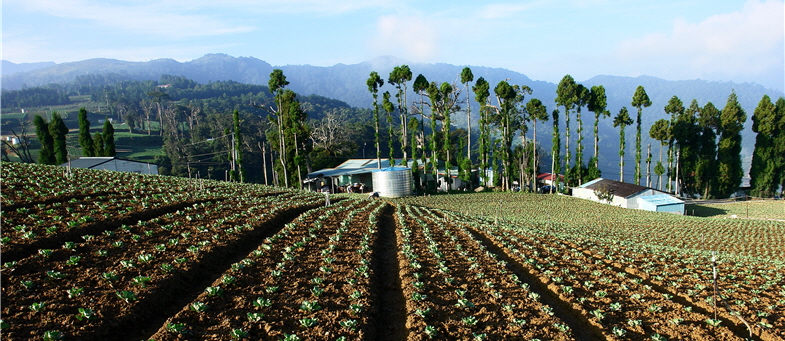
"The problem of land exploitation has been serious. Crops grown in mountains appear to be economically useful, but in the long run, turn the soil infertile. To transport those crops, roads and bridges are built in mountain areas; yet, they will be destroyed whenever heavy rains come, and be fixed again by spending taxpayers' money. Every year during the typhoon season, the same things happen again and again. People get used to this vicious circle but realize its severity only when it's too late.
In the aftermath of Typhoon Morakot, some people thought that the national land lacks thorough planning; others argued that a more strict law is needed to protect the national land.
"In fact, every inch of land in Taiwan is under planning, and plenty of laws regarding environmental protection have existed. The problem is whether the law can be enforced effectively. For instance, if Taiwan Power Co. by following the law does not give the permission for electricity to someone who wants to build fish ponds in conservation areas, then the over-pumping of groundwater will not occur. So I think we should focus on how to thoroughly enforce the existing laws," Chang said.
National land protection cannot be done overnight but requires a comprehensive checkup. "Densely built bridge piers would obstruct the flow of flooding rivers, which may cause bridges to break easily. Taiwan should build bridges with large spans of piers. More budget is needed for this type of construction, but the cost for future maintenance and reconstruction will be saved,” Chang suggested.
Schopenhauer once said people could only live in accordance with the experience inspired by Nature. While humans can hardly withstand the damages caused by global climate change, trees standing in the mountains for generations and easing the impact the land suffers from have given humans the answer for a sustainable environment: when the land is conserved, Nature's blows will be alleviated. Tragedies may be bitter, but it will awaken people to give serious thoughts on a better future for later generations.
- upper left: Iceland boasts picturesque sceneries and abundant geothermal resources, but it opened up its market for the American aluminum factories and triggered great controversy. / by Laurence
- upper right: The suspension of the construction of the New Central Cross-Island Highway helped preserve Yushan National Park, the wildlife paradise. The government has to carefully weigh the pros and cons of development and conservation. / by Jinyuan Dai
- lower: The agricultural output based on massive mountain exploitation such as growing mountain crops and tea will never compensate for losses due to debris flows and mudslides. / by Zhenyi Zheng


