
Compassion for Land Crabs-An Interview with Crab Expert Hung-chang Liu
In the eyes of most people, crabs may be nothing more than a dish, but to Hung-chang Liu, assistant professor in the Department of Ecology at Providence University, crabs are so important that they shouldn’t be treated as such.
Liu’s research into crabs dates back to 1988, when he was fascinated by an article in World Geography Magazine describing the spectacle at Christmas Island, Australia, where tens of millions of land crabs travel from land to sea to lay their eggs. Later in 1994, he accompanied foreign scholars to Kenting National Park (KTNP) to collect samples. There they found the presence of as many as 20 species of land crabs within just one hectare of land.
Pleasantly surprised by this land crab paradise with rich and diverse ecological resources, Liu soon threw himself into the research on land crabs and has remained consistent all along for nearly 20 years.
Zeal for a Cold Topic
Unlike well-known protected species whose data are more complete, basic research into land crabs is still sparse in Taiwan, and efforts had to be multiplied in the collection of their biological information.
Backed by his decade-long research, Liu noted that the rainy season marks the peak of breeding season for land crabs in Kenting, and different species visit the sea to lay eggs at different times.
Commissioned by Kenting National Park for a research project on land crabs, Liu’s research team had to, in addition to the monthly field trips, quarter for two weeks in Kenting following the full moon. They patrolled tidal flats repeatedly after the sunset and counted every single female land crab traveling from coastal forests to bear her eggs on the shore.
As the egg-laying time differs considerably among different species of land crabs, Liu had to adjust his schedule accordingly. He used to conduct research all alone, carrying arduously all sorts of heavy gear of up to 20 kg in the dead of the night and walking between the rugged and bumpy uplifted coral reefs and the dark coasts with great drop height, not to mention the many close calls he survived.
But his all-out effort eventually paid off. Over the years, he has identified 4 new species and 6 new record species of land crabs (see Note 1) within KTNP. Moreover, Liu and his team recorded 6 families and 30 species (see Note 2) of land crabs in KTNP in 2009, setting the world record for the most diverse species of land crabs found in the habitat of coastal forests.
Land Crabs’ Habitat: Paradise Once Lost
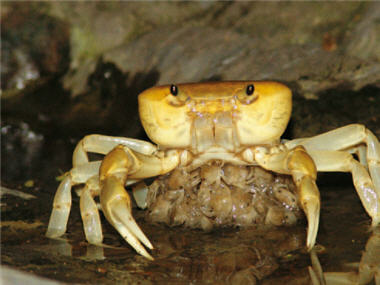
Of Taiwan’s forests, the coastal forests in KTNP’s Banana Bay are most akin to tropical forests. The ground of the forests is covered by uplifted coral reefs that offer plenty of hiding places, while inside the forests are springs offering abundant sources of fresh water. These conditions make the coastal forests a perfect dwelling place for land crabs, whose shells are devoid of wax and are thus susceptible to water loss. It’s thus no wonder as many as 6 of the world’s 20 species of Gecarcinidae land crabs and 3 of the world’s known 4 species of Genus Geograpsus can be found here, which makes Banana Bay the world’s most diverse known habitat of the creatures.
However, habitat destruction, fishing by humans and climate change have threatened the very survival of land crabs. Among these factors, fishing by humans has proven most devastating for large land crabs. In particular, the mass hunting for crabs in 1998 still makes Liu’s heart sore whenever he talks about it.
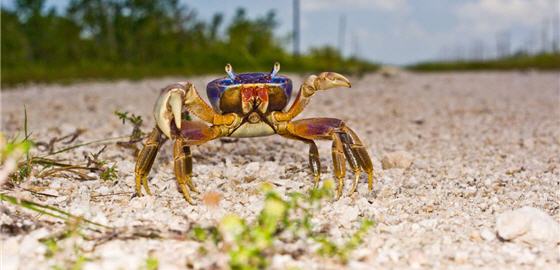
- upper left: Habitats of the land crabs often overlap those of humans, so land crabs have to compete with people and the traffic on the road all the time; they need the helping hands from conservationists. / by Jonathan
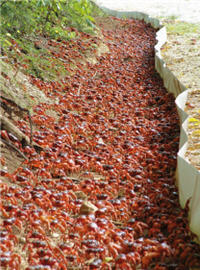
- upper right: Christmas Island in Australia is famous for its innumerable Gecarcoidea natalis, but there are only 21 crab species on the island. The diversity is much lower than that of Kenting. /Photo provided by Hung-chang Liu
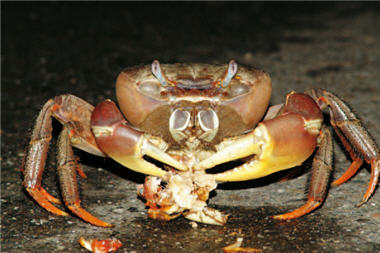
- lower left: Cardisoma carnifex is eating a Sesarmops intermedisus crushed by a car. The former is a large-sized crab on the land, and tends to be captured by humans easily. /Photo provided by Hung-chang Liu
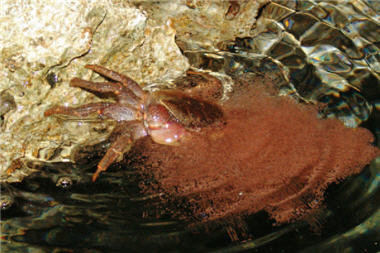
- lower right: Discoplax rotundum is releasing the larva into the sea. /Photo provided by Hung-chang Liu
Interview & Text/ Joyce Chang
Translator/ Yonglan Huang
In 1999, a gambling type of fishing on the giant grouper (Epinephelus lanceolatus) caught on in central Taiwan, thus increasing the need for the baits--- large land crabs. Back then some bait merchants offered NT$50 for each such crab; therefore, the lucrative deal led to the mass hunt and trade of tens of thousands of large land crabs in Hengchun Peninsula within just two weeks.
Compared to sea crabs, which take only a year or two to mature, leaf-eating land crabs grow a lot more slowly. Large land crabs, in particular, need 4 to 5 years to reach maturity and 15 to 20 years to reach their maximum size. The mass hunt in 1998 nearly wiped out the entire population of large land crabs. Fortunately, the local residents ceased the hunting and KTNP put a strict ban on crab hunting; therefore, the crab’s population and average size were gradually restored.
A Little Effort That Makes a Great Difference
Liu’s life has been closely intertwined with land crabs for over 22 years. He also once stood up for soldier crabs (Mictyris brevidactyius Stimpson, see Note 3) to protect their habitat from destruction of industrial development. Though he eventually failed, some like-minded people joined the force, and KTNP is just one of them.
In 2003, KTNP initiated an activity designed to escort land crabs across the roads. This event takes place before and after the full moon during the summer months. Besides controlling the traffic on the highway during these times, the police put up warning signs at Banana Bay to alert drivers to slow down and to yield to mother crabs.
After years of public education, the scene of people catching and selling crabs has been replaced by the sight of local ecological tourism providers guiding visitors along the highways to observe land crabs breeding. To Liu, it’s heartwarming to witness such a change.
Unlike the majority of Liu’s contemporaries who throw themselves into the popular biotechnology, Liu committed himself to the cause of land crab protection. He also noted that starting this year, more effort will be put in the conservation of land crabs on the coastal area in western Taiwan. By doing so, he hopes to see more land crabs roaming the area one day.
(Note 1) The 4 new species include the two tree-dwelling tree crabs and Scandarma lintou. Both move about on plants and eat shoots, leaves, fruits and bugs and usually don’t leave the trees so as to shun their enemies.
(Note 2) These include the Chiromantes obtusifrons, which were found for the first time in Taiwan, and Neosarmatium fourmanoiri, which appeared for the first time in KTNP.
(Note 3) Mictyris brevidactylus, or soldier crabs, live on tidal flats.
- What’s the difference between crabs and land crabs?
In a broader sense, crabs that live on tidal flats and on land are land crabs, while a narrow definition equates land crabs with those in the Gecarcinidae family. In Liu’s definition, land crabs are terrestrial crabs living above the high water mark and in coastal forests and land forests. - Why do land crabs act mostly at night?
Except for fiddler crabs, Macrophthalmus and sand bubbler crabs, most land crabs are nocturnal. As a result, observation of these creatures has to take place during the night. In particular, Gecarcoidea lalandii and Metasesarma aubryi lay their eggs in the dead of the night, so observation of them has to be carried out during midnight. Furthermore, observation of crabs living on tidal flats of rocky coasts has to be conducted in accordance with the tidal flows. - What is the impact of climate change on crabs?
It still remains unknown as to what impact climate change could bring to crabs, but Liu’s points are as follows:- Impact on the crab habitat: climate change aggravates all kinds of natural disasters. Liu’s research revealed that coastal forests of Banana Bay were dense and thick prior to 2000, but strong typhoons and sea fogs thereafter thinned out the forests, exposing the coastal forests to direct sunlight and causing the moisture content to drop, which has led to a gradual decrease in the bushes and then in the number of land crabs. In addition, the habitats of land crabs have also been damaged by floods and debris flows.
- Climate change has changed the geological distribution of land crabs: it seems that more land crabs such as fiddler crabs, Neosarmatium meinerti and Lithoselatium pulchrum now can be found in northern Taiwan. However, the lack of previous research and data means the claim can’t be fully supported, as no one can be sure as to whether these crabs have already been in existence in northern Taiwan or spread into the area due to climate change.
- Article 13 of the National Park Law describes:
"No living thing may be taken out of the national parks." Anyone caught capturing land crabs will be fined up to NT$15,000 and prosecuted for the theft of national property. (Complaints line: 08-8861331, Kenting National Park Police.)


Hung-chang Liu
Liu is the assistant professor of the Department of Ecology at
Providence University. He specializes in Crustacean Biology and Ecology.
Though the researches of land crabs are not in popular demand, he has
invested most of his lifetime in it and has published many reports about
new breeds of crabs and crab’s ecology for many years.
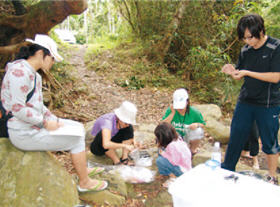
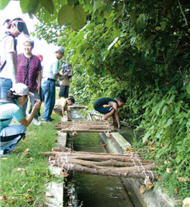
- upper left: The research on land crabs are not in popular demand, but Liu and his team still insist on fighting for the conservation of land crabs with enthusiasm. / Photo rovided by Hung-chang Liu
- upper center: The research on land crabs are not in popular demand, but Liu and his team still insist on fighting for the conservation of land crabs with enthusiasm. /Photo provided by KTNP
- upper right: KTNP has held activities every summer to promote the conservation of land crabs since 2003. The activities aim to let the public experience how precious these creatures and ecologies are. /Photo provided by KTNP
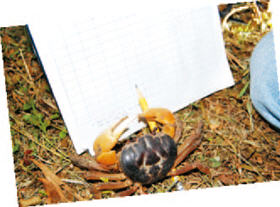
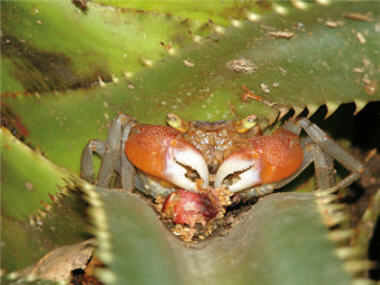
- lower left: Scandarma lintou is eating the fruits of Marabutans plants. It usually perches on the plants and only goes down to the land when necessary. / Photo provided by Hung-chang Liu
- lower right: Land crabs have various ways of reproduction. Take Taiwan's endemic species Geothelphusa albogilva Shy Ng and Yu for example. It directly hatches its baby crabs without laying any eggs at the seaside, so they can live more deeply inland. / Photo provided by Hung-chang Liu


