The Pearl on South China Sea-A Special Report on Dongsha Atoll National Park
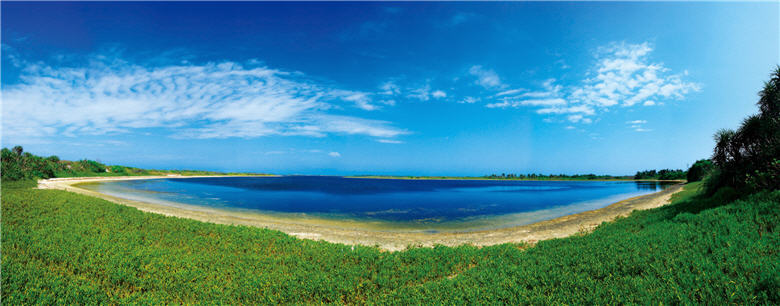
“I wonder who had opened the jewelry box of the universe, and dropped on South China Sea this bright pearl emitting its glory in every sunset and sunrise ever since.” – excerpted from Dongsha Reminiscences.
Dongsha Island is known to most people as one of the four islands on the South China Sea (Note: the other three are Paracel Islands, Macelesfield Bank, and Spratly Islands), as well as a military-controlled, mysterious tropical island. Rich in natural resources and coral reef landscapes, Dongsha Island is also touted as the “Bright Pearl on the South China Sea.” While the island is not open to visitors, it’s also mysteriously veiled in the blue ocean.
Faraway but Well-conserved
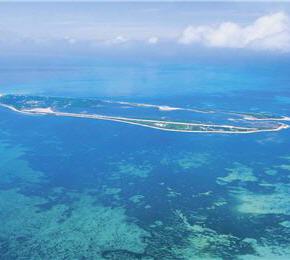
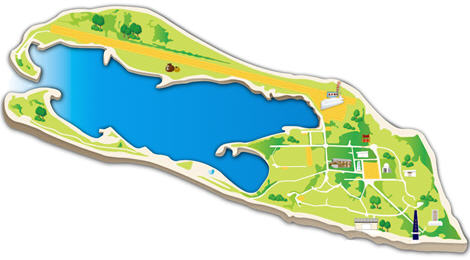
The major form of transportation to and from Dongsha Island is by air. Apart from the Air Force freighter that departs once a month from Ping Tung Air Base, there is only one flight per week between Kaohsiung Int’l Airport and Dongsha Airport. After over an hour’s flight, as the plane descended from the sky, the Quarterly staff overlooked the island shaped like a pincer of a crab, and the whitish island lies in the shiny blue ocean, resembling a jade on a ring.
As the plane landed on the simple runway of the island, the staff were greeted by the red-and-white flags at the Dongsha Airport blowing in the wind and sending a warm welcome.
Once faced with a shrinkage in resources due to wars and human exploitation, Dongsha Island has finally had a chance to prosper under Taiwan’s protective marine policies. Since the establishment of Dongsha Management Station in 2008, the island has been well conserved and restored by the staff and researchers to show its exquisite beauty as seen today.
The island’s only a few old buildings that mostly belong to Kaohsiung City Government and the R.O.C. military have been much utilized. What’s intriguing among them is an address plate written “No.31, Qijin Dist., Dongsha Island” that is hung the Dongsha Fishermen's Service Station built in 1987.
A Kaohsiung Jurisdiction Hundreds Mile Away
How is Dongsha Island, 450 km away from Taiwan, still part of Kaohsiung City?
In fact, the island has been designated as part of the jurisdiction of Kaohsiung City Government and assigned this address plate since 1990. But it certainly doesn’t mean that one can hop on a taxi at Kaohsiung Railway Station and ask the cabbie to take him to Dongsha Island!
- upper: Object and every scene on the primitive beautiful Dongsha Islands is definitely worth people's cherishing. / by Jin-yuan Dai
- lower left: Overlooked from the sky, Dongsha Island looks like a jade on a ring. / Photo provided by Marine National Park Headquarters, taken by Guo-wei Li
- lowe right: The map of Dongsha Atoll National Park. /Photo provided by Marine National Park
Interview & Text/ Hsin-hua Lian
Special thanks to/ Chief Shu-guo Xu of
Interpretation and Education Section of Marine National Park Headquarter、
Technical Specialist Le-jia Shang
Technical Specialist Shu-jing Huang Chief Guo-yong Chen of Conservation Research Section
Researcher Ya-ru Cai
Translator/ Yonglan Huang
Lily Tseng
Kuan-yu Ou
While the plate symbolized the start of Dongsha’s administration, conservation and research work has begun since the founding of Marine National Park (MNP) in 2007.
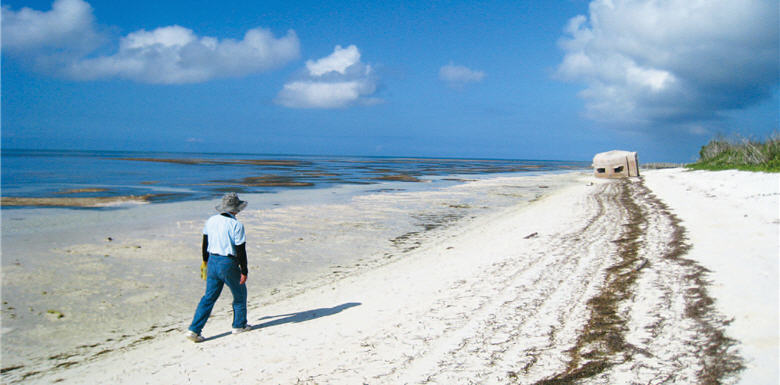
The coastline of Dongsha Island features sandy beaches stretching over 8,000 m, and every MNP staff here could easily elaborate on the characteristics of each creature or even a seashell. Such high level of familiarity and professional knowledge has suggested their full dedication to the job.
The changes of the island are dearly felt by all the long-time serving staff, each of whom is characterized by a dark tan, hearty smiles and a readily helping hand. Among them, Technical Specialist Ms. Hui-ru Chen, tall, slender, and always smiley, had been a great guide to the Quarterly staff by offering plenty of professional knowledge.
To Chen, who has stationed on the island since July, 2008, Dongsha Island is just like her second home. Everything here, whether it’s carrying heavy loads or helping with the logistics, must be shared by all men and women on the island. “I’ve never considered myself any different from our male staff!” she laughed.
With a long-time interest in marine creatures and a Master’s degree in aquaculture at National Taiwan Ocean University, Chen had been learning techniques related to coral restoration and conservation at National Museum of Marine Biology & Aquarium before working here for MNP.
Difficulties Overcome Tasks Come First
While tasks on the island are now well assigned and organized, everything had to be started from scratch at the initial stage when the MNP staff first arrived.
Besides Chen, the first-comers included Mr. Deng-fu Hong, an bird expert; Dr. Jui-hsien Wu, who specializes in ocean and water resources; contract research fellow Ms. Wei-chien Lai, a Yale graduate.
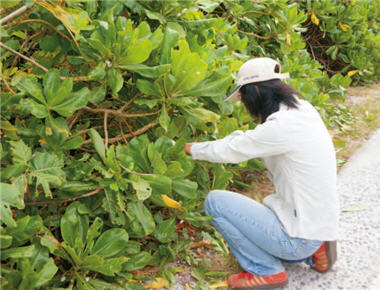
In the first year of the establishment of Dongsha Atoll National Park, the absence of research vessels had limited the staff’s tasks to researching the Ocean. So their first job was to rid the island of the alien species white leadtrees (Leucaena leucocephala).
- upper: Coastal patrol is one of the important duties of the researchers. / by Hui-ru Chen
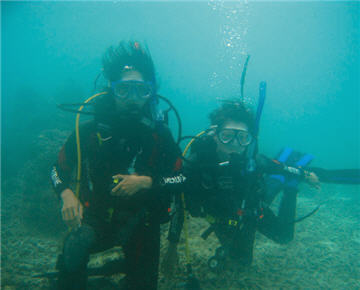
- lower left: Left: Wei-chien Lai, right: Hui-ru Chen. The demanding jobs on the island can't stump the MNP staff at all. This picture was taken during the process of a diving training. /Photo provided by Hui-ru Chen
- lower right: Conservation, cultivation and restoration are the important duties of the researchers on the island. /Photo provided by Wei-chien Lai
But the white leadtrees were too much and too tough to be cleaned up, not even with the help from Coast Guard Administration. Also, due to the lack of manpower, every staff member must do all the heavy work of sawing and chopping the plant.
But the job doesn’t end here. Subsequent work such as conserving and restoring native plants, uprooting the leadtree’s sprouts regularly, blocking the sunlight to keep the sprouts from growing, etc. are also important and demanding.
After MNP’s first research vessel Atoll No. 1 joined force six months later, the staff had been conducting thorough investigations about the coral reefs around the island for a year and given an initial form to Dongsha’s ecological observatory area.
Beautiful but Dangerous Underwater World
With the help of vessels, MNP’s research has extended to and under the sea. Researchers diving into the water could see amazing ecological abundance in shallow waters, not to mention the unimaginable surprises awaiting in the deeper waters
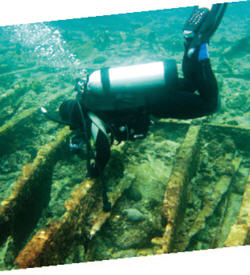
But the beauty also comes with danger. Wu had an unforgettable, near-death experience when researching the wreckage of a ship in the west coast. “The ship was located in the western tip of the atoll, where the seabed suddenly deepens and the currents hit. Waves there could rise up to three stories high in bad weather. No wonder why ships would be wrecked at the spot.”
Wu’s heart thumped as he recalled the incident. “Luck favored us the first two times. But when we passed by the shallow waters a third time, a large wave came right at us. The wave almost became parallel with the ship, and we nearly capsized. I was terrified.”
But, there are always two sides to everything. The combined danger of currents and landforms has effectively kept foreign fishermen off. And poof! You get a fish haven and least disturbed paradise in the Dongsha seas, with a marine ecology no less abundant than that of Great Barrier Reef in Australia.
Research and surveys on the island are conducted voluntarily by the MNP staff, who would propose research projects, patrol the coast and keep records of ecological resources before posting the latest data to the MNP’s website. While confirmation is carried out before each data release, experts’ revisions are still welcome in order to provide the public most accurate information.
A long distance away from Taiwan and a lack of resources and supplies have made the research and conservation on the island truly challenging. But how the MNP staff reuse the natural resources is just as impressive.
With limited modern facilities on the island, the water used for shower baths still retains some salinity even after desalination and filtering. Pure water such as water dripping from air conditioners and dehumidifiers would be well cherished and used for brushing teeth and washing face.
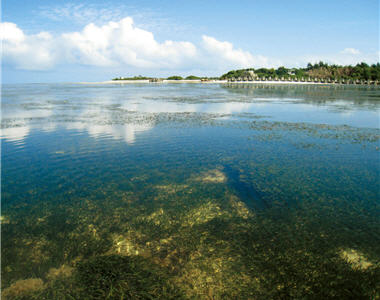
- upper left: The lagoon mouth of Dongsha Island. In sunny days, the water surface of the lagoon shines like a mirror. The beauty of Dongsha is achieved by many people's full efforts. / by Hui-ru Chen
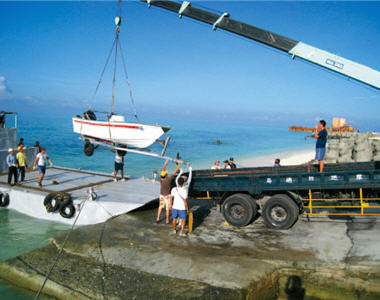
- upper right: Atoll No.1, shown craned up onto the island, bears great significance for it is an important means for the MNP researchers to go out to the sea. /by Hui-ru Chen
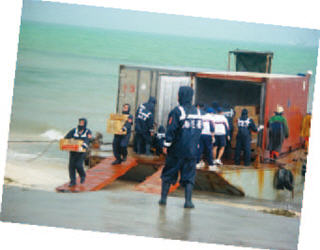
- lower left: Logistics from ships is crucial to Dongsha Island; everyone on the island would participate in carrying goods when the shipments arrive. /by Jui-hsienWu
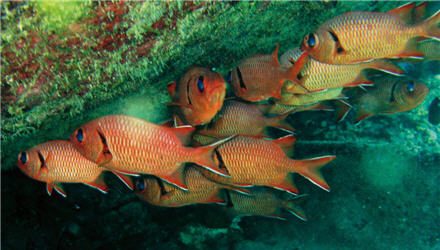
- lower right: The shipwreck under the sea is the place where the currents are turbulent, and the dangerous landscape has formed an undisturbed garden of marine ecology. /by Yi-chuan Chiu
So explained Technical Specialist Mr. Yi-chuan Chiu, whose experience in the execution of agriculture policies helped him quickly adapt to the environment and relate to the idea of ecological conservation. And you think saving dehumidifier’s water for watering flowers and washing cars is called thrifty? Wait until you spend a few days on Dongsha Island!
The major form of transportation on the island is the bicycle, while electric cars are also used for carrying supplies. The maintenance of all the machinery has been the responsibility of Technical Worker Mr. Ji-bang Gao, who must serve as the plumber, engineer, and mechanic all by himself because help from Taiwan would be too faraway for urgent needs. Gao would make numerous checks and make sure everything is fine before he goes back to Taiwan for a leave.
An Encounter with Feathered Friends
Research at Dongsha is by no means limited to the sea. Much can also be explored on land, especially the feathery flocks at dance.
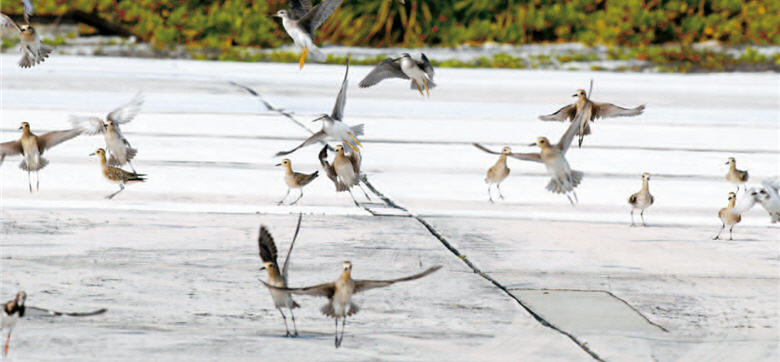
Dongsha Island is a key stopover site for migratory birds in east Asia. Its lagoons, seas, intertidal zones, sandbars, and shoals crown it a choice place for temporal rest and foraging before moving on. These birds cross many a seas to find this shimmering pearl in the vast ocean. Frequent visitors include the Cattle Egret (Bubulcus ibis), Little Egret (Egretta garzetta), Golden Plover (Pluvialis fulva), Ruddy Turnstone (Arenaria interpres), and the Barn Swallow (Hirundo rustica), though the Ruddy Turnstone predominates the island.
Thus an interesting sight to behold on Dongsha is the "busy" runway, not for planes, but nearly exclusively for birds. The rarity of plane flights has made this a normal scene, though the spectacle would certainly have induced fright elsewhere.
Technical Specialist Mr. Deng-fu Hong, one of the first Dongsha pioneers, knows the fauna and flora here like the back of his hand, having dedicated himself to recording Dongsha's life forms since his arrival. He'd take along a hefty long lens and creep into the tall grasses to capture images of birds or dive into the atolls for pictures of creatures among the reefs.
Though on vacation in Taiwan during the Quarterly staff’s visit, Hong expressed concerns about the fragile Gray-faced Buzzard Hawk (Butastur indicus) left behind by its companions. Hong's sincere attachment to Dongsha is clearly visible in richness of his photography, as though transfused onto the images themselves through his lenses.
Seagrass, a Secret Treasure
If the azure seas are Dongsha's "theme song," the fluttering feathers its "refrain," audible in close proximity with the island, then the seemingly humdrum seagrasses would be its most amazing "encore," one that pampers the ears.
Seagrasses are outright rampant on Dongsha. And undoubtedly one would question all the fuss made over such an ordinary "weed." Why all the research and preservation efforts invested?
- upper: Dongsha Airport's runways are often empty due to few flights, and it is entertaining to see flocks of water birds wander on the runways. / by Deng-fu Hong
- lower left: The shipwreck under the sea is the place where the currents are turbulent, and the dangerous landscape has formed an undisturbed garden of marine ecology. /by Yi-chuan Chiul
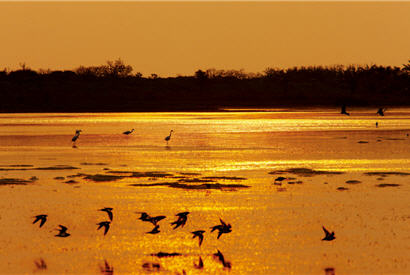
- lower right: The lagoon at the sunset shows its most stunning beauty; it is touching to see the sunset and the birds' feathers shine and reflect each other. / by Jin-yuan Dai
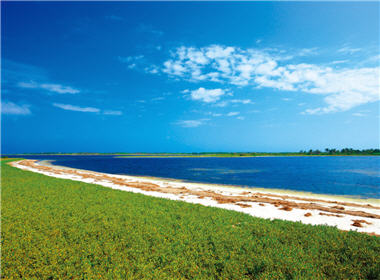
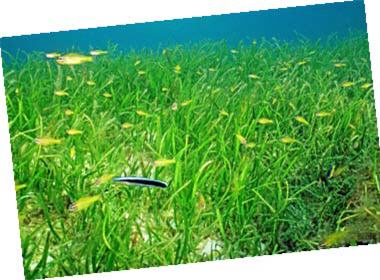
Dongsha boasts of the largest seagrass coverage and variety in the nation. The roughly over 1,185 hectares of seagrass is about ten times that on the Taiwan proper. Capable of absorbing 30 tons of carbon dioxide each day, the plants are pivotal for maintaining the park's rich marine ecology. In an effort to sustainably guard the valuable natural assets, a monitoring study on the seagrass beds at Dongsha Atoll National Park is now underway, conducted by Prof. Hsing-juh Lin of the Department of Life Sciences, National Chung Hsing University, as commissioned by MNP.
Seagrasses make up the best breeding ground for marine lives. Sea turtles, for example, trust their eggs to the land where seagrasses grow underwater. And while dried seagrass washed ashore by the waves could be mistaken as maroon strips of waste lining the beach, under the parched surfaces are moist cavities that harbor and add to the diversity of creatures on Dongsha Island.
Partnership with Coast Guard in Conservation
Were it not for a personal visit and interview with the stationed staff, one would never have imagined the hard fight involved in maintaining Dongsha's beauty, what we so matter-of-factly sees on the press and media.
Since the establishment of Dongsha Atoll National Park in 2007, its staff have overcome many a challenges. Its research efforts have also been flowering gradually. Yet this achievement is not attainable without joint efforts of various departments and institutions.
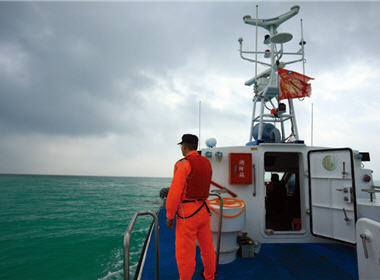
MNP Director Mo-lin Yang once said, "CGA keeps a sharp eye on the island's security. Preservation and restoration projects at the national park are definitely more effective under their protection and control. They are indispensable." Yang gladly expressed his gratitude to the Dongsha Command Center of CGA.
Stern-looking Commander Chia-lin Wang of the CGA Dongsha Command Center holds no reservation in showing his concerns for marine preservation and his soldiers. Wang is in the habit of hastily finishing his meals to make rounds and see that his soldiers are well fed. On special occasions, he would treat them to delicacies at his own expense, so as to ease their home-sickness.
In addition to providing substantial assistance to MNP, Wang instills ecological protection into military training. His soldiers attend monthly education programs, and are required to hold individual meetings with him to ensure they have a correct understanding of environmental preservation.
"Take Earth Day for instance, he would always set an example, even if it means picking up trash himself. With his example set before us, how can we do less?" recounted a sergeant. Wang's way of leading by example has won him respect and inspired subordinates to follow suite.
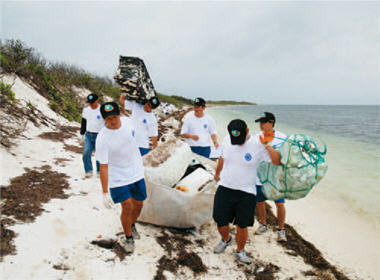
CGA not only fully supports MNP to focus on research, but additionally lends its hand to cleaning up the coast. Brought in by currents and waves, all sorts of waste from different countries line Dongsha's white gulf, making coast-cleaning a major preservation task.
- upper left: The dried seagrasses on the white beach look like strips of brown litters from a distance, but the areas under the seagrasses are moist and warm and offer a pleasant environment for many creatures. /by Jin-yuan Dai
- upper right: The Dongsha patrol team of CGA is responsible for patrolling Dongsha's sea area. It is their unshirkable responsibility to safeguard the ocean around the island. / by Jin-yuan Dai
- lower left: Seagrasses can form the most nutritious and comfortable “delivery room” for marine creatures in Dongsha lagoon and thus help breed sustainable marine resources. / Photo provided by Marine National Park Headquarters
- lower right: The soldiers of the coast guard are engaging in the regular beach-cleaning activity. / by Hui-ru Chen
Yet instead of abandoning itself to a passive cycle of waste collection and disposal, MNP records the sources of the waste, and seeks to promulgate the statistics on international occasions, like Earth Day. MNP believes that only by appealing to the nations through their respective delegations will a clean coast eventually be achieved, and its value truly appreciated.
A Long and Unpredictable Way Home
Dongsha has long been hailed with names that evoke association with the Great Barrier Reef. But working here is not quite "the best job in the world." The pains and toils required for protecting a land from contamination and depletion of ocean resources takes much more than what meets the eye. It takes more than a handful of people giving selflessly to the cause. Each man is bound with responsibility.
The Quarterly team's five-day stay was prolonged by facility failure at the airport. And the wait of three more days for the resumed flight far exceeded the team's expectations. Not only was the staff’s return to Taiwan prevented, Dongsha Marine Station Chief Zhong-zuo Zhang was likewise compiled to give instructions via phone connection from Taiwan.
Unlike the pioneering staff, Zhang is mostly engaged in administration and management, and stays in close contact with the island while on leave in Taiwan. Zhang emphasizes maintaining sound communication with the patrol team on views concerning environmental protection, for although the MNP and CGA differ in functions, the two often work in mutual support.
The unexpectedly prolonged interview finally did come to an end. The plane lifted off from the runway. Gazing at this patch of beautiful island nestling against the blue sea invoked a surge of appreciation and gratitude for the MNP and CGA staff. They are there to continue the fight. A prosperous city of abundance awaits us in Taiwan, a stark contrast with hot and water-deficient Dongsha. But the Dongsha memories are here to stay. May this report voice our gratitude for their cheerful giving to marine conservation, their willingness to step up to the frontier, 450 km away from Taiwan.
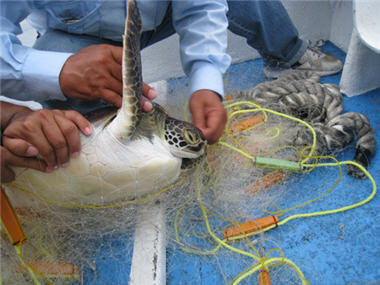
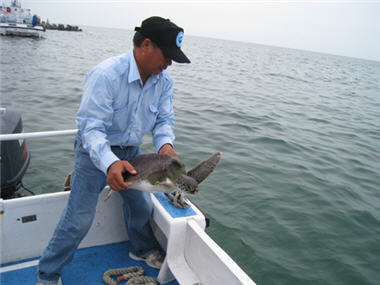
- upper left& upper right: The Dongsha patrol team of CGA and the researchers of Dongsha management station worked together to save two little sea turtles trapped in the fishnet on May 7, 2010, which served as a successful example of conservation work.
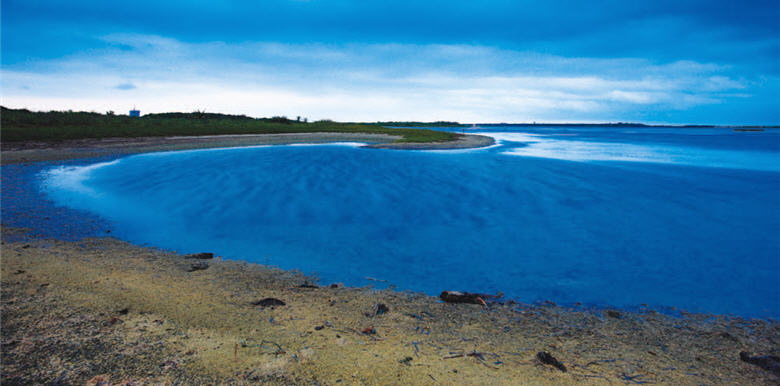
- lower: The seashore of Dongsha lagoon shows different faces of beauty during the rising tide and the ebb tide. / by Jin-yuan Dai
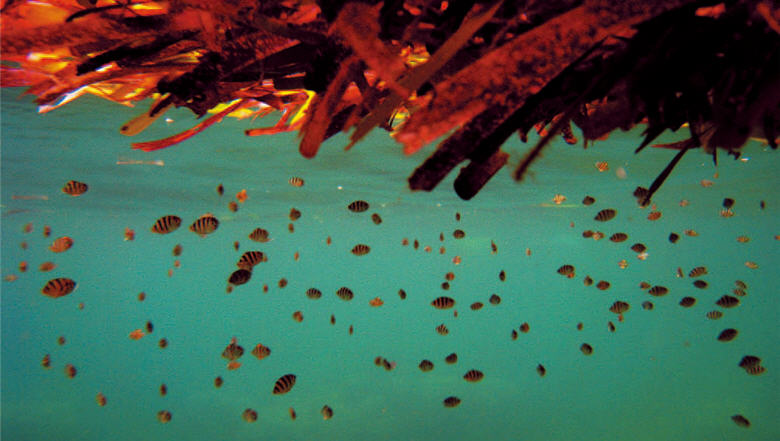
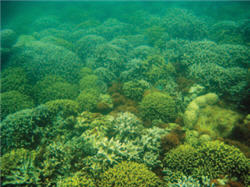
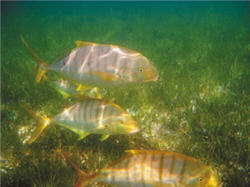
By these excellent pictures, we can introduce you the abundant marine ecology of Dongsha's seas.