
A Clearer View of the Ocean-The Secret Behind the Underwater Monitoring System
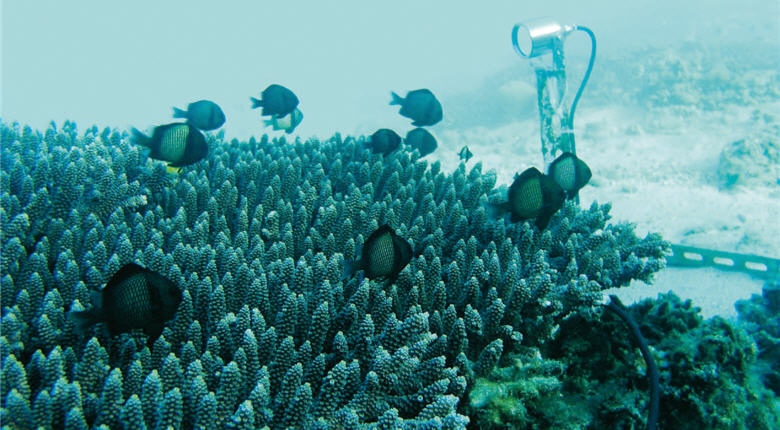
Divers know how difficult it is to observe the scenery under the water, as different weather conditions or ocean currents may disturb underwater observations. Stormy waves are dangerous while calm ones contain more suspended particles (because without the disturbance of ocean currents) that will hinder image monitoring.
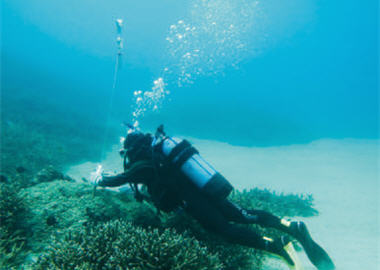
The task of underwater monitoring is much tougher than one can ever imagine, as factors such as waves, buoyancy, the observer's breathing and vigor all come into play.
However, in Kenting National Park, where water areas are included, underwater monitoring is still ongoing as of today. It is hoped that marine conservation can be enhanced with the help of new technology of underwater image monitoring system, so that problems such as the coral bleaching caused by the El Niño effect in 1998, over-fishing, industrial pollution and eutrophication can be tackled in a timely manner.
Eco-monitoring Prompted by Pollution
“In 2001, a Greek cargo ship stranded in the coast off the South Cape of Kenting, leading to a spill of 1,100 tons of fuel oil and devastating the corals in the area,” recalled Dr. Tung-yung Fan, a research fellow at the National Museum of Marine Biology and Aquarium. The world first took notice of the effect of global warming around 1980 and started to carry out the eco-monitoring of corals, and the oil spill highlighted the importance of such practice.
To conduct eco-monitoring under the vast ocean, the analysis of data is crucial but difficult. Besides Fan, Dr. Fang-pang Lin, who learned numerical simulation in Wales and designed airplanes in London, also still took the challenge.
When asked why a computing expert like him would ever want to promote eco-conservation, Lin said he felt obliged to do something for his land and he hopes to unveil the beauty of the underwater world through images to promote the protection of the marine ecosystem.
In addition to observing the corals, the entire underwater monitoring system is also applicable to the monitoring of the water temperature, depth, turbidity and tide marks. In fact, some equipment could even calculate the cover rate of different corals and other immobile marine creatures.
Lin noted that, the world under the sea becomes more fascinating as more is revealed about it. “We have captured images of curious marine creatures, including the nearly extinct sea turtles and the venomous sea snakes.”
However, maintenance of the equipment can be a headache. “The cameras are long submerged in the seawater, impacted by the currents, water pressure, temperature fluctuation, and saline erosion, hence their maintenance is vital. The camera lenses have to be cleaned every week so they won’t become home for creatures like seaweeds and affect the quality of the images captured.
Although maintenance is costly, it’s crucial. Fan and Lin will be embarking on a coral monitoring project in August 2010, when the cameras will record and broadcast images of corals 24/7. Three cameras will be deployed on reefs 5 meters deep at waters where a variety of corals abound. The data collected by the cameras will be transmitted to receivers in a control room, through which it is then distributed to the National Center for High-Performance Computing. Following compression and format conversion of the images, people can enjoy live broadcast on the KTNP website of amazing phenomena such as the corals’ mass ovulation.
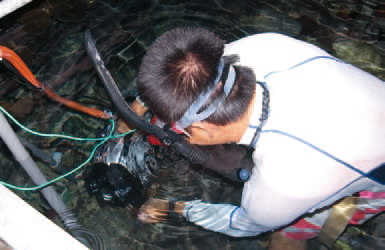
- upper: Thanks to underwater monitoring system, every image of marine creatures in the proximity can be captured. / Photo provided by Dr. Fang-pang Lin
- lower left: The researcher is setting up the camera in the large sink to simulate the situations under the sea. / Photo provided by Dr. Fang-pang Lin
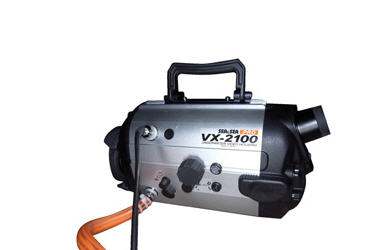
- lower right: The lifespan of underwater photography equipment is short. On average, equipments have to be replaced every four months, and a small lens would cost $20,000 NT. / Photo provided by Dr. Fang-pang Lin
Interview & Text/ Jane Chiu
Translator/ Yonglan Huang
Special thanks to/ Dr. Tung-yung Fan, the research fellow of Biology Department of National Museum of Marine Biology & Aquarium
Dr. Fang-pang Lin, research scientist of Grid
After the collected data is analyzed by Fan, then Lin would use streaming technique to install a multi-functional distributed system capable of providing images of different bandwidths such as MPEG, WMV, JPEG and FlashPix, based on the preference of the viewers.
Lin noted that the technique of streaming is predominantly confined to multimedia application. By contrast, the monitoring system deployed in Kenting not only displays precious images of corals in the area, but is developed in Taiwan, setting the precedent for the application of such technique in underwater eco-observation.
Challenged by Climate Change and Lack of Willing Researchers
The unusual increase in the temperature of the Western Pacific waters in the summer of 2007, as Fan pointed out, would have led to the bleaching of corals in Kenting area.
However, the observation showed the opposite. In addition to the protective measures taken by KTNP, in the waters of Nanwan are the rare upwelling currents with lower temperature, PH value and higher nutrient salt. Because of these, the coral reefs in Nanwan are able to endure drastic changes in the environment and become more resilient to bleaching, decay or death.
However, this doesn’t mean the corals in Kenting are well blessed and free from threats of any sort.
In 2009 the raging typhoon Morakot slashed the coverage of coral reefs and other creatures in Wan-li-ton from 40% to a meager 10%, while other corals situated on the windward side were also pounded. It is apparent that the growing number of super typhoons due to climate change will be the leading killer of coral reefs. “Another worry is the serious lack of field researchers who are willing to stay underwater for an extended period of time for research,” noted Fan.
Just as the land animals, the underwater creatures also have to battle for their own survival under all kinds of harsh conditions. We humans, therefore, should learn to love the ocean, respect it and treasure it, as much as we do to the land.

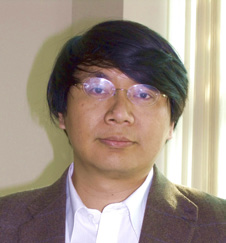
Fang-Pang Lin
Graduated from University of Swansea Wales, U.K., Lin is currently a research scientist of Grid Computing Division of NCHC. His research specialties and interests include computational fluid dynamics, multigrid methods, optimization design, and grid computing, etc.
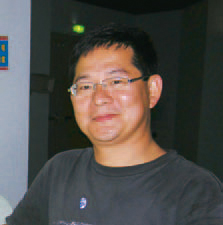
Tung-yung Fan
Fan holds a Ph.D. in oceanography from National Taiwan University. He is currently a Research Fellow of Biology Department at National Museum of Marine Biology & Aquarium, and Associate Professor of Graduate Institute of Marine Biodiversity and Evolutionary Biology, National Dong Hwa University. He specializes in ecology, marine invertebrate zoology, evolutionary biology, and coral reef biology.
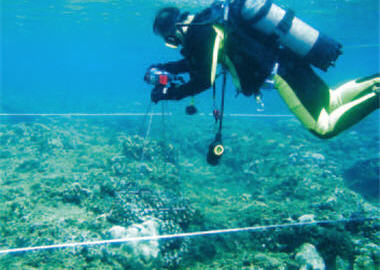
- 上左圖:The researcher was conducting the monitoring of the transect lines of coral reefs. / Photo provided by Dr. Tung-yung Fan
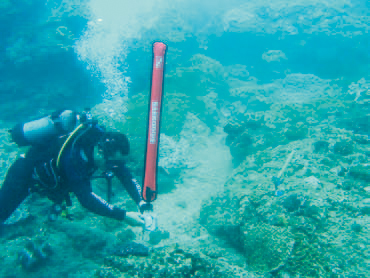
- 上右圖:The measurement of water temperature and depth is also an important procedure of the recording task. / Photo provided by Dr. Tung-yung Fan
- 下左圖:The researcher left the buoy under the sea and located the GPS position of the monitoring spot from above the sea. / Photo provided by Dr. Tung-yung Fan
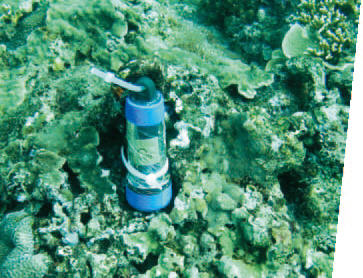
- 下右圖:This is the recording machine for long-term monitoring of the water temperature. / Photo provided by Dr. Tung-yung Fan


