
Decoding the Secret of Climate Change-An Interview with Prof. Kuang-lung Fan of the Institute of Oceanography, National Taiwan University

The ocean
Provides humanity with rich resources
And reveals secrets of the climate.
Aside from the national parks,
There is another group of guardians over marine
Resources—a group of scientists.
They try to decode the messages from the ocean,
And unlock the mysteries of climate change.
Global warming is by far the hottest environmental issue in recent years. From the U.S. documentary An Inconvenient Truth (2006) to the locally produced ±2°C (2010), the world’s growing anxiety over it is unmistakable. While there are still debates over the science behind these films, no one can deny that the weather is indeed getting hotter. The enormous impacts caused by extreme climates are seen and felt everywhere.
The Challenge of Rising Sea Levels
Record-breaking droughts, floods, snow storms and hurricanes have recently occurred on different parts of the planet. Yet an even greater disaster is still looming—global warming-induced sea level rise. Land, already representing less than 30% of the Earth’s surface, may be further diminished by the oceans’ expansion. Simply put, it is the Green versus the Blue, the land’s defense against the invading oceans. It is a battle Taiwan cannot afford to lose.
Since 1991, Prof. Kuang-lung Fan of NTU’s Institute of Oceanography has been monitoring tidal levels in coastal cities like Keelung, Yilan, Taitung and Kaohsiung. He found that, for the decade, Taiwan’s sea level has risen at an annual rate of 0.32 cm, exceeding the global average. At this speed, it will rise by at least 0.3 m in just a century’s time.
Two factors contribute to current sea level rise, and both are caused by global warming. The melting of continental ice sheets adds water to the oceans, and thermal expansion increases the volume of seawater. The combined effects of these factors threaten the coastal ecosystems first.
Ocean-Climate Interactions
The ocean plays a vital role in regulating and stabilizing global climates, making a sustainable environment possible for all living beings. Crucial natural processes like water circulation and the exchange of energies take place in the ocean and the atmosphere. Monsoons and typhoons expedite atmospheric heat exchange between Earth’s poles, and ocean currents help maintain energy balance for the planet by bringing warm seawater from the vicinity of the Equator to high-latitude areas.
- upper: Once the marine environments changes, human beings will face unpredictable adversities. “The battle between the green and the blue,” the land's defense against the invading oceans, is the issue that humans should take seriously. / by Kristian
Interview & Text/ Jia-jun Lan
Translator/ Cary Chuo
When typhoons swirl up counterclock- wise, they bring the nutrients of sea floors to the surface, affecting the distribution of fish species. Tropical cyclones are formed over and strengthened by the ocean. In the case of Cyclone Nargis, which ravaged Burma in 2008, the storm’s sudden intensification came from the unusually heated and thickened layer of Indian Ocean’s warm water, according to a study by NASA scientists and NTU Prof. I-i Lin. Since the abnormal heating of the ocean can be detected by satellites, Lin’s discovery helps to improve the ability to forecast disastrous events in the future.
In March, Taiwan was hit by the biggest sandstorm in its history. Although sandstorms may have positive effects (the micronutrients they carry, such as organic phosphorus and organic nitrogen, can benefit the growth of marine life), overall they do more harm than good to marine ecosystems, according to Fan.
Of course nobody has the absolute standard to call certain natural changes “good” or others “bad.” Fan admitted that even global warming brings short term benefits to high-latitude nations like Russia and Canada by increasing arable land and mining opportunities. But for most countries whose coasts are densely populated, the impacts of global warming can be catastrophic. If the trend keeps going, some smaller islands may even disappear from the surface of the planet.
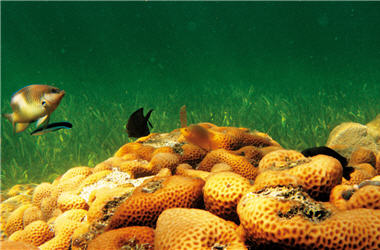
Global warming, in general, is a disaster to Earth’s ecosystems. It is responsible for the extreme climatic phenomena that keep emerging. Many marine species are highly sensitive to temperatures; an increase of one or two Celsius degrees may be more than they can tolerate. While fish can still relocate, immobile creatures have much fewer alternatives, as evidenced in the massive death of corals. But the escaping fish or crustaceans may still perish if they lose suitable habitats. Although life will ultimately find its way, a huge number of species may face extinction when the environments change too fast.
The Lesson for Mankind
“All living creatures are interrelated. Once the marine environment changes, mankind will face unpredictable changes too,” Fan warned. Ironically, mounting evidences show that the disturber of the balance between the climate and the ocean is mankind itself.
The history of mankind is short, but the damages it has caused are monstrous.
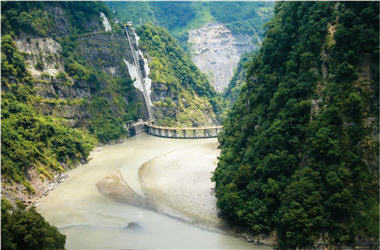
- upper left: Existing reservoirs in Taiwan tend to suffer from sediment deposition due to steep landforms and soft soils. It is costly to maintain Taiwan's reservoirs and their life are short. / Photo provided by Prof. Kuang-lung Fan
- upper right: Many marine species are highly sensitive to temperatures; fish can still relocate, but immobile corals may face the threats of bleaching or death. / by Deng-fu Hong
When too much carbon dioxide accumulates in the atmosphere, trapping more and more heat from the sun, Earth becomes an overheated greenhouse. The use of large amounts of fossil fuels results in enormous CO2 emission, and man-made deforestation weakens Earth’s ability to self-regulate. Scholars also point out that the acidification of the ocean, caused by excessive amounts of carbon dioxide dissolving in water, will bring new environmental problems.
Aside from triggering global warming, mankind is also guilty of ill treatment of the sea. Overfishing, coupled with the use of illegitimate fishing tools, has dramatically reduced fish populations. And serious pollutions are caused by overdevelopment of coastal areas and eco-threatening practices of marine transportation. Fan said that heavy-metal-laden chemicals are usually applied to cargo ships to fend off rust. And the toxic materials may eventually find their way to people’s stomachs through the seafood they consume.
Yet it is not enough to discuss the issue merely from the viewpoint of climatic or marine impacts. They are, after all, just one part of Earth’s current environmental woes. To keep the intricate ecosystems of this planet operating in a sustainable way, a more comprehensive approach is needed.
A Long Battle Requiring Concerted Efforts
Conservation of water resources on land is particularly important and challenging for Taiwan. Existing reservoirs in the island tend to suffer from sediment deposition due to steep landforms and soft soils, but to build new ones are not environmentally viable.
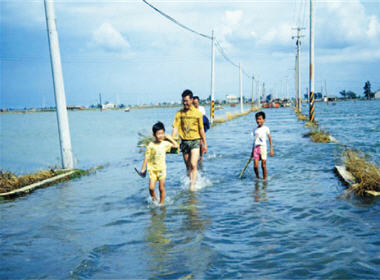
Illegal logging and cultivation on the mountain sides only made the situation worse. Besides, land subsidence induced by groundwater extraction in plain areas has put coastal lowlands like Changhua, Yunlin and Chiayi vulnerable to the threats of sea level rise. Moreover, Taiwan’s west coast is facing tremendous pressure for massive development out of economic concerns. Fan worries large-scale projects have jump started without a careful review of environmental impacts. And the consequent damages are hard to compensate for.
The above discussion not only concerns Taiwan’s policies on water resources, but involves the long term conservation outlook as well. For a sustainable future of this island, “the government must tackle these problems with determination,” Fan emphasized.
The root of all the mess may still be the desires and misconceptions of mankind. Fan believes Earth’s current problems starts with overpopulation, and when people overindulge their own cravings and ambitions, the balance between the climate and the environment suffers. Therefore, everyone must use the resources responsibly to lighten the burden on the planet.
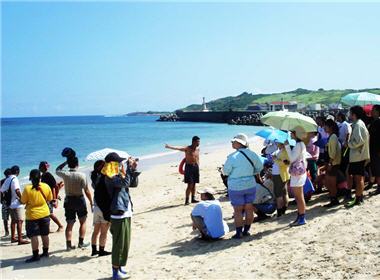
Behind the warnings of global warming and sea level rise is a battle on which the survival and security of most existing species depend. It requires changes in all aspects from governmental policies to each individual’s daily habits. No one can afford to stay out of it.


Profile of Kuang-lung Fan
Professor Fan owns a Ph.D. in Earth Sciences from the University of North Carolina. He earned his M.S. from NTU’s Institute of Oceanography (IO) and his B.A. from NTNU’s Department of Physics. His research areas include marine environment, marine physics and marine pollution. A former member of EPA’s Environmental Impact Assessment Committee, Fan is currently a part-time professor at IO, NTU, where he used to serve as director and full-time professor.
- upper left: The picture shows the situation of land subsidence and seawater intrusion in Taiwan's coastal areas. /Photo provided by Prof. Kuang-lung Fan
- upper right: Marine conservation requires changes in all aspects from governmental policies to each individual's daily habits. / Photo provided by Houbihu Police Squad


