
A Secret Garden, an Amazing Grace-A Visit to Shou-shan in Kaohsiung
 Mysterious Ravines and Gullies
Shou-shan is also known as Chai-shan, Takao Hill, Qilin-shan, and even "Gold-mine Hill." Situated south-west of Kaohsiung City, it is a north-south extending coral reef-covered mudstone hill, spanning 1,107.11 ha and 356 m above sea-level.
The hill's peculiar geological structure renders is a "living geography classroom." And not just metaphorically. Parts of its slopes continue to move annually this day!
An isolated mudstone hill encrusted in limestone, Shou-shan is proof of land bulged from seabed and is Taiwan's only Lower to Middle Pleistocene (approximately 1.8 million-year-old) coral reef cliff joining sea. Prof. Shyh-jeng Chyi of the Department of Geography, National Kaohsiung Normal University (NKNU) notes the existence of similar landscapes in Taiwan, e.g. Kenting's Upper Pleistocene coral reefs and Taroko's more ancient metamorphic limestone.
Though primarily made-up of the former two, Shou-shan is layered from bottom-up with the "Gutingkeng," "Kaohsiung limestone," "rugged foot," "Shou-shan limestone," and "recent alluvium" formations. Foraminifera and calcareous algae fossils in the Gutingkeng formation date the oldest stratum to 1.8 to 3 million years old.
"Shou-shan is susceptible to slides because its harder, more permeable limestone layer is located on-top a less pervious Gutingkeng mudstone formation that weathers easily with water. The limestone layer thus tends to either collapse from steep cliffs or glide along the mudstone surface. Imagine chocolate-coated ice-cream. The limestone, or the coating, glides and crumbles, on melting ice-cream," explains Chyi. Dividing the hill into five parts, Chyi depicts the north as featuring limestone debris, corrosion, and chemical precipitation, the center, deserted quarries, the most developed south, terrace landscape, and the steep-sloped coastal west, landslides.
Monitoring of the western slope shows parts sliding at varying speeds toward the Taiwan Strait. Kaohsiung City Government statistics from 2002 to 2006 indicate the hill currently moving southwest. Regions have skid 3 to 11 cm in three years, while the Chai-shan tribe and elementary school sites lead with a current 24 cm progress toward the Strait.
Geological uniqueness promises natural spectacles. The rugged reefs and grottos, the gorges, cliffs, and caverns are results of the geological evolution, weathering, erosion, and rain-wash on coral reefs. Stalactites, columns, draperies, helictites, and much more, further accentuate the hill's beauty.
- upper left: It is truly special and precious that Shou-shan is close to the downtown of Kaohsiung while being able to keep its primitive features./Photo provided by Trongman Co.Ldiv>
- upper right: Exposed rock formation can be seen everywhere in Shou-shan, a living classroom of geology. / Photo provided by Trongman Co.Ldiv>
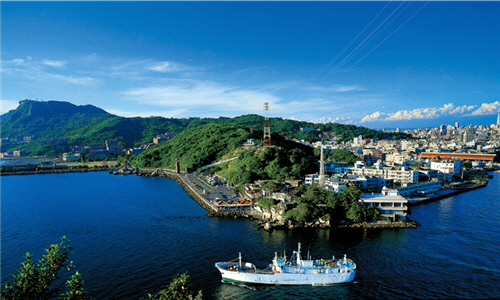
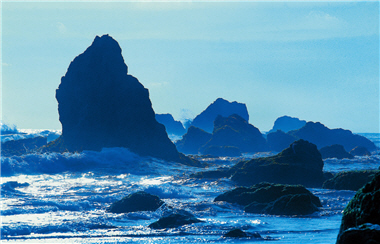
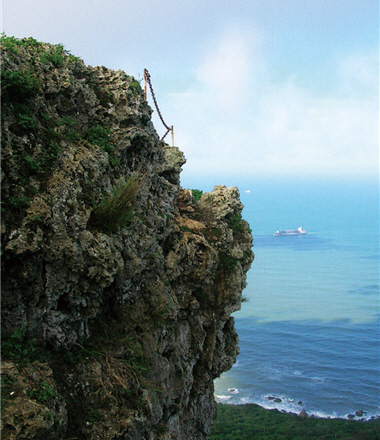
- lower left: Overlooking Sizihwan from the highest point of Shou-shan, one can see strangely-shaped rocks in the sea, a spectacle that resembles the famous tourist attraction the Great Ocean Road in Australia./ Photo provided by Trongman Co.Ldiv>
- lower right: Overlooking Kaohsiung Port from Southern Shou-shan, one can see downtown Kaohsiung on the left side, and Cijin, the long and narrow island in the picture, on the right side./ by Blogger A-Qin
Interview & Text/ Wan-ching Lai
Special thanks to/ THA Director-general Ping-yu Yang
Prof. Hsueh-wen Chang of Department of Biological Sciences, NSYSU
Prof. Shyh-jeng Chyi of Department of Geography, NKNU
Translator/ Lily Tseng
Pristine Beauty Preserved by a Long Ban
Facing the Taiwan Strait, Shou-shan is a natural barrier to Kaohsiung. It has been a strategic military base since the Koxinga Era in late 17th Century, and the Qing Dynasty built a battery on its south end. But it was the Japanese who solidified its military status by expanding and building the Kaohsiung and Zuo-ying military ports. The Nationalist Government further pronounced Shou-shan a military control zone, thus preserving both its mystery and primitive looks. The ban was finally lifted in 1989 when the authorities partially opened the hill to the public.
Shou-shan also holds the earliest proof of human activity in Kaohsiung over 1,000 years ago. There were the Ping-pu Tribe, the Dao-chien Lin pirates' nest, and the Nei-wei district, which by the late Ming Dynasty already had self-defense corps. The opening of the Kaohsiung port later set the city's industrialization in motion, starting with the nearby Qi-hou and Hamasing regions.
Though hailed as the root of human culture in Kaohsiung, Shou-shan's limestone reserve also made it the chief cement supplier to the entire island. Passing by the Shou-shan quarries in the 50s and 60s meant coming out covered in a thick layer of cement dust. And residents there lived looking up to a gray sky.
Tainted Lungs of the City
In the years of Taiwan's economic take-off, Shou-shan's copious limestone quarries gave form to new buildings, bridges, and cities. Yet, left bruised and ravaged, the hill was no longer associated with vibrant green, but ashen gray.
Amongst calls for recuperation, Kaohsiung City Government closed the quarries in 1997 and kicked off restoration projects. Surely enough, post-quarry Shou-shan won the hearts of the citizens, who came for early morning hikes and exercise. Nonetheless, conservationists and locals had to fend off fierce attempts at reopening quarries before the authorities decided to formally tag the hill "Shou-shan National Natural Park" in 2010, ending the tension once and for all.
Culture and Development
Shou-shan was also home to the relics of Makatao Tribe. During the Japanese colonial rule, K. Toya, a teacher of natural history, discovered three shell mounds near the Long-quan Temple in northern Shou-shan. The mounds covered an area of around 250 m and are estimated at 400 to 2000 years old (Dr. I-chang Liu recently corrected the range to 400 to 1500 years). The Creek Shell Mound was a dumping area for shells from meals, mainly consisting of clam and oyster shells. Other than shells, the richly layered mound contains numerous unglazed pottery shards and bracelets. Other finds include artifacts made of stone, shell, and clay, as well as some animal bones and bone needles.
The Creek Shell Mound is instrumental in tracing back to pre-historical Kaohsiung, and therefore a key preservation site for the Park.
"Shou-shan isn't just a geography classroom; it's a living science textbook as well," exclaims Prof. Hsueh-wen Chang of the Department of Biological Sciences at National Sun Yat-sen University (NSYSU).
Though prone to human impact due to its low altitude, military control has coincidentally kept this eco-treasure house intact. Statistics reveal the existence of 769 types of known plants, 106 bird species, 10 mammal families, 23 kinds of reptiles, and numerous other life forms.
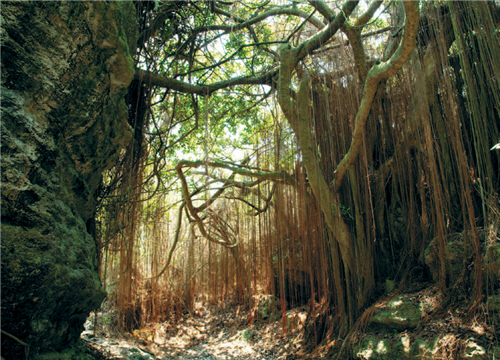
- upper left: Aerial roots of “Plate Marabutans” (Ficus microcarpa) constitutes a beautiful curtain naturally, the scene is quite stunning. / Photo provided by Trongman Co.Ldiv>
- upper right: Once suffering from the destruction caused by the mining industry, Shou-shan finally sees the hope of being upgraded to a national natural park. / Photo provided by Trongman Co.Ldiv>
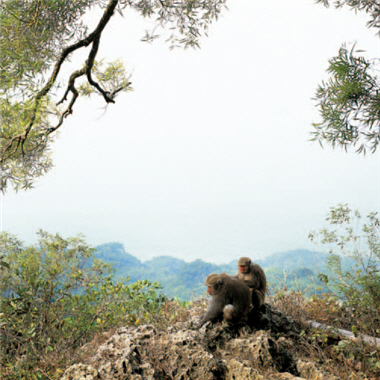
- lower left: Shou-shan is also called “Monkey Mountain”, in which Formosan macaques (Macaca cyclopis) abound; tourists are advised not to feed those protected species endemic to Taiwan.
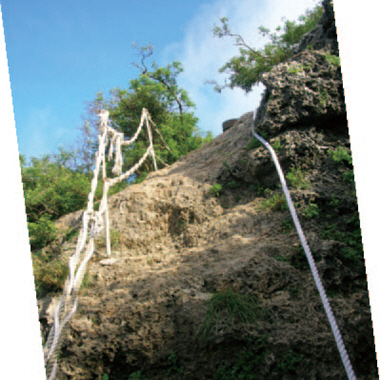
- lower right: It takes quite a lot stamina to climb to Maiden Peak (Shao-nu-feng) for the best view of the Shou-shan area. Mountaineers must climb through all the crooked rocks by grabbing ropes before enjoying a panorama view and blow-drying all the sweats by the sea winds. /by Blogger A-Qin
 Primitive Ecology at the Suburbs
"There are the Formosan macaques (Macaca cyclopis) of course, but even the timid Formosan Reeve's muntjacs (Muntiacus reevesi) at such low altitude. One may also run into protected wildlife, like the Stejneger's narrow-mouthed toads (Micryletta steinegeri), Formosan grass lizards (Takydromus formosanus), Stejneger's grass lizards (Takydromus stejnegeri), Formosan smooth skinks (Scincella formosensis), Cobras (Naja), Crested Goshawks (Accipiter trivirgatus), Serpent Eagles (Spilornis Cheela), Chinese goshawks (Accipiter soloensis), Gray-faced Buzzard (Butastur indicus), and Little Terns (Sterna albifrons)," observes Chang.
Prof. Yu-feng Chen of Providence University identifies several unique vegetation features along the west coast of Shou-shan, including Taiwan's largest and densest dye fig scrubs, main Formosan date palm clusters, and thickest Pacific Island thintails. The Academia Sinica is also currently verifying a possible new plant species called oriental hawksbeard, found on the sea cliff at Shanhai Temple.
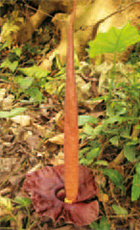
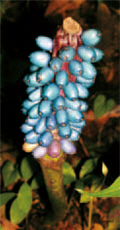
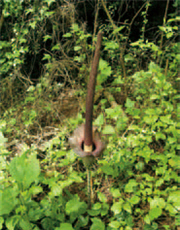
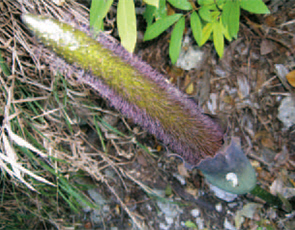
If the reasons above aren't enough to necessitate a Shou-shan National Natural Park, Chang has more to add. Taiwan's endemic species Taiwan Amorphophallus (Amorphophallus henryi N. E. Br.) and Taiwan Titan Arum (Amorphophallus hirtus N.E.Br.) can both be found here. The latter, of peculiar shape and fragrance, is Taiwan's tallest flower, measuring over 280 cm.
And still, new species are being discovered. Chang, who had published a series on Shou-shan's flora and fauna in 1996, finds revision an increasingly formidable task. "What's most rewarding as a biologist is to keep Shou-shan's ecology intact so that people may savor this invaluable trove."
A Joint Victory in Conservation
Shou-shan isn't all that dazzling and shimmering, but poised by the sea, telling of its own story. Locals who hold it dear to their hearts toil and petition for the preservation of this square of paradise amidst the bustling city. "We started out simply with the vision to reserve the best of the hill that is so close to our lives," explains Ping-yu Yang, Director-general of Takao Hill Association for National Park (THA).
Yang had studied law in Germany and doesn't call Shou-shan home, but she'd toiled willingly with the locals. "Shou-shan inspires me. I once came upon a baby common papermulberry deprived of sunlight by the surrounding bittervine. But years went by and somehow it broke free and lived to be the tree that it is today." This is only an example of the true stories that Shou-shan has told Yang over the years. Give her three nights and days, and Yang could still go on recounting.
Yang isn't the only one. Every THA volunteer could go on ceaselessly about the geology, ecology, and history of this endearing hill. Local efforts have worked together to wriggle Shou-shan out of the fate of modern construction and relentless mining activities. These guardians enter every cave, run hands over each cliff surface, and connect with the lives there. Yet more importantly, they educate tourists to, for example, not feed the macaques or set up rest areas. And the annual "Takao Festival," is now famed throughout the city.
"Under local pressure, the city government had plans to make Shou-shan a natural park. But a firm legal basis was required to effectively ban disruptive actions. Making Shou-shan a national natural park would at last guarantee protection for its environment. We, however, will carry on, doing what we can for the hill," promised Yang.
Shou-shan has quite a few of those elfland spots comparable to the ones abroad. There are that breathtaking curtain of princess vine pouring down from heaven and swaying in the breeze, and the miniature Grand Canyon, where one must squeeze through formation crack for closer inspection. One may also brace for the unbelievably intertwining banyans, or step onto the best spot for sea view…. Wandering into Shou-shan, tourists often gasp with awe, for who would have thought that there exists a neverland just outside the city? As Shou-shan is formally becoming a national natural park, may each and every visitor to the Park keep its history in mind as he or she fully drinks in the vibrancy of life. And, yes, may he say a prayer for other secret gardens that each may find a haven before destruction strikes. May the amazing grace remains.
※ Many thanks to blogger Mr. Jian-qin Wang, who offered us many excellent pictures and information about Shou-shan, if you intend to appreciate more pictures of Shou-shan, please go to Wang's blog: http://www.prowang.idv.tw/
- left: It takes quite a lot stamina to climb to Maiden Peak (Shao-nu-feng) for the best view of the Shou-shan area. Mountaineers must climb through all the crooked rocks by grabbing ropes before enjoying a panorama view and blow-drying all the sweats by the sea winds. /by Blogger A-Qin
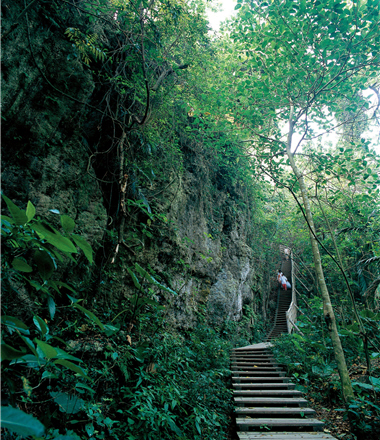
- right: Wooden paths are built in Shou-shan, allowing tourists to enjoy the views along the hiking trails. / Photo provided by Trongman Co.Ldiv>
Shou-shan National Natural Park features a wide variety of rare species in Taiwan. However, due to the limited length, we can only briefly introduce the odd-looking Taiwan Amorphophallus (Amorphophallus henryi N. E. Br.), Taiwan Titan Arum (Amorphophallus hirtus N.E.Br.), and the precious Rhinolophus monoceros.
Taiwan Amorphophallus & Taiwan Titan Arum
Shou-shan is where most Amorphophallus rivieri Durieu are distributed. Two major species are Taiwan Amorphophallus and Taiwan Titan Arum, which are everywhere on the sides of the mountain trails. Taiwan Amorphophallus are shorter and have hairless pedicles, whereas Taiwan Titan Arum are known for their relatively bigger size and pedicles which are covered with fine hairs. Amorphophallus rivieri Durieu are special in that their flowers grow first before leaves do. The flowers would then release a kind of odor that attracts the flies to help them pollinate. Amorphophallus rivieri Durieu blossom around April and May (with Taiwan Amorphophallus earlier and Taiwan Titan Arum a bit late, around May and June.) The plant is also nicknamed “Thunder God’s Bolt” in Chinese because it usually breaks the ground to grow when the spring thunder rumbles.
Rhinolophus monoceros
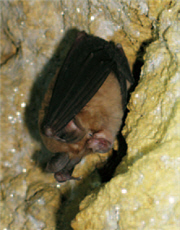
Rhinolophus monoceros is a bat species endemic to Taiwan. Its most distinguishing feature is its nose that resembles of shape of a horseshoe. Rhinolophus monoceros are smaller in size and like to stay in the caves. As there are many caves in Shou-shan, the dark and deep caves have become their optimal habitat. The one in the picture is already up, and when they see the light, they would cover their heads with their wings and keep quivering, making them appear quite adorable.


