
Super Model from under the Sea-Pygmy Seahorse
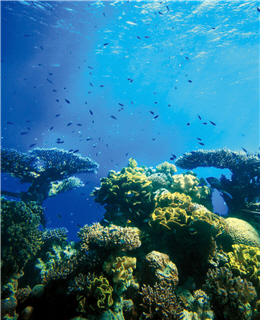
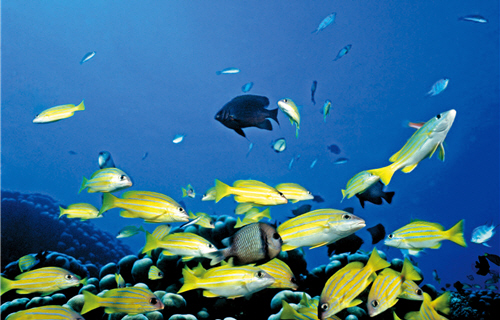
Kenting National Park is the first of its kind in Taiwan that covers colorful coral reefs and abundant sea creatures. With evolution spanning millions of years, the Park boasts diverse species of wild animals. As divers go 20 meters below the sea level, they get to see the charming tiny pygmy seahorses resting in sea fans.
“Their camouflage is just impeccable!” exclaimed Dr. Ming-shiou Jeng, once the director of the Taiwanese Coral Reef Society and a long-time research fellow of the Biodiversity Research Center of Academia Sinica.
Seahorse are actually not horses but bony fish that do not look like fish. Jeng pointed out that according to the recorded literature, roughly 50 species of seahorse are Hippocampus. They breed like kangaroos do—in their abdomen. But what’s more intriguing is that it is the female seahorse which deposits the eggs in the male's brood pouch for the male to hatch them. This is arguably the best model of bearing offspring by both sexes of parents together.
Effective Camouflage
So far only four species of this midget among seahorses have been categorized and named. The world’s first pygmy seahorse was found by a staff member of the New Caledonia Aquarium in 1996, and the legend of the seahorse and their host, the sea fans, has begun.
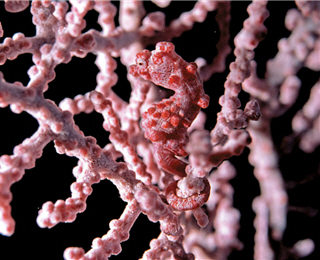
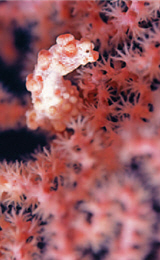
The pygmy seahorse is also known as Bargibanti’s seahorse. It is so tiny that even an adult is no larger than 2.4 cm, thus it has to rest on soft corals such as gorgonian corals that only live in the environment with strong ocean currents and dim sunlight. Jeng recalled that once he went to Bunaken National Park, Indonesia, and dived as deep as 20 meters in the Manado Lembeh Strait to observe the seahorse, whose shape, color and tubercles match the color and shape of the polyps of the host gorgonians. Because of this, the seahorse can’t be easily identified.
“Because pygmy seahorse are so delicate and rare, it is understandable that they can bring in as much as 300 million NT dollars worth of revenue for Indonesia annually,” said Jeng, who praised the Indonesian government for their effort in promoting the country as an international scuba diving destination featuring pygmy seahorses.
A Striking Resemblance To Sea Fans
In addition to Manado Strait, Indonesia, pygmy seahorse also occur from Japan, Taiwan, the Philippines, Malaysia in the Northern Hemisphere to Australia and Papua New Guinea in the Southern Hemisphere.
Because of a research project he was in charge of, Jeng went to the Manado Strait, most of it designated into Bunaken National Park. The Park quickly rose to fame and drew divers around the world since two pygmy seahorses were discovered there. Jeng noted that as the seashore is so tiny, it is difficult to see clearly what it really is like even with the presence of a diving coach, not to mention capturing an ideal image. Still, swarms of scuba divers were willing to wait in line underseas just to take a precious shot. If they are lucky enough to capture the image of a tiny pygmy seahorse smaller than 2 cm, all the wait would be well worth it.
With intense interest in pygmy seahorses, Jeng initiated an activity of finding pygmy seahorse during the 2004 coral reef conservation campaign. No one spotted any in the first week, but a month later, scuba divers in Taiwan started to see the fish in waters of Lanyu (Orchid Island) and Nanwan, Kenting. In particular, the presence of three pygmy seahorses in Nanwan brought in a lot of tourists for Henchun. However, the situation took a turn for the worse when Taiwanese media reported in Jan. 10th, 2009 the theft of three pygmy seahorses in Nanwan.
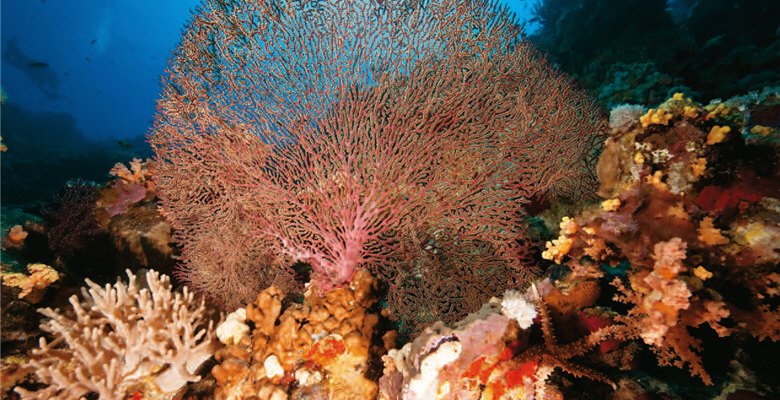
- upper left: Everyone should cherish the resources in the ocean and allow them to prosper sustainably. / by Kristian
- upper right: Kenting National Park is the first of its kind in Taiwan that covers coral reefs with abundant sea creatures, which predominantly characterize KTNP. / by Yung-chun Tsay
- lower: The sea fan is pygmy seahorses' host. / by Stephan
Interview & Text/ Jane Chiu
Special thanks to/ Dr. Ming-shiou Jeng, research fellow of the Biodiversity Research Center of Academia Sinica
Xie-qun Ma, Chief of Conservation Research Section of Kenting National Park
Ms. Cyong-yao Lin from Interpretation and Education Section of Kenting National Park
Disgrace to Taiwan’s Eco-conservation
It has been over a year since the reported theft of gorgonian corals along with the three pygmy seahorses, but Jeng still fumed over it and regarded it as “the disgrace to Taiwan’s eco-conservation.”
The stolen gorgonian coral is about 150 cm in length and 150 years of age. Gorgonian corals are also known as the sea fans because of their shape, and they occur deep in the sea, usually perpendicular to the ocean currents, thus making food-finding easier. In addition to some small shrimps and crabs, pygmy seahorse are also attracted to the corals.
In Jeng’s words, the three stolen pygmy seahorse are the cash cows for Kenting. Each scuba diver spends an average of over NT$ 2000 in Kenting on boat rentals and diving only, and that does not include expenses such as accommodations. Given the rough estimate of thousands of scuba divers that visit Kenting each year, the stolen pygmy seahorses are truly a great loss to Kenting. But what’s more distressing is that of the poachers not only took away the seahorses, but plucked the sea fans, the fish’s hosts, with hammers. Such poaching was not just illegal but also adversely affected the population of rare species in Taiwan’s marine ecosystem. Jeng said the theft served as a warning signal to Taiwan because its protection of marine animals is by no means enough.
Over-fishing and Habitat Destruction
The major threat to the seahorse population comes primarily from over-fishing or destructive fishing gear that damage the habitats of seahorses. Dried seahorses are used as traditional Chinese medicine while living ones are used for display. In view of this, the Convention on International Trade in Endangered Species of Wild Fauna and Flora (CITES) listed all seahorse species in Appendix II, which means seahorses are not in immediate danger of extinction but will likely be so if trading of the species resumes.
More than a year has passed since the three pygmy seahorses went missing, and Jeng is still blaming himself for making public their habitat. He also condemned the poachers for stealing the seahorses and their hosts all together. He said the two are symbiotic, and their growth conditions make the rearing of them in an alien environment next to impossible because the former cannot live with the latter, which only live in deep sea with strong ocean currents and dim sunlight.
The theft prompted Jeng to report it through the media and the Internet, for he wanted to increase the public’s awareness in marine conservation and expects the government to reinforce the protection of rare marine species. As the laws are the last means for maintaining social justice, anyone engaging in illegal activities harmful to marine animals within national parks should be brought to justice. To report any suspicious act, call the Kenting National Parks Police Corps and Kenting National Park Headquarters at (08)8861331. Offenders can be fined or charged. It must be stressed that marine resources are shared by all, and everyone should all do the utmost to protect them and allow them to prosper sustainably.


Profile of Dr. Ming-shiou Jeng
Jeng holds a Ph.D. in Oceanography from NTU and is currently a research fellow of the Biodiversity Research Center of Academia Sinica. His research area covers marine animals, ecosystem and water ecosystem conservation.
- upper left&upper center: The pygmy seahorse is so tiny that it is also called “the fairy in the sea.” / by Yung-chun Tsay
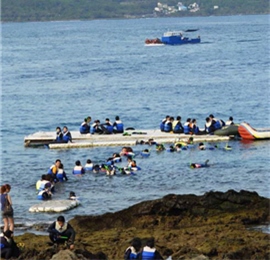
- upper right:Kenting is a must-visit spot for divers. If the concepts of conservation are not well perceived by the businessman, it will bring great damage and burdens to the sea. / by Yung-chun Tsay


