
Back to the Coast-
This spring I went back to a familiar fishing boat along the coast for a project.
About 20 years ago I’d been fishing in the same area. I remember well the boiling splashes on the water surface during the capricious spring; those were actually clumps of frightened Japanese anchovies (Engraulis japonica), fleeing from the attack of striped tunas (Sarda orientalis).
Long wing-like poles would also be set up on boats during this season in order to troll for striped tunas. All the hustle and bustle was probably resulted from the arrival of a large number of some fish spawns or planktons that attracted Japanese anchovies, which then brought striped tunas. Involved herein was not only some maritime ecology, but the Kuroshio fishing culture of an island.
Then in the evening, trolling fishing boats returned with harvest to the harbor one after another and loaded the whole fish auction market with fresh striped tunas. Fishermen and fish vendors bustled around, and the air was infused with oozing joy.
Now I am back here after 20 years. Also in this capricious spring.
Not a single boat is seen at the loading dock; laid in the market are a few unattractive fish and many other imported farm-raised fish. Without people, the auction market appears lonesome.
I met there an old captain in his seventies. “Still fishing?” I asked. “Only for some easy ones. I’m gratified with such a career,” he answered. When asked about the fishing condition of striped tunas this year, “not seen any,” he sighed. “And I don’t think they’ll ever come again.”
As for those old acquaintances fishing around the same area 20 years ago, some get old, some sick, and some have died.
The fish does not come; the number of boats shrinks; the fishermen are gone. They don’t have to be scientists to observe that fish have lost their body mass and that fishery catch has greatly plunged. Even worse, no effective measures are taken to salvage the shocking decline.
I wonder if this is it.
The problems following the exhaustion of fishery resources are far more complicated than the outward “decrease of fishery production” and “soar of fish prices.” There are also the fall of local fishing industry, the decline of maritime spirit and culture, and the deterioration of the marine environment. The environment, ecology, and culture actually form a feedback loop.
Now the coast condition in Taiwan has fallen into a vicious circle and certainly demands more aggressive actions.
Two measures should be taken right away to save our coastal fishing and culture:
- To widely establish coastal reserves to effectively manage our resources.
- To collect and record extensively local coastal fishing culture.
These are to nurture our maritime natural resources and to salvage our long- accumulated but rapidly-fading maritime cultural assets.
I am back here after 20 years, but the fish have long gone, and the people have left. And the capricious spring has turned into a gloomy one.

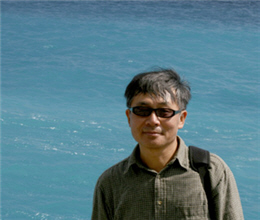
Hung-gee Liao
Liao was born in 1957 in Hualien. Once a fisherman, he used to conduct research on whales and dolphins, plan and promote the whale-seeing activities. He was also the founder of the Kuroshio Ocean Educational Foundation. He has written over a dozen works of ocean literature, including The Fisherman, lonely Island, The Book of Whale and Dolphin, Flying Fish & Lilies, etc. His works show the strong connection between humans and the ocean, have won many awards such as the Judge Prize of China Times Literature Awards, the Best Book Prize of United Daily News Literature Awards, etc.
Text/ Hung-gee Liao
Translator/ Chunyi Cheng


