
All the Dreams and Persistence-Underwater Photographer Wen-sung Wang in a Sea of Colorful Life
At 25, he had done a feat most people could ever dream of: travel around the world.
At 27, he began to explore the undersea garden by plunging into the ocean.
At 30, he had showed countless works in five individual photo exhibitions.
At 40, he had warned about human selfishness by displaying all the wonders and sorrows of marine ecology in his hundreds of dives.
Without him, people would not have realized the beauty of the ocean and their ruthless destruction to it.
An Adventurer with an Urge to be the First
He is Wen-song Wang, a pro underwater photographer who has traveled in nearly 40 countries. Back in a time when round-island pedaling was still new in Taiwan, Wang had finished it alone in 13 days at the age of 17. Years later he took the trouble to find the same reporter that once covered his teenage feat. The reason? “I want to let him know how and what his then-interviewee is doing now,” Wang said.
He has turned into a mature man with a deeper focus on more meaningful things.
Wang has become a photographer and the editor-in-chief for several well-noted magazines. In 1997, he embarked on a whole new adventurous challenge – underwater photography. In the same fashion as he pedaled around Taiwan, Wang wanted to be the pioneer in shooting the undersea world.
More Difficult than Imagined
Back then, only diving coaches and academic researchers would and knew how to get beneath the sea surface, so Wang had to overcome all the difficulties in a self-taught way. Underwater photography is hard because the lenses cannot be changed underwater, and thus only one lens, either macro or wide-angle, can be used. It is also challenging to keep balance in the gravity-free water and to stay in pose amid the strong water currents.
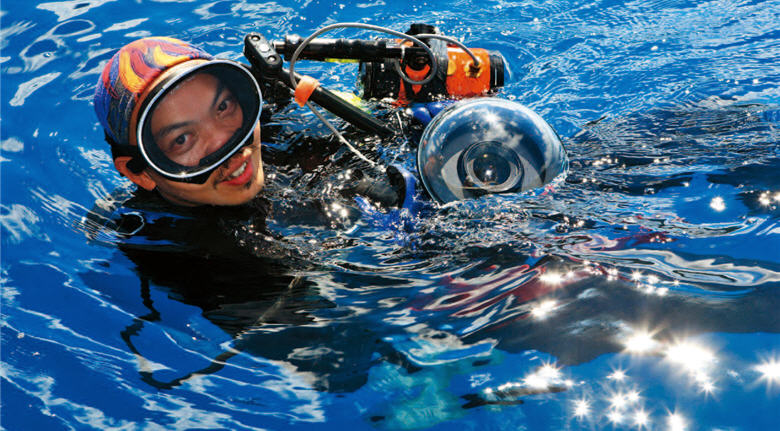
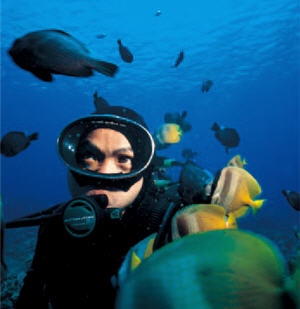
- upper: It is not easy to take pictures underwater, but Wang still smiles joyfully when doing it.
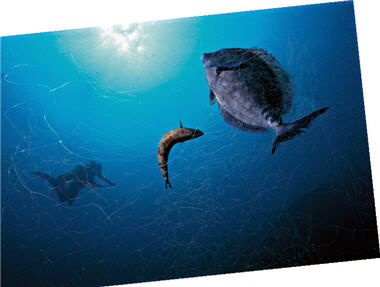
- lower left: It is sad to see the fish stuck in the limpid fishnet and unable to do anything but wait to die.
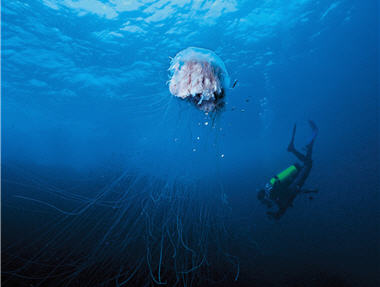
- lower right: The body and the tentacles of Phacellophora sp. are poisonous; even professional divers have to be careful and stay away from them.
Interview & Text/ Wei-ting Lin
Photo provided/ Wen-song Wang
Translator/ Kuan-yu Ou
Despite all these, Wang still learned “to compose on the move” and pressed the shutter whenever there’s a chance. With professional photographic skills, he well handled everything, whether it’s lighting (sunlight plus the flashlight) or deciding the appropriate shooting distance.
Wang had also learned how to approach the sensitive marine creatures, which can be scared away even by a bubble exhaled by a photographer. “Under the sea, something as trivial as breathing is important. You couldn’t possibly get any pictures if you can’t even get close to those animals.”
Not Even Sharks Deter His Love for Ocean
Wang admits that in spite of the difficult parts, the fun and joy underwater photography brings is truly worthwhile and most of his underwater memories were wonderful.
He particularly loves the surprise and uncertainty of it. For example, the encounters with different subjects each time at the same location, as well as the challenge that he must finish tasks before the oxygen runs out, urge him to continue the adventures.
Even in the face of hammerhead sharks, Wang never felt frightened. “Why would I? I was thrilled to see such a precious scene,” he laughed with a veteran’s smile.
The only time he regarded as life-threatening was when his diving fins got caught in the fishing net coming right toward him. He saved himself by cutting the net open immediately, but the experience showed him how deadly the fishing net is.
Perhaps it takes guts and adventurism to be an underwater photographer, but Wang has something more: his meticulousness.
He would approach his subjects with extreme care and capture a creature as tiny as a fingernail on his camera with stunning clarity. “What makes me different is that I’ll set up a goal first and do whatever possible to fulfill it.”
And he makes the photo gadgets on his own to optimize the photographic effects. He would ask some friends at an ironworks to modify the gear he needs; now he can even produce the connectors for flashlights and cameras.
Human-inflicted Waters as Warnings
Wang has been to numerous diving sites including Great Barrier Reef, Marshall Islands, Palau, Guam, etc.
“To tell the truth, the seas of other countries are more beautiful than those of Taiwan. This is because the concept of conservation of marine resources has sprouted in other countries much earlier.”
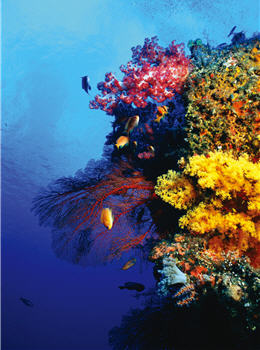
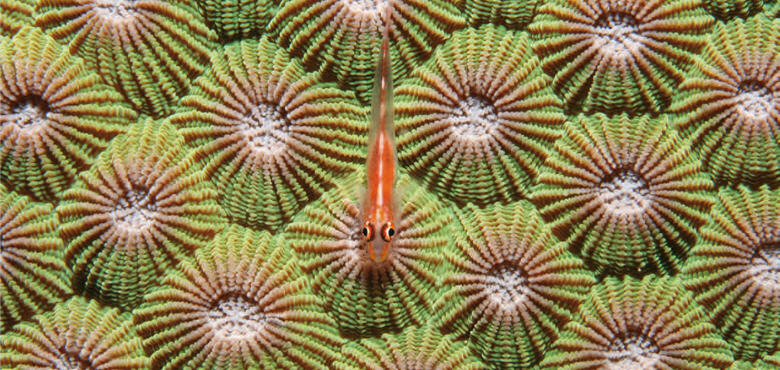
- upper: A Pleurosicya micheli is waiting for its prey on the colorful Favites flexuosa.
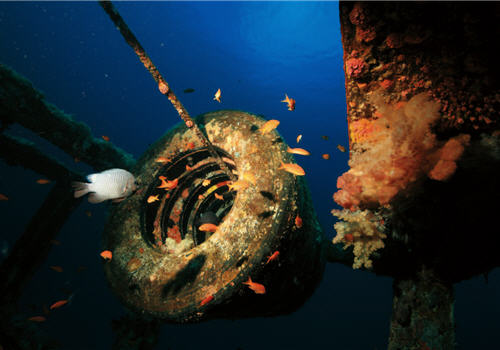
- lower left: After more than two decades, the coral polyps which fell on the wreck of a ship has become a mysterious and fantastic part under the sea.
- lower right: Sea Goldies (Pseudanthias squamipinnis) and Chromis fumeus are swimming around the rubber tires which flow with water.
Wang spent a great amount of time under the sea around Taiwan to see what he could do for the ocean of his homeland. “It wouldn’t have made a difference if I had just shot the beautiful part of Taiwan’s ocean,” he said. So Wang decided to arouse Taiwanese’s concern about their ocean by shooting something special and challenging – human-inflicted waters – as the themes of his works.
Sea areas near Ba-Dou-Zi garbage dump, Longdong Bay, Abalone Pond, Badai Bay shipwreck in Lanyu, Maanshan nuclear power plant in Kenting, Jibet Islet in Penghu, etc. have all been recorded by him on the film. Wang was particularly impressed and touched by the liveliness under the sea near Ba-Dou-Zi garbage dump.
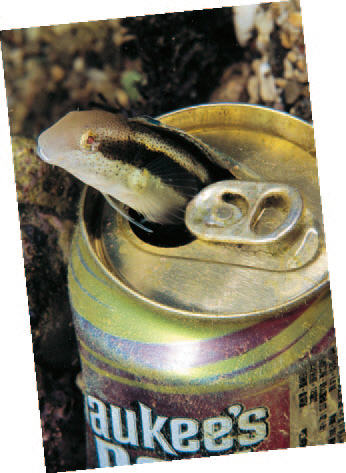
“The vitality and tolerance of the Nature is so powerful” that plenty of creatures can still be found in such greatly damaged area. Wang had spotted Ornate Ghostpipefish, Harlequin Shrimp, Dunckerocampus multiannulatus, Blue Ringed Octopus, etc. Wang once found a Combtooth blenny living in an iron can, which represented a funny spectacle with a sad feel.
“By showing them the truth, I hope my fellow countrymen can care more about the ocean.”
Marine conservation may seem irrelevant to most people, especially those who have never tried scuba diving to see what’s going on down there. “To protect the ocean may not necessarily involve getting into the sea. Reducing the use of detergents and the amount of waste water can be of help, too,” Wang said.
Under Wang’s lens, one photo after another guides people into the quiet underwater world with an urgent call for its conservation. More of his works are still to come, through which people may witness the closest but also the most distant views under the sea.

Profile of Wen-song Wang
Wang was born in Taipei in 1970. In his high school years, inspired by the book Fred Ma Roving Around the World, he started travelling all over Taiwan while recording details and precious moments in his trips.
Since 1997, he has extended his photographic views into the seas around Taiwan, trying to prompt people’s concern about the ocean by recording peculiar and unknown marine life. His works are mostly seen in Rhythms Monthly magazine. His Marine Kingdom: Underwater Observation on Taiwan’s Marine Ecology was published in 2009 by Rhythms Monthly. His work had also won the “best photography” award at the 33rd Golden Tripod Awards for Publications (Taiwan) in 2009.
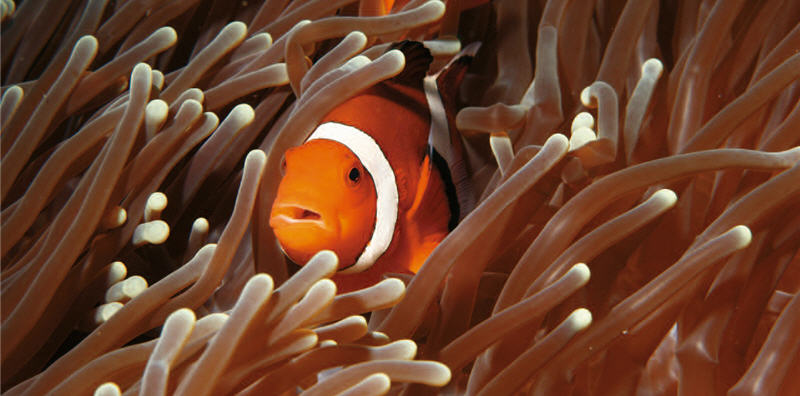
- upper: The cute Clownfish (Amphiprion ocellaris) is known to people in Taiwan through Finding Nemo. Clownfish and anemones are symbiotic.
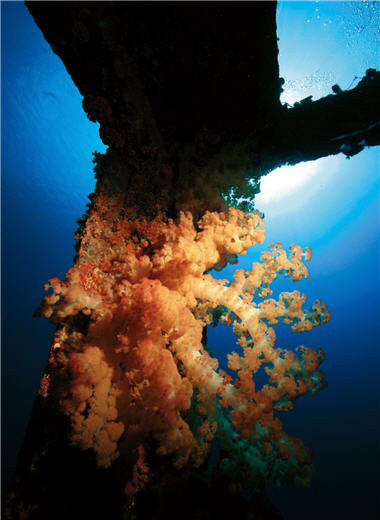
- lower left: Strong currents bring rich nutrients so the artificial reef is fully covered with soft corals (Alcyonacea).
- lower right: A Combtooth blenny lives in a can, creating an ironic scene in the sea.


