
A Look at the World of Birds in Taiwan's National Parks-The Features of Bird-watching in Taiwan's National Parks
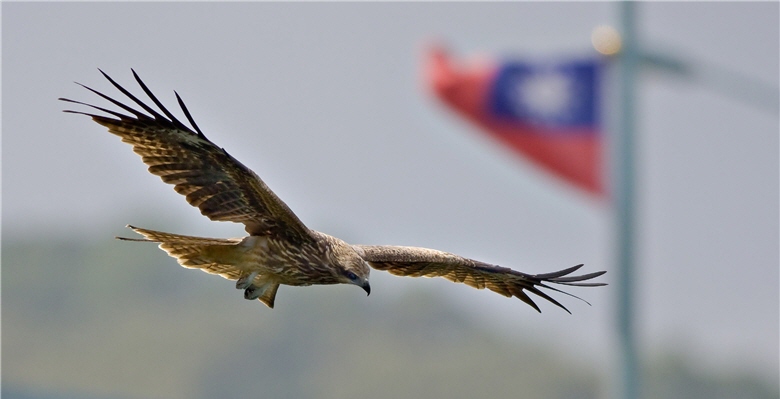
In the sky above Sheding Nature Park, eagles soar majestically amid people's exclamation; at Cigu Wetland, beautiful Black-faced Spoonbills (Platalea minor) rest peacefully after their long journey; in the misty forests, the soft chatter of Formosan Yuhina (Yuhina brunneiceps) linger in the mind of mountain climbers.
As we take a stroll in national parks, we always miss out the birds flying above us, so we never truly get to know them. As a result, most people are just plain clueless when it comes to the whereabouts and the name of a particular species of bird they seem to be interested in. Across Taiwan's national parks, a dazzling variety of birds make their presence at the mountains, costal wetlands and outlying islands. Let us take a closer look at some of the birds that have been patiently awaiting our visit.
Bird-watching in a City Bird Park
We may start with Yangmingshan National Park (YMSNP), where from Erzihping to Xinbeitou there is lush and verdant landscape and multiple bird species, making the area one of the most well-liked bird-watching sites in northern Taiwan.
A sound resembling that of a wooden fish comes from the treetop, but it is actually the call of a Muller's Barbet (Megalaima oorti), an iconic species of YMSNP. The plumage of the bird is patterned with red, yellow, blue, black and green, with green constituting the bird's natural camouflage and making it difficult for people to spot the bird. So its unique call becomes the key to identifying the adorable bird hidden in the woods.
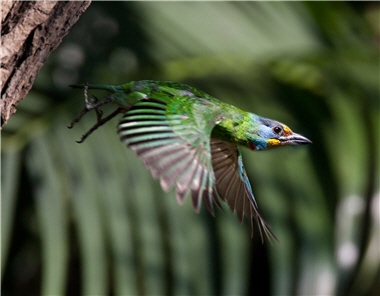
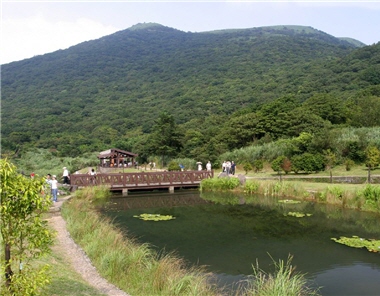
- upper: When you feel crowded in the concrete city, we suggest that you take a casual walk at one of the national parks, watch all the birds flapping their wings and listen to their interesting chirps. / by Jun-hong Lin (Bird Warrior )
- lower left: Muller's Barbet (Megalaima oorti) is the iconic species of YMSNP. / by Jun -hong Lin (Bird warrior)
- lower right: In Yangmingshan National Park, from Erzihping to Xinbeitou there is lush and verdant landscape and multiple bird species, making the area one of the most well-liked bird-watching sites in the park. / Photo provided by YMSNP
Organize & Text/ Hsin-hua Lian
Special thanks to/ Chief Jun-shan Chen, Mr. Mao-yao Lin of Taroko National Park Headquarters
Ms. Cyong-yao Lin, Mr. Yi-rong Cai of Kenting National Park Headquarters
Ms. Zhen-yu Chen of Yushan National Park Headquarters
Ms. Shu-chun Yu of Yangmingshan National Park Headquarters
Ms. Shu-yi Chen of Kinmen National Park Headquarters
Ms. Ying-chan Chen of Taijiang National Park Headquarters
Ms. Le-jia Shang of Marine National Park Headquarters
Ms. Hui-fang Liu of Shei-Pa National Park Headquarters
Translator / Yonglan Huang

The implementation of conservation works has brought YMSNP to prominence as the best spot to see Formosan Blue Magpies (Urocissa caerulea ). The birds breed each year from March to July at places such as Qianshan Park, Yangming Park, Yangmingshuwu, Zhuzihu Lake and Lengshueikeng, so visitors interested in observing them may try these places. But beware that the birds are highly defensive, so keeping a distance and causing no disturbance is the best rule; otherwise the birds may initiate attacks simply to defend themselves.
Bird-watching amid Misty Mountains More mountainous national parks such as Shei-Pa (SPNP), Taroko (TNP) and Yushan (YSNP) are of similarly higher altitudes, but still abound with different species of alpine birds due to distinct environments and habitats.
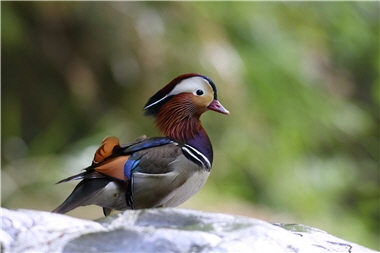
The Mandarin Ducks (Aix galericulata ) living a carefree life in SPNP are listed as the protected species in Wuling area, whereas in places like Cijiawan Creek, Yousheng Creek and Sihjielan Creek a great number of the birds congregate.
If fortunate enough, one can see these elegant birds on the Yingbin Bridge. As the ducks are vigilant and elusive by nature, visitors aspiring to see them are advised to first take part in the exploratory activities held by the SPNP Headquarters during the summer to get closer to the birds.
In Yushan, when walking on the Yushan Main Peak Trail, one can readily see the Formosan Laughing Thrush (Garrulax morrisonianus), a brown colored endemic species of Taiwan with a plump figure and white superciliums and white whiskers. The birds are nimble and show little watchfulness to humans, thus they are easy to observe at close distance.
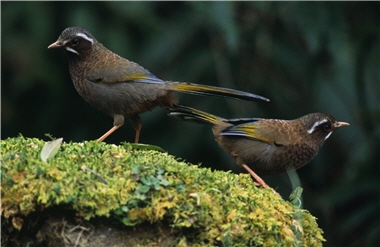
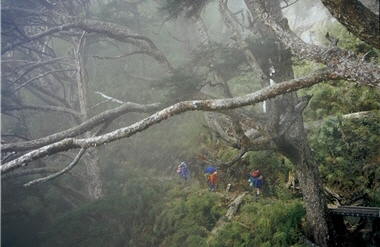
- upper left: Mandarin Ducks (Aix galericulata) are listed as a major protected species in Wuling area of Shei-Pa National Park./ Photo provided by SPNP, taken by Yan-ling Zhang
- upper right: One can see the beautiful figures of Mandarin Ducks (Aix galericulata) on the Yingbin Bridge. / Photo provided by SPNP, taken by Yan-ling Zhang
- lower left & lower right: Formosan Laughing Thrush (Garrulax morrisonianus) (lower left) is a common species on Mt. Jade Main Peak Trail (lower right). /Photo provided by Yushan National Park, photo 1 taken by Jia-sheng Chen; Photo 2 taken by Yu-lin Wu
Vinacceus Rose Finch (Carpodacus vinaceus) is also a must-see on the Trail, whereas Johusten's Bush Robin (Tarsiger johnstoniae) and Nutcracker (Nucifraga caryocatactes) make frequent appearance in Tataka Recreation Area. At Walami Trail also live many birds nesting at low altitude. There are also many bird-watching trails around Southern Cross-Island Highway area, which, unfortunately, are currently closed after Typhoon Morakot. And as a staggering 188 species of birds can be seen in YSNP, a bird-watching trip on the weekend may prove to be memorable and worthwhile.
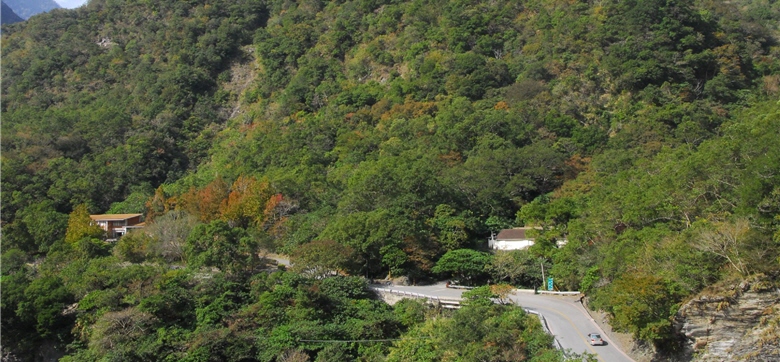
Taroko National Park also makes a wonderful bird-watching site, where Plumbeous Water Redstarts (Rhyacornis fuliginosus), Little Forktails (Enicurus scouleri), Formosan Whistling Thrushs (Myiophonus insularis) linger along mountain streams. Zhucun Trail, Lüshui Trail, Buluowan and Shakadang Trail are some of the must-gos for bird-watching in the low-elevation forests.
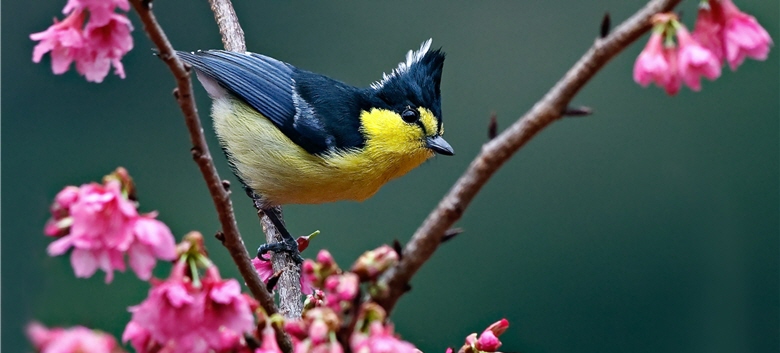
As winter comes, birds such as Yellow Tits (Parus holsti), White-tailed Blue Robins (Cinclidium leucurum) and Green-backed Tits (Parus monticolus) that normally reside in broad-leaved forests or conifer-broadleaf mixed forests in mid-elevation area descend to the terraces in TNP to take shelter, offering some surprise and excitement in the frigid wintertime.
Further down south in the warm Hengchun Peninsula there are also charming birds that definitely merit a bird-watching trip.
Bird-watching at Southern Tip of Taiwan
The majority of Taiwan Bulbuls (Pycnonotus taivanus) live in the Hualian-Taitung area and Hengchun Peninsula, with Kenting National Park (KTNP) being a major habitat. Unfortunately, the birds have been threatened to lose its pure breed due to excessive habitat intrusion by Chinese Bulbuls (Pycnonotus sinensis) over the past four decades. Besides in KTNP, Taiwan Bulbuls also fall victim to Chinese Bulbuls in the TNP from Xibao and Tianxiang to Chongde and Heping.
- upper: Yellow Tits (Parus holsti) with a punk, black crown is a common species in Taroko National Park in winter. / by Jun-hong Lin (Bird Warrior)
- lower: Lüshui Trail, Buluowan and Shakadang Trail are some of the must-gos for bird-watching in Taroko National Park. /by Mao-yao Lin
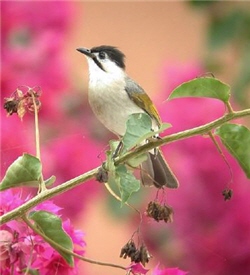
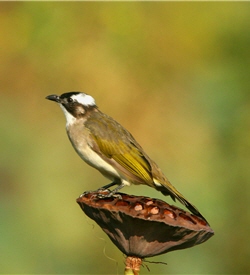
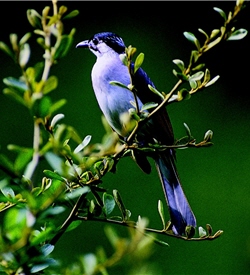
To protect the precious endemic Taiwan Bulbuls from the threat of hybridization, people may help as bodyguards to the birds to make sure no one is releasing Chinese Bulbuls in the wild and contact Headquarters for support should there be any suspected hybrids from the two Bulbuls.
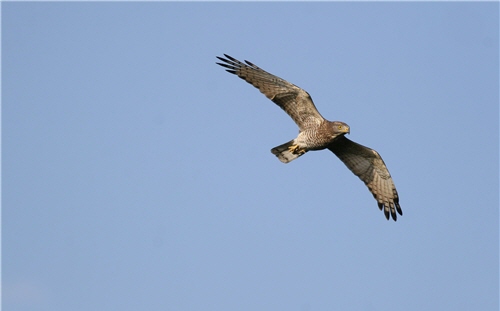
Also, bird watchers should not miss out on the world-renowned Eagle Festival in autumn, where thousands of eagles pass by in Kenting. But as the migratory raptors visit Taiwan at different times, observations should take place in the right spot at the right time. On the morning from 5:30 to 7 a.m. in September, one can see eagles rallying and flying southward; in October at Sheding Nature Park the sight of eagles flapping their winds in large groups in the morning can be truly amazing. From noon to dusk at Manjhou, one can see eagles hovering in the sky, diving and landing. Though observers cannot get too close to the eagles, the sheer spectacle is still mind-blowing.
Bird-watching in Taijiang and Dongsha
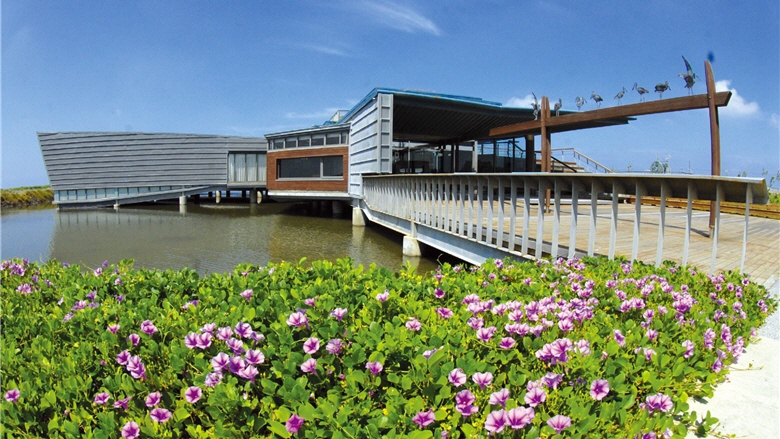
Each autumn and winter in Taijiang National Park, Black-faced Spoonbills and other migratory birds pass by to search for food and make a temporary stop. The birds would stay at Cigu salt pan wetland and Zengwun estuary wetland before they fly northward in the next spring to breed. Visitors could go to the Black-faced Spoonbill Ecology Exhibition Hall for more detailed information on the birds or take a ride on a plastic raft at Sihcao Lake to witness the beauty of the spoonbills.
Sihcao mangrove area is one of the best-kept mangrove preserves in southern Taiwan. The area maintains a high degree of diversity of marine life including fiddler crabs, mudskippers and soldier crabs. As visitors watch Black-faced Spoonbills, they may also experience a ride down the mysterious water forest.

- upper left, upper center & upper right: From left are Taiwan Bulbuls (Pycnonotus taivanus), Chinese Bulbuls (Pycnonotus sinensis) and the hybrid from the two Bulbuls. Taiwan Bulbul (Pycnonotus taivanus) is one of the precious endemic species of Taiwan; to protect it, people should not release Chinese Bulbuls (Pycnonotus sinensis) in the wild so as to reduce the threats of habitat intrusion./ Photo (left) provided by KTNP, Photo (mid) provided by Ming-yuan Chiu, taken by Su-lan Chiu- Lu, Photo (right) taken by Mao-yao Lin
- lower left: Hanbi Pavilion at Sheding Nature Park is one of the best bird-watching sites in the Eagle Festival in Kenting National Park each autumn. / Photo provided by KTNP
- lower right: A Grey-faced Buzzard (Butastur indicus) is soaring in the sky. / Photo provided by KTNP
In addition to Taiwan proper, the outlying islands of Kimen and Dongsha are also endowed with various species of birds for people to see.
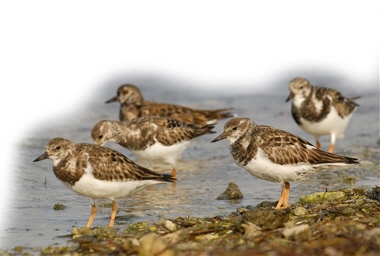
Due to Dongsha1 Island's unique geographical location, as many as 234 species of birds have been recorded there, only 16 of which are resident birds while the majority are migratory birds. The most common one is Ruddy Turnstones (Arenaria interpres), which winter on the island each year. Besides, up to 400 to 500 Ruddy Turnstones pass by each spring and autumn, while in summer they would search for food in piles of rocks or seaweeds. The birds' plumage appears rather dull in winter, whereas in summer, it turns shiny orange and demonstrates dazzling sparkle under the sun.
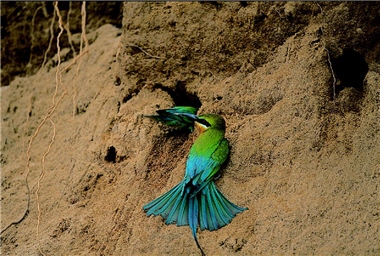
Another outlying island that boasts multiple bird species is Kinmen, which is on the major migration route of migratory birds. Privileged natural environment, plentiful food sources and little man-made disturbances put Kinmen on the list of another bird-watching paradise. Hoopoes (Upupa epops) at Banyan Park, Blue-cheeked Bee Eater (Merops philippinus), and birds of Halcyonidae family all make Kinmen one of the best bird-watching sites.
It may be unrealistic for humans to dream of flying one day like birds do, but people can certainly take a casual walk at one of the national parks, watch all the birds flapping their wings and listen to their interesting chirps. That would definitely help ease our trouble and generate hope in our mind that flies in the sky as free as a bird.
- upper :The Black-faced Spoonbill Ecology Exhibition Hall established by Endemic Species Research Institute in Taijiang National Park helps the public understand more about the ecological background and other detailed information about Black-faced Spoonbills (Platalea minor). / Photo provided by TJNP, taken by Jin-yuan Chen
- lower left: Kinmen is the only place where beautiful Blue-cheeked Bee Eaters (Merops philippinus) can be seen. / Photo provided by KMNP, taken by Dong-kun Liao
- lower right: Many Ruddy Turnstones (Arenaria interpres) would visit Dongsha Island and make a temporary stop there every winter. / Photo provided by MNP, taken by Jian-de Wang

※Because of limited space, the chart is organized from article. For more info, please contact Taiwan National Parks Headquarters.
Taiwan National Parks Place Kind
- upper : As we take a stroll in national parks, we can appreciate the beauty of various kinds of birds. / Photo provided by KTNP


