
The Most Beautiful Silhouette on the Skyline-Lake Nakuru National Park
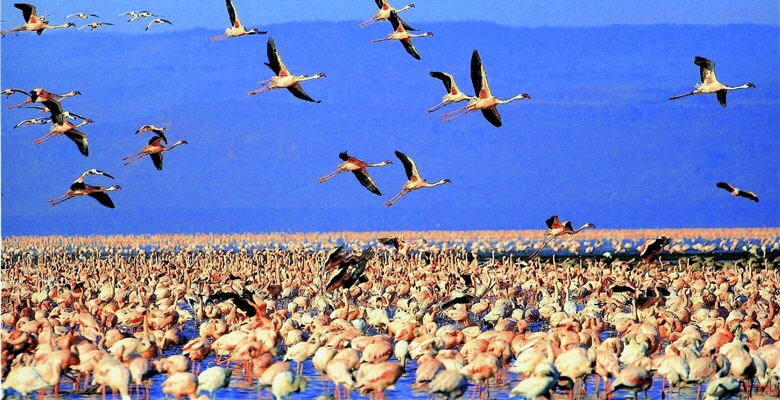
Running from Turkey to Mozambique, the 9,600-kilometer-long East African Rift is scattered with numerous highland lakes. Not only does the vast expanse of azure lakes draw tourists but the abundant water supply also nourishes thick lakeside vegetation and attracts wild animals to inhabit and feed here. Home to more than 400 bird species, Lake Nakuru National Park (LNNP) is particularly one of the best known spots along the rift.
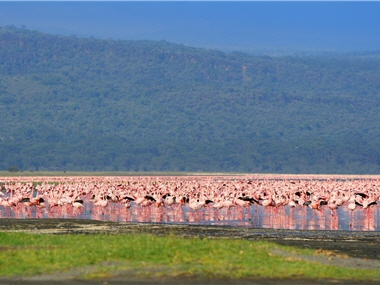
Lung-sheng Chang, Chairman of the Urban Regeneration R&D Foundation, praised LNNP's ecological efforts as he shared his two study visits to the park during his term as Director-general of Construction & Planning Agency. During his effort to promote the establishment of Taiwan’s national parks, Chang had visited many natural preserves around the world. Among all trips, Chang has always remembered well how, seven years ago, he had witnessed tens of thousands of flamingos feeding in LNNP and flapping their wings to form red waves.
A Beautiful Habitat Full of Life
The East African Rift was formed 12 million years ago when the African continental plates drifted apart. As tectonic uplift continued, the underground lava flows surged through the rifts and formed volcanoes. Water gushing out of the volcanoes in turn formed a series of lakes; some are freshwater, while others are saltwater.
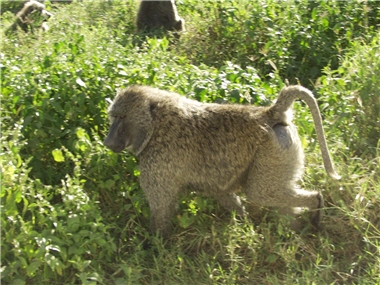
Established in 1968, LNNP covers an area of some 188 km². The majority of it is a blue, pear-shaped alkaline lake, whose abundance of blue-green algae attracts sometimes as many as more than two million flamingos, about a third of the bird's total population around the world. "Though Lake Nakuru National Park is small, it is home to more than 400 bird species besides flamingos, as well as other animals, like black rhinos, baboons, and gazelles. It's a paradise for animals." Though half-retired, Chang still delighted in talking about the natural resources of this Kenyan national park.
Birds flock to Lake Nakuru because of the natural resources there. Besides algae, Lake Nakuru also attracts flamingos and other birds with its abundance of copepods, a class of shrimp-like crustacean zooplankton. To safeguard birds and their food sources, said Chang, the national park has strived to protect its water quality from pollution so as to provide birds and other fauna with safe food and shelter.
However, will the flamingos face threats as the lake keeps shrinking due to reduced rainfall resulting from climate change? This is still no cause for concern now, Chang assured. Because even though the lake is shrinking due to diminished rainfall, such a natural lake is unlikely to totally disappear, since it will still be fed by underground water. "Even if it does, birds can still fly to other habitats. What's more, Lake Nakuru is only a feeding ground for flamingos, not a breeding ground; the impacts posed to the birds are limited," Chang reassured.
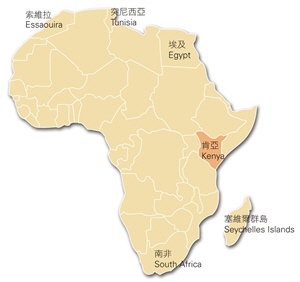
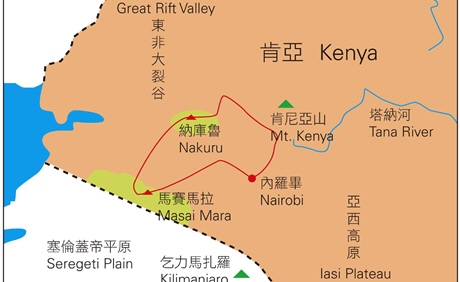
- upper: Lake Nakuru National Park in Kenya is a well-known for the more than 400 bird species that inhabit in it. /by Ling-yao Ye
- lower left & lower right: Map of Lake Nakuru National Park (lower right), Kenya (lower left) / Reference: lower left http://www.agoda.com.hk/africa.html, lower right http://www.panden.com.cn/?thread-380-112.html
Interview & Text/ Jane Chiu
Special thanks to/Lung-sheng Chang, Chairman of the Urban Regeneration R&D Foundation
Secretary Mei-li Liao
Translator/ Miranda Wang
Self-discipline in Addition to Flow Control
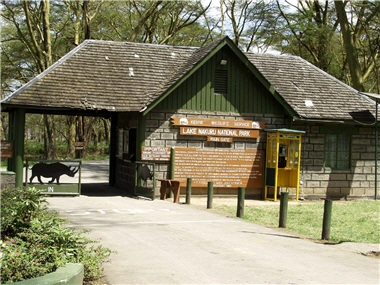
Different from the management practices of Taiwan's national parks, which usually use many guides, LNNP has a limited staff. To better monitor the number of visitors and prevent unlawful stays or activities, the park has only one entrance/exit. Furthermore, wire fencing is used all around the park to prevent animals such as deer, rhinos, or baboons from straying. Either driving their own cars or coming in guided groups, visitors show great respect to animals and behave themselves.
When asked if a raise in admission fees could help improve the facilities of national parks, Chang gave a discreet answer. "It does help to address many pressing needs if a national park can allocate its own income.
However, policies varying from country to country must be taken into consideration. Take Kruger National Park in South Africa for example; 80 percent of its income is allotted to other national parks. Similarly, the income of Lake Nakuru National Park may also be reallocated by the government. Likewise, the funds of Taiwan's national parks are also reallocated by the government. What's more, Taiwan's national parks are open to the public, just like ordinary parks, with local residents living in them, so it's improper to charge visitors for admission."
A Natural, Unpolluted, Undisturbed Paradise
LNNP is situated on a plateau at an elevation of 1,500 meters and next to the fourth largest city in Kenya. The key to this park's success, as Chang analyzed, is its unique natural lakes and unpolluted, undisturbed ecology, which make it an ideal shelter and feeding ground for birds.
By comparison, Taiwan's Taijiang National Park, though also featuring wetlands and bird life, has a tougher challenge to face. In the park, natural wetlands exist only around the estuary; scattered in the rest of the park are fish farms, salt pans and man-made wetlands. "Black-faced Spoonbills (Platalea minor) only inhabit areas undisturbed by humans, so it's necessary to research into their feeding, behavior, distribution, breeding and migration routes in order to create a favorable habitat for more of them to stay. That way, visitors can watch birds at close distance without using telescopes. So, the mission is to create an environment where humans and birds can get along!" Chang noted.
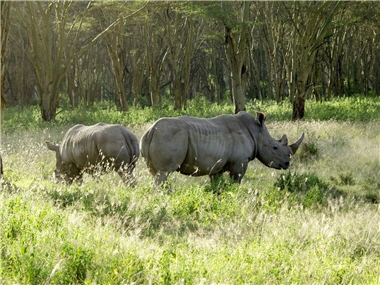
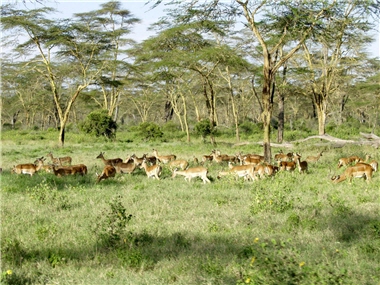
- upper left, upper right & lower left: Besides flamingos, there are other animals commonly seen in the park, such as black rhinos, baboons, and gazelles. / by Lung-sheng Chang
- lower right: Looking down Lake Nakuru National Park from sky, the beautiful pink ribbon is in fact a spectacle constituted by millions of flamingos.
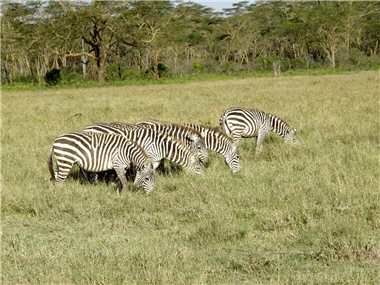
Compared with Taiwan, despite its much wider poverty gap, Kenya rivals developed countries with regard to conservation of wildlife habitats. "It's a country in which half of the population earn as little as less than one U.S. dollar a day, but the harmony between animals, tourists and local people there is something for us to learn from." Chang commented with a feel of heaviness in his voice.
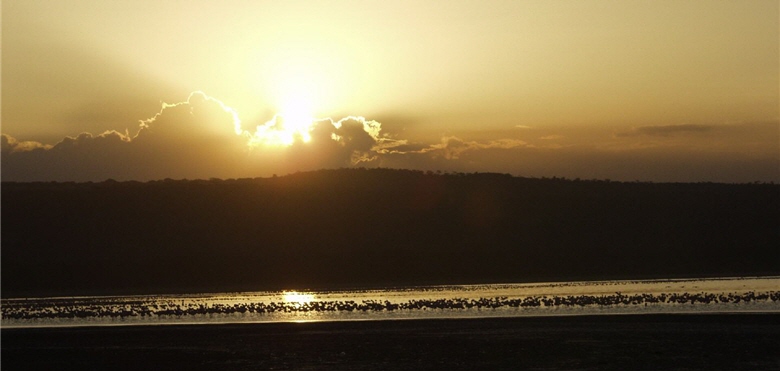
In a photograph presented by Chang, flamingos flap wings and soar high in the sky, bursting with vitality. And Chang's concern for environmental conservation is just as impressive and inspiring.

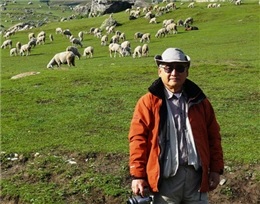
Lung-sheng Chang
Chang graduated from the Department of Architecture at National Cheng Kung University, and earned a master's degree in City and Regional Planning at University of Pennsylvania (U.S.A). He had served as Director-general and Administrative Deputy Minister of Construction and Planning Agency, Deputy Minister of the Council for Economic Planning and Development, Minister of the Environmental Protection Administration, etc., and currently the chairman of Chien-Chen Sustainable Development Foundation and of Urban Regeneration R&D Foundation. He had also published books include Expedition to Penguin Kingdom and Roaming in the Bering Sea: Travel Notes on the Tour to Kamchatka.
- upper left: To prevent unlawful stays or activities, Lake Nakuru National Park has only one entrance/exit. / by Lung-sheng Chang
- upper right: The Kenyan wisdom of bringing animals, tourists and local people into harmony with balanced management is something for us to learn from. / by Lung-sheng Chang
- lower: In the twilight, birds congregate on the lake; Chang hopes that this lively scene should not just appear in the photograph. / by Lung-sheng Chang


