
A Career Deeply Connected with Birds-Something about the Bird Photographer Qing-song Sun
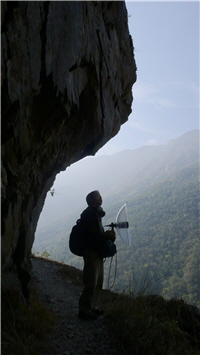
With his relentless passion for birds, he has been a bird watcher for nearly three decades.
His rich knowledge about birds, excellent photography skills, and familiarity with bird ecology have all contributed to one extraordinary picture after another.
He can't fly, but owns the strongest pair of wings in the world. Though those wings had once broken, he has no regrets and he never quits.
Say No to Superficial Photography of Ecology
He is Qing-song Sun, a photographer of bird ecology who has started his career in bird photography since 1984. He had also once worked with Yushan National Park (YSNP) and produced a well-received music album Yushan Concert by spending 3 years recording bird chirps in five main spots in the Park.
Without ever paying for photography lessons, the self-taught Sun was courageous enough to have chosen bird photography as his niche. His photography style has always been about one of bird ecology instead of some superficial shooting of birds. He hates to take just clear “mug shots” of birds but hopes to capture the creatures' spirits on films that tell great stories and make an impression.
“All creative arts should incorporate different elements to show their distinction in addition to the basic requirement of presenting beauty,” explained Sun about his ambition to interpret bird ecology through photography.
Old School Long-lasting Works
Sun had at first used the most primitive and the most tiring way to photograph birds: waiting. But simply waiting was so passive and ineffective that Sun had to adopt an improved, more planned style of photography, which encompasses several key steps. It requires an initial reconnaissance over the target area, followed by ecological observation and great judgments on the surroundings. After a site is chosen, a camouflage needs to be made and takes one or two weeks for the birds to get familiar with before any photo shooting can take place. The photographer must disguise him/herself and blend in with the environment as well as the birds. That's the photography Sun has insisted upon.
“It requires more efforts, stamina, time and thoughts. Many photographers wouldn't do it this way because they might not get to press the shutter at all after waiting for dozens of days.” But Sun has been doing so for over 20 years.
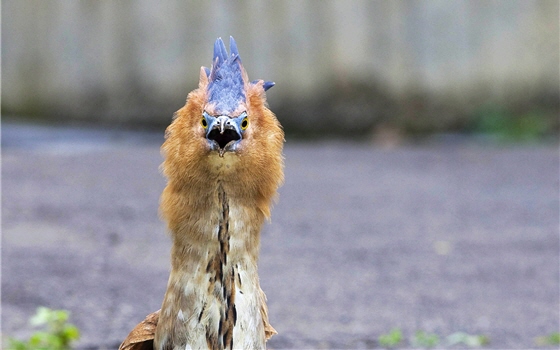
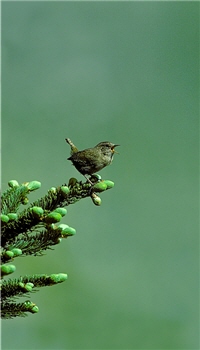
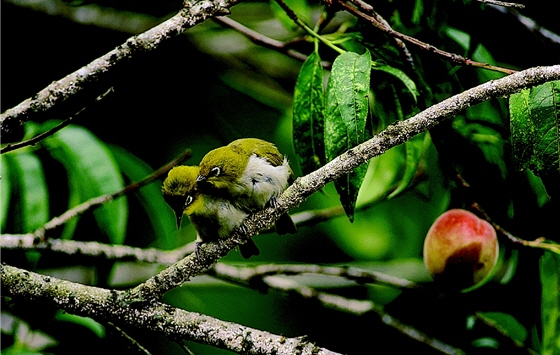
- upper left: Whether it is bird photography or birdsong recording, Sun has learned it from a trial-and-error process all by himself.
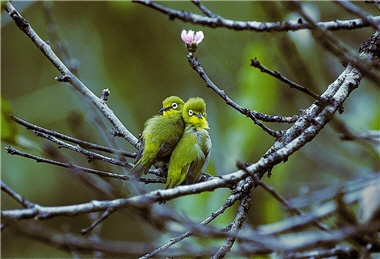
- upper right: Joking about this intimate couple of White Eyes (Zosterops japonicus) photographed by him, Sun said their love will last until the seas run dry and “the peaches rot.” (while the original Chinese idiom should be “until the sea runs dry and ‘the rocks crumble,’” meaning “till the end of time.”)
- lower left: Malay Night Heron (Gorsachius melanolophus) is demonstrating.
- lower right: Sun hopes to capture the creatures' spirits on films that tell great stories and make an impression; this is also the philosophy he has been trying hard to pass on to his students.
Interview & Text/ Wei-ting Lin
Photo provided/ Qing-song Sun
Translator/ Kuan-yu Ou
Never Shun Difficulty in Pursuit of Depth
In his 1997 book The Story of the Turtledoves, Sun recorded in detail the life of a pair of Turtledoves (Streptopelia chinensis). He chose this ordinary bird as his subject instead of a more unusual one because he thought every journey of a thousand miles begins with a single step; only by accumulating knowledge about something ordinary can we achieve greatness.
“People have been crazy about photographing Black-faced Spoonbills (Platalea minor). But how much time do they spend in observing the bird? If the time they invest in observation is limited, so will be the depth of their photos.” The depth is determined by the level of a photographer's willingness to understand the world of birds.
This was also the philosophy by which Sun later conducted the observation and research on White Eye (Zosterops japonicus), a bird Sun had watched closely for four years. But soon after Sun began his work, the 9/21 Earthquake struck. Things about White Eye were halted as Sun lost his house and his beloved wife.
“I felt so exhausted both physically and emotionally that I just couldn't go on carrying those long lenses around.” But as Sun still had to shoulder the responsibility to make ends meet for his life, he came back to rebuild his home a year later.
Focus Changed to Collecting Birdsong
During the 4-year observation, Sun had collected numerous valuable files of sounds, images and texts. But as he was getting more involved in the observation of the bird, he had also become less focused on photography but more on something he felt more interested in: the birdsong. As this was a relatively unexplored area and an opportunity for him to try something else, Sun quitted his long-time job at National Museum of Natural Science and plunged into the task of collecting birdsong, but only found there was hardly any market for bird chirps.
Sun sighed about the frustrating situation that he almost had to give up and make a living by selling fruits and betel nuts. But he just wouldn't bow to adversity but insisted on braving all the hardship like a pine standing straight in harsh weathers. Finally, under some friends' referral, he was hired as a producer of a music album, and has since rid himself of financial trouble.
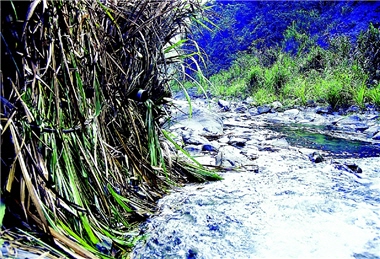
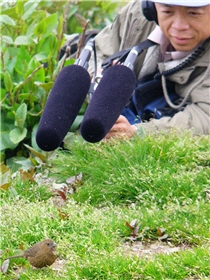
- upper left: See where the long lens was hidden in this picture? In order to photograph the birds near the stream, Sun disguised himself and blended in with the environment.
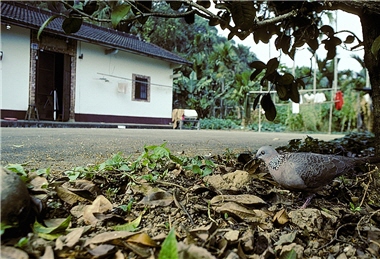
- upper right: Look at the world from the eyes of this Spotted-necked Dove (Streptopelia chinensis) and feel about the quiet and sweet life it lives.
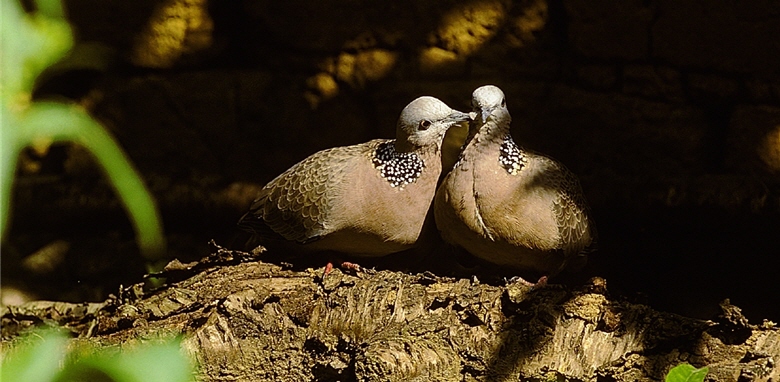
- lower: Turtledoves (Streptopelia chinensis) hid in the dark and clung to each other.
Recognized as a Leading Pioneer in Birdsong Recording
In 2004, Sun raised a lot of eyebrows with his first album of birdsong music Birds by collecting 43 kinds of chirps of wild birds in Taiwan in only 18 months. How did he make it? “It could be difficult for laymen, but I've been with birds for over 20 years!” Indulged in the world of birds as he has been, Sun never considers himself an expert. “I'm no more than a person fond of birds,” he said.
This bird lover then secured an irreplaceable spot in the world of birdsong recording as he released the album Yushan Concert in 2009.
Overcoming the low points in his life, Sun now stands as strong as a well-seasoned pine tree, showing his fortitude and determination as he always has. He never pursues fame or wealth but a career in which he could blend in with the birds in the Nature.

Qing-song Sun
Sun started bird photography in 1984, and had worked for National Museum of Natural Science for 18 years from 1986 to 2003. He had been dedicated to the observation, research and photography of birds, and published a book titled The Story of Turtledoves in 1997. Sun quitted his job at the Museum in 2003 and has since become fully devoted to collecting birdsong. After his album Birds was released by Wind Music in 2004, he had worked with Yushan National Park for three years and released another album Yushan Concert in Dec. 2009.
- upper left: Couples of White Eyes (Zosterops japonicus) usually maintain a loyal and long-lasting relationship; the two White Eyes in the picture that are in love and cling to each other constitute a sweet, lovely scene.
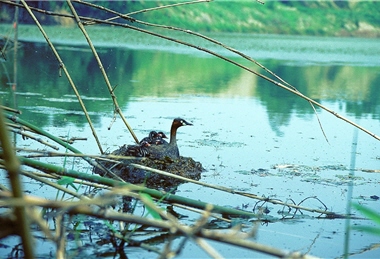
- upper right: The whole family of Little Grebe (Tachybaptus ruficollis) is leisurely resting on the river. It’s truly a lovely scene.
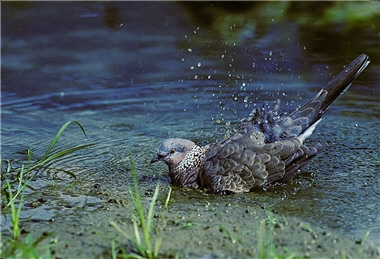
- lower left: Birds could do exercise and have fun while cleaning themselves with water. In this picture, a Spotted-necked Dove (Streptopelia chinensis) is enjoying its bath.
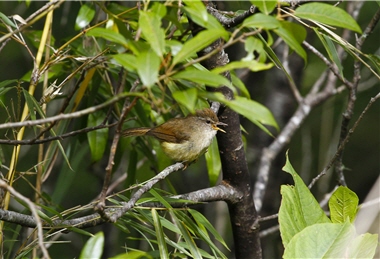
- lower right: The birdsong of Yellow-bellied Bush Warbler (Cettia acanthizoides) resembles the sound of a flute, which is a string of thin and sharp chirps “di-di-di” with one higher than another.


