
The Most Intriguing Fishermen-The Kingfishers
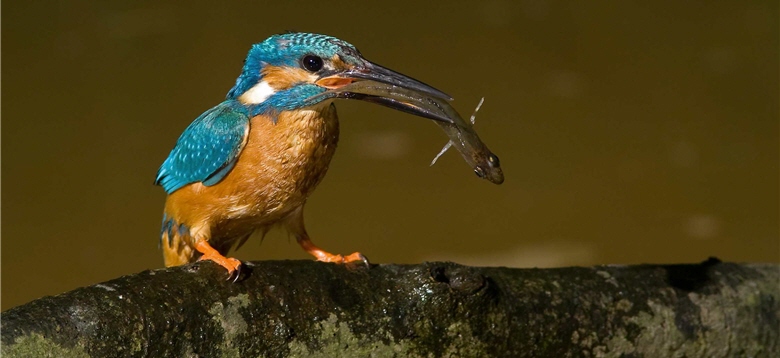
Small, blue, with a pointed bill and a short tail, the Kingfisher (Alcedo atthis) is a common sight by the waterside. It is so widely known that most people can describe its appearance. Even elderly people know what a "fisherman" (a Taiwanese colloquial name of the bird) is. However, is the Kingfisher all alone in Taiwan? No pity for this fisherman--not only does it have family and relatives, but it has plenty!
Don't be too shocked—the Kingfisher, the Bee-eater (Meropidae), and the Hoopoe (Upupidae), three groups which look nothing like each other, are all members of the order Coraciiformes! As if the surprises weren't enough, the recent molecular techniques analyzed the DNAs of birds and found out the Bee-eaters in Kinmen had actually evolved from Hornbills (Bucerotidae). How amazing it is to find the two totally different-looking species are somehow related! If you still have your doubts, let's take a look at what textbooks tell us.
The Fisherman Is Not Alone
Taxonomists did not classify the Alcedinidae, the Meropidae, the Upupidae, and the Coraciidae under the order Coraciiformes for no reason. Bird-watchers must know well these families share a common characteristic: their bills are either long and thin or broad-based. These birds have developed such distinct bills to dig tunnels as nests easily. Kingfishers in Taiwan build their nests in dirt banks, and the long, strong bills make useful tools. Nevertheless, though all assigned to the order Coraciiformes, Bee-eaters, Hoopoes and Kingfishers have certainly evolved at different paces. While Bee-eaters, Hoopoes and rollers are able to capture insects in continuous flight, most Kingfishers, except for a few species that do not belong to Alcedinidae, can only catch prey in a perch, lagging behind in terms of evolution.
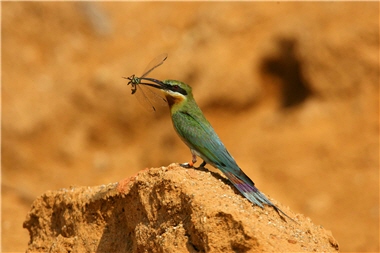
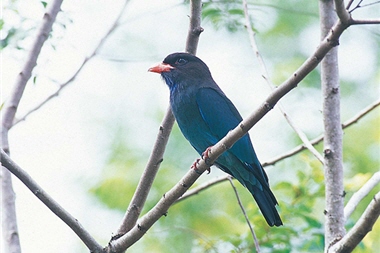
- upper: The kingfisher is a famous fisherman./ by Ben
- lower left: The Bee-eaters (Meropidae) in Kinmen are most characteristic summer migratory birds in the area. /Photo provided by Ming-yuan Chiu, taken by Su-lan Chiu-Lu
- lower right: Eurystomus orientalis is also named Sam-bo bird; it doesn't look like Common Kingfisher (Alcedo atthis), but they have a lot in common./ by Jia-sheng Chen
Text/ Chien-chung Sa
Special thanks to/ Bird photographer Jia-sheng Chen
Ms. Shu-chun Yu of Yangmingshan National Park
Professional Biological Proofreader Ms. Yi-de Xu
Yu-cheng Sheu, Assistant Professor of Institute of Natural Resources National Dong Hwa University.
Photo provided/ Jia-sheng Chen
Translator/ Miranda Wang
People often think of tree Kingfishers, river Kingfishers, and water Kingfishers as the same; to many, these are just different names of the same bird. This is wrong—the three names actually refer to members from three totally different genera, or even families. In fact, the physical differences between tree Kingfishers and river Kingfishers in Taiwan are noticeable even to the naked eye.
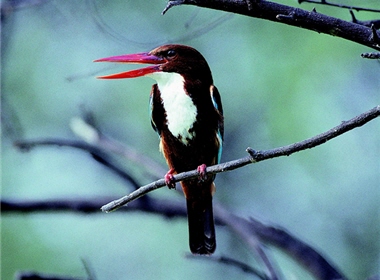
When walking by mountain streams in Taiwan, we often encounter a familiar bird— with metallic blue upperparts, flying low and letting out "cheer-cherrrr" squeaks—the Kingfisher. If not startled, after a short flight, the bird may perch again on some nearby twig by the water. Notice then if its tail is much shorter than its bill—this is it, the main characteristic of the Alcedo species. Then, where are the best places to watch tree Kingfishers? The answer is Kinmen and Matsu. Every year, many bird lovers on the Taiwan island spare no expense to travel all the way to Kinmen just to watch birds. The White-throated Kingfisher (Halcyon smyrnensis), Black-capped Kingfisher (Halcyon pileata), and Striped Kingfisher (Halcyon chelicuti) are must-sees. Among all, the Striped Kingfisher is especially a distinct species of Kinmen; it would be easier to win a lottery than to see a Striped Kingfisher elsewhere!
The Common Kingfisher is the second smallest in the Alcedinidae family in Taiwan, only larger than the Oriental Dwarf Kingfisher (Ceyx erithaca); in comparison, tree Kingfishers are much larger. What's more, all Halcyon species on the island have tails a little bit longer than the bills, a characteristic different from the Alcedo species. Nevertheless, there are always exceptions in nature. The Striped Kingfisher (Halcyon chelicuti), the only black-and-white plumage in Kinmen, differs from other Halcyon species in Taiwan in both appearance and behavior. Some taxonomists thus place this bird in the family Dacelonidae instead.
Common Kingfisher
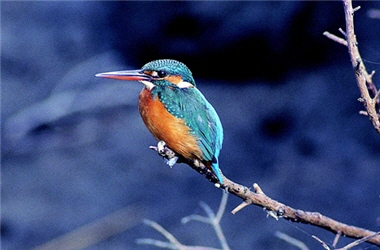
This blue, short-tailed bird is the most familiar river Kingfisher. From seashores to mountain streams at medium elevations, Common Kingfishers are often found perched in silence on twigs or rocks near water, waiting to hunt fish. They mainly feed on fish, but also take crustaceans and small amphibians when fish are scarce. When hunting, Common Kingfishers choose waters of certain depths, so that they won't crash onto the bottom. On the other hand, in areas where the water is relatively deep, Common Kingfishers also modify their hunting strategies. Instead of hunting from a perch, they fly to a higher position first before swooping down so that they can dive deeper. Diving as fast as 40 km per hour, these birds seldom fail to snatch fish that swim within 60 cm below the water surface. Another interesting fact: while many birds (including Kingfishers, egrets, etc.) foraging on fish and other water creatures are able to quickly adjust their vision to the light refraction in water, Kingfishers diving to catch fish even develop an ability to switch between foveae when entering water. As a result, Kingfishers boast visual acuity both in air and underwater.
Once catChieng the fish, Common Kingfishers usually return to their perch, and slam the fish against a twig or a rock until the prey is motionless before swallowing it head-first.
- upper left: Every year, many bird lovers in Taiwan spare no expense to travel all the way to Kinmen just to watch birds. / Photo provided by Kinmen National Park
- upper right: Having a bill with the upper part and lower part in symmetrically same thickness and a tail that is much shorter than the bill are important features of birds of the genus Alcedo. / by Jia-sheng Chen
- lower left: White-throated Kingfisher (Halcyon smyrnensis) is named by a large white area around its breast (from the throat to the upper abdomen). / by Jia-sheng Chen
- lower right: but in China, it is also named “Blue Kingfisher” in Chinese according to the color of its back. / by Jia-sheng Chen
White-throated Kingfisher (Halcyon smyrnensis)
While these large-sized tree Kingfishers are a frequent sight in South Asia and boast huge populations, they seldom occur in Taiwan, except migratory species. Most of the time, they are spotted in Kinmen and Matsu. These Kingfishers often perch on twigs at the edge of woods near water. The favored food ranges from reptiles to amphibians; fish constitutes only part of its diet. The birds are noisy and competitive in nature. They replaced Collared Kingfishers (Todiramphus chloris) and became a dominant species in Sumatra, Indonesia 60 years ago and have also done so in Egypt ever since 1986.
Black-capped Kingfisher (Halcyon pileata)
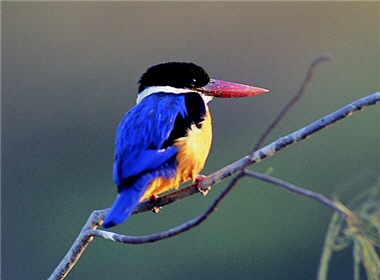
Though a migratory bird in Taiwan and its off-shore islands, this Kingfisher's presence throughout the year is far from regular. Like the White-throated Kingfisher, this bird is a common species at the edge of woods near water and is sometimes found perched on wires. It feeds on a variety of prey like other tree Kingfishers, only less on fish. Easily disturbed, it flies away once startled by noises.
Ruddy Kingfisher (Halcyon coromanda)
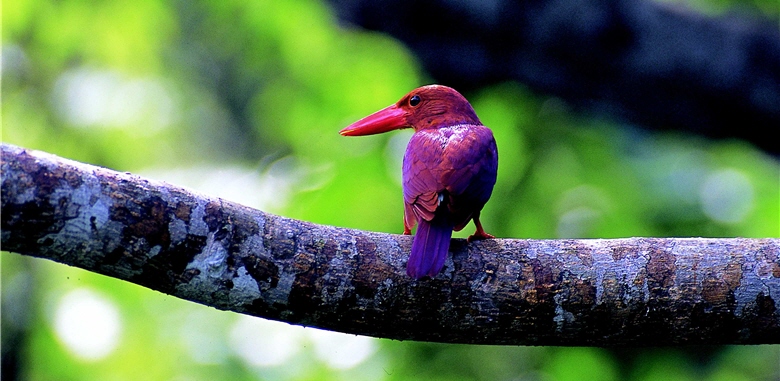
This brightly colored bird is the only Alcedo species on the island that is rust red all over the body. The regular presence of this rare migratory bird in Taiwan proper, excluding off-shore islands, indicates that Taiwan, especially its east coast, is on one of its major migration routes. It stays in a wide range of habitats, most of which are in woods away from waters. Known to inhabit forested areas, this species hunts reptiles and insects. In the Philippines, the bird is reported to smash snails on a surface before it eats the flesh inside the shell.
Collared Kingfisher (Todiramphus chloris)
Though resembling Halcyon Kingfishers, this Todiramphus species mark its difference from them with its black legs. Widely distributed and with 50 subspecies around the world, the species may have the biggest population among the family Alcedinidae. However, it is extremely rare in Taiwan; it takes luck to see even one each year. It is most commonly found in coastal wetland and tends to observe the prey from high above, such as on utility poles. It hunts a diversity of prey, except for fish.
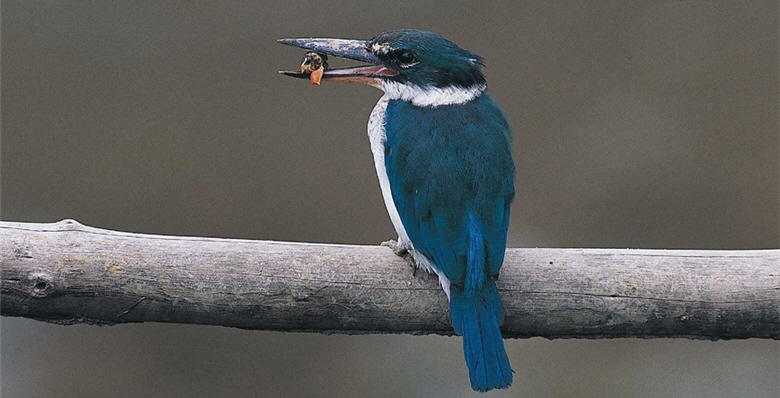
- upper: A characteristic of the Halcyon genus is that their lower bills are usually thicker than the upper bills. The picture shows Ruddy Kingfisher (Halcyon coromanda). / by Jia-sheng Chen
- lower: Collared Kingfisher (Todiramphus chloris) is extremely rare in Taiwan; only the lost birds can be found so far. / by Jia-sheng Chen
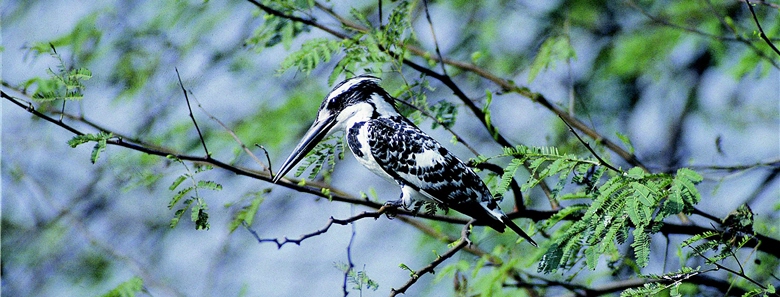
Striped Kingfisher (Halcyon chelicuti)
Found almost only in Kinmen, this noisy bird's piercing squeaks can be easily heard even from a long distance. Striped Kingfishers usually hover above the Ci Lake in Kinmen and hunt for the prey, but tend to fail a lot; it seems they are not skilled hunters compared to Common Kingfishers. Their way of treating the prey is also different from that of Common Kingfishers: they usually swallow the prey right in the air, only large fish prey being shaken vigorously first.
Whether the above descriptions are familiar or new to you, all of us should bear in mind that other species on earth evolve with such a simple purpose as to adapt themselves to the environment and to survive. Unfortunately, humans do not seem to have bothered to learn from the wisdom presented by the evolutions of other creatures. Without proper understanding, humans are more and more alienated from other life forms; mankind's greedy exploitation of the Nature also reveals a total disregard for the needs of other species.


Chien-chung Sa
Sa has started bird observation since he was twelve. He had served in Interpretation & Education Section of Yushan National Park Headquarters from 1985 to 1992, and had served in Interpretation & Education Section of Yangmingshan National Park Headquarters from 1992 to 2009. He has worked in Taiwan’s national parks for more than 23 years.
- upper: Though Striped Kingfisher (Halcyon chelicuti) belongs to the genus Halcyon, the proportion of the bill and tail of Striped Kingfisher is very similar to that of the genus Alcedo. The main source of food of Striped Kingfisher is fish, which differs from that of other birds of the genus Halcyon. / by Jia-sheng Chen
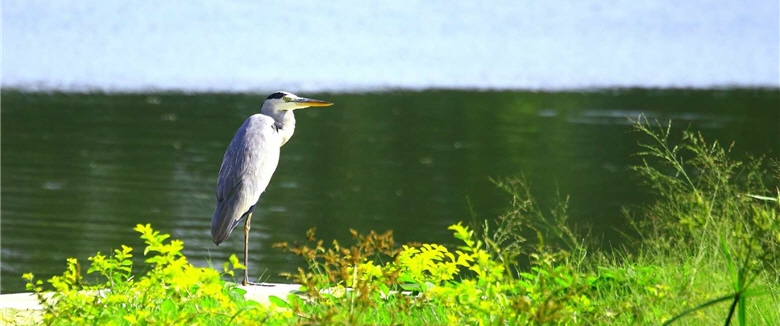
- lower: All life forms on earth evolve with such a simple purpose as to adapt themselves to the environment and to survive. / by Kevin


