
Love for Bird-watching-Love for Bird-watchingAn Interview with Chuan Liu, Associate Technical Specialist of Kenting Nationa
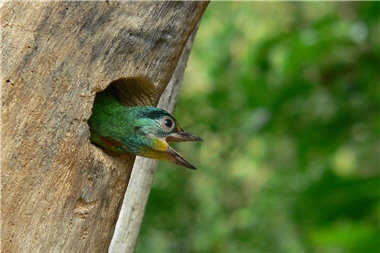
Where can anyone find a job in which he or she is able to be up close to Muller's Barbet (Megalaima oorti) and record details about them while sitting in the office? For Chuan Liu of Environment Maintenance Section, Kenting National Park (KTNP), it's a privilege endowed by heaven.
Back in April, 2006, two barbets built a nest on a coral tree (Erythrina) right outside the window of Liu's office. Setting up a telescope and a camouflage net and acting like paparazzi, Liu and his colleagues had spied on that cute pair of new tree-borne neighbors. They had eye-witnessed some precious moments of the birds' life and recorded the chirping of the fledglings, even though they also missed some important scenes.
But “it may be a good thing to miss some part of it, especially the ending,” said Liu, as he recalled a sad experience of observing another flock of barbets nesting near Conservation Section the next year. While everyone was eagerly anticipating the growth of the young birds, they were devoured by a rat snake. “Their parents might not have survived the attack, either,” mourned Liu.
Actions out of Deep Love for Birds
Liu's love for birds is as deep and natural as that for the Nature.
A long-time employee in KTNP, Liu was lucky enough to take advantage of his job to maintain his hobby of bird-watching that has been developed since his college years.
Back in college, Liu was a frequent mountain climber, but was disgusted by many hikers' meaningless urge to conquer one peak after another. Later he inadvertently saw some intriguing pictures of natural ecology taken by students from the Department of Biology. This ignited his passion for the Nature, and he decided to join Tunghai University's Wild Bird Club, the first-ever bird-watching club in college level across Taiwan, and has since become a bird lover for the next 36 years.
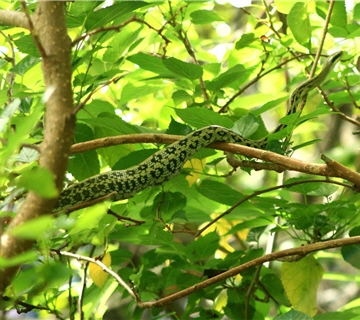
- upper left: Maintaining beautiful bird scenes is Liu's persistence and prospect when processing ecological engineering. / by Chuan Liu
- upper right: A young bird of Muller's Barbet (Megalaima oorti) is looking around.
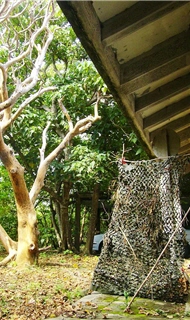
- lower left: In order to observe Muller's Barbet (Megalaima oorti) at close distance, Liu set up a camouflage net outside the window of his office.
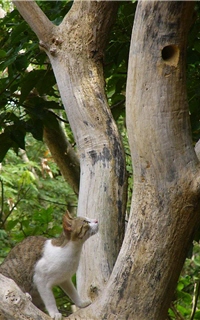
- lower center & lower right: Before leaving the nest the young birds have to face many natural enemies, such as stray cats (lower center) or rat snakes (lower right).
Interview/ Joyce Chang
Organize & Text/ Hsin-hua Lian
Photo provided/ Chuan Liu
Translator/ Kuan-yu Ou
“Bird-watching is only a means; my real purpose is to get close to the Nature and to relieve stress at work.” In 2008, Liu was recognized by the Ministry of Interior (MOI) as Honest Civil Servant for his incorruptibility and perseverance in handling numerous construction projects. Such dull and stressful work has made Liu choose bird-watching as his hobby to vent the pressure.
The MOI praised Liu as “a pioneer in applying ecological engineering to a variety of oudiv>
One of his award-winning projects is the newly-built bird island at Longluan Lake in Kenting.
Longluan Lake is located at the southern tip of Taiwan, and has long been an important supply depot for over 200 recorded species of migratory birds. Despite a bird-watching house in place since 1993, the birds resting at the lake surface had never stayed whenever “Luo-shan wind” (downhill wind) started to blow in autumn and winter. It was until Liu planned the construction of a strip-shaped bird island, which functioned like a dike but looked far more natural, that the birds began to flock together on the lake under the protection against the wind and waves.
Besides, during the process of soil preparation in the same project, Liu insisted on retaining the topsoil of the target area by excavating the soil while scraping and nurturing the topsoil and the weeds on it before putting the subsoil and topsoil back in place. This has kept the most viable plants in their original living environment and has saved both time and money spent in greening and planting grass.
Better Cameras Not Help Relax Birds' Vigilance
Liu knows about every single kind of wild birds at Longluan Lake, and his most recent focus has been on the Ospreys (Pandion haliaetus), a migratory bird that can be seen as late as in June and July but should've moved northwards much earlier.
The osprey is a raptor that belongs to the top level of the food chain of the fauna. The abundance of it or other raptors means a better ecological environment with sufficient food supply. Once the evidence of Ospreys nesting in Taiwan should be found, “that'd be really big news!” Liu said excitedly.
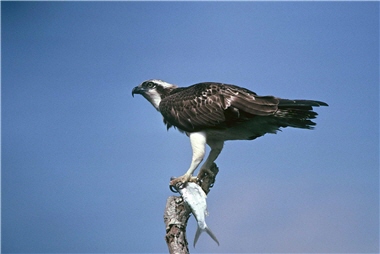
Liu's first and unforgettable encounter with the Osprey can be traced back to the winter of 1990, when Liu was on a routine check at the Lake and accidentally spotted an Osprey standing atop a tree and searching for preys. With familiarity with local terrains, he managed to get as close as only 7 or 8 meters from the Osprey and carefully photographed the bird enjoying a milkfish. Liu's nervousness at that close-up moment is still so vivid in his mind 20 years later.
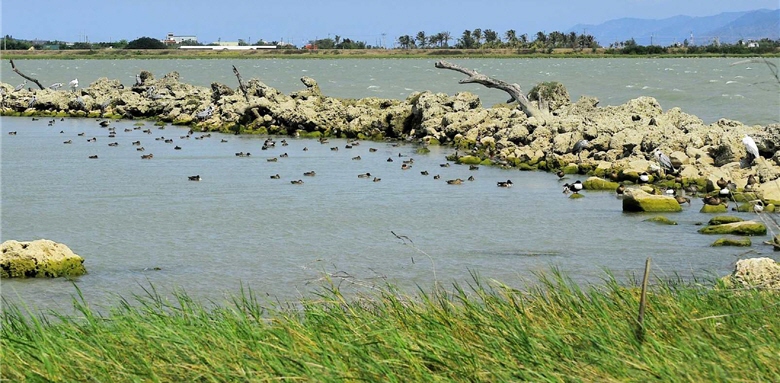
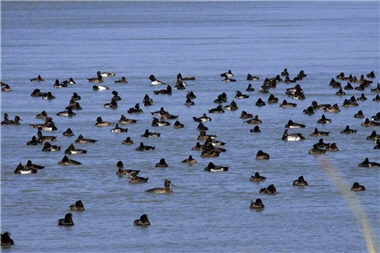
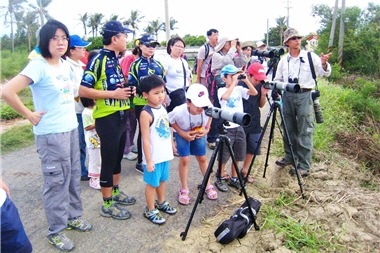
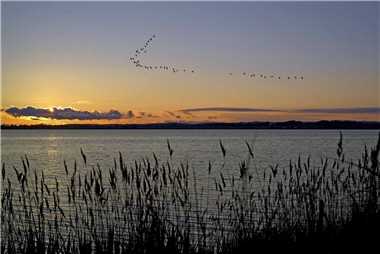
- upper left: Liu expect that Taiwan will become a fixed habitat for migratory birds someday. The picture shows Tufted Ducks (Aythya fuligula) flock together in Longluan lake every winter. / by Chuan Liu
- upper right: Liu is working as an interpreter and guiding the citizens. / Photo provided by Chuan Liu
- lower: All kinds of water birds flock together in the man-made bird island at Longluan Lake in Kenting when the weather is sunny.
Pitifully, as the camera equipment gets newer and more powerful, the Osprey's vigilance against humans has never lessened. While admitting his lack of stamina now to watch for any raptors, Liu described in humor a comic-like scene about a veteran bird educating the rookies about migration: “Well, gentlemen, on your way from Siberia down south, you may get to an island that looks like a sweet potato. People over there are so dangerous that you've got to make a detour if you don't want to get killed.”
A Tough Guy with a Soft Heart on Birds
Always mentioning about birds, Liu tends to give the wrong impression that he's a bird expert instead of an engineer.
After just finishing the story of the Osprey, Liu was ready to talk about yet another bird family: the Anatidae.
As the wetland around Longluan Lake is vanishing, the Anatidae at the Lake are facing grave danger posed by economic development. Barely able to maintain its natural outlook under the protection of KTNP, Longluan Lake area now provides less and less food for the Anatidae as farmland on its east side has been transformed into lodgings and racetracks. If things get worse “with habitats for wild birds totally destroyed and food gone, the birds will never stay however friendly people try to be,” said Liu.
To his comfort, the north side of the Lake is still underdeveloped, where over 700 Gray-baked Starlings (Sturnus sinensis) have chosen a gigantic banyan at a sheepwalk as their habitat. Liu hoped that “once migratory birds choose a fixed habitat in Taiwan, it means this island has some great places to visit with friendly humans and ecological environment.”
“You know what? At nightfall in October every year, numerous Gray-baked Starlings would gather up on the electric wires near the banyans. When they fly up in flocks, it's truly spectacular. And by looking up to the sky on the main street in Kenting, you can always spot egrets migrating 24/7 right above your head!” Liu's enthusiasm in introducing all his feathered friends is just as sincere, natural, and touching as those lively birds in KTNP.

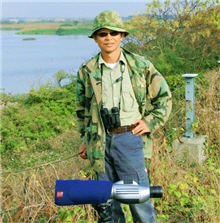
Chuan Liu
Chuan Liu, Associate Technical Specialist of Kenting National Park Headquarters, has been a bird lover for 36 years. Serving in KTNP Headquarters since it was established, Liu has been responsible for numerous construction works in the Park. He was recognized as Honest Civil Servant by the Department of Civil Service Ethics, Ministry of the Interior in 2008.
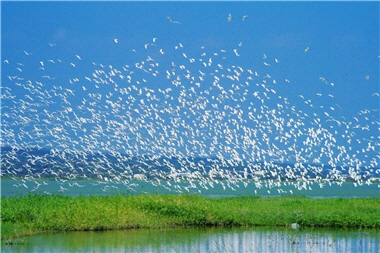
- upper left: In this picture, Little Egrets are migrating. If we don't protect this scenery with our heart, it will surely hard to be seen in the future. /by Yu-wen Chen
- upper right: 20 years ago, Liu managed to elude the sharp eyes and hearing of an osprey (Pandion haliaetus) and took a close-up picture of it eating a milkfish.


