
Keeping an Eye on the Land-Kuang-ying Huang, Conservation Section Chief of Taijiang National Park on the Significance of Wild B
At sunset, Black-faced Spoonbills (Platalea minor) rest and feed leisurely on the sparkling lagoons in Cigu. This sight may appear nothing more than normal, but it is the result of years of painstaking efforts by NGO and government, noted Kuang-ying Huang, Section Chief of the Conservation Section of Taijiang National Park.
“Zengwun Estuary Watland and Yanshuai Estuary Watland are successful cases of conservation initiated by the public. Though the establishment of 8th Naphtha Cracking Project remains debatable at this point, we nevertheless have to give credit to the achievement made by the government and the public in habitat conservation,” said Huang.
The scene of flocks of birds flying in the air is always magnificent, but in order to see it we must strive to guard their habitats and ensure the quality of them. To that end, habitat and bird poplation monitoring will be a critical step.
Establishing a Monitoring Database to Benefit All
Birds are widely distributed in various types of habitats and are sensitive to the impact of the environment. Compared with other forms of life, birds are clearly classified, easily identified and are high up on the food web. While the monitoring of most land mammals depends on indirect evidence such as excrement, birds are an ideal bioindicator for environmental monitoring.
In the mid 1980s, BirdLife International proposed the idea of Important Bird Areas (IBAs), and Taiwan put the idea into practice in 1999. Up to now about 53 major wild bird habitats have been designated in national parks, coastal areas, wetlands and mountains.
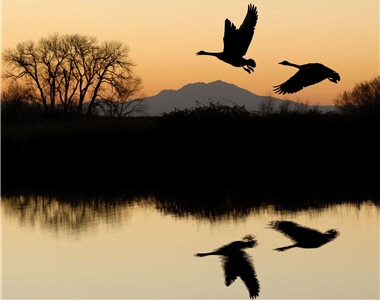
- upper left: A natural environment can bring benefits to all life forms on Earth. /by Terrance
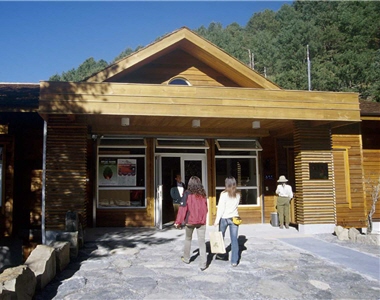
- upper right: Admissions to the parks and the accommodation limit of the villas inside the parks are all carefully monitored and controlled. Through small-scale ecotourism, the biodiversity and environmental balance of the parks can be maintained. The picture shows Paiyun lodge./Photo provided by Yushan National Park, taken by Wun-ke Tsai
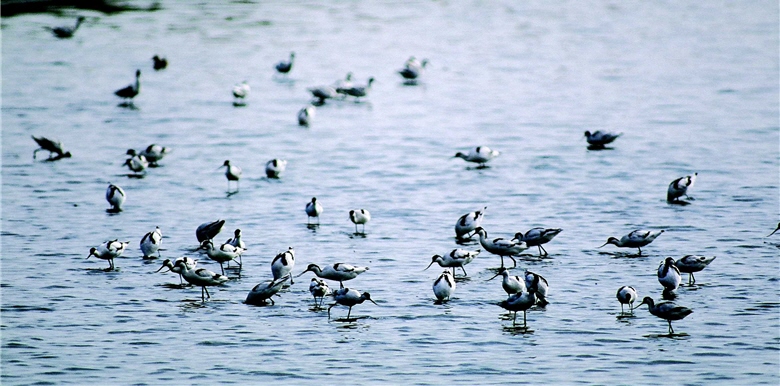
- lower: Proper management and restoration of wetlands can provide birds with safe habitats and feeding grounds. Picture shows many Avocets (Recurvirostra avosetta).
Interview & Text/ Hsin-hua Lian
Photo provided and taken by/ Kuang-ying Huang
Translator/ Yonglan Huang
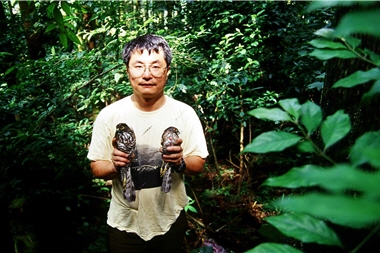
Huang noted that the wild bird habitats designated by NGOs are not legally binding, but NGOs' expertise and knowledge on habitats are still what governments rely on in land development projects.
Some might see little or even no relevance between the monitoring of birds and our living environment. “This is a short-sighted mindset. People nowadays want immediate rewards and results and fail to appreciate how the data obtained from longitudinal monitoring and research can contribute to the natural environment,” commented Huang. The U.K. government, for instance, has used bird population and species as indicators for the quality of environment, so they could base their future environmental policies on environmental changes in the past.
Through tracking the ecological environment and natural resources of an area, we get to know the changes1 in an area and are able to adapt our management approach accordingly. This can be of great help to birds, humans and even other animals and plants. “Take national parks as an example, we monitor the number of visitors on a long-term basis so as to measure the impact to the habitats when the number of visitors exceeds the environment's carrying capacity. That's why visitors must apply for admission to the parks. Through small-scale ecotourism, the biodiversity and balance of the parks can be maintained, and that's how we monitor and manage the parks,” noted Huang.
Location-specific Monitoring For a Common Goal
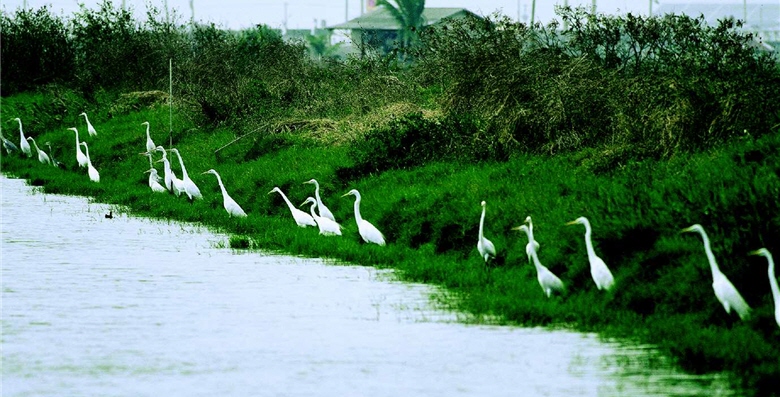
Just like teachers teach students according to their aptitudes, monitoring of bird and habitats can take different forms. In Kenting National Park, researchers can just look up and use counters to count the number of raptors flying overhead. In Taijiang National Park a method known as “counting flocks” can be used, where the observer selects a spot in an area with great view and count all the species and population2 of birds within that area. Marking and banding are another ways for monitoring bird population.
But sometimes if a bird suddenly flies up while the observer is still counting, other birds will follow suit and the counting gets interrupted. Therefore, experienced observers would roughly count the number of bird species first and then estimate the proportion of a species of the bird within all the birds present there. That way their observation won't end up in vain.
“But the most widely applied methods are the line transect method and the circular-plot method. I recalled that in 1982, as a student I participated in a bird survey project. We went to Hehuan Mountain and recorded many bird species as well as their calls. That was my very first lesson of bird monitoring,” said Huang.
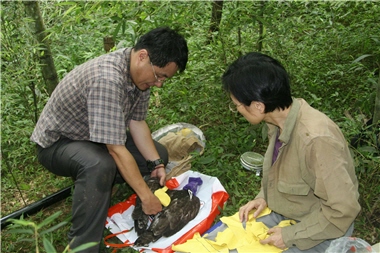
- upper left: Lucia Liu Severinghaus (right) and Kuang-ying Huang are doing “Mark-Release-Recapture” research (with wing mark and radio tracking device) for follow-up monitoring.
- upper right: Yangmingshan National Park has been implementing bird monitoring and tracking plans since 15 years ago. The picture shows two Besra Sparrowhawks (Accipiter virgatus), a female (left) and a male (right).
- lower: Great White Egrets (Casmerodius albus) in the wetlands in Taijiang National Park would separate spontaneously to avoid fighting over limited space when they feed, and thus are easier to be monitored by the “counting flocks” method.
With the line transect method and the circular-plot method, observers record the birds' calls within a defined area and these methods are most commonly used in field observation. Observers adopting the methods, however, must first recognize the calls of different birds and make sure they keep a proper pace throughout the observation so that there won't be bird species omitted in haste or repeatedly recorded in lingering stays. In sum, the execution of monitoring is far more complicated than one can imagine.
Despite the different methods, bird monitoring generally takes place around the same time period. Birds are most active from sunrise to 3 hours thereafter, or around 5:30 a.m. to 8:30 a.m. Later as sun rises up, the calls of the birds become less frequent and fewer bird species can be recorded, which explains why there are fewer birds when it approaches noon. Then 2 hours before sunset birds become highly active again, though not so much as they do in the morning. Therefore, the early morning is the best time in a day for bird observation.
Learn and Care for the Nature and the Environment
Take water birds for example. Different species dwell in waters of different depths. In addition to that, factors such as water quality, sediment, velocity of water currents, pH value and vegetation all affect bird's habitats. If the habitat gets disturbed and the environmental factors changed, restoration of the habitat can only be based on the previous data acquired through continuous monitoring.
In fact, the establishment of Taijiang National Park represents an effective way to protect Black-faced Spoonbills. Yet the hardship lies not in the monitoring work but in reaching a consensus with the local fishermen. As Black-faced Spoonbills winter in the Park from Sep. to Apr. each year, we try to persuade the fishermen not to fish in this period but fish from May 15th to Sep. 5th instead at the main habitat of the spoonbills. In the Park, the catch of clams by the fishermen at the main habitat of Black-faced Spoonbills has also been recorded as an indicator of the habitat's productivity. This is immensely helpful for the management of the habitat in the future.
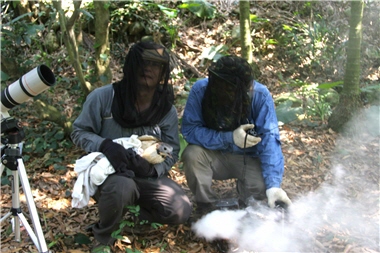
- upper left: The monitoring and tracking of birds can be a dangerous job. The picture shows the protective gears and apparel that Kuang-ying Huang and the researchers have to wear to prevent bee stings as they try to retrieve the radio tracking device on Oriental Honey Buzzards (Pernis ptilorhynchus).
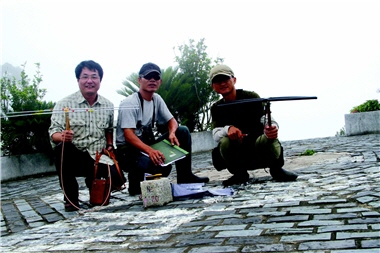
- upper right: Tracking the signals from those radio transmitters attached to the birds through GPS triangulation is one way to monitor the birds and understand how the birds utilize the habitats.
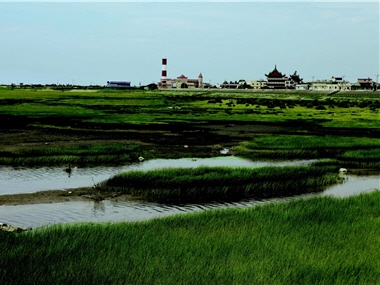
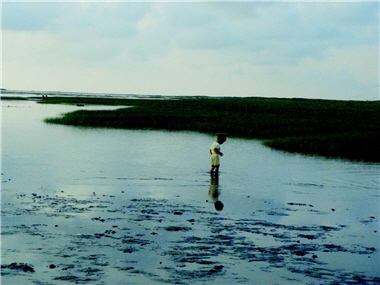
- lower left & lower right: Before being polluted, Gaomei Wetland (left) used to be a good place for recreation, but recently the area around the Sea Club-rush (Bolboschoenus planiculmis) was polluted by heavy crude oil and became a black patch (right).

Not long ago Gaomei wetland, one of the major wild bird habitats and Taiwan's most important wetland, was found polluted. It was fortunate the problem was spotted at an early stage and was not beyond remedy. Huang noted, however, years of painstaking efforts by NGO and government.
In fact, we humans can simply choose to hold protests, take to the street and throw eggs to show our disgruntlement when our hometowns or neighborhoods are under threat by nuclear plants, but how do other creatures that can't talk stand up for their own habitats and make their voices heard?

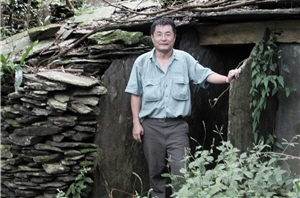
Kuang-ying Huang
Dr. Huang received his doctoral degree from the Institute of Ecology and Evolutionary Biology, NTU and a master degree from the Department of Fishery and Wildlife, Michigan State University. Educated in the department of forestry and veterinary medicine in NCHU, Huang established the first campus Nature conservation society in Taiwan in 1984 and worked as the first chairman. Huang has devoted his life to the conservation and research of raptors and wildlife, and is currently Conservation Section Chief of Taijiang National Park. He is a hunter, fisherman, environmentalist, and licensed veterinarian. His work includes“ The Fildguiled to the Birds of Taiwan.”
- upper: We should cherish and respect the Nature so this beautiful scene can be preserved.


