
From Hell to Haven-A Brief History of Bird Conservation in Taiwan

A tiny island, Taiwan is where birds frequent and pass by. But before the concepts of conservation became prevalent among local people, the island had once been a graveyard and a slaughterhouse for these feathered creatures. Back then, farmers used to hunt birds for food and justify this misdeed because they saw the birds as thieves that would peck at the grains on the farms. Street vendors would roast birds on the grills and sell them as barbecue in large quantity.
The Quarterly particularly presented here some photos that revealed the miseries of birds in the early times, when people in Taiwan knew little about conservation.
Later, numerous bird lovers, including bird societies and volunteers in different cities and counties across Taiwan, were motivated by mournful cries from birds to make effort to protect them. Besides, as conservation began to be in trend in the 1980s and national parks were established one after another, birds have been legislatively protected and conserved in Taiwan. This important step has kept many endangered and rare species of birds alive, making this land a true haven for them.


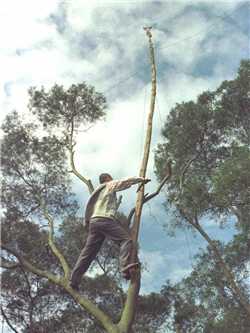
- upper: Cherish our Formosa and give a beautiful environment to birds and to ourselves. / by Po-lin Chi
- lower left: A bird hunter set up a bird trap by using a fake bird as lure and playing audiotaped bird chirps.
- lower center: Dead bodies of birds would be hung up high in the field as a deterrent to birds. / by Reporter Jian-wang Luo
- lower right: Bird lovers would brave the danger and climb up high to remove the bird traps and nets.
Interview & Text/ Jane Chiu
Special thanks to/ Ling Lin, the Section Chief of National Parks Division
Min-hwang Liang, the Associate Professor of Graduate Institute of Environmental Policy at Dong Hwa University
Chien-chung Cheng, the President of Chinese Wild Bird Federation
Secretary-General Wei-dao Yu
Chao-chieh Chen, the Assistant Professor of Department of Biomedical Science and Environmental Biology of Kaohsiung Medical University
Translator/ Kuan-yu Ou
Once a miserable and outrageous hell for birds and a target of criticism by international conservation groups, Taiwan now has finally rid itself of the name of a slaughterhouse for migratory birds, and become an activist in promoting bird conservation, an ongoing process that requires every one of us to continue to work together for the welfare of our feathered friends.
In the 1980s, these bird lovers started to be heard and known due to their efforts in advocating the protection of Brown Shrike (Lanius cristatus) and Grey-faced Buzzard (Butastur indicus), and turned over a new leaf for bird conservation in Taiwan. From tearing down countless bird trapping sticks by hands to tracking birds with hi-tech gears, the bird lovers have braved great difficulties for the past two decades and proudly given freedom and rights these feathered friends deserve back to them.
Conservation Concepts in Place of Bird Traps
Taiwan had once been called “the last shelter” that winter migratory birds would choose, an embarrassing nickname but also a sad truth Taiwanese must face and change.
Back in the 1980s in Hengchun, locals were still in the habit of catching migratory birds with bird trapping sticks and roasting them as barbeque snacks in winter, something hurtful and shameful in the eyes of the bird lovers.
This phenomenon was mainly attributed to a lack of conservation concepts, which had been the most challenging part when Kenting National Park (KTNP) Headquarters pushed for bird conservation.
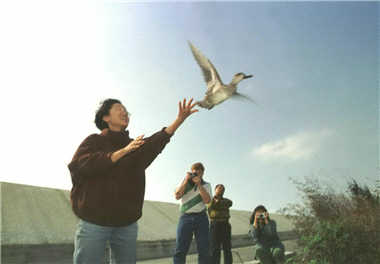
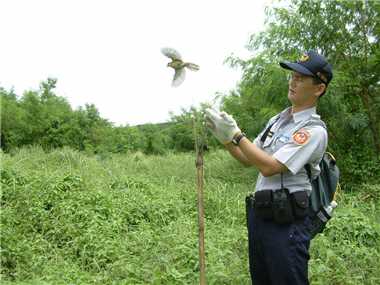
- upper left: Upon being released by a volunteer of Chinese Wild Bird Federation, a Teal (Anas Crecca) which had been kept in captive because of an injury flew toward the sky and the Nature
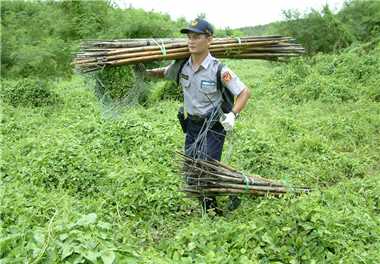
- upper right: Tearing down countless bird trapping sticks by hands is one of the missions that Kenting National Park Police Squad must do when implementing migratory birds' conservation. / Photo provided by Zai-quan Xiao
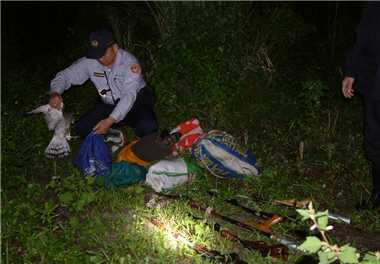
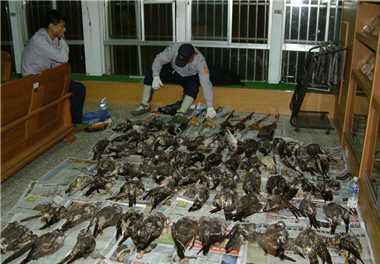
- lower left & lower right: In 2004, Kenting National Park Police Squad raided the illegal capture of Grey-faced Buzzards (Butastur indicus) in midnight, but unfortunately, the hunters had already ran away when the police arrived. Picture on the right shows the 68 dead bodies of Grey-faced Buzzards discovered by the police on that day.


“The reclamation of Longluan Lake by KTNP definitely helped with community empowerment and the conservation of migratory birds.”
So said Associate Professor Min-hwang Liang of Graduate Institute of Environmental Policy, National Dong Hwa University. Liang had helped plan and implement conservation work of migratory birds since KTNP was established. Before 1989, his job content focused on conservation education in schools and communities as well as trainings of national park police on law enforcement.
Liang used to patrol alone on his motorbike across villages in Hengchun area to look into the excessive hunting for Grey-faced Buzzards. He once bumped into over 70 illegal hunters in just one night! “The large number of those hunters was just outrageous!” Liang still fumed about it when he recalled that long-ago episode.
Familiar with law enforcement of national park police, Liang would also compile statistics on the frequencies of illegal hunting cases and the distribution of migratory birds' habitats. He had concluded that the period from early Sep. to Nov. each year was the peak of caught cases of illegal hunting of the Shrikes and the Buzzards. Through analyses, he could also learn the number of bird trapping sticks being removed and its fluctuation over the years.
“A simple look at the statistics of the police's duty records may easily help identify the time, places and results of the police's crackdown on illegal hunting,” said Liang.
In 1989, Liang was astounded by the results of his questionnaires that surveyed about 2,400 junior high students in Hengchun area. Despite years of education on migratory bird protection, about one quarter of the respondents said their parents would catch migratory birds as food and saw searching for birds' nests and roasting birds as local customs rather than devastating acts to the Nature.
To correct these misconceptions and deter harmful behavior, Liang kept going to the schools to urge on bird conservation. Emotionally, he encouraged students to appreciate birds; rationally, he elaborated on the image improvement protecting migratory birds could bring to Taiwan; and legally, he warned about the arrests and punishment illegal hunting would lead to.
“To younger kids, a Confucian style of edification would be useful, while to an audience above the middle school level, persuasion focusing on values would be more appropriate, which means to help people see migratory birds as common resources, educating them about the benefits of tourism based on ecological conservation.” Liang believes it requires different approaches to educate different audiences, and better understanding of local customs by authorities and mutual trust between locals and the police would mitigate the opposition to conservation of migratory birds.
- upper left: Let children learn the correct conception of bird conservation from playing games is a good way to implement the environmental education. / Photo provided by Kenting National Park
- upper right: It requires different approaches to educate different audiences, thus the conservation education of migratory birds can be well-implemented. /Photo provided by Yi-rong Cai
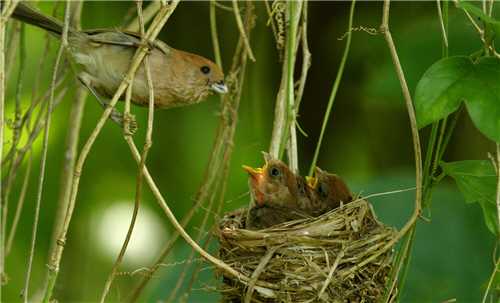
- lower left: The picture shows a Red-headed Tree Babbler (Stachyris ruficeps) feeds its children by herself. The scene is so precious that we should cherish and protect it. /by Su-lan Chiu-Lu
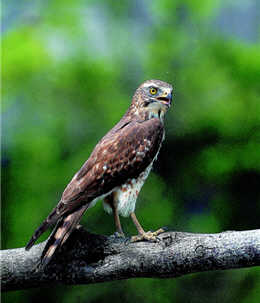
- lower right: The period from early Sep. to Nov. each year was the peak of caught cases of illegal hunting of the Brown Shrikes (Lanius cristatus) and the Gray-faced Buzzards (Butastur indicus). /Photo provided by Kenting National Park
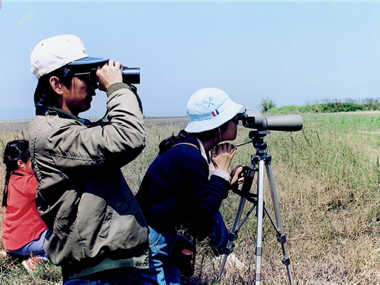
Ongoing Love for Birds
Following the enlightenment of conservation concepts, the bird lovers turned their focus to the restoration of birds' habitats. An agreeable living environment is something humans should try hard to provide to birds, even though they are migratory.
Continuous efforts by people on the ground had finally brought an amazing abundance of avian species in the sky. In addition to the protective work on migratory birds by KTNP, high-mountain national parks such as Yushan (YSNP) and Shei-Pa (SPNP) had conducted censuses of bird species in the parks. The newly established Taijiang National Park had also protected birds that frequent the coastal areas and wetlands in eastern Taiwan.
Among the cases, Assistant Professor Chao-chieh Chen of Department of Biomedical Science and Environmental Biology at Kaohsiung Medical University was commissioned in 2009 by YSNP for a census of bird species in Yushan, a task Chen viewed as a necessity in understanding the ecological features of the area.
“The purposes of this project are to give a clearer picture of the avian resources in the Park and to set up a database of birds,” Chen explained.
As a mountainous national park at an altitude ranging from 300 m to 3,952 m and with a variety of geographical and climatic features, YSNP boasts great diversity in its flora and fauna, including many precious bird species, however data of which was mostly two decades old. “The number of avian species in Yushan was 107 according to the survey done by the two professors Yao-sung Lin and Pei-fen Lee, and later added another 28 by Doctor Da-ren Guo and others of the Wild Bird Society of Taipei in 1986, and then another 1 to 3 by other surveys before 2008, and our census has brought the total number of bird species to 189.”
Under the collaboration of bird societies and biologists, the data of avian resources in Yushan has been gradually collected and compiled. All the conservation efforts have paid as the bird species in the Park became abundant and diverse after a quarter of a century.
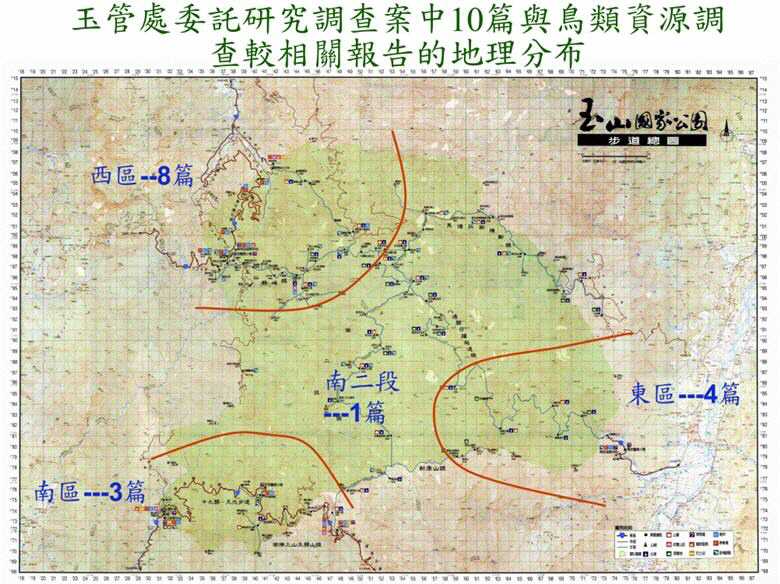
- upper left: Building a good environment for birds is the goal that we all need to work on together. / Photo provided by Zai-quan Xiao
- upper right: When off work, Lin would volunteer as an interpreter and guided citizens to watch birds in Guandu, Yeliou, Wulai, HuaJiang Bridge, Yake River, etc., and sometimes participated in bird banding projects. /Photo provided by Ling Lin
- lower: Under the collaboration of bird societies and biologists, the data of avian resources in Yushan has been gradually collected and compiled./Photo provided by Chao-chieh Chen


How is this laborious survey of birds helpful to the environment?
“The number of resident birds, the time and routes of migratory and resident birds, etc. would all demonstrate the progresses of conservation work in Yushan. The appearance of some bird species that had never been recorded before would signify the importance in conserving natural environments.”
People in the academic circle are just part of the large crusade of bird lovers in Taiwan. Also fully devoted in bird conservation are the volunteers in numerous local bird societies, each one of which the Quarterly may not introduce due to limited space. In this Sep. issue, chosen as an example is Section Chief Ling Lin of National Parks Division, CPAMI, who has joined one of the bird societies and radiated her love for birds.
“There was once I saw a vagrant bird of the family Coraciidae, and that night, I dreamt of myself flying in the sky like a bird!”
Lin's eyes would just light up whenever she talks about birds. When off work, Lin used to volunteer as an interpreter on Sundays under the arrangement by Wild Bird Society of Taipei and guided citizens to watch birds in Guandu, Yeliou, Wulai, HuaJiang Bridge, Yake River, etc., and sometimes participated in bird banding projects.
Lin considers herself nobody among all bird lovers as she looks up to the guidance and devotion from those professionals and seniors such as Wen-hong Lin, Mei-hua Tsou and Yong-hong Zhuang. “I think the future of bird conservation in Taiwan is definitely promising. From all the toil, frustration and even conflicts in advocating bird conservation in early days to the initiative taken by local people now in establishing Taijiang National Park for the sake of conservation of Black-faced Spoonbills, we can see a positive trend along the years. Now we are planning a migratory bird corridor in Central Mountain Range to offer a safe passage to birds visiting from China, Korea and the Philippines,” said Lin.
Bird Conservation Goes International
The success in bird conservation in Taiwan is by no means achieved by national parks single-handedly and overnight. There have been numerous people, events and groups giving tremendous support and assistance, “especially all the bird societies, to which we felt an immense gratitude for their help in research of birds,” the modest Lin said, giving as many thanks as she could to the bird societies and her predecessors for their unselfish contributions in bird conservation.
- upper left: Bird societies offer national parks many resources and assistances. /Photo provided by Chien-chung Cheng
- upper right: Besides the conservation in Taiwan, Chinese Wild Bird Federation also protects wild birds by participating in global projects and exchanges in conserving Black-faced Spoonbills (Platalea minor), Blue-Winged Pittas (Pitta brachyurs) and other seabirds worldwide. /Photo provided by Chien-chung Cheng
- lower: Government and conservation units should help fishermen improve their fishing gears, thus the chances of hurting water birds could be avoided. / Photo provided by Chien-chung Cheng
Among them, Chinese Wild Bird Federation (CWBF) has been an important organization which was co-founded by 20 local bird societies and conservation groups in 1988 with nearly 4,000 members in total. In addition to educating the public and setting up protected areas, CWBF also protects wild birds by participating in global projects and exchanges in conserving Black-faced Spoonbills, Blue-Winged Pittas (Pitta brachyurs), and other seabirds worldwide.
“Bird conservation is not just about the physical safety of a bird's body. Their natural enemies and the conditions of their habitats also need to be taken care of. Especially the maintenance of their habitats is extremely important. ” said Chien-chung Cheng, President of CWBF.
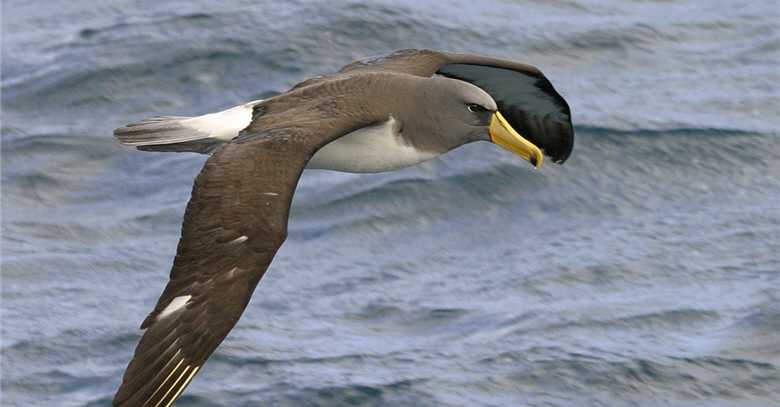
Another factor affecting birds' safety is far more unimaginable: fishing practices on the sea. It turns out that waterfowls such as albatrosses and shearwaters would be lured to peck at the bait fish attached on the traditional fishing gears such as drift nets and longlines used by fishermen. The birds would either be strangled to death in the nets or get drowned on fishhooks as bycatch.
International studies have concluded that for the past 30 years the longline fishing gears have put 18 species of albatrosses in danger and another 14 to 15 on the verge of extinction. To help fishermen use less harmful fishing gears and prevent the problem from worsening, CWBF has offered training programs of seabird conservation to fishermen, and invited staff from international organizations such as BirdLife International and the International Union for Conservation of Nature (IUCN) to share their experience in redeveloping fishing gears. The upcoming 5th International Fishers Forum, to be held in Taipei, is also an important platform for conservation groups and an opportunity for Taiwan to wield soft power in diplomacy.
In a grand gathering of the conservation circle, Hsung-hsiung Tsai, a senior bird expert once said: “We must learn to watch not just the birds above our heads but also the plants down at our feet. Wisdom is everywhere around us.” In the eyes of Liang, Lin and Cheng, Tsai and other retiring predecessors in bird conservation are trying hard to pass on to the next generation a modest and respectful attitude toward the Nature, hoping that many a little makes a mickle. Some more respect and love from humans, and there'll be some more hope for the birds.


Chien-chung Cheng
Dr. Cheng holds a Ph.D. in Biology from Imperial College, University of London and is currently the President of Chinese Wild Bird Federation and Associate Professor of the Faculty of Biomedical Science and Environmental Biology, Kaohsiung Medical University. He specializes in population ecology and entomology. His research specialties include minimum viable population analysis and wildlife hazard investigation.

Min-hwang Liang
Dr. Liang holds a Ph.D. in Natural Resources from the University of Michigan. He is currently Associate Professor of Graduate Institute of Environmental Policy at National Dong Hwa University. His research specialties include natural resources conservation, environmental education, assessment research, and conflict management.

Ling Lin
Dr. Lin holds a Ph.D. in Geography from National Taiwan University. She had served in Taroko National Park and is currently the Section Chief of National Parks Division, CPAMI.

Chao-chieh Chen
Chen is currently the Assistant Professor of Department of Biomedical Science and Environmental Biology of Kaohsiung Medical University. After graduated from Louisiana State University, Chen went back to Taiwan to teach and study birds in 1997. His research specialties include Migration and foraging behavior of birds, etc.


