
Xuejian Stories: Past and Present-
Above today's Beikeng Creek Historic Trail was once the Atayal hunting field, Buan Bala, where the aborigines used to hunt muntjacs prior to the Japanese Occupation Era. When the Japanese came and saw the snow-coverd ridgeline of Xue Mountain (later refrred as Holy Ridge) in winter, they renamed the place as “Yukimi,” meaning “seeing the snow” and thus translated as“ Xuejian,” its current Chinese name. Henceforth, the Japanese began to construct the Beikeng Creek Trail to better administer the Atayals and exploit the aboudant natural resources in the forest.
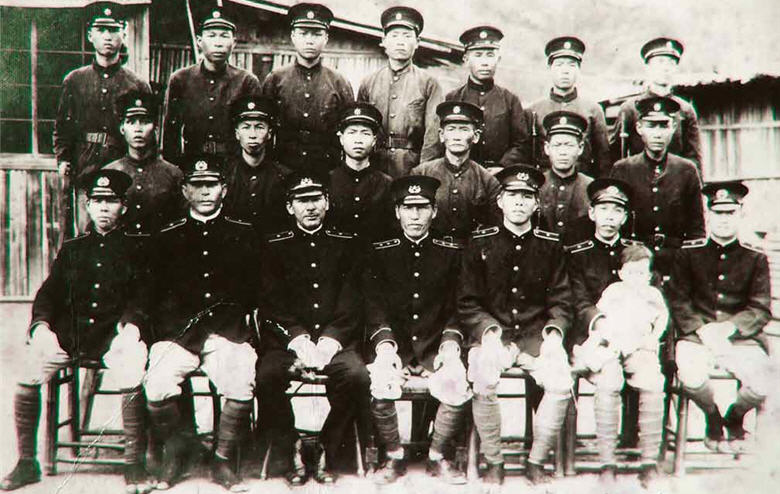
The construction of the 30-plus-km trail started from Sep. 1922 to Mar. 1923. 12 police stations were set up on the way from Guanwu to Erbensong. The Xuejian Police Station was thelargest among others. The Station was home to 16 personnel,including 1 police director, 5 police officers, and 10 associateofficers. In addition to the police station, during the Japanese rule there used to be a sports field with a 150-m running track, a school, a marketplace for indigenous traders, a clinic with a full-time doctor, a dormitory, and a sericulture house.
The ROC government took over Taiwan after World WarII, relieving the bitterness Taiwanese people endured under Japanese rule. Police stations along the Beikeng Creek Trail were consequently deactivated. Meanwhile, however, areas along Sihmasian Forest Road above Beikeng Creek Trail continued to suffer from exploitation activities, which did not stop until 1992 when Xuejian area was included in Shei-Pa National Park.
On Jan. 8th, 2008, Xuejian Recreation Area was formally opened to the public, and in late 2010 the first tarmac road to the Area via Simaxian Forest Road was completed. Unfortunately in 2004, Beikeng Creek Historic Trail was shattered by continual typhoons, with its history buried in the mid-altitude cloud forests around the upstream of Da-an River.
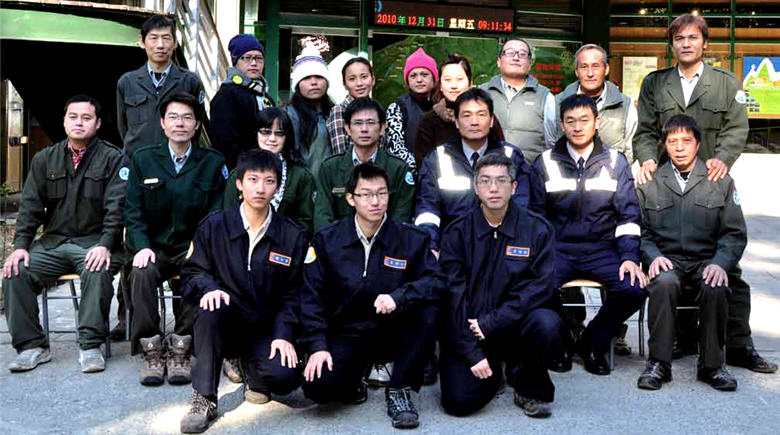
Xuejian Station and Visitor Center is located 400 m above Xuejian Police Station, hosting 1 station chief, 1 associate technical specialist, 1 technical driver, 1 contract interperter, 3 park rangers², plus 5 aboriginal park rangers, 3 substitute civilian servicemen, 3 aboriginal interpreters, and three janitors³. Also, a three-man Xuejian Police Squad from Shei-Pa Police Brigade has been dispatched since Nov. 2010 to prevent and crack down on illegal hunting and logging and to provide public service.
Compared to 90 years ago, today Xuejian is being administered in a very different fasion. The past and present administrative systems of Xuejian run paralell to each other at the foot of the left bank of Da-an River. Perhaps they only meet up when todays’ park rangers come across their colonial-time counterparts as they enter the ancient domain.
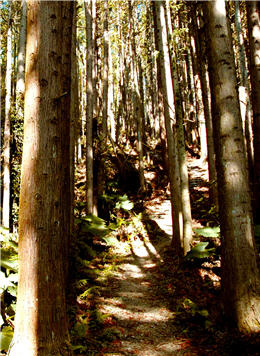
- upper left:With the disruption of Beikeng Creek Historic Trail, the history of the Trail is buried in a thick layer of fallen leaves for now.
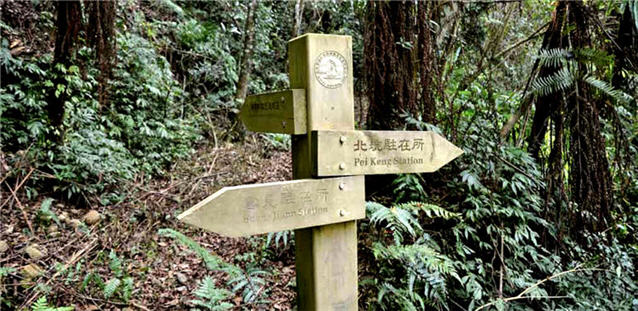
- upper right:The road sign still stands in the discruped historic trail, pointing to the directions toward the past.
- lower:The past and present (Next) of Xuejian Station. After 90 years, the place seems a modern version of its long-ago state./Photo provided by Zi-cai Zhang; copied by Jia-hong Chen from archive photos
Text & Photo provided by/Jia-hong Chen
In the past, staff at the Police Station were laid with heavy workload, such as guarding roads and maintaining telephone landlines. Today, public workers in high mountains also live a dull and difficult life, albeit dwelling in a scenic environment envied by many tourists. They must endure boredom and inconvenience, especially during typhoon and monsoon seasons that separate them from outside world and from the access to water and electricity supplies for a long time.
Still, some public workers, in the past and present days alike, asked for being re-appointed to Xuejian after having served their terms due to strong nostalgia of their life in the mountains. Some others came back with their family, and there was once a former police director who even parted from his wife and dedicated himself to aboriginal affairs in the mountains for 20 years!
One feels differently at different times, whether in the past or present, when gazing at the snowy Holy Ridge, the misty waterfall in Mt. Sihmasian, and Da-an River Valley. It can be a sense of superiority felt by the conquerors, of gloom and melancholy by the oppressed, or of powerlessness by the colonized.
Viewing from the upstream area of Da-an River, one could still savor the phantasmagoria of clouds and fogs that remains as always while recalling the history of Xuejian with a sentiment in an ancient Chinese verse: “We witness rivers flowing and hear tides rumbling; but the good old days have gone with the war.”
- upper:The past (Previous) and present of Xuejian Station. After 90 years, the place seems a modern version of its long-ago state./Photo provided by Zi-caiZhang; copied by Jia-hong Chen from archive photos


