
Toward the Revival of Taiwan Lily-
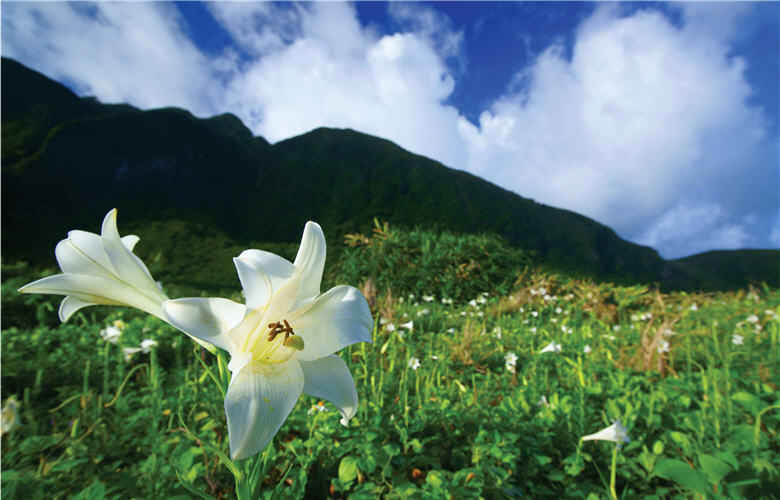
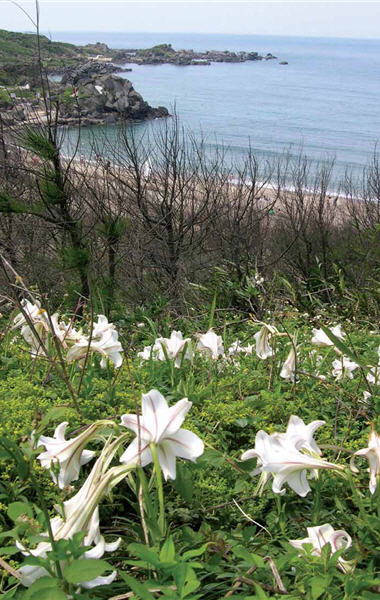
Taiwan Lily (Lilium formosanum) can take root everywhere and thus best represent the spirit of perseverance that characterizes people in Taiwan.Taiwan Lily in the wild was once threatened by excessive exploitation to the environment. As a result, Taroko National Park (TNP) Headquarter began to restore the flower around Buluowan area from 1995, making blooming Taiwan Lily the featured theme of spring-time Buluowan.
Although Taiwan Lily is not a rare species, its restoration still carries great significance in terms of environmental education.
As Resilient as the Spirit of Taiwan
Taiwan is home to 4 native Lilium species, including Lilium formosanum, Lilium longiflorum, Lilium speciosum, and Lilium callosum, among which Taiwan Lily is endemic to Taiwan.
Taiwan Lily belongs to the genus Lilium. It is a perennial herbaceous plant with white or beige yellow succulence bulbs, upright and thin stems, and lance-shaped leaves.Its blooming season spans from Aprils to Septembers yet depends on the location. The number of flowers that a stem blossoms can vary dramatically — sometimes more than a hundred per stem. The Lily’s bulb allows it to store energy generated though photosynthesis to weather harsh conditions and to blossom when the time is ripe. It manifests the perseverance and stamina of life also found in the people of Taiwan.
- upper:Taiwan Lily (Lilium formosanum) can take root everywhere and thus best represent the spirit of perseverance that characterizes people in Taiwan./by. Jin-yuan Dai
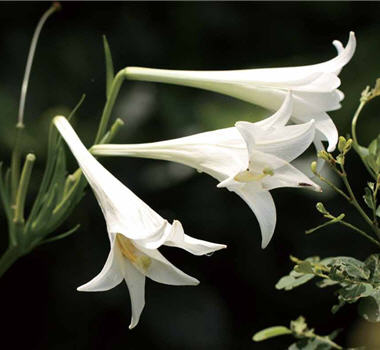
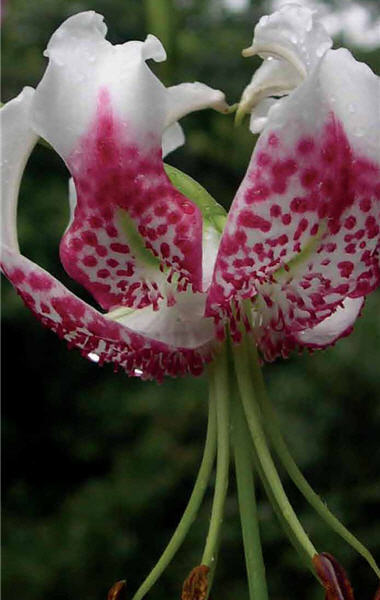
- lower left:Currently there are 4 species of native lilies in Taiwan. In the pictures are Lilium longiflorum, and Lilium speciosum/by Ellen Chang
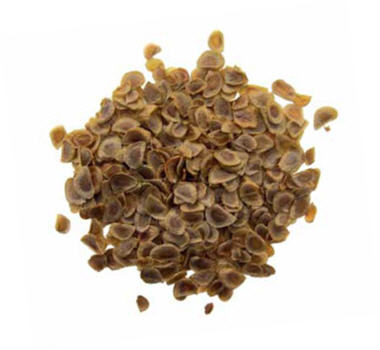
- lower right:The Seeds of Taiwan Lily.
Text & Photo Provided by/Ming-yong Luo
Translator/Stephen Liu
Taiwan Lily has trumpet-shaped corollas that send out fragrance between evening and early morning. It has maroon-striped white perianth (varying greatly with places) 10 to 18 cm in length and 5 to 7 cm in width. The flower has six stamens, big anthers, 3-cleft stigma with cylindrical capsules that break on the top upon maturity and produce hundreds of flat and thin seeds. The buds change directions at different times: they stay upright at 0˚ when first appearing, then bow down to 180˚ as the stamens are ready in shape, then make a 90˚ upturn during blossom, and move back to where they begin when bearing seeds.
Stamens of Taiwan Lily appear stick-like as the flower begins to blossom in the early morning; they look more like pollens a few hours later. One has to approach closer to the flower to smell the light fragrance it sends out during full bloom, which lasts more than one week. Petals and stamens begin to fall down after blossom. If the pollination is successful, the ovary will grow and slowly erect upright after the stigma falls down. Seeds ripe and are neatly containedin capsules about 3 months later; they are disseminated afar by winds as the pods gradually dry and crack; eventually they will grow elsewhere with enough rainfall someday.
The Strength of Life in Adversity
Taiwan Lily is such a unique flower that it grows everywhere in Taiwan, ranging from sea-level ground to mountains above 3,000 m in elevation. Lilium longiflorum is the second widely-spread species, commonly seen in coastal areas and offshore islands. Lilium speciosum comes next, spanning in mountains in northern Taiwan.Lilium callosum originates in Jhuolan, Miaoli County, but has become extinct owing to environmental degradation.
Varied growing environments in different places give birth to different lilies in terms of appearance, height, leaf shape, and even bulbs growing underground. Lilies growingin coastal and windy circumstances are around 20 cm in height; they tend to cluster and fully blossom in a horn shape. Lilies as tall as 2 to 3 m can also be seen in Lishan and Jinshan, Hsinchu. Wild Taiwan Lilies often stand out from long grass and showcase their magnificent flowers.
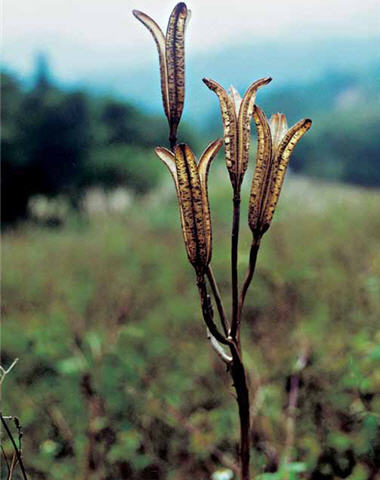
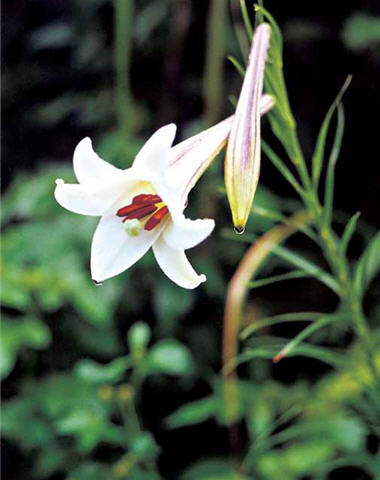
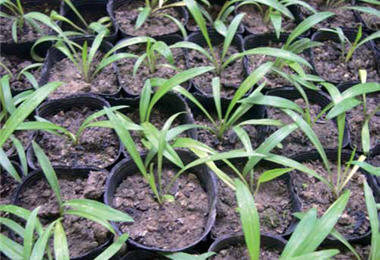
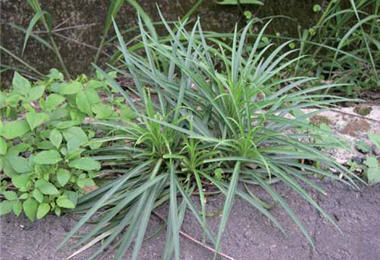
- upper left:the little seedlings in winter.
- upper right:shows the leaves that grow in spring.
- lower left:shows the blossoms in summer, when the scape of the Lily grows tall.
- lower right:shows the pod borne after the bloom. The green pods would turn brown in autumn, indicating the seeds inside are ripe.
Safeguard the Everlasting Purity
For most people, lilies are special because of their beautiful appearance and practical values. For aboriginal Rukai people, lilies symbolize their pure and chaste characters. All Rukai men desire to be hunters and heroes. In order to wear lilies on their hair, they must capture 6 or more big boars. As for women, only the virtuous unmarried are qualified to wear lilies after performing a “lily-purchasing” ritual, or kialidao. What’s more, since lily petals expand like a hexagon that, during full bloom, altogether resemble a starry sky, the flowers are said to have descended from the heaven by the folks; thus, lilies are often transformed into stars in some paintings.
Among the many native plants on the island, Taiwan Lily is rather commonly known. People adore its trumpet-shaped, maroon-striped white flowers in full bloom. Unfortunately, many people love the lilies in such a selfish and destructive way as picking them right away whenever seeing one.
In fact, TNP Headquarters is not the only party that can bring Taiwan Lily back to the wild. Local people should also cherish Taiwan Lily as a valuable asset. In addition to safeguarding the flower from being plucked by tourists, people can adopt on-site restoration to cultivate it in winter with cooler temperatures and greater precipitation. Or they can plant it at where it originally grow by covering it 1 cm underground in the autumn, or to peel down the outer, ripe part of its bulbs and bury them 1 to 2 cm underground so as to prepare the flower for environmental changes and challenges. Blooming lilies will therefore not be limited to Buluowan.
Taiwan Lily has yet become endangered on the island, but because people are so used to seeing it around that they hardly care about its existence. Out of a lack of understanding about the flower, people tend to grab it for short-lived pleasure. These kinds of actions often drive humans farther from the Nature.
While most people hold the utilitarian thinking that all other beings in the Nature are there at the disposal of humans, the truth is that humans have nothing to return to the Nature. Hence, it is sincerely hoped that people will spare flowers growing in the Nature, and let the lilies prosper freely in the wild.


Ming-yong Luo
Luo has long been concerned about the land and environment of Taiwan. Formerly the president of Taiwan Ecological Stewardship Association and a council member of Taiwan Environmental Information Association, he is currently a member of Taiwan Land Ethics Association, and commits himself to the restoration and promotion of native lilies in Taiwan. In 2007 and 2009, Luo bought two pieces of land to provide safe habitats for Taiwan Lily and other native plant species in Taiwan.He leaves the grass at these places the way it is without mowing it, so as to allow more life forms to live there. Luo also set up Taiwan Lily Studio to promote Taiwan Lily with various activities and in different venues.
(For more information, visit blogs “Meet Taiwan Lily”http://tw.myblog.yahoo.com/lilium-formosanum/and “Peace for Taiwan”:http://blog.yam.com/liliumformosanum/)
- upper left:People are advised not to pick flowers growing in the Nature, so that the lilies could prosper freely in the wild.
- upper left:Currently there are 4 species of native lilies in Taiwan. In the pictures are Lilium longiflorum, and Lilium speciosum/by Ming-yong Luo
Information about Taiwan Lilies in the National Parks
Name of the ParkLocation of DistributionBloom TimeCurrent Conditions Taroko National Park台20線梅山-埡口路段
National Park


