
Guarding the Nature against Mining-
In front of Chongde Station on the North-Link railway, at 45 meters above sea level, the 2.35-hectare bald mountain wall poses a stark contrast with the surrounding forests. The place used to be a marble mine that ceased operations in 1987 after it was designated into TNP. Now, despite 24 years of effort, the near vertical wall still remains barren with little vegetation.
Prior to the establishment of the national parks of Taroko, Yushan, and Yangmingshan, many companies with mining rights had been quite active in these areas. The 1980s saw the advent of the three parks, but it was accompanied by constant battles between environmental protection and mine exploitation, marking the history of Taiwan’s national parks with hard-fought victories against mining andreflections on the relation between humans and the land. In the end, the then Premier Vincent Hsiao took TNP's side and put an end to the conflict.
Imagine a treeless Taroko, a truck-rampaged Jade Mountain, and a slag-filled charred Yangmingshan..... Had the national parks not been established, these could well have become some painful realities.
A Long Fight in Taroko
Mining had once played a major role in Taiwan's social, economic and cultural development. However, it drastically changed the landscapes, dried up the aquifers, and caused landslides and desertification. Besides, once the exploitation of the mineral deposits began, it almost always led to confrontations between parties with conflicting stances.
In 1950, the government sought the support of the mining industry to fuel industrial development. As a result, as many as 33 mining sites mushroomed before TNP was set up. Then opposing voices for the establishment of TNP emerged during the planning stage, and things took a nasty turn when some mining companies used excavators or even explosives for the ores and damaged the landscape of Qingshui Cliff and Sanzhan River valley. Mr. Lung-Sheng Chang, the then Director-general of CPAMI, recalled that when he saw the limpid water had been turned into dark mud, he was heartbroken.
In 1986 when TNP was set up, some companies with mining rights didn't actually do mining there, for some failed to obtain leasehold or were bound by laws. However, the companies would still apply for an extension to the rights as they were about to expire. On April 12, 1998, an approval to extend mining rights by the Bureau of Mine to a marble factory in Hualien sparked public debate. In the meantime, the bureau and TNP also stuck to their respective grounds.
In 1998, mining in the 19 sites remaining within the TNP had mostly stopped except for one near the Chongde area. This was because marble is not wear-resistant due to its low hardness. Besides, marble is susceptible to erosion if it’s exposed in acid rain for a long time, so eventually it was replaced by the imported granite as a building material.
Even though most mining sites had been shut down by then, TNP was determined to resolve disputes resulting from mining rights and restore the damaged sites, so it called for a meeting on August 10th, 1998 with the 19 mining companies to discuss compensation for a ban on mining. Though the proposal was appealing to them, it marked a formal first step by TNP to the right direction.
Then in 2002, TNP began compensation negotiations with miners. In 2002, TNP initiated meetings with representatives from the Bureau of Mine, Forest Bureau, Xiulin Township Office, and Mining Industry Association as well as the mining companies concerned for negotiating no-mining zones and compensation matters while collecting information and data of the mining areas to determine no-mining zones.
To propose a number of compensation agreeable to both sides, TNP entrusted the Industrial Technology Research Institute for a detailed research into the mining sites for aspects such as the cost of exploitation, application for and renewal of mining rights and facilities assessment in the mining sites. In addition to onsite observations, the ITRI also compared and analyzed the satellite and aerial images of the sites in different time periods for traces and the scope of the mine excavation, in order to calculate a reasonable amount of compensation.
After such efforts, four companies with mining rights finally accepted the compensation offer in 2004, which marked an initial breakthrough. Then in 2005 another 12 companies agreed on the terms, and soon the entire compensation process was officially completed in June 2007.
During the process, there were obstacles such as petitions by the mining companies regarding the amount of compensation or even the companies’ financial difficulties, but TNP was willing to negotiate with them and the efforts paid off in April 2008, when the compensation involving 16 mining sites totaling an area of 2,570 hectares as distributed. Thanks to the efforts, the forests and the animals’ habitats were able to recover from the damage, and mining activities in TNP also went into history.
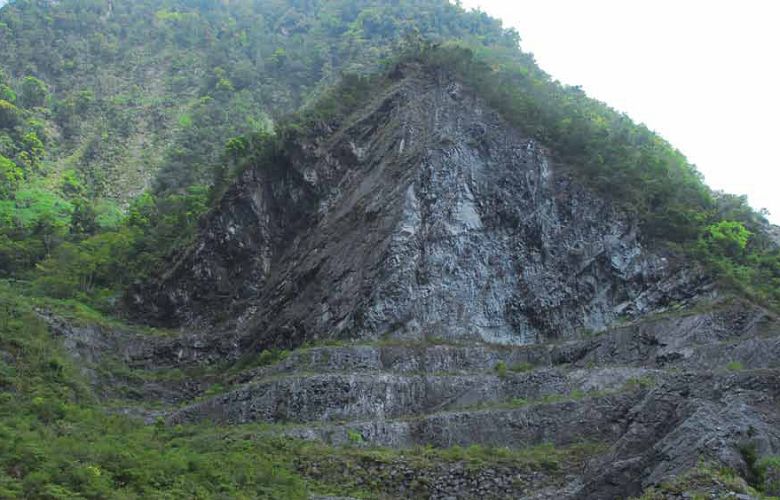
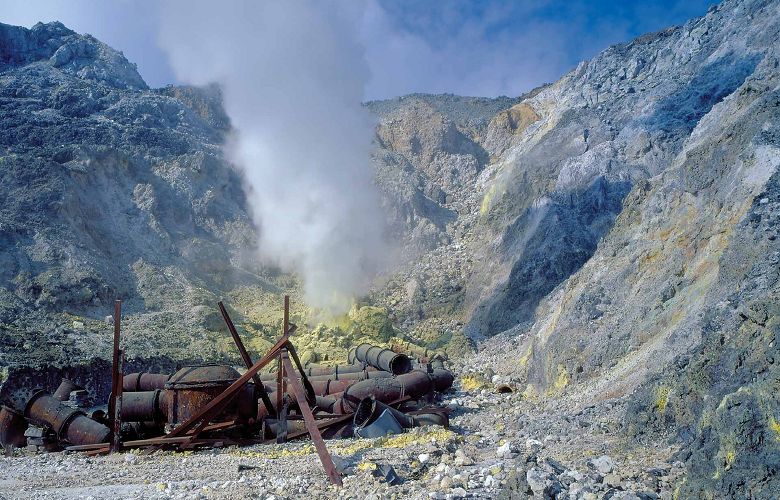
- upper:The sulfur mining relics at Dayoukeng in Yangmingshan National Park. / by Chi-hsue Wu
- lower:The traces of excavation left by Huide Mine./ by Mao-yao Lin
Interview & Text/Hsiu-mei Li
Translator/Yonglan Huang
Special Thanks to Contract Interpreter Mr. Mao-yao Lin of TNP Headquarters,
Section Chief Mr. Shun-fa Chang, Chief Mr. Li-chang Lu, Technical Specialist
Ms. Shu-chun Yu of YMSNP Headquarters, former Director Mr. Lung-sheng
Chen, and Technical Specialist Ms. Zhenyu Chen of YSNP Headquarters
Conservation vs. Mining in Yangmingshan
Compared to TNP, YMSNP had undergone a much easier fight in revoking the mining rights.
Minerals resources in YMSNP include coal, sulfur, iron sulfide, clay, fire clay, aluminum, and geothermal. In particular, the discovery, excavation and export of sulfur ores can date back to the Spanish and the Dutch rule, the Qing Dynasty and the relocation of the nationalist government. Sulfur mining was arguably the longest standing industry of northern Taiwan.
As volcanic activities in the Datun Volcano Group resulted in peculiar geology and landform, excavation of sulfur and clay used to be quite common in Yangmingshan. During
Japanese occupation, loose regulations had facilitated the excavation and trading of sulfur ores. In its heyday in 1911, there were as many as 27 mining sites. It was not until 1953 when both sides of Yangjin Highway were designated as no-mining zones that the mining business took a downturn.
As the sulfur industry has lost its economic value, there were only a few players staying in business before the establishment of YMSNP. Starting in 1987, the park began to carry out the national land appropriation and the related compensation. From 1993 to 2005, it successfully obtained the mining rights in Liuhuanggu, Longfenggu, Macao, Dayoukeng, Lengshuikeng and Wanli.
Preemptive Action against Mining in Yushan
Marble, dolomite, serpentine, copper, talcum, asbestos and other mineral resources are present in YSNP. During the planning stage of YSNP in 1983, there were still 47 mining sites and a national reserve of copper ore. In particular, there were 9 sites in the Walami area, where the miners were just prospecting for ores there for subsequent excavations.
“The recorded number of species in the Walami area is over 900. The area is also the catchment area of Siouguluan River and the historic sites of the Japanese Occupation
Era Batongguan Traversing Trail. Former Director of YSNP Headquarters, Mr. Lung-sheng Chen noted, "the profits generated from mining could never ever make up for the damage done to the water, land, landscape, and the natural resources."
After the establishment of YSNP in 1985 and the environmental assessment, the government decided to call off the road construction from Yuli to Yushan. This has led to the petitions by the mining companies in that area.
Article 16 of the Mining Act states: "Mining right is valid for 20 years, which can be extended for another 20 years after the expiration. The Bureau of Mine is opposed to the designation of a no-mining zone on grounds that, first, the marble in the Walami area is of great quality and quantity, so it's worth excavating, and second, the Marble in Taroko can be exported to increase Taiwan's foreign reserves. In response to this, the YSNP designated the Walami area as an Existing Use Area to regulate mining activities while retaining the rights of the mining companies.
YSNP started its compensation talks with the mining companies in 1997, and nine of the companies demanded over hundreds of millions of compensation. The number was decreased to 37 million after a few rounds of negotiations and eventually the Walami area was finally designated into a no-mining zone. In 2000, it was upgraded to an ecological protected area, meaning the highest level of protection that prohibits any intrusive acts. Now, when people talk about Walami, they immediately think of natural trails or Formosan Black Bears, without realizing its potential doom as a barren place in early days.
Fulfilling the role and the promise of a conservationist in safeguarding the precious natural landscape and cultural heritage, Chen concluded in a pleasant tone, "The public is happy to see the Walami area being protected and the tourism industry booming. We are thus confident to say that the value of sustainable tourism far exceeds that of mineral exploitation."
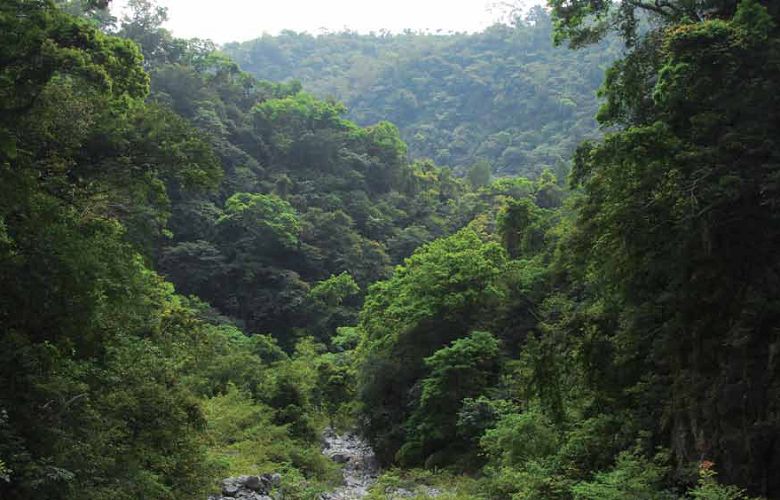
- upper:The primitive vegetation in Huide Mine./by Mao-yao Lin
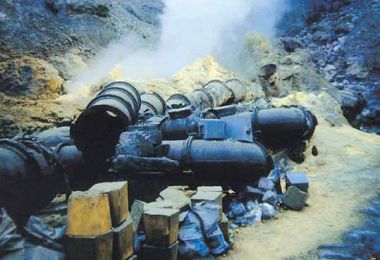
- lower left :As the sulfur industry lost its economic value, YMSNP Headquarters hadsuccessfully obtained the mining rights in Liuhuanggu and 5 other sites from1993 to 2005.The sulfur mining site at Dayoukeng./ Provided by YMSNPHeadquarters
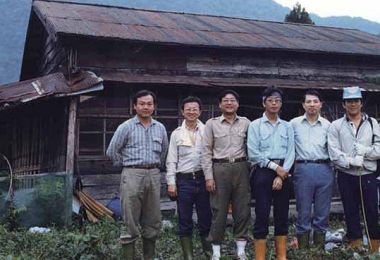
- lower right:In April 1989, then-Chief of Conservation Section of YSNP HeadquartersLung-sheng Chen (3rd from the left) had followed some representatives ofthe mining companies to conduct an investigation on the mining sites in theWalami area./ Provided by YSNP Headquarters


