
Eternal Imprints with Life-An Interview with Senior Documentary Director Chin-yuan Ke
In the realm of image recording, many have chosen a high-profile style of career, while this man has opted for a toilsome and quiet one. Over the 31 years as a photographer and filmmaker, he has produced 18 documentaries, 400 plus feature reports, over 200,000 images and text files of fieldwork on Taiwan's environment, and participated in the production of more than 200 program episodes of environmental issues. He presented the stories of Taiwan's people and ecology, as well as the meaning of his life. Mountains and oceans are just like a part of him. In the trees of Yushan, in the coral reefs of Green Island, or in the flying fish festivals in Lanyu, he has seen the cry of the ecosystem, and the human exploitation on the Nature. In his works and through his lenses, he has shown a strong love for this land, and led people to some important issues long ignored. He is the ironman in Taiwan's image recording, the documentary director of PTS, Chin-yuan Ke.
Recording the Realities of Life
It's hard to imagine from his warm smile and modesty that Ke has recorded such a staggering amount of image with such strong will power and perseverance. In a sun-lit cafeteria in the PTS, Ke elaborated on his 31 years of career and his thoughts on Taiwan's cultures and ecology.
Ke grew up in a coastal village in Shenkang Township, Changhua County, where a clear little stream laid in front of his home, a humble traditional Taiwanese house. Villagers would do their laundry, take baths and catch fish and shrimps in this tributary of Dadu River, and use the water for irrigation. At the end of the stream was a world-famous wetland, a summer wonderland in Ke's childhood.
Unfortunately, heavy industry has turned the wetland into a hell of pollution with dried, infertile farmland, polluted air, and a industrial sewage drainage that used to be the clear stream. "The mouth of Dadu River was so seriously tainted that the water had turned practically black with some scary bubbles, and nobody dared to get close to it." In the face of the negative impact and injustice on the environment, Ke refused to be just a victim but started in 1980 to advocate for the weaker in the society through images on the print media. He quitted from dazzling commercial and news photography, and plunged into the world of reportage recording,hoping to present events and phenomena worth exploring, and to make more voices and perspectives on this land heard.
At first, this change brought a huge challenge to Ke since he had long used to pursue "beauty" in his photography, an impossible mission when the subjects were garbage dumps, pollutants and wastes. So he gave up his "beautiful past" by having a farewell photo exhibition, and moved on to the level of imagery reportage for a presentation of true realities.
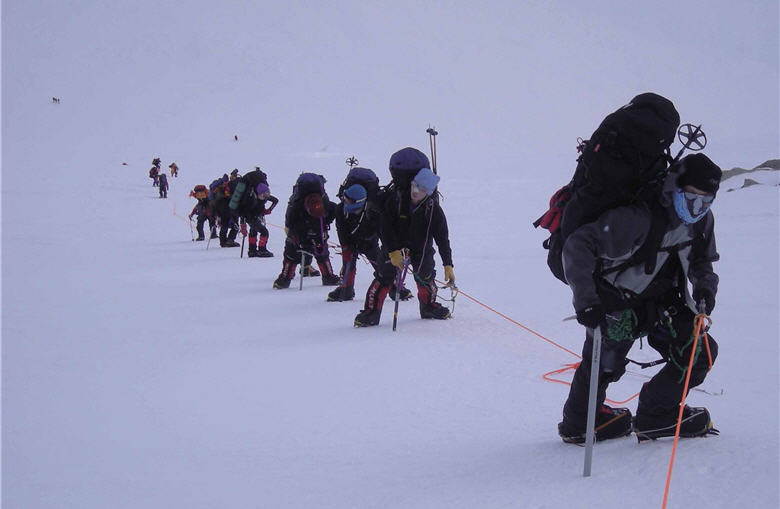
- upper:Ke was moving forward in the snow slope with members of the Seven Summit Expedition Team./ by Yu-long Wu
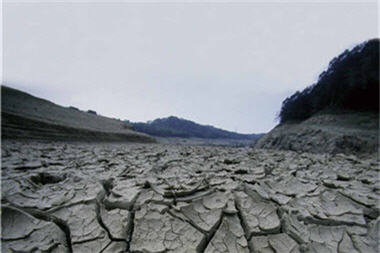
- lower left:A shocking image of a dried reservoir is what Ke intended to present with the power of photography.
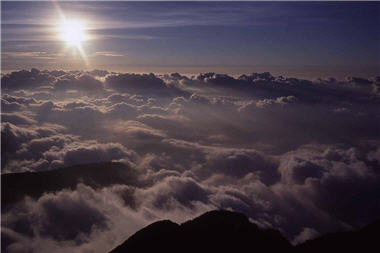
- lower right:Ke was determined to give up the" beautiful past" he had once been indulged in, and turned to pursue the presentation of true realities.
Interview & Text / Zih-yin Chen
Photo Provided by/ Chin-yuan Ke
Translator/ Kuan-yu Ou
Special Thanks to/ Ms. Li-ping Yu of Our Island program, Public Television Service (PTS)
Using the Power of Image
Seeing the recording of the environment as a life-long career, Ke has always done crazy things whenever at work. He had spent over 10 years in foreign jungles and the black market in the Southeast Asia only to produce a 50-minute film about the tragic destiny of orangutans. He had also, over a span of 7 years, recorded the story of a group of marine conservationists who volunteered to restore the Loliginidae in Taiwan's coastal areas. His ongoing love and care for the ocean has lasted for 13 years and been shown in his recording of more than 40 islets.
Among them were Lanyu and Green Island. These two popular destinations of tourism have been eroded by overexploitation and waste water, with the coral reefs in serious danger of bleaching and blackening. The disaster is not just a result of global warming but of an increasing amount of snorkeling tourists. All this was also recorded by Ke with a heart-broken note.
Along the coasts of Taiwan have existed the so-called "yin-yang sea" (sea water in patches of different colors), which is ascribed to the industrial sewage nearby. Filming from a helicopter, Ke once saw a purple strip of the polluted sea right off the coast of Guanyin Industrial Zone. He had also eye-witnessed the gradual death of the algal reefs in coastal areas of Taoyuan. To save the marine environment, said Ke, requires well-thought-out land planning, reasonable use through zoning, effective enforcement, and responsible enterprises that are willing to pay all the external costs of development.
Spending most of his time and energy on filming documentaries, Ke had paid the price as he felt guilty about his constant absence at home. Fortunately, his family had turned their initial intolerance into wholehearted support, giving Ke a boost to continue his pursuit. Furthermore, another type pressure – hostility and resistance in the real world – has also challenged Ke when he tries to present the ugly truth of our environment. "I just have to do what I've got to do; otherwise it'll be too late to save the environment. I know I can chance it through my lenses," the fearless Ke said.
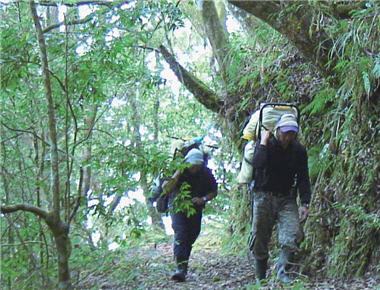
- upper:Ke always strives to grab every possible second to record a meaningful moment
- lower left:Ke has regarded recording the environment as his lifelong career, and never shunned any challenge. In the picture is Dafen Area in Yushan National Park.
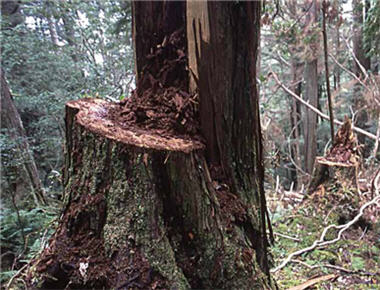
- lower right:The trees inside the area reserved for the pending Ma-Kau National Park had once suffered illegal logging. Ke suggested that it takes more forces and measures, in addition to national parks, to better protect the natural environment.
Cherishing the Nature
Many people would question why he always approaches an issue with such dark and worrisome tones. "Because people just keep exploiting the Nature and competing with it without realizing how they are going to live if they don't stop destroying the land they live on." People in Taiwan do know a lot of most advanced concepts of conservation and environmental protection. But their thoughts and deeds seem to part ways. "People know national parks are for the protection of the Nature and ecosystems," Ke said. "But as people get closer to them, they want more, and thus ruin more. So it takes more forces and measures, in addition to national parks, to maintain a healthy and sustainable environment."
For example, to better protect the ocean from pollution and to better manage marine resources, regulations and zoning of land use is crucial. As land-based pollutants account for 70 to 80% of the pollution sources in the ocean, they must be countered and controlled to ensure a robust future for marine environment. More careful planning, investigations, research on the marine ecosystem, resource capacity, and management are also needed to make possible the sustainability of marine resources.
During his advocacy for Taiwan's natural environment, Ke always braves all kinds of challenges with full energy, and strives to grab every possible second to record a meaningful moment. It is this dedication and momentum of his that would inspire more actions from others to care about Taiwan's environment.
Ke shared a well-said analogy by himself: "I just light up the sparks everywhere without caring about when they are going to trigger a sea of fire." This is how strong one's will power could be!
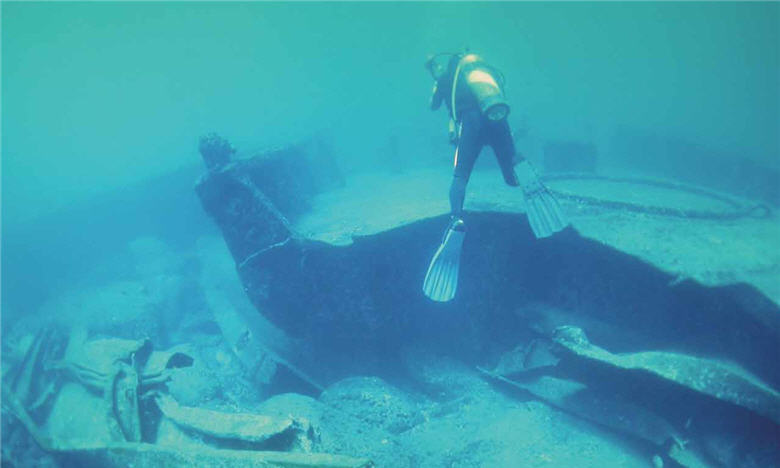
- upper:Ke's ongoing love and care for the ocean has lasted for 13 years.In the picture is Ke went underwater to film the wreckage of the Amorgos.
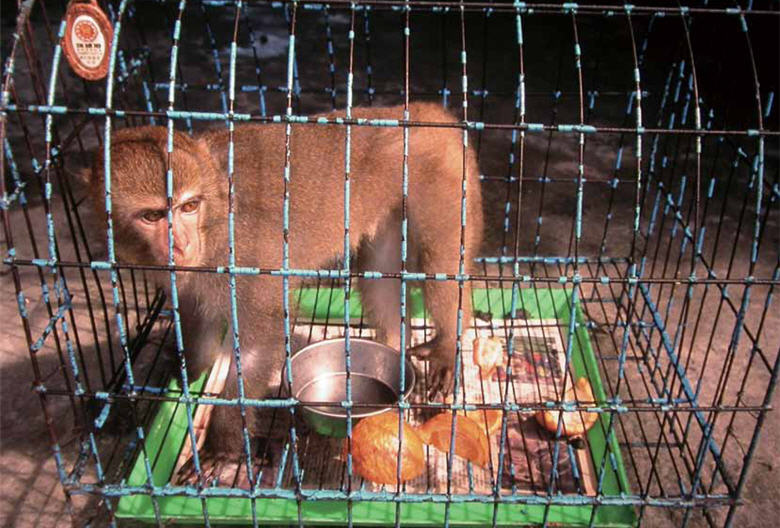
- lower:The monkey in the cage seemed to convey some gloomy messages.


Chin-yuan Ke
Ke was born in Shenkang Township, Changhua County in 1962. During the 12 years from 1993 to 2006, he had been a monthly columnist for some magazines of political, economic and ecological issues. His works include more than 200,000 images of environment, 400-plus in-depth feature reports, 3 books, and about 200,000 words of text files of fieldwork on Taiwan's environment. He has won or been nominated in over 70 awards, home and abroad, since 1997, and is currently a producer at the news department of Taiwan Public Television Service.


