
The Lighthouse of South Cape in Memory-
Jumping over a coral reef groove, pushing aside bushes along the path, and climbing up the deserted coastal defense fort, one would see a splendid panorama emerge like a scrolling painting, with white-cloud-dotted azure sky and blue ocean as the background. Mt. Dajian is distinguishable from surrounding mountains, while at the center stands out the slender and brightly white Eluanbi Lighthouse.
In March 1867, the American merchant ship the Rover struck Qixingyan. The captain couple and the crew escaped in lifeboats and managed to go ashore on Guibishan (now Tanzih Bay) in Langqiao (now Hengchun), but were attacked by aborigines in Guizijiao (now Sheding). Only two Chinese survived. The American Consul to Amoy, General Le Gendre, immediately requested the Qing government to intervene but was rejected. In June, the U.S. sent a military expedition against the tribe members responsible but was defeated. After several negotiations, the Qing government finally sent General Ming-deng Liu with 500 soldiers to Langqiao (now Hengchun Peninsula, referred to the area south of Fangshan) to resolve the issue in September.
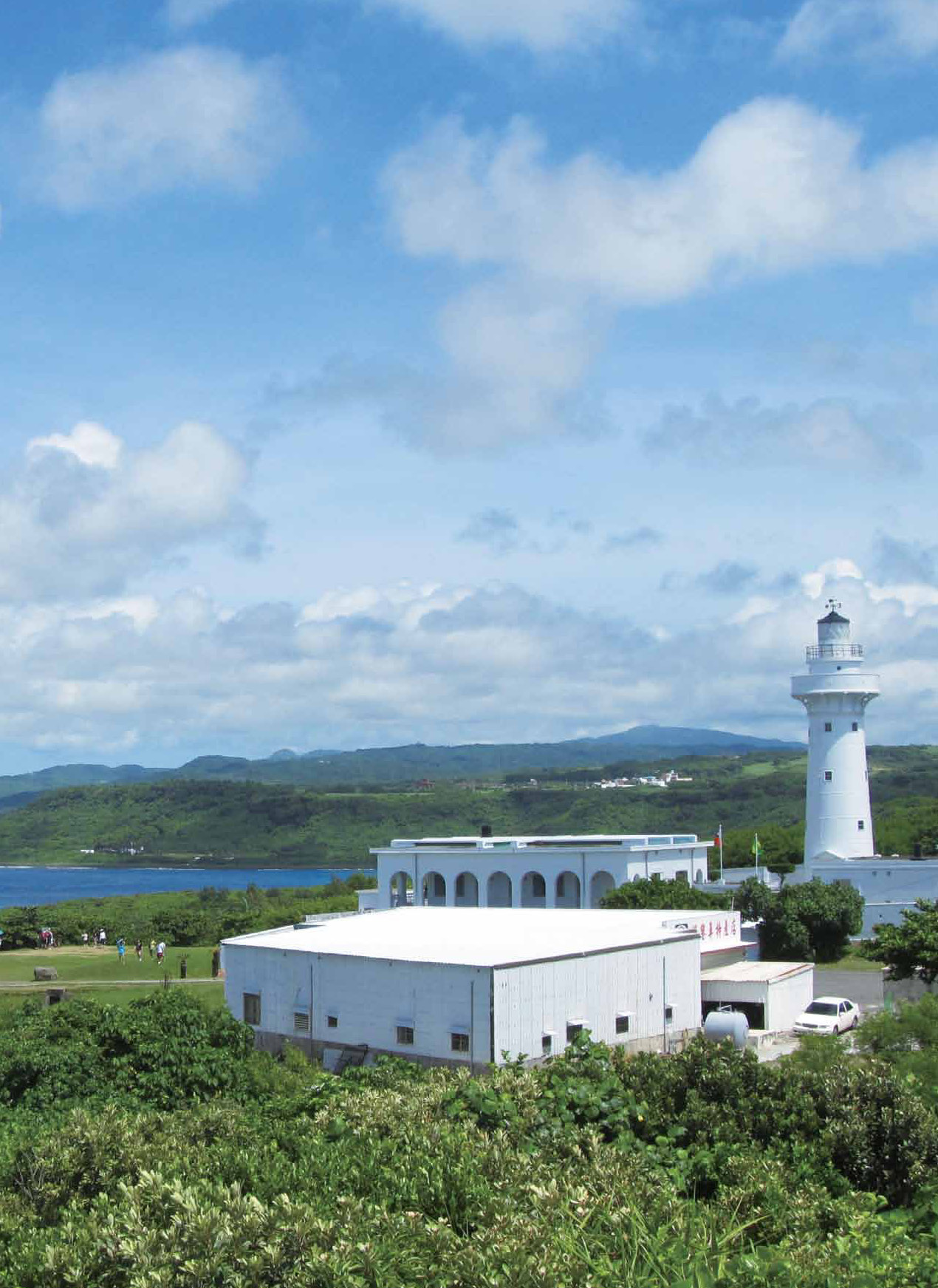
- upper:Eluanbi Lighthouse stands at South Cape, guarding all the boats and travellers on the sea.
Text & Photo provided by / Contract Interpreter Ms. Cyong-yao Lin of KTNP Headquarters
Translator / Donna Hu
With the aid of a translator, W. A. Pickering, who was fluent in Chinese, Liu and Le Gendre negotiated an effective treaty with Tauketok, the chief of 18 aboriginal tribes in Langqiao, guaranteeing the safety of shipwrecked American and European sailors. In Pickering’s book, Pioneering in Formosa, he recorded his adventures in Taiwan in detail including how he advised that Le Gendre intimidate Tauketok to sign the treaty by using fake eyeballs. To appreciate Pickering’s contribution, Liu bestowed him a Chinese name meaning auspiciousness and prosperity.
Following the Rover Incident, Le Gendre once proposed the Qing government to build an artillery battery at the south point of Taiwan and a lighthouse at South Cape, but the proposal was not accepted. In 1871, the massacre of Ryukyu people whose ship was shipwrecked triggered Japan’s invasion into Taiwan, the so-called Mudan Incident, in 1874. Under diplomatic pressure, the Qing government hired W. F. Spindey, a member of Royal Geographical Society, to build a lighthouse.
In June 1875, Spindey led a team of over 80 people from Takau to Langqiao for land inspection. They went southward along Chi-hou Peninsula, crossed Xiadanshui River (now Gaoping River), passed through Donggang to Fangliao, where they first met with the first magistrate of Hengchun, You-ji Zhou, then their journey continued from Fonggang, Checheng, Mudan, to Manjhou. After repeatedly cutting across primitive forests and communicating with aborigines, they arrived at Cape Eluanbi. Spindey wrote in his inspection report: “(paraphrased) This is an unimaginably beautiful land with neat and short grass. Forests on both sides are composed of various hardwoods, such as ebony trees, with sounds of Common Pheasant (Phasianus colchicus) and presence of Formosan rock monkeys (Macaca cyclopsis). We measured the land and angles needed for the lighthouse before we left.” On their way back, Spindey bargained with the chief of aborigines and eventually bought the land with a low price of 100 silver dollars.
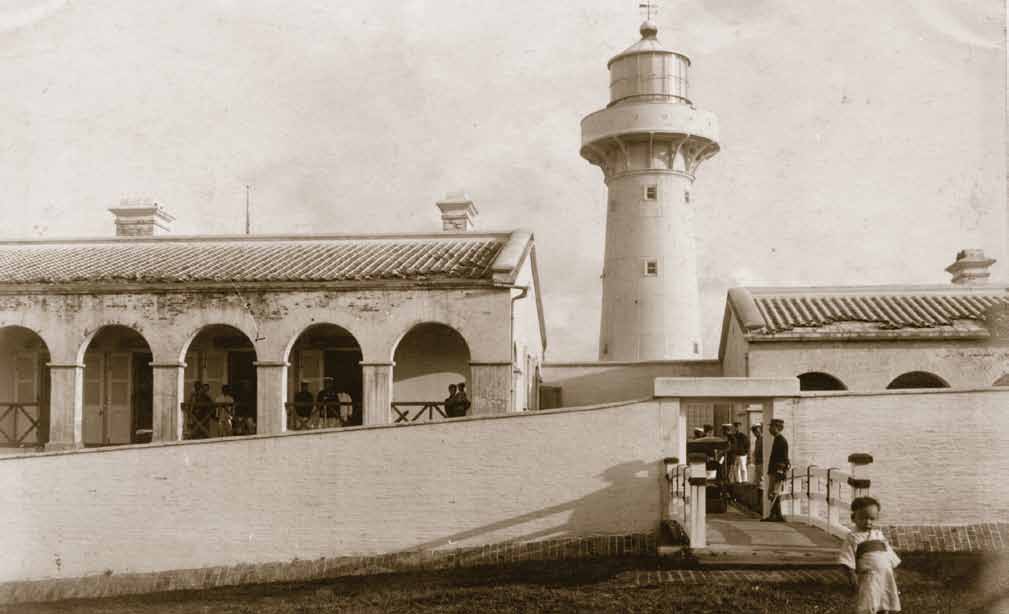
The construction of Elunabi Lighthouse, designed by the Englishman J. Reginald Harding, started in 1881 and was completed the next year, costing around 200,000 silver dollars. It was first lit in 1883. To prevent frequent raids by local aborigines, Eluanbi Lighthouse had a trench surrounding it and many gun holes on its walls. Extra fortifications were also required, making it one of the few armed lighthouses in the world. It was also the first western-styled lighthouse in Taiwan during the Qing occupation era. Shipwreck accidents at last came to an end.
In 1895, the Qing government signed the Treaty of Maguan, agreeing to cede Taiwan to Japan. Eluanbi Lighthouse was bombed out by Qing soldiers before they retreated. In 1898, the Japanese rebuilt the lighthouse. In 1927, Elunabi Lighthouse was voted as one of The Eight Magnificent Sceneries of Taiwan in an activity held by Taiwan Daily News. In December 1929, a monument in memorial of this honor was erected at the south side of the lighthouse and has existed till today.
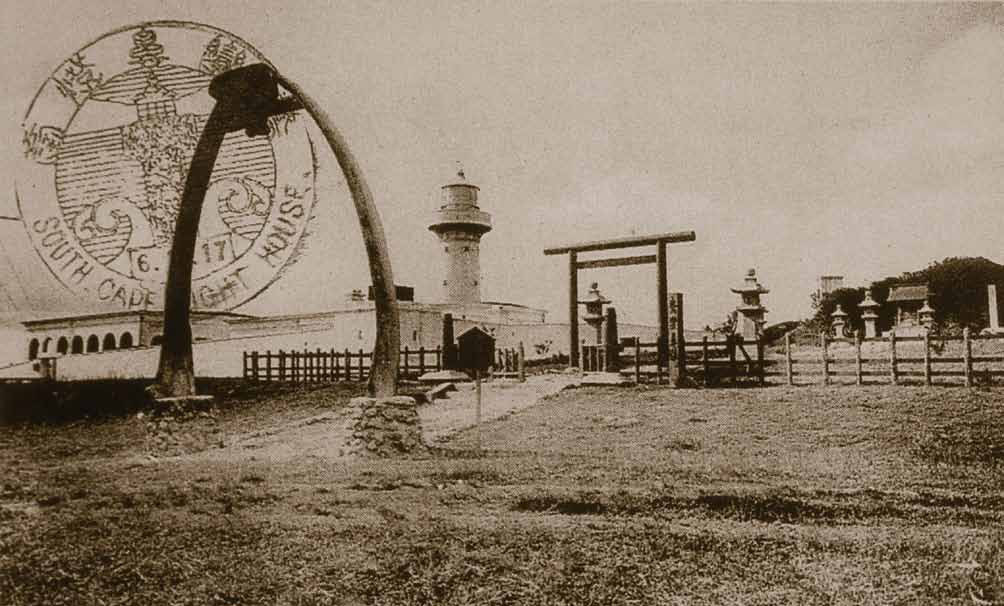
In February 1930, a Japanese whaling company at Dabanle (now South Bay) dedicated whale bones to building the torri for a Shinto shrine, which had been built next to the lighthouse one year earlier. Unfortunately both the lighthouse and the shrine were seriously damaged in WWII. In 1950, the lighthouse was again rebuilt; and in 1962, it was equipped with rotating fourth order Fresnel lenses, flashing once every seconds with an intensity equivalent to 1,800,000 candlepower. Eluanbi Lighthouse, the most powerful lighthouse in Taiwan, has been called “the Light of East Asia.” In 1982, it was included in the heritage areas of KTNP.
In midsummer 2011, volunteer interpreters of KTNP gathered around Eluanbi Lighthouse practicing, preparing to welcome tourists from all around the world, includingChina and Japan. Foreign tourists visit and pay their respect to the lighthouse deemed as a historic symbol. The shipwreck history is long gone. What needs international arbitration in the 21st century is the issue of ocean pollution. What lasts forever is that“ the Light of East Asia” still stands majestically at South Cape of Taiwan, guarding all the boats and travellers on the sea.
- upper left :Eluanbi Lighthouse was the first western-styled lighthouse in Taiwan during the Qing occupation era. /Copied from archive photos at SMC Publishing Inc.
- upper right:In 1929, the Japanese built a Shinto shrine at the left side of Eluanbi Lighthouse. /Copied from a postcard of the Japanese Occupation Era.


