
A Summary on the Current Status of Taiwanese Lizards-
A Summary on the Current Status of Taiwanese Lizards
Taiwan is geologically located at the edge of Eurasia and Philippine Sea Plate and as aresult of constant clash of the underlying earth crusts, there are many mountains andsome reach as high as 3,000 meters above sea level. Given the extreme deferential andabundant rainfall brought by the Northeast and Southwest seasonally wind, Taiwanhas developed a complex and versatile climate combining characters of Sub-arctic,Temperate, Subtropical and Tropical climate type. This has made an ideal inhabitablecondition for many species. Furthermore, the location of Taiwan also happens tobe at the biographical intersection of the “Palearctic Ecozone”, “East Ecozone” and“Australasian Ecozone”. In other words, species from three biogeographic zones can allbe found here, and this explains why Taiwan has such as high biodiversity.
Taiwan only accounts for about 0.3% of the total landsiteof the world but it is the natural habitation land of morethan 86 types of terrestrial reptile (snakes, lizards andturtles) – approximately 1% of the global populationwhich makes Taiwan a country with high reptiles diversity.Amongst all those reptiles, 39 types of lizards have beendiscovered, named and as high as 40% of those areclassified as endemic, which is noticeable in the vertebratein Taiwan.
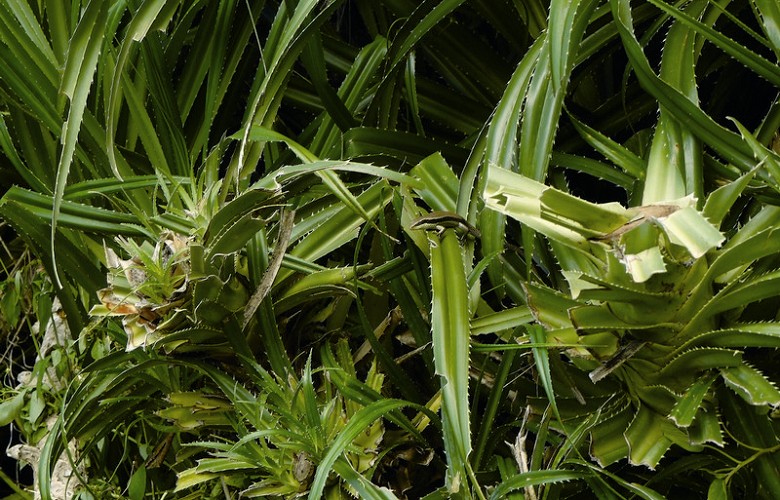
- upper:Long-tailed skink (Eutropis longicaudata) / Lin Te-En
Article: Lin Te-En
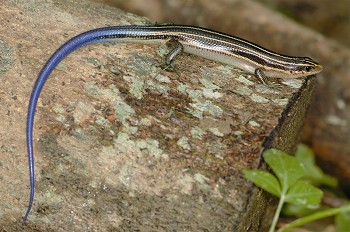
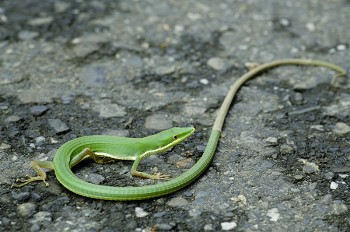
Some of those lizards can be easily found in parks,campuses or mountains near metropolises, such asSwinhoe’s tree lizard (Japalura swinhonis) which spendsmost time on trees; Elegant five-lined skink (Plesiodonelegans) which enjoys “sunbath” on stones and has beautifulskin patterns; Common house gecko (Hemidactylusfrenatus) which likes to hide under the roof tiles orwall corners; and Indian forest skink (Sphenomorphusindicus) which lives at the bottom zone of moist forests.Nevertheless, some of these species only live in specificenvironmental surroundings. For example, Coastal skink(Emoia atrocostat) only resides on the coastal coral reefsin Kenting National Park with superb climbing skillson cliffs and the ability to filter excess salt from its nasalcavity – which allows it to prey on coastal species such ascrabs and sea slaters. On Mt. Hehuan (3,000 metres abovesea level) in Taroko National Park, t Hsuehshan grasslizard (takydromus husehshanensis) is born to withstandthe freezing temperatures and snowy weather condition.Contrastingly, there are various types of lizards can only beseen on specific islands.
Moreover, some lizards are only spotted in southernpart of Taiwan or Taitung; such as Long-tailed skink(Eutropis longicaudata) – longest lizard found in Taiwan,Formosan smooth skink (Scincella formosensis) – smallestand endemic. On the contrary, some species are only found in central and northern area of Taiwan, Yilan, orHualien. Special types such as Both Maki’s tree lizard(Japalura makii) is rare spotted and can only be glimpsed(if you are lucky enough) in the forests located in theCentral Mountains at an altitude of 1,000 meters orabove. There is also another unique lizard named Hart’sglass lizard (Ophisaurus harti) that inhabits at the bottomzone of primeval forests with completely degenerated anddisappeared limbs. Although this type is still recorded toinhabit in mid or low altitude areas throughout the entireisland, the quantity is very scarce.
In order to protect the environment and biodiversityof Taiwan, eight National Parks had been subsequentlyestablished since1984. Those national parks cover all kindsof natural surroundings including ocean, coastal, low andhigh mountains and islands which together create theideal habitation zones for those endemic lizards native toTaiwan. When you have the opportunity to visit theseareas next time, apart from enjoying the beautiful scenery,the phytoncide in the forests, the singing birds and thearoma of the flowers, do not forget to turn your attentionto the edges of hiking trails, forests, short shrubs or coastalreefs, there could be a chance for you to have a glimpse ofthese beautiful and “precious treasure (lizards)” in Taiwan.
- left:Elegant five-lined skink (Plesiodon elegans) / Lin Te-En
- right:Sauter’s grass lizard (Takydromus sauteri) / Lin Te-En
Article: Lin Te-En
Profile

Lin Te-En | Assistant Researcher, Division of Zoology,Endemic Species Research Institute, Councilof Agriculture, Executive Yuan.
With an expertise in Ecophysiology, Ethology,Road Ecology, Invasion Biology, EcologicalEvolution , Amphibians and Reptiles etc.


