
Kenting Showing Lizards-
Kenting Showing Lizards
Although Taiwan has a very small area of 36,000square kilometers, it has the towering mountainsand rugged landscape. On this small island, itsforest features across different biological communitycategories such as Tropical, Subtropical, Warmtemperateand Cold-temperate etc., which alsocreates multifarious biodiversity. There are currently7 National Parks with diverse natures on the MainIsland of Taiwan, and Kenting National Park isthe one with lower in both latitude and altitude.Amphibians and Reptiles are poikilothermal, andthe diversity of their species has a significantcorrelation with the climate. Kenting area has atropical climate which is rare in Taiwan, and becauseof that it breeds rich resources of Amphibians andReptiles. Please follow our footsteps and enteringthe world of Amphibians and Reptiles in Kenting!
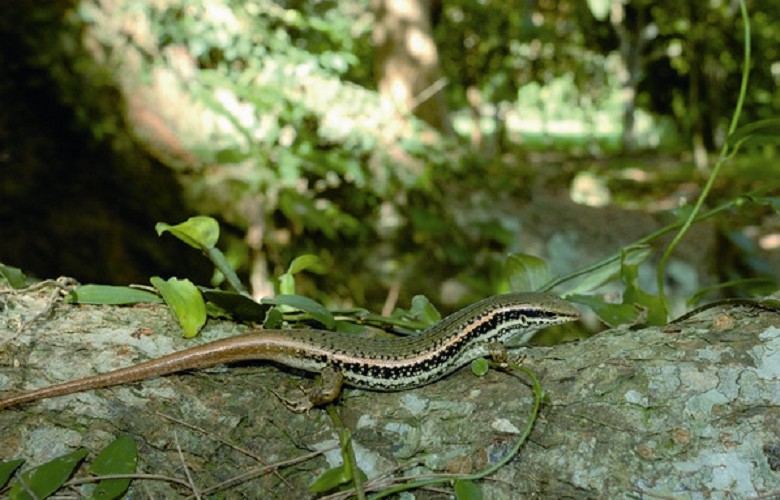
- upper:South China forest skink (Sphenomorphus incognitus) / Wang Jen-Chieh
Article: Wang Jen-Chieh & Lin Si-Min
Nighttime
As the last shimmer of the sunset reflected and graduallydisappeared on the Chuanfan Rock, the Small-leavedbarringtonia (Barrintonia racemosa) cannot wait to bloomnear the Kenting Police Station, which seems to be themost vivid impression of the southern border. As we headeast along the Pinge Road, far away from Kenting Streetand with fewer light pollution, the intermitting, pitchingcroaks of Indian rice frogs (Fejervarya limnocharis) andspectacled toad (Duttaphrynus melanostictus) from theroadside gutter, are making vocal chords at night.
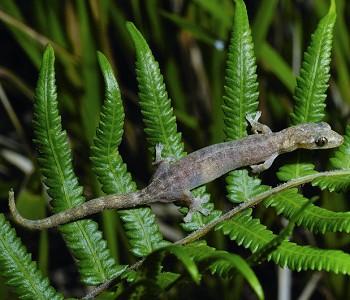
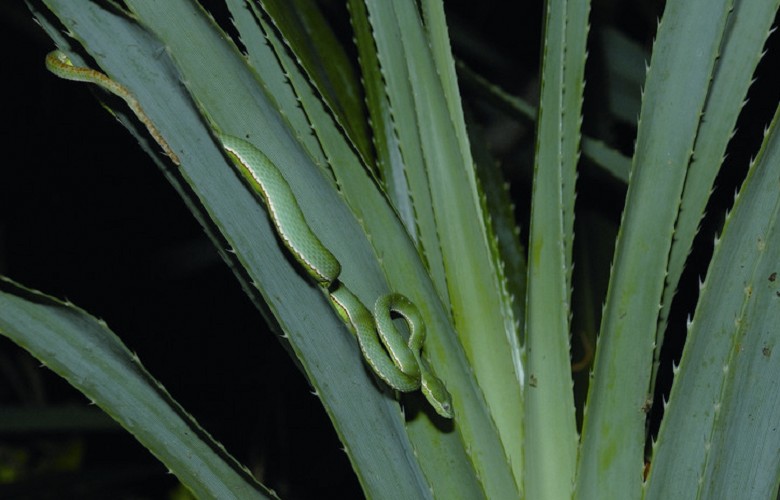
With a torch in hand entering into the roadside shrubsand sharp screw pines away from the busy street, it seemsto find oneself in another time and space. A thin layer ofElephant’s Ear (Macaranga tanrius) leaves amassed on theground; the uplifted coral reef pouring into eyes; LandHermit Carb (Coenobita) climbing through dried leaves,leaving a cracking sound track that reminds us of tidaldecay and erosion occurred at this place million yearsago. Every year in between summer and fall, countless Land Hermit Crab (Coenobita) and Grapsidae (GeograpsusGrayi) are still making efforts to cross the road to breedin the ocean. The beam light of torch penetrates theforest, making the vines and branches mirrored with theirstretched shadows on the sharp coral reefs, when the torchlights behind the silhouetted forest, an unusual touch ofpale green comes into sight— a Chinese green tree viper(Viridovipera stejnegeri) is curling up on barbed leaves,waiting for a careless Gecko passing by. There are seriesof white dots on the dorsal part of this Chinese greentree viper, a particular type that is often seen in easternpart of Taiwan. Those white dots vary as geographicalcharacteristics alters, showing the hidden nuances of geneticdiversity. A rather strange looking Gecko cautiouslyclimbs out between the gaps of Screw Pine leaves nottoo far away; dedicate scale covers its fine skin, so finethat we can almost see the eggs in the abdominal cavity.From the slender body and short limbs, we recognize itas a rarely seen Tree Gecko (Hemiphyllodactylus typus), aneccentric species can only be seen in Hualien, Taitung andthe southern part of Taiwan. This magnificent kind of lizard is parthenogenesis— meaning that the females arecapable to reproduce young and female ones without malefertilization— a cloned version of itself. It takes only onesingle female to reproduce and colonize the new territorywhen a few of those venturing into new environment, andthere are traces of them all over the islands in the EasternPacific. The man-made light might cause panic of this tinyGecko. It was cleaning her big eyes with its tongue whilecrawling into the shadow of the leaves.
- left:Tree gecko (Hemiphyllodactylus typus) / Wang Jen-Chieh
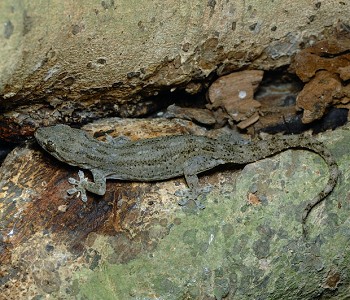
- right:Common house gecko (Hemidactylus frenatus) / Wang Jen-Chieh
- lower:Chinese green tree viper (Viridovipera stejnegeri) / Wang Jen-Chieh
Article: Wang Jen-Chieh & Lin Si-Min
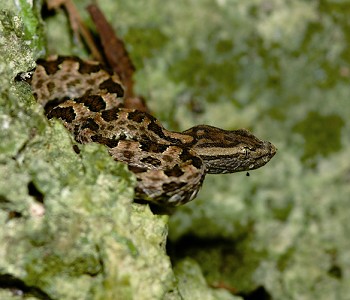
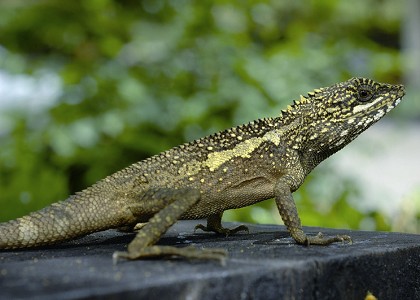
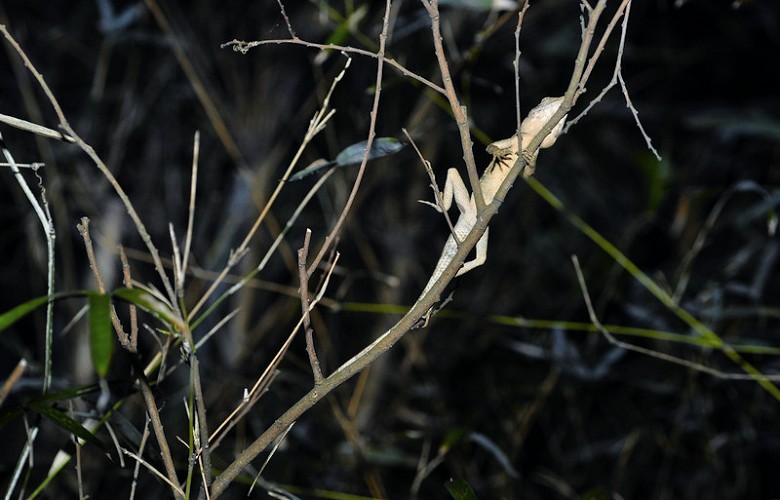
A lot of Swinhoe’s Tree Lizards (Japalura swinhonis) fallinto sleep in the night on those thin, mixed sized branchesin different position. If the light posed momentarily, theywould have opened their wondering eyes gazing at you.These lizards are unique to Taiwan, and are named afterRobert Swinhoe in order to commemorate the Britishcouncil of Taiwan around one hundred years ago. Duringthat time, Taiwan had not yet developed and a lot ofnew species were discovered and collected by him, andtherefore lots of them were named after him. These littledinosaurs in forest have a bright yellow longitudinal bandalong their masculine body. Each male will mark a tree asits territory during the daytime, and with a body gesture resembles the act of doing push-up exercise. This may wellbe used to scare other males by showing off their physicalstrength. It is often to see the male lizard standing on themost obvious spot of a trunk, and female lizards withsmaller body size and color are not so obviously to find. ABrown sported pit viper (Protobothrops mucrosquamata),with excellent protective coloration, curls up in the shadowof Limestone, its skin pattern perfectly blends into thesurroundings of fallen leaves; this type of poisonous snakehas the largest population in Kenting. Fortunately they donot like to get in contact with the human and it is unliketo stumble into this creature as long as tourists do not offtrackthe walkways. Brown sported pit viper is a member of the rattlesnake subfamily, the buccal fossa between eyesand nostrils is their weapon for sensing heat sources, sothey can still attack accurately in pitch-dark. However thisBrown spotted pit viper in front remained idle and doesnot want to make a move, only the cat-like pupils constandiv>
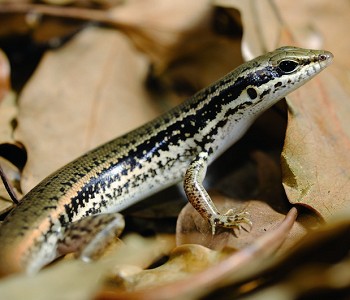
- left:South China forest skink (Sphenomorphus incognitus) / Wang Jen-Chieh
- right:Brown spotted pit viper(Protobothrops mucrosquamata)/ Wang Jen-Chieh
Article: Wang Jen-Chieh & Lin Si-Min
Daytime
The sun is strong and shine on Hengchun Peninsula, thecrystal blue sky and ocean mixed with the humid, saltyand sticky ocean breeze which bring peace and serenityas if the land was brought to a complete stand-still bymagic. Walking into the National Forest RecreationArea, the enthusiastic singing of Chremistica Ochraceaand Cryptotympana Takasagona penetrate the lush forest,this is a typical Tropical Monsoon Forest, the damp anddark spaces between the huge Heritiera littoralis Dryand,in collection of aged fallen leaves, is the heaven for manybiological creature. Gecko and Five-striped blue-tail skinksoften use the spaces as hideouts, they would hide intothe gaps urgently when there are slight movements, andthe land of small insects is a gourmet feast for all sortsof lizards. Stepping on the thick layers of fallen leaves,there would be a hasty commotion occasionally near thefeet, after a carefully search and realize that a chubbySouth china forest skink (Sphenomorphus incognitus) isdisturbed and nervously watching three meters away, andthe sunlight falling on its smooth scales makes peopledazzling. South china forest skink get its Chinese namefrom the irregular arrangement of the inner thigh scales,it looks similar to the Indian forest skink (Sphenomorphusindicus) that appears throughout the island, but with abrighter body colour and only appears to be seen at southof Kaohsiung, it is also the most often sighted skink atKenting. Gently brush aside the petiole of banana tree,there is a nocturnal Mourning Gecko (Lepidodactyluslugubris) hiding in the space of the roots, this kind ofsmall— less than 10 centimeters — gecko is excellent incolouration, its body is sometimes in beautiful light yellow,and sometime it becomes dark brown with patterns, theonly consistent features are pairs of black stripes at itsshoulder and the junction of body and tail. Same with theTree Gecko mentioned above, Mourning Gecko is alsoparthenogenesis, habitats in the tropical coastal forest, it ismost seen in Kenting, Lyudao (Green Island) and Lanyu(Orchid Island) in Taiwan, in the view of biologists, theexistence of this kind of small lizards is the true treasure inthe southern border of Taiwan.
When we walk into the deserted building in the deepforest, a few Common house geckos (Hemidactylusfrenatus) glued on the glass window bring people’sattention. Although most of the geckos are nocturnal,it seems like the Common house gecko at southernboarder cannot resist the temptation of the beautifulsun; sunbathing in daytime and only sneaking back tothe gaps in shadow when human is approaching fromclose-by. Common house gecko is also named “goodbug” in Taiwanese; evidencing that it has been knownby our ancestors that Common house gecko eats insects.Household lights tend to attract some small phototaxisinsects and those geckos become the Heroes— cleaningup all insects! Common house gecko is also called Wartstail gecko in Taiwan because of the many protruding wartson the tail, like a mace, and some larger wart scales onthe body. It is often said that only Geckos from south ofJhoshui River would make sounds, then why can we oftenhear gecko chirping at the north? The saying is originatedbecause there is another kind of gecko looks similar tothe Common house gecko without the wart scales on itsbody or tails, it is called Bowring’s gecko (Hemidactylus bowringii). These two kinds of geckos used to spread outin Taiwan as North Bowring’s , South Warts Tail, and thekind of gecko making chirping sound is the Commonhouse gecko. Due to the intermigration in past decades,these two kinds of geckos that often found in householdswere migrated with furniture or goods. Therefore peoplecould hear gecko chirping in northern border could alsofind the trace of Bowring’s Gecko in the south!
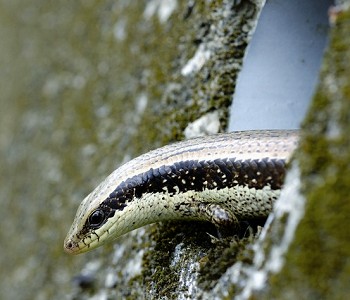
- left:Long-tailed skink (Eutropis longicaudata) / Wang Jen-Chieh
- right:Male Swinhoe's tree lizard (Japalura swinhonis) / Wang Jen-Chieh
Article: Wang Jen-Chieh & Lin Si-Min
Arriving at the roadside gutter visited the night before,finding that daytime belonged to the long-tailed skink(Eutropis longicaudata). This type of skink is the largestskink native to Taiwan with a streamlined body and longtail, a black strip stretching from the eyes to the rear leg;making this skink looks like wearing a black eye mask.
Their short legs and chubby body pop in and out of thedrainage holes on the retaining wall, or they simply lyinglazily under the sun absorbing the heat; and if you get tooclose, they will quickly disappear into crevices or grasses.Many raptors fly pass Kenting every year, small reptilesand insects are their cuisine, even the small but fiercelyaggressive brown shrike will treat those small lizards andskinks as a feast. This constant thread had enabled themto develop and evolve ability as dropping tail and survive.This special skill lies in the vertebrae of the long tailwhere each section has a broken point that it would dropif attacked by the predator. The disconnected tail wouldtwitch vigorously for a while, capturing the attention ofthe predator while the lizard made its escape.
The blue ocean of Kenting was clear and warm that attracted many tourists to the water andnobody would contemplate a type lizard be within close distance. Sitting patiently on thereef edge of the intertidal zone and enduring the exposure to the strong sunlight, one wouldpossibly find a little dark lizard, quickly and swiftly climbing from one reef cavity to anotherand suddenly looks up, sticks out its tongue and starting its investigation. Like snakes, mostlizards relies on their tongues to collect odorant molecule to explore your scent; and as longas you sit quietly and let it adapts and determines there is no threat, it will happily search thereef cavities for food, preying on little crabs or picking up the remains of small fish completelyignoring your existence. Once you achieved this far, congratulations! You are now officially afriend of the coastal skink (Emoia atrocostata). Needless to say human is actually quite close tonature, only if you are willing to open your heart and listen to the response of lives.
Afterwords
Although KenTing National Park situates in a low lying altitude that does not possess thetopographic variation of mid and high-altitude regions; nor does it provides the ideal habitationzone to amphibians compared to the moist northern border, it is the only National Park thatcan be classified as a tropical one. The monsoon forest and coral reefs in Kenting are full ofbiological wonders and preserves flora and fauna that are hardly found in other parts in Taiwan.The lizards (a member of amphibian and reptiles) are very treasured members in this area—from the mysterious small gecko in the coastal forest— to the coastal skink shuttling at thesouthern coastal reef— and the easily spotted Swinhoe’s tree lizard and skinks. They are all thenatural habitants of the peninsula and each plays an irreplaceable roll in the ecosystem.
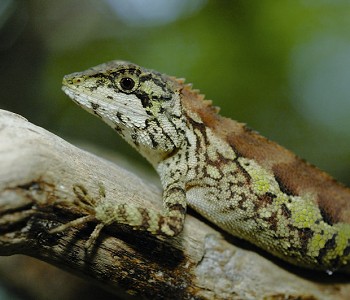
- upper:Swinhoe's tree lizard / Wang Jen-Chieh
- left:Swinhoe's tree lizard / Wang Jen-Chieh
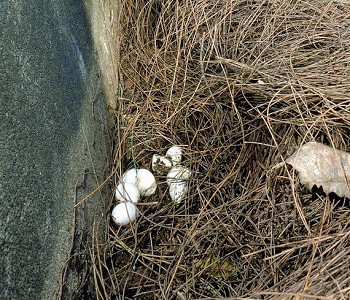
- right:Eggs of Long-tailed skink/ Wang Jen-Chieh
Article: Wang Jen-Chieh & Lin Si-Min
Profile

Lin Si-Min |
After Lin graduated from the Department ofPhysics at National Tsing Hua University, hediverted to Fresh-water Fishes as his researchtopic for Master degree; then transferredto research Amphibians and Reptiles for hisPhD. He taught in the Department of LifeScience in Chinese Culture University during2004 to 2008.
From 2008 onwards, Lin has been teachingat the Department of Life Science in NationalTaiwan Normal University.

Wang Jen-Chieh |
With an expertise in field observation andecological photography, Wang is especiallyinterested in amphibians and reptiles, andis passionate and enthusiastic about thepromotion of ecological education. Wangis currently a postgraduate student at theNational Taiwan Normal University.


