
The Taste of Overseas Fusion-
The Taste of Overseas Fusion
The 2012 Word Min-Nan Culture Festival
Culinary culture is a subset of culture inextricably linked to its people’s lives. The ingredientsused often vary depending on the local environment— leading to delicious discrepancies.When immigrant populations bring their culture to foreign lands, the respective culinarytraditions evolve and metamorphose into a unique mixture of native and foreign cuisine.
In distant times, around the fourth century A.D., the Han people of Zhongyuan began theirsoutherly migration. Upon their arrival in the southeast, they intermixed with the Minyuepeople. As a direct result of this, the Min-Nan culture arose. As such, it is entirely valid to claimthat Min-Nan culture originated in Hoklo, then expanded from Fujian to Kinmen, Taiwan,Japan, Singapore, Malaysia, Brunei, Indonesia, the Philippines, Vietnam, and Thailand. Aftermixing with the local cultures, numerous unique Min-Nan cultures emerged in these foreignlands.
One of the important cultural repositories of Min-Nan culture is Kinmen. It has preservedMin-Nan traditions faithfully through war and strife. Additionally, it is the point from whencemany Southeast Asians emigrated— thus, it is intimately linked to those of Chinese descentthroughout Southeast Asia. Consequently, Kinmen has preserved a mixed culture composed ofMin-Nan culture, immigrant culture and warzone heritage.
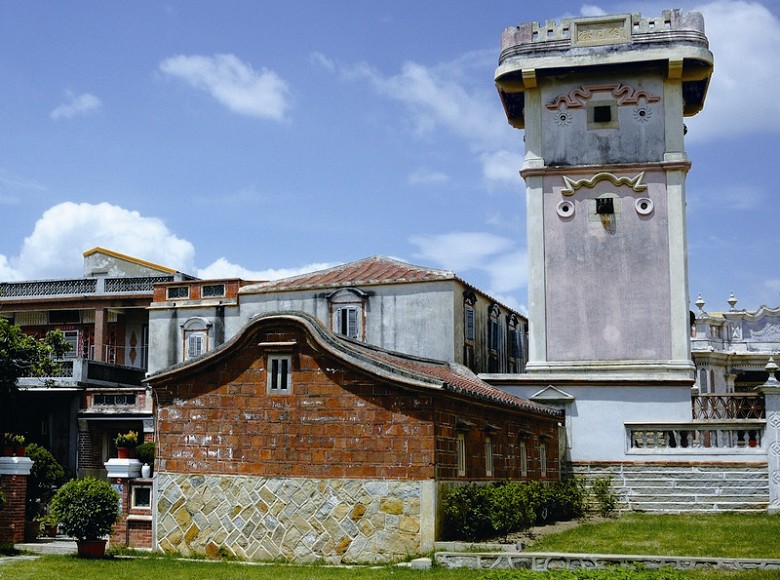
- upper:Kinmen Shuitou Village / Chen Chin-Chun
Article: Kinmen National Park Headquarters
Kinmen has its own unique flavor of Min-Nan culture. At the same time, it was a startingpoint for expansion toward the southeast along the coast, toward the east into Taiwan, towardthe south into the South Sea and toward the north into Japan. Along with martial law came a multitude of soldiers whose mission it was to protectKinmen. This led to the local residents emigrating andforeigners (the military garrison) immigrating—thisemigration was in part responsible for the disseminationof Kinmen’s culinary curiosities into the Southeast Asianconsciousness. The garrison in Kinmen had as manyas 100,000 soldiers from all over China. They infusedtheir own culinary cultures into an enormous and variedculinary culture in Kinmen up until the inclusion of themodern health and organic food movement—thus creatinga rich and varied culinary tradition that is inclusive ofthings both new and old. Overall, Kinmen culinaryculture is the result of years of tribulations and abundance,isolation and openness and all of the external forces withwhich it has dealt during those times.
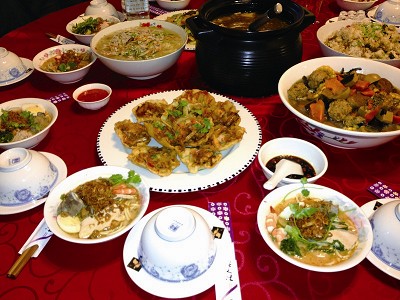
The 2012 Wold Min-Nan Culture Festival has assembledChinese from Singapore, Malaysia, Japan, Indonesia,Mainland China, and Taiwan to explore the uniqueMin-Nan cultures of Tainan, Kinmen and Taoyuan. Thesingularity of Kinmen’s culture is especially evident whenconsidering the City God Reception Parade—taking placeon the 12th day of the 4th month of the lunar calendar.Additionally, there is a Min-Nan culinary experienceactivity, which clearly displays the unique cultural fusionthat has taken place.
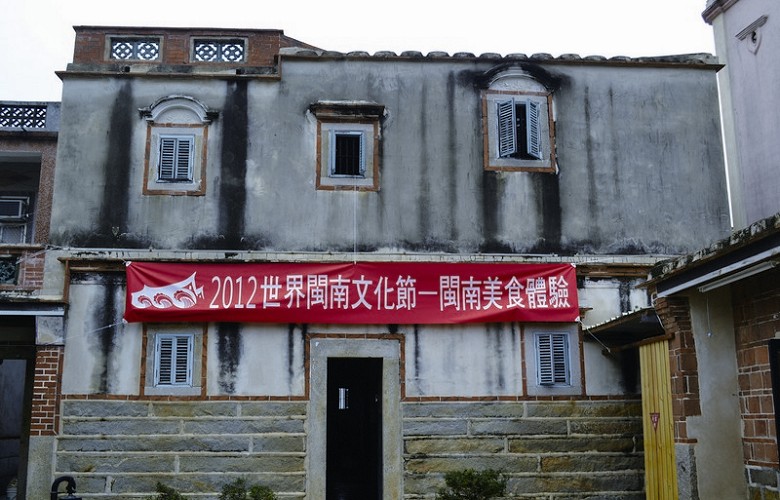
- upper:Locale for Min-Nan Culinary Banquet / Chen Xiu-zhu
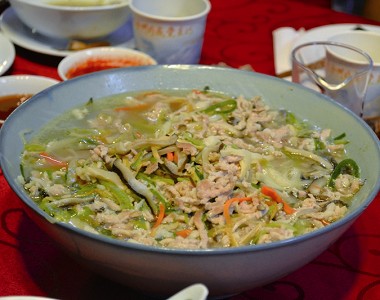
- left:Special dish for feast Yancai / Chen Xiu-zhu
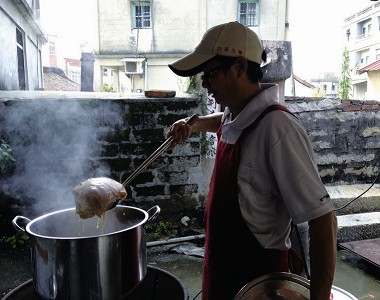
- right:Boiling the Bak kut teh / Huang Zi-juan
Article: Kinmen National Park Headquarters
Singapore is a country of friendly acceptance: numerousimmigrants from varied places all live together here inharmony. This tolerance and acceptance extends to cuisineas well—for example, you can savor the flavors of differentcuisines from Fujian, Chaozhou, Hakka, Guangzhou,India, Europe, the Malay Muslims and the PeranakanChinese among others. Not only can you get traditionaland authentic dishes, but you can also try the uniquelylocal fusion cuisine.
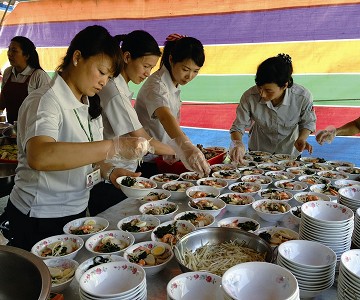
For the 2012 Wold Min-Nan Culture Festival, an emphasishas been placed on the Fujienese Shrimp Noodle Soupfrom Singapore, thus allowing everyone to experiencea dish with origins in Fujian that has undergone fusionwith local Southeast Asian cuisine. This is done so as to letpeople experience the process and power of cultural fusion.
「Bak kut teh is an incredibly creative invention of theChinese in Malaysia. The port of Klang in Selangor stateis the birthplace of Bak kut teh. Over a century ago, manyimmigrant dockworkers braved the hostile environment,silently gritting their teeth and putting their nose to thegrindstone to survive in the hopes that one day they wouldbe able to return to their faraway homelands. Ironically,though, this foreign land became their homeland as theseimmigrants slowly started to take root in this distantland. Those hardworkers from days of yore, collectedthe miscellaneous herbs that had fallen on the pier, theneveryone in their group pooled their resources to buymeaty bones to make a meat soup that was light on meatand heavy on soup: piping hot Bak kut soup. Enter thethousand year-old Chinese tradition of tea consumption and thus Bak kut soup became Bak kut teh. This delectabletea recounts the bittersweet tale of the Chinese migrationinto Southeast Asia.
The oysters used in Kinmen’s oyster noodles are chewyand fresh delights of the sea; the noodles themselves arenaturally sundried and devoid of chemical preservatives.Gourd with fried clams is a dish always made with localand seasonal ingredients. As such, this dish is made inaccordance with healthiness as a priority. Garlic bolts withfried three-tiered pork and blood sausage with bambooshoots are indicative of simple living—a lifestyle acquiredthrough carving out a living from the uncooperative islandand sea and the stoic spirit to which this leads. Simple,sated and optimistic, Kinmen’s cuisine is reflective of itspeople’s now comfortable manner of living.
Yancai is a food fit for banquets and catered occasions.Kinmen’s Yancai utilizes locally grown cabbage—havingbecome sweet due to freezing in the cold Kinmen winter,which leads to an exceptionally sweet-tasting dish. Whenthe ingredients are fresh, the broth becomes even moredelicious.
The 2012 Wold Min-Nan Culture Festival allows allcomers to experience the extent of the abundance andvariety of this group’s culinary heritage. Simultaneously, itenables people to better understand the appeal of fusioncuisine within the independent culinary traditions.
- left:Min-Nan Culinary Banquet / Huang Zi-juan
- right:Preparing the Fujienese Shrimp and Noodle Soup / Huang Zi-juan
Article: Kinmen National Park Headquarters


