
Welcome aboard the Eco-navigation Ark!-
Known as the Conservation Olympic since 1948, the World Conservation Congress (WCC) held its 24th conference at the Hawaii Convention Center in Oahu, Honolulu, Hawaii in September 2016 to discuss environmental and development issues and policies. First hosted in the United States, the WCC this year was attended by about 6,000 government agencies, international organizations, non-governmental organizations, academics and experts, indigenous groups and students from over 170 countries. The 6th World Park Congress (WPC) held in Sydney, Australia in 2014 and the first Asian Protected Areas Conference in held in Sendai, Japan in 2013 were presented by the Ministry of the Environment heads of the respective countries. The presence of US President Obama added to the scale of the conference, and the spotlight on the improved conservation performance in the six-fold expansion of the Pacific Remote Islands Marine National Monument to make it the world's largest marine protected area highlighted his political career.

Investing in ecosystem has become the best way to enhance the resilience on climate change impacts. / Hsiao-Lu Ho
For the time being, regardless of the ambition of politicians, the conclusion is that protected areas have become internationally recognized important tools for sustaining ecosystem services and human development. Although the designation of protected areas poses real subsequence challenges of governance, protected areas are undeniably vested with legal authority and legitimacy in the field of conservation. Trends in global climate change is a present day concern, and the question remains as to how ecological reserves can ultimately help and protect humankind. The world has invested a lot of resources into such research, and interim results are proving that protected areas are the most cost-effective ways for confronting climate change and resolving the consequent challenges. In the storm of climate change, the challenge is to seek a sustainable lifeline by intelligently navigating the ark of ecosystem. So together, let us take the opportunity to understand and open the door of wisdom!
/ Hsiao-Lu Ho
Adaptations to Climate Change
Asia is highly affected by climate change. In recent years, the frequency of typhoons, floods, droughts, rising sea-level, rising temperature and other climate-related disasters have increased significantly. The number of developing countries in Asia is also relatively higher, and lowlands, coasts and densely populated cities have become potential environment for large-scale disasters. In the 2013 Asia-Pacific post-disaster resilience report, the United Nations Economic and Social Commission for Asia and the Pacific (ESCAP) noted that Asia and the Pacific are the most disaster prone areas in the world, and that from 1970-2011, about 2 million people in Asia and the Pacific were killed in disasters, accounting for 75% of the world's disaster related deaths. With population growth, river and coastal environment are dramatically altered by urbanization. In addition, high risk intensive use of land exposes communities to increased risk of natural disasters and natural disaster related losses.
To cope with the impact of climate change, international conservation has adopted two main responses: Climate Change Mitigation and Climate Change Adaptation. Climate change mitigation attempts to reduce the emissions of man-made greenhouse gases, such as by reducing transportation, energy production and landuse carbon emissions, or by increasing the level of carbon sinks and carbon sequestration, such as increasing forest area. Since 12% to 17% of global greenhouse gas emissions are due to changes in land use and forest reduction, reducing carbon emissions from forest development has become an objective in development policies over the past decade.
In the climate change mitigation concept of "prevention is better than cure", addressing the resulting or imminent impact of climate change is the focus of adaptation to climate change. By then, the impact of climate change has come to the point where measures must be taken. In climate change adaptation, the core concept is helping affected societies confront and respond positively to disasters, and associated concepts include Adaptive Capacity, Vulnerability, and Resilience. In recent years, resilience has been a popular keyword in the conservation community, and refers to the potential of systems such as individuals, communities and countries to recovery from disasters while maintaining the original operational capability of the system.
Protected areas provide different values and benefits to nature and society, and such concepts have been increasingly validated and recognized in recent years. Since 2000, the World Wide Fund for Nature (WWF) and the World Conservation Union (IUCN) have been gathering important information on the natural ecosystems of protected areas and demonstrated the cost-effectiveness of protected areas and their asset to many social, cultural and biological services. Protected areas also play an important role in human health, water supply systems, recreation, food security, climate stabilization and disaster mitigation. The United Nations International Strategy for Disaster Reduction (ISDR) believes that ecosystem management is an essential element in disaster risk reduction and mitigation (reducing the degree of natural disaster damage to the community is also known as disaster mitigation).
Ecosystem-based Adaptation (EbA) integrates the use of biodiversity and ecosystem services into an overall strategy to help people adapt to the adverse impacts of climate change. It includes the sustainable management, conservation and restoration of ecosystems to provide services that help people adapt to both current climate variability, and climate change. Healthy ecosystems, such as forests, wetlands, mangroves, and coral reefs, have a greater potential to adapt to climate change themselves, and recover more easily from extreme weather events. EbA emphasizes the value of ecosystem services: healthy ecosystems provide drinking water, habitat, shelter, food, raw materials, genetic materials, a barrier against disasters, a source of natural resources, and many other ecosystem services on which people depend for their livelihoods. Unlike other climate change adaptation initiatives, which focused on the use of technologies and the design of climate resilient infrastructure, such as embankments and drainage works; EbA offers a means of adaptation that can be readily integrated into community-based adaptation and collaborate with local residents people. Ecosystem-based Adaptation involves a wide range of ecosystem management activities in the world. These activities include:
• Sustainable water management , where river basins, aquifers, flood plains, and their associated vegetation are managed to provide water storage and flood regulation services.
• Disaster risk reduction, where restoration of coastal habitats such as mangroves can be a particularly effective measure against stormsurges, saline intrusion and coastal erosion.
• Sustainable management of grasslands and rangelands, to enhance pastoral livelihoods and increase resilience to drought and flooding.
• Establishment of diverse agricultural systems, where using indigenous knowledge of specific crop and livestock varieties, maintaining genetic diversity of crops and livestock, and conserving diverse agricultural landscapes secures food provision in changing local climatic conditions.
• Strategic management of shrublands and forests to limit the frequency and size of uncontrolled forest fires.
• Establishing and effectively managing protected area systems to ensure the continued delivery of ecosystem services that increase.
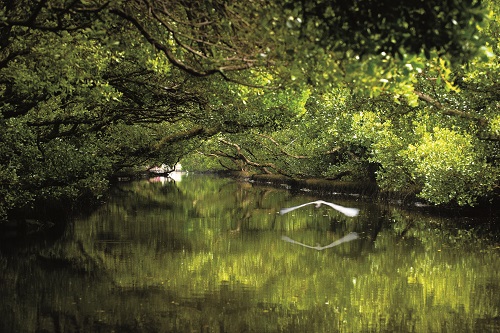
Ecosystem-based Adaptation (EbA) emphasizes the direct benefits of cooperation with local communities and disadvantaged communities in rural or remote areas. The 2009 the EbA Handbook published by IUCN contains 10 examples of implementation, and include areas such as developing and developed countries, local, regional and national scales, and marine, terrestrial and freshwater ecosystems. The cases are widely distributed in regions such as East Africa, Central America Andes, Sri Lanka, Southeast Asia, Tanzania, Australia, Britain, Sweden and Papua New Guinea and etc.
Coastal areas are vulnerable to global climate change, including storms, floods, seawater intrusion and coastal erosion. The Green Coast program aims to restore coastal resilience and help restore tsunami-damaged coastal ecosystems in Indonesia, Sri Lanka, India, Thailand and Malaysia. The Green Coast program is a community-based approach for improving the lives of local residents through four methods:
• Restore coastal ecosystems
• Build a sustainable way of life
• Develop community norms that support environmental conservation
• Environmental Education Action. Involve local populations in planting mangrove and other coastal vegetation to reduce disaster risk in local coasts affected by climate change

humanity to adapt to climate change. / Hsiao-Lu Ho
The entire project was funded by the Netherlands Oxfam Novib and jointly implemented by the Wetlands International, the World Wide Fund for Nature, International Union for Conservation of Nature and Natural Resources (IUCN) and Both ENDS. Sixty local NGOs and community organizations in Indonesia participated in training and helping tsunami-affected residents sow and nurture mangroves along the coast. In 2009, 1.6 million mangroves and 250,000 coastal plants in Aceh and Nias were re-cultivated, and coral reef conservation were actively implemented. Since the multi-root form of mangroves can contain the impact of the waves on coast roads, mangroves are used as coastal vegetation, and wave height can be reduced fivefold compared to vegetation-free coasts. In addition to restoring the benefits of the ecosystem itself, all actively participating private groups can receive zero interest mortgage-free loans for pursuing new ways of livelihood.
Invest in improving ecosystem resiliency
The World Conservation Union (IUCN) uses the United Nations International Strateg y for Disaster Reduction (UNISDR) definition of disaster, stated as "A serious disruption of the functioning of a community or a society involving widespread human, material, economic or environmental losses and impacts, which exceeds the ability of the affected community or society to cope using its own resources. " In this context, no catastrophe is" natural ", and all disasters are due to a society's inadequate ability to respond to disasters.
How a society manages the environment and its vulnerability to damage, its ability to face adversity and its resource resiliency have become the focus of disaster reduction. Since natural changes are difficult to predict in advance, losses due to disasters can be prevented or at least mitigated through effective Disaster Risk Reduction (DRR) strategies. The ability of ecosystems to effectively reduce losses caused by natural disasters have gradually become a key tool in DRR, and such ecology-based concept for disaster risk reduction is called Ecosystem-based Disaster Risk Reduction Eco (DRR). Increasing the resiliency of residents and the sustainable management, conservation and rehabilitation of ecosystems ensures that ecosystems have the capability to mitigate the risks of natural disasters.
Although declarations of the importance of ecosystems and biodiversity are commonplace, international conservation organizations continue to practice and innovate through promoting different short-, medium- and long-term projects such as the Relief Kit Project (tentatively translated as Eco- DRR relief first aid package plan). This three-year program (2015-2018) aims to cultivate the ability of policy makers, practitioners and stakeholders in Asia, Africa and Central America to bridge the gap in the knowledge of biodiversity and natural disasters. To fulfill the spirit of Eco-DRR, the program objectives are:
• Promote understanding of Eco-DRR knowledge and experience.
• Train at least 120 decision-making and implementation specialists who understand the importance of the Eco- DRR approach to Disaster Risk Management Plan.
• Promote training experience to raise awareness about the importance of Eco-DRR./p>
Japan Case Study
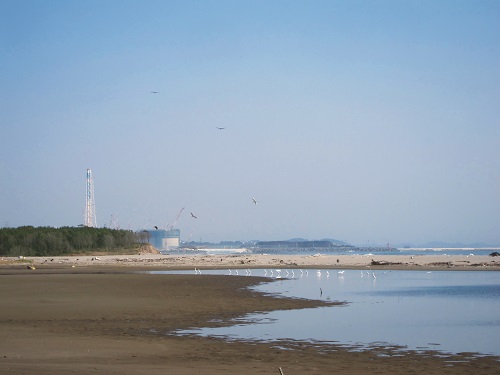
The Gamo Tidal Flat in Sendai, Japan is used as a case example to demonstrate the effectiveness of ecosystems in mitigating disaster from climate change. The National Wildlife Sanctuary in Gamo Tidal Flat is a resting habitat for migrating birds from Russia, Australia and other countries. The lagoon here is a mixture of fresh and salt water. At low tide, the tidal flat become an extension of the surrounding wetlands, and is a habitat where many plants and animals reproduce. However, since the 311 tsunami, the landscape has changed dramatically. The tsunami flooded over 2,000 kilometers of coastline in Aomori, Iwate, Miyagi, Fukushima, Ibaraki and Chiba prefectures. Due to the flat terrain of the Sendai coast, the tsunami swept up to 5 kilometers inland and resulted in severe damage to the local population and natural environment. The significant change in the terrain and tidal beach substrate have affected local biology, and organisms not previously recorded here have appeared.
After the tsunami, Japan's Ministry of the Environment continued to observe the natural environment of these seawater flooded coastlines, including changes in vegetation, changes in sandy and muddy beaches, and changes over the century, and monitored the ecosystem. The ecosystem is mainly monitored for benthos in the tidal flat (16 areas), eelgrass bed (6 areas), seaweed bed (5 areas) and seabird breeding sites (4 areas); 4 key points in monitoring in total. Comparing with aerial map over the last century, the Ministry of the Environment attempts to observe changes and the degree of changes in the Sendai coast and vegetation before and after major earthquakes. Results show lesser impact in areas with coastal forest plantation while flat farmlands were severely eroded and the landforms drastically changed. Such knowledge base of ecosystembased effective disaster risk reduction can be translated into strategies for future ecosystem management, and more importantly, ensure societal resilience and recovery capability against catastrophes in the face of global change.

2016 World Conservation Congress and National Park
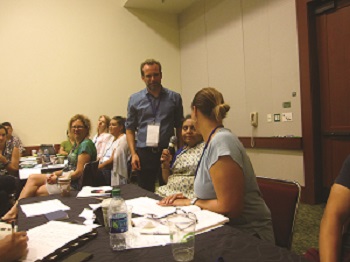
The theme for the 2016 World Conservation Congress (WCC) is Planet at the Crossroads, which conveys more severity and urgency than the previous theme on quest for innovative solutions. The 2016 WCC repeatedly emphasized the important role of protected areas in climate change adaptation. Furthermore, the management of protected area is no longer limited to protected areas, but also include human populations who depend on the diversity of services founded on the organisms found in the protected areas. The value and model of protected area management have transformed from excluding human existence in "pure land" to gradually building a co-management mechanism with the residents. In fact, there is no absolute good or bad in a management model or strategy; rather, only an adaptive management developed from a local context can truly balance conservation and local residents’ livelihood, and become widely promoted by the international conservation community.
On the other hand, "adaptive solutions based on the natural ecology of the climate change " reflect changes in the value of human will over nature and the supremacy of technology. Solutions no longer pivot on the use of air-conditioning in offices or festive conservation conference; neither is there a miracle or overnight cure. The key to adaptive remedy is through the slow but most pragmatic approach of repeated field work, understanding and working with protected areas and the local residents and improving their existing resources. Let us board the ark of intelligent ecosystem navigation and help each other!
About the Author
Pei-Ying Lee
With previous experience in environmental NGOs, Pei-Ying Lee is currently a doctoral student at department of Forestry and Resource Conservation, National Taiwan University. Li's research focus is on the management and governance of protected areas.


