
Visting Wetlands Keeps You Young-We are All on the Road of Learning

landscapes and foresight technology./ Photo by Hau-Hau’s Taiwan Tour
Visting Wetlands Keeps You YoungWe are All on the Road of Learning
Interviewee /
Chien-Wei Wu, Director of Taichung Coastal
Resources and Fishery Development Institute
Ching-Hai Cheng, CEO of EIET
Article / Hui-Ying Lui
The sea recedes following the footstep of the westward sun, and the vast beach gradually reveals itself from the shallow water. The wooden boardwalk that was originally immersed under seawater meanders toward the beach where tender faces brighten with expectations. Flocks of Fiddler Crabs and Soldier Crabs are foraging on the beach at a brisk pace. When little feet move forward, the crabs would spread out like ripples; when the little feet retreat, the crabs would once again resume their peaceful foraging time. On the clean beach, kids would lie down and roll around happily, as if sand and mud are the most fitting clothes…until the sun goes down. Some people say that Gaomei’s sunset is a must-see in life; maybe only the pairs of big and small footsteps on the wetland can witness the unmissable time in life!
National Parks × Taiwan Wetlands
Wetlands, where water and land meets, are important origins of life. The “Wetland Conservation Act” was passed by Legislative Yuan in 2013 and implemented on February 2, 2015.Starting from this year, the “National Park Quarterly” will include introductions to important wetlands in Taiwan, connecting mountains, wetlands, and ocean, in order to get a comprehensive view of the rich ecological and cultural landscape of our land.

Gaomei community. /Provided by Gaomei Wetland Visitor Center
In search of fun in Gaomei
Due to its rich wetland ecology, clean beaches, and safe coastal environment, Gaomei Wetland has become a popular spot for parent-child travel in recent years. The happy scenes of playing in the sand and looking for clams where the sea melts into the sky have made many families come in a swarm. Gaomei Wetland is also a wildlife sanctuary with many precious ecological resources, including endangered plant population such as Da-Ann Hygrophila (Hygrophila pogonocalyx) , Yun-Lin Cyperaceae (Bolboschoenus planiculmis) and Southern Ladies Tresses (Spiranthes sinensis), and is also a foraging habitat for Ardea alba, Ardea cinerea, Bubulcus ibis, Egretta garzetta and Threskiornisaethiopicus.
The waves of people who came to Gaomei Wetland are an opportunity to enhance our people's understanding of the wetland ecology and environment. Therefore, many local groups that love Gaomei wetlands have joined the ranks of environmental education. In order to strengthen environmental education and channel tourists, the Taichung City Government Construction Bureau spent more than two years to build the Gaomei Wetland Visitor Center and began operations in July 2018. The environmental education courses provided by the visitor center have cooperated with "EIET Eco-Interpreter Education Training Camp" to design content suitable for parents and children to learn together.

Gaomei community. Provided by Gaomei Wetland Visitor Center

and culture and is suitable for the whole family to do together. /Photo by Feng-Neng Hsu
Reading the cultural Gaomei by foot and bicycle
Before designing the environmental education courses, the most important thing is do resource survey and inventory. Ching-Hai Cheng, CEO of EIET Eco-Interpreter Education Training Camp, said, “Over the past few years, we have been continuously doing community resource survey and exploration activity planning. In 2019, we have also been commissioned by the Environmental Protection Bureau of Taichung City Government to carry out a plan for cycling in the community and have planned five to six distinctive routes.” Many of them contain numerous culturally interesting attractions around Gaomei Wetlands in the surrounding communities. For example, households near Gaomei use spring water as their daily water source, so many special local water features have emerged; the Chen family garden is full of exotic flowers and antiques; the Yan family garden is full of stone carvings made by the deceased old homeowner conveying his observations on everyday living, creatures and animals; there is also the rarely seen ten dragon courtyard at the ancient Li family home. This remarkable Gaomei and its cultural heritage in the community neighborhood can all be explored through riding bicycles and on foot.
The current “Green Trail Ride” activity provided by the Visitor Center, “We have run six rides in the second half of last year, and the visitors were all very surprised, saying that they never thought they could see a Gaomei they could never imagine in just a few kilometers.” The entire tour would last about 2.5 hours, including observing the ecology along the boardwalk, visiting the villages, and passing by the Gaomei Lighthouse on the way back. Such time and distance are easy and doable for both the parent and children. In fact, the initial plan has included spots that another team thought was very interesting, but after two actual operations, adjustments were made in order to meet the physical strength of most customers so that they would not need to rush on their way back.
The most special thing about arranging the ecological program at Gaomei Wetland is to match the rhythm of the tide, “The general schedule of the tour is from 9:00 ~ 16:00. To accommodate the boardwalk opening time during low tide in the morning, we would walk the boardwalk first and do ecological observation on coastal plants, birds, and crabs, then return to the Visitor Center for lunch at noon, and use this time to use the multimedia in Eco-Experience Hall for learning practice, and then undergo various ecological games in the afternoon.” Designing ecological games is the strength of the EIET team. The content of the game echoes the ecological observation done in the morning so that children can have fun and learn at the same time.
Wetland Plants in Gaomei

full of treasure and can be made into all kinds of toys

and endangered plant in Taiwan.

most famous plant at Gaomei Wetland.

many international media. /Photo by Ching-Hai Cheng
Switch on the learning switch
“Play and do, do and learn” has always been the core spirit of EIET. Nature has many interesting things to discover. It is the main reason that made EIET gathered together, think together, and learn from each other. Therefore, EIET also hopes to use "simple and fun" ecological games and lively interpretations to arouse public interest in exploring nature. The designing of all the activities and curriculum contents are like the process of exploring and investigating the mysteries of ecology to them, and by using a more naiveté way, allowing people to gain the deepest impression through the five senses. Ching-Hai Cheng believes that everyone has a "learning switch". Different exploration experience games are like different switches. Once the switch is activated, it has the opportunity to turn on the motivation and incentive for learning.
Empty, in order to return home full
In the process of guiding a group of visitors, it is inevitable to encounter some parents who are eager and impatient. “Give children a chance” become the best keyword to remind them. “Families who come here all have different backgrounds, which are great learning opportunities for both the participating parents and the guides.” What Ching-Hai Cheng hopes most is that parents and children who come here can “empty” the inherent ideas that were in their heads. He used a simple question to point out the key, “The question I ask most often is ‘how many legs do crabs have?’ and the most common answer I hear is eight.” Have you who are reading this article also neglected the two specialized chelipeds? Another question is, “How do crabs walk?” Children will answer without thinking, “sideways.” But after watching the Soldier Crab (Mictyris brevidactylus) and rare Pyrhila pisum swarming for food at Gaomei Wetland, people will completely overturn this stereotype. There are crabs that can walk forward as well!
“The predicament of education today lies in the accumulation of too much intellectual information and memory of abstract concepts.” Children's cognitive development (after seven years of age) first acquires the ability of logical thinking through specific operation periods, and then enters the period of abstract conceptual thinking. If sensory perception is the way and foundation for us to understand the world, should we not think about how we can make it to the fullest? Ching-Hai Cheng once led the children to play the party freeze game on the beach, “when children rush forward the crabs would retreat; when we say ‘freeze!’ we would ask everyone to close their eyes and listen to the sound of the sea and the wind and smell the scent the ocean. When they open their eyes, they will see themselves surrounded by countless crabs which make them exclaim in surprise!” At this time, we will ask everyone, “How does the crab know danger is coming to avoid it?” The innocent faces would race to answer, “through voice” and “by vibration”. “Let us say hello to the crab aloud, why didn’t they respond? Let’s stamp out feet together, hum, it doesn’t seem to work either.” In such a series of actual actions, making children use their physical senses to understand that crabs rely on their vision to avoid natural enemies.

/Provided by Gaomei Wetland Visitor Center

into the holes sequentially. This activity tests children’s hand-eye
coordination and teamwork, as well as allowing them to recognize the plant seed.
/ Provided by Gaomei Wetland Visitor Center

(this is Fiddler Crab in the photo).


Take root, environmental protection starts from the most subtle place
All the materials used in ecological games and DIY crafts designed by EIET are recycled or renewable resources. “Straws are recycled to make into crabs, wrapping papers are turned into colorful fish or origami crabs, and plastic bottles are transformed into windmills. Even Linden Hibiscus which is common in the coastal environment is full of treasure, and can be incorporated in many different games.” Even for lunch, bucket meals are used to allow participants to only take as much as they can eat. The Visitor Center’s eco-tour allows everyone to practice environmental protection even at the smallest detail.
Such as the “Ecological Pyramid” game, when everyone takes turns to remove a total of six sticks supporting the pyramid, it is difficult not to let the pyramid fall apart. This makes children realize that the existence of creatures at every level has its meaning and value. It is even more difficult to put the stick back to restore the pyramid, just like once the natural environment is damaged, it takes more time to recover. In addition, every small step we take in environmental protection is like protecting a small corner of the ecological pyramid, subtle yet important. Ching-Hai Cheng believes that “leading by example has the greatest influence, but it is not easy to accomplish.” If parents can lead by example, their children will be influenced by them and develop the ability to take action of environmental protection while they are still young.
Respect, the foundation of life education
“We have the only ‘crab cart’ in Taiwan that uses aquariums to raise crab species that are represented in Gaomei Wetland,including Cardisoma carnifex and Chasmagnathus convexus,etc. Most people are afraid of being bitten when they see crabs. We will show you how to interact with crabs through guidance. After breaking the fear, people can enjoy the feeling of crabs ‘crossing the hand bridge’.” When the crab crawls from the first pair of hands to the last, when realizing even the big Butcher Land Crab can also interact with people docilely, “it turns out that as long as the creatures are treated in the right way, they will also return a friendly response!”
Wise Use of Wetland
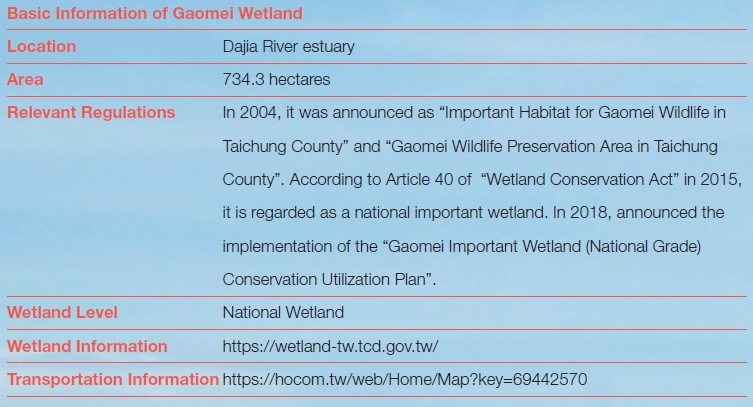
The “Wetland Conservation Act” takes wise use as its core spirit, and establishes conservation utilization plan base on the different characteristics of the wetlands. At the beginning stage of promoting and delineating of Important Wetlands, the locals did not understand the meaning and purpose of the Wetland Conservation Act, so when they heard that the land would be designated as important wetland, it was often linked to the prohibition of production or restriction of use. In fact, Wise use refers to a timely, fittingly, moderately and adequately sustainable utilization of the biological resources, water resources and land resources that is achieved in a compatible approach within the wetland ecological capacity. It can be said it uses a way that protects natural resources to support the sustainable development of agriculture and fishery, respects current use, and protects the existing livelihood rights of the local residents. Gaomei wetland has abundant flora and fauna and is rich in habitat diversity; it is also an important natural resource for the residents of the Qingshui coastal areas.
It is protected by the Wetland Conservation Act as well as the Wildlife Conservation Act, where the two are slightly different in land use zoning and restriction content. According to Article 21 (1) of the Wetland Conservation Act, “……, in the event where the utilization should violate stipulations set by other related laws, it is to be processed per the stipulations.” People must follow the relevant provisions of the two laws when performing recreation or other use at Gaomei Wetland.

and interact with crabs. / Provided by Gaomei Wetland Visitor Center
Follow the right "path"
The Taichung City Government has built a wooden boardwalk of about 691 meters in length, hoping to effectively guide the crowds and avoid recreational impact. The boardwalk passes through the restricted area, along which red lines and warning signs are set forbidding the general public to enter. Everyone is welcome to observe the ecology in the area an end of boardwalk, but remember not to damage the creatures and habitats, or take away any creatures in the wetland. Or according to the Wildlife Conservation Law, you can be fined NTD $50,000 to $250,000. The boardwalk is routinely maintained every year about one week during Nov.to Dec.and is also closed during typhoons. “Every day 1.5 hours before and after the high tide (2 hours when encountered spring tide), the boardwalk will also be temporarily closed. Please follow the instructions of the patrolmen.” the Coastal Resources and Fishery Development Institute has also launched the “Explore Gaomei” ecological guide app. It is a good helper for pre-trip travel arrangements and on-site self-guide travel. It is recommended that everyone can download and install before departure.

Another fun game is called “shifting crabs”, where children need to send the crab puppets back to the right home. In the process, children will learn that each crab species has its own suitable living environment, and it is our responsibility to maintain a diverse habitat. “Just like in the Sustainable Area, children can enjoy raking out the clams from the beach, but after teaching them about the habitat of the clam, we will still ask everyone to put the clams back.” At this time, parents and children are also informed that a group of local people depends on the clams in this Sustainable Area for their living. If they want the environmental resources to be sustainable, they must know to cherish them.

back to their correct homes. /Photo by Ching-Hai Cheng

in the Ecological Interactive Area of the Gaomei Wetland Visitor Center.
/Photo by Ching-Hai Cheng
Persistence, future is the proceeding of now
Most Gaomei Wetland tours will include a combination of indoor and outdoor activities, and the place for ecological games is right at the Gaomei Wetland Visitor Center. There are many fascinating experience designs in the Visitor Center, and technology has become the best partner for environmental education here. Facing the 3C generation, environmental education can also make better use of the multi-media in a more intelligent way, opening up the connection between the new generation and nature, and ignite their enthusiasm for "reality" through guidance. Interested families can also visit independently.
Heading up to the viewing platform on the second floor of the Visitor Center from the external staircase, you can overlook the entire Gaomei area and admire the vast wetland and beautiful sunset. “In April and May of 2019, the ‘Junior Marine Guide in the Big Taichung Area’ training camp was held in Gaomei. The course included an overnight stay in Gaomei. Students camped in the Visitor Center and went up to the viewing platform to observe stars at night. Early in the next morning, they all went for a morning exploration at the boardwalk.” Under the clear night sky, people's voices faded, so they can better hear the whispers of all creatures; in the early morning among the coastal mist, people are hardly seen, so they can fully observe all the different states of creatures. This is a very precious experience for children.
Finally, Ching-Hai Cheng mentioned, “We also hope that through different activities and curriculum designs in the future, people will be able to learn more about the different aspects of Gaomei Wetlands. This includes nighttime ecological exploration activities to see a different ecology from the daytime; a working holiday camp combining people from different fields to brainstorm and discover Gaomei’s resources, and let ideas and thoughts continue to affect more people through new activity designs! These are all still continuous efforts….” All environmental educators who love nature can always discover new things in nature and are more than happy to see more and more people fall in love with nature.
Family trip reminders
• Tidal fluctuation varies seasonally. In order to make the best travel arrangements, please remember to check the tide table.
• There are public parking lots 1 and 2 in the surrounding area. People can use iBike to get to the Gaomei Wetland entrance at Mei-Ti Street.
• The boardwalk is about one-kilometer roundtrip. Please remember to let the children use the restroom first.
• The open recreation area is only at the end of the boardwalk. All other areas along the boardwalk are restricted areas, do not leave the boardwalk! Penalties will be made according to the “Wildlife Conservation Law” for those do not follow. If you accidentally dropped important items, please go to the patrol station at the entrance for help.
• People who would like to take cover from the sun, please wear hats with drawstrings to prevent it being blown away by the wind; if you take out your belongings, remember to hold it down with weights.
• In order for children to fully enjoy the Gaomei Wetland, please remember to bring an extra change of clothes and windbreaker.
• Do not leave anything behind except beautiful scenery.
• For your safety, please fully comply with the instructions of the patrolmen!!!


