
At the Forefront of Protecting the Ecology-Interview with the First National Park Service Director- General Mao-Chun Chen
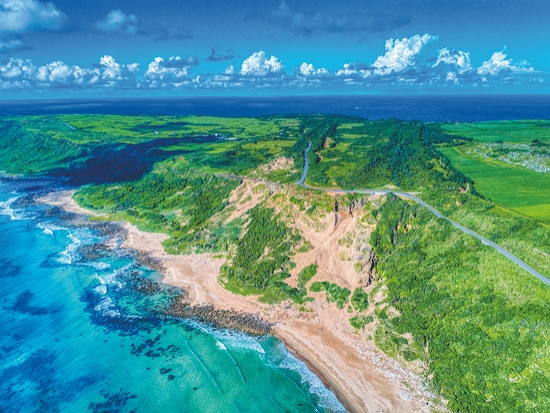
one of the reasons why the National Parks were established./Photo by Chin-Huang Lai
The Guinness World Records list the current longest 24-hour distance run without stopping at about 310 kilometers; and the extremely demanding 5,000-kilometer ultramarathon takes a massive 52 days to complete. Such time and distance records make us marvel at humanity’s potential and perseverance.
But there is another kind of long-distance race, one that takes place on neither a road nor a mountain; has no scheduled time or distance; and cannot be completed by one person alone – yet which has just as strongly borne witness to the possibilities of human persistence and foresight. People in government agencies, experts & scholars, and civilsociety organizations have all taken turns, through countless discussions and meetings, to keep pushing forward to protect the mountains and the sea. Finally, this effort reached an important milestone in 2023.
After 25 years of discussions and negotiations regarding organizational transformation for the Ministry of the Interior, on May 26, 2023, a major draft amendment to the Organization Act of the Ministry of the Interior was finally passed on its third reading. This new amendment established the National Land Management Agency and the National Park Service (NPS). As an agency specifically dedicated to Taiwan’s National Parks, the NPS will have its own director and budget. Minister of the Interior Yu-Chang Lin feels full of gratitude at being able to partake in the important moment of the NPS's establishment.
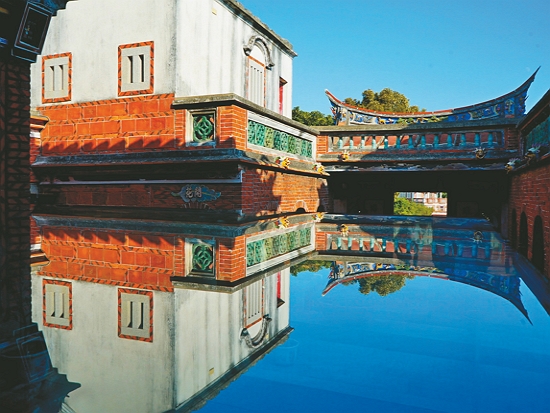
/ Provided by KNPH
“I thank the heavens for giving me the opportunity to work with all the enthusiastic people who have helped enhance of the competent authority for Taiwan’s National Park system. I also thank all the former ministers, directors-general, and directors for their unremitting effor ts over the past 25 years.” Minister Lin’s eyes sparkle, full of thanks to everyone for all their hard work every step along the way, and full of pride for this new milestone that has been reached through so many people’s efforts.
It’s been 25 years since Taiwan’s National Park Law was enacted; and Kenting National Park, the first National Park in Taiwan, is going on 15 years old. Additional National Parks have been established, such as Yushan, Taroko, and Shei-Pa to conserve Taiwan’s unique subtropical alpine terrain; Yangmingshan, highlighted by its volcanic landforms; and Kinmen, aimed at preserving Hokkien cultural landscapes and battlefield historical sites. With the growing governmental and public awareness of conservation, there has been a greater and greater expectation that these six National Parks will take on ever-more important missions. It was from this kernel that the idea of establishing a NPS gradually blossomed.
Today, not only has a major amendment to the Organization Act of the Ministry been passed, but Taiwan’s National Park system has grown from the original six to add three more: Dongsha Atoll National Park and South Penghu Marine National Park, both focusing on marine conservation, and Taijiang National Park, which aims to protect wetland ecosystems. Taiwan’s first National Nature Park, at Shoushan, has also been included to conserve important urban natural environments. As Minister Lin describes what makes the nine National Parks and one National Nature Park unique, it is clear how important he believes the establishment of the NPS to be for the development of Taiwan’s National Parks. “This is not only an organizational transformation,” he says, “but also an important new start for environmental work in Taiwan.”

/ Provided by YNPH
Building a Platform to Connect 23 Million Hearts
In the past, when we had to sacrifice the environment for economic development, we would establish different protected areas such as national/nature parks, wildlife preserves, and forest reserves as recompense for this sacrifice. Protected land areas came to account for 19.3% of Taiwan’s overall land area, and 6.7% of Taiwan’s marine area. National Parks account for 66% of the protected areas, and serve as home to 80% to 90% of species in Taiwan. “With the National Parks having completed their phased tasks, and with the establishment of the NPS,” says Minister Lin, “we must keep striding forward, to spread the value and concepts of National Parks far beyond the parks themselves!"
Standing at this historical turning point, Minister Lin continues to ponder what new missions the National Parks should undertake. “The NPS should act as a grand platform that incorporates strengths from all parts of society,” notes Lin. Over the past four or five decades, National Parks have been nurtured by everyone from the government, to National Park personnel, to scholars, volunteers, and community residents. However, Taiwan has 23 million people in Taiwan, so there are still many oppor tunities and challenges awaiting this new platform. “I believe that, whether we’re talking about an individual or an organization, vision is critical for future development,” says Lin. “The greater the vision, the greater the goals will be, and the greater the achievements can be.”
Minister Lin takes the conservation of species such as the Formosan black bear Hynobius, and purple crow butterflies as an example. Animals migrate not only across National Parks, but also entire habitat corridors. When we realize this fact, we understand that individual National Parks not only have to consider collaboration with other National Parks, going beyond the borders of their single parks, but need to link with organizations and individuals along the species’ entire migration routes. Only then can we implant the values and concepts of National Parks into people’s hearts. “If the values and concepts we are promoting fail to take root in all people’s hearts,” Lin notes, “we will never free ourselves from back-and-forth struggles.” Minister Lin hopes that the NPS can become a platform for natural and cultural governance, which will be critical for Taiwan to develop from an economic society to become a sustainable society.

/ Provided by the Ministry of Interior
Keeping Enthusiasm in Mind Helps Pave the Way Toward Sustainability
Minister Lin is well-acquainted with species conservation. This is not merely because of his position as head of the NPS's parent agency, but also because of personal dreams he has long held. Minister Lin recalls with a smile, “I loved watching animals when I was a kid, and dreamed of becoming a zoo director when I grew up. When I was in university, during a visit to Taroko National Park, I got the idea of becoming a National Park docent.” Since becoming Minister of the Interior, that enthusiasm has stayed in the back of his mind, and has helped him gain deep insight when visiting the National Parks.
“I often see parents with children, even three generations of family members visiting National Parks together,” says Lin. “This shows how that environmental awareness is expanding across generations, and is a huge achievement. This sense of identity, built upon the contours of our land, must continue to be passed down from generation to generation.” The Minister notes how National Parks become part of school children’s life experiences, through education systems, and that this should be promoted in a proactive way and supported by close collaboration among government agencies. “If we can work with the Ministry of Education's K-12 Education Administration to integrate National Parks into the curriculum, new possibilities will be created.”
In addition to Taiwan’s citizens, enterprises that support the country’s development are also indispensable partners for carrying on the sense of national land identity. There have already been many positive examples of collaboration between the National Parks and enterprises, but Minister Lin hopes for even more. “On the topic of environmental and social governance (ESG), National Parks should help enterprises understand what opportunities we can create for them.” Only through mutual benefit can the National Parks’ value and concepts penetrate enterprises’ thinking, thereby promoting changes in economic behavior and paving the way toward sustainability.
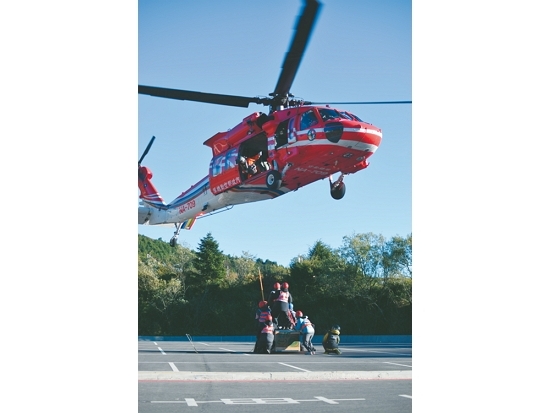
lot of collaborative experience in matters such as disaster/accident rescue and
transporting materials for high-altitude building projects./ Provided by TNPH
Comprehensive Collaboration to Weave a Strong Conservation Network
After a National Park is planned and formally established, it isn’t just a static thing. Instead, it is subject to continuous, dynamic changes due to factors such as human use, climate change, and natural disasters. That means the parks cannot be protected by the NPS's efforts alone. “By making the NPS a part of the Ministry of the Interior,” notes Lin, “a huge advantage is the active collaboration that can be facilitated with other units under the Ministry of Interior, such as the National Police Agency, National Fire Agency, National Airborne Service Corps, and Department of Civil Affairs.”
For example, with poaching, illegal logging, illegal land development, or other such violations, police enforcement is required to prevent irreparable damage to ecosystems and habitats. Also, with forest fires in the mountains becoming more likely due to climate change, collaboration with the fire safety service will become more and more impor tant. And when mountains and forests become accessible to the public, disasters and accidents unfortunately follow, so the National Airborne Service Corps is needed for rescue.
The National Land Management Agency, which was concurrently established with the NPS, incorporates climate change, sustainable management, and national land restoration into its land management mission. Before the Spatial Planning Act was officially implemented in 2016, ongoing environmental restoration and sustainable management was implemented according to different National Parks’ plans. In the future, all this valuable experience accumulated over the years will be shared with the National Land Management Agency. The National Park Service and National Land Management Agency will have more and closer interactions in relation to environmental restoration, indigenous rights protection, smart utilization, and more.
Minister Lin emphasizes, “If we look at it from the perspective of national spatial planning, Taiwan’s three existing national land laws – the Spatial Planning Act, Wetland Conservation Act, and Coastal Zone Management Act – added to the National Park Law weave a strong network for national land conservation.” This network extends the National Parks’ functions from environmental conservation, to include social economy, tourism, and distribution of ecological education resources.
Learning from Others: Cross-Border Exchange and Interaction
Article 1 of the National Park Law states, “This National Park Law is hereby enacted for the purpose of protecting the nation’s unique natural scenery, wildlife and historic sites, as well as setting aside areas for public recreation and scientific research”. So in addition to protecting nature and human culture, National Parks also undertake missions of education and recreation. Therefore, as a platform for connecting people with society, the NPS will not only focus on conservation, education, and research, but will also think about how to encourage people to access National Park information and come see the parks in person.
“We have seen a trend for many years in Western countries in which National Parks are linked to citizen health”, says Minister Lin. “Physicians even prescribe going out into nature or visiting a National Park.” Lin believes that enhanced health awareness due to improved economic and living standards will be another opportunity for National Park development. More and more research data has showed that people’s physical and mental health is closely related to economic development. This means that, if the NPS can take a page from other countries’ experiences and collaborate with the Health Promotion Administration, new ideas can be sparked for National Park development.
However, if we only learn about other countries’ experiences from words on pages, the knowledge gained can be shallow. Minister Lin, who has attached great impor tance to international exchanges and interactions since he served as Mayor of Keelung, hopes that international connections can be seen as one of the NPS's major responsibi l i t ies. “For example, each Park headquarters could send a worker every year to visit another country, to gain and share experiences. Perhaps for one month, perhaps three.” By constantly accumulating experience through international exchange, the NPS platform will continue to uphold its values and concepts, and spread them from home to abroad.
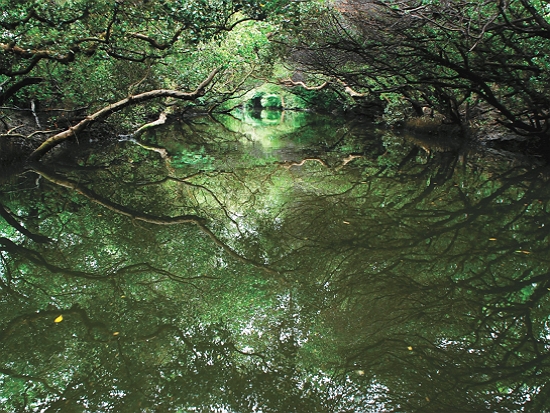
are important carbon sinks./ Provided by TNPH
Seeking Highlights and Leading the Way for Visitors
With the multiplicative effects of internet and mobile devices, a vast tidal wave of information has captured people’s attention. In order to compete for scarce attention, we need to make sure that the National Parks’ information gets well received. But this task is becoming harder. “The first step is to help people recognize and remember the National Park brand,” says Lin. Different visual elements, including logos, colors, fonts, graphics, etc. should be integrated through design to convey a uniform National Parks image and essence. This will help transmit context-based, eye-catching highlights to visitors.
Minister Lin brings up the example of the Tropic of Cancer, at roughly 23.5° north latitude. “Most of the places around the world that this line passes through are deserts or oceans. Taiwan is a rare place where the Tropic crosses dense vegetation and diverse land ecosystems.” If we trace the Tropic of Cancer across Taiwan from west to east, we begin with Penghu in the west, pass through the ocean, come to land again in Chiayi, then go up Yushan – a journey full of topographic variations. Only when local people understand Taiwan’s rich diversity from new perspectives and new angles will there be opportunities for them to build up more physical and spiritual connections with the land and its landscapes.
The same applies to how to attract foreign tourists’ attention. Lin notes, “Taiwan’s National Parks all have their own unique characteristics: Mountains, sea, wetlands, culture, volcanoes – the National Parks have it all. For such a small island to have such diverse National Parks, I’m confident this is unique in the world.” Minister Lin points out that a country’s National Parks can best represent its natural environment and human culture. If we can create a brand image to promote the density and diversity of our National Parks, there will be opportunities for Taiwan to become a can’t-miss stop for foreign travelers visiting East Asia.
Net-Zero Emissions: Leaving a Clean Planet for the Future
Of course, connections between Taiwan’s National Parks and the world are not only about international exchanges and tourists from other countries. The National Parks are also part of how Taiwan plays a role in the global village, and how we respond to global issues alongside other countries. “Climate change has been discussed for many years. The whole world has been taking action, but it hasn’t been enough. Taiwan has therefore set our goal of net-zero emissions by 2050, and the National Parks will play an important role in reaching that goal.” Carbon sinks are one of the 12 key strategies for net-zero emissions. This means it’s critical how the NPS governs the National (Nature) Parks, wetlands, and coastal areas to improve the efficiency of nature’s largest carbon sinks – the forests, soil, and oceans.
From a variety of sources – the requirement to build a platform, demand for inter-agency collaboration, the need to connect with local people, and the necessity of international linkages – the NPS is under considerable pressure. However, Minister Lin notes that, even with limited labor and resources, tasks still need to get done. “When an agency gets upgraded, it is natural that it will undertake new tasks. First, we need to convert our vision into effective policies and plans. Then, we need to provide explanations to the Executive Yuan to help them understand the goals and importance of our policies and plans. Only then can we obtain the required labor and resources.” Minister Lin also hopes that, based on the solid foundation we’ve already built, we can grasp this rare, historic opportunity and propel our National Parks toward even loftier goals.


