Is Conservation Marketable? A Look into Kenting’s Langjiao Hawk-watching Season-
Is Conservation Marketable? A Look into Kenting’s Langjiao Hawk-watching Season
Article/Hsiao-Chun Chen Photos provided by Kenting National Park Headquarters
Interviewees/Chiung-Yao Lin, Senior Interpreter, Kenting National Park Shu-Guo Hsu, Division Head, Conservation and Interpretation Division, National Park Service Roger C. J. Wang, Secretary-General, Wild View Taiwan
Every autumn, the events held during the Langjiao Hawk-watching Season draw numerous bird enthusiasts and tourists to Kenting National Park. There, they can marvel at the majestic flight of grey-faced buzzards across the sky. These bird-loving visitos, flocking to the area, also help stimulate the local economy. However, such a bustling scene was unimaginable about 30 to 40 years ago.
Back then, awareness of conservation was lacking, and hunting hawks remained a main source of livelihood for many. After Taiwan’s first national park – Kenting National Park – was established, focused initiatives in law enforcement, education, and promotion strategically incorporated charismatic species into nature conservation marketing. This led to a gradual shift in public perception, and it birthed a symbiotic relationship between conservation endeavors and economic prosperity, paving the way for win-wins all around.
Although some experts and scholars argue that the expansive nature of “marketing” contradicts the intrinsic essence of “conservation,” however, as the concepts and ractices of social marketing and ecological marketing become increasingly mature, as long as a balance is struck, these two aims can complement each other ef fectively
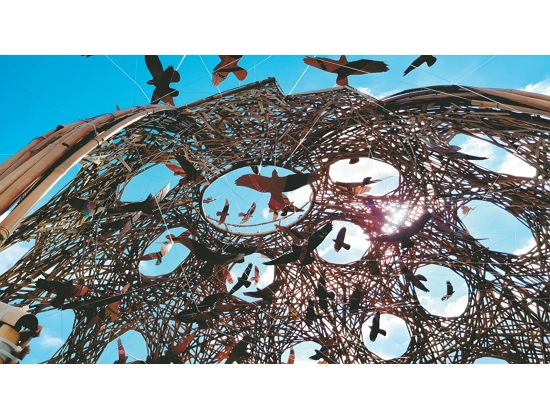
At dawn at Lingxiao Pavilion in Sheding Nature Park, you can marvel at the spectacular “Ascent of Hawks”. Over a hundred grey-faced buzzards spiral upward along the thermals, soaring northward. And at dusk, you can witness the equally-captivating “Descent of Hawks” at Shanding Bridge in Manzhou Township. Here, the migrating hawks search for night-time perches. These are the highlights of the events taking place during the Langjiao Hawk-watching Season in Kenting National Park. The volunteer-led birdwatching sessions usually draw huge crowds. Even on weekdays, numerous bird enthusiasts and locals – whether they enjoy the sight of the hawks alone or join community-guided tours with their families – delve deep into understanding Kenting’s local ecology.
Discussing the precursor to the Langjiao Hawk watching Season, Kenting National Park Senior Interpreter Chiung-Yao Lin explains. “In the early days, starting actually from late August, the brown shrikes were already passing through, while the grey-faced buzzards began their southern migration around the National Day in October. So, before we formally organized the events under the name ‘Langjiao Hawk-watching Season’, we called them all ‘Kenting Bird-watching Season’.”
At that time, the general public had a limited grasp of conservation concepts. Local residents considered the brown shrikes to be a protein supplement during the summer and autumn seasons, while the grey-faced buzzards were heavily sought after by Japanese trading companies as biological specimens. The birds were thus seen as a significant source of income by hunters. Lin, who is also a local resident, recalls: “Before Kenting National Park was established, we could only engage in gentle persuasion and collaborate with local schools to promote migratory bird conservation. It wasn’t until Kenting National Park was formally established in 1984 that birds conservations could be implemented through a combination of education outreach and law enforcement. After the passage of the Wildlife Conservation Act in 1989, conservation efforts were further strengthened.



Turning Obstacles into Opportunities
However, with crackdowns came conflicts. Shu Guo Hsu, head of the National Park Service’s Conservation and Interpretation Division, vividly recalls his early experiences serving in the Kenting National Park Headquarters. “There were hunters who, despite the ban, repeatedly caught hundreds of shrikes. In response, the prosecutor issued a warning: ‘Capture one shrike, pay a bail of NT$10,000.’ That caused a huge uproar. Some hunters even went so far as to deliberately leave hawk beaks and talons on the riverbed while we were hosting hawk-watching events on the Shanding Bridge, as a form of protest.”
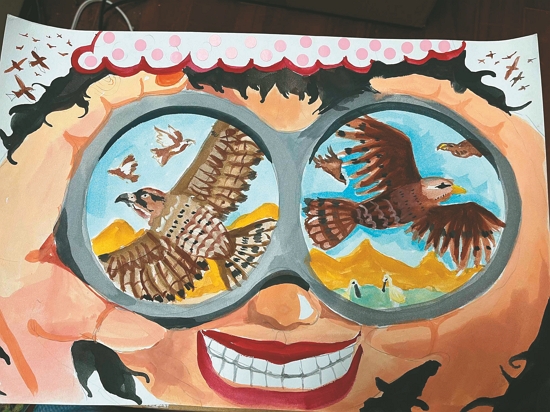
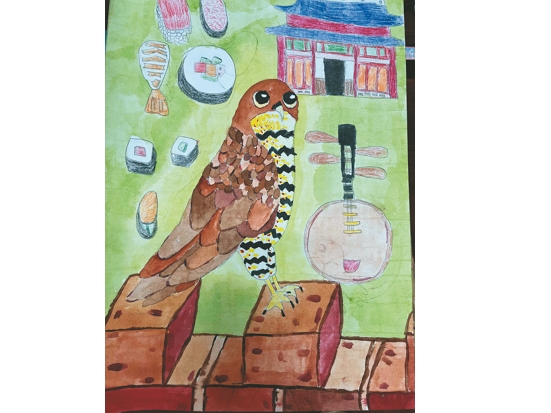
At the same time as penalties were being implemented, officers from the Conservation and Interpretation Section visited many schools. Through these platforms, they organized advocacy events such as speeches, essay contests, calligraphy exhibitions, and singing competitions, all focused on migratory birds. “Once children understood the importance of migratory bird conservation,” says Hsu, “they went home and asked their parents not to hunt or cook shrikes. We heard about one student who found a shrike in their lunchbox. They closed the box like it had never been opened, and refused to eat the contents. That proved that conservation values had taken root in their thinking.” Hsu and Lin agree that many elders, who had once been avid hunters, were gradually swayed by the persistent advocacy of the students, by their the clear commitment to conservation they demonstrated through tangible action. It was only through such work that shrikes have slowly vanished from dinner tables across the Hengchun Peninsula.
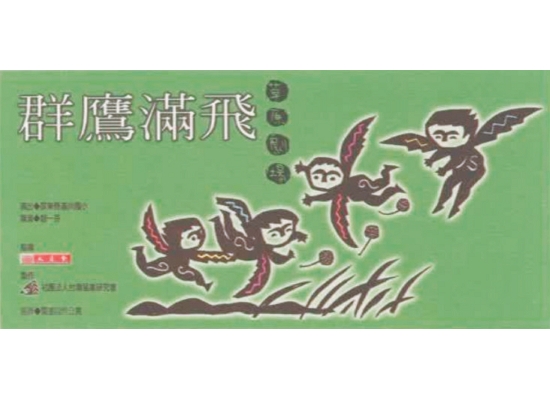
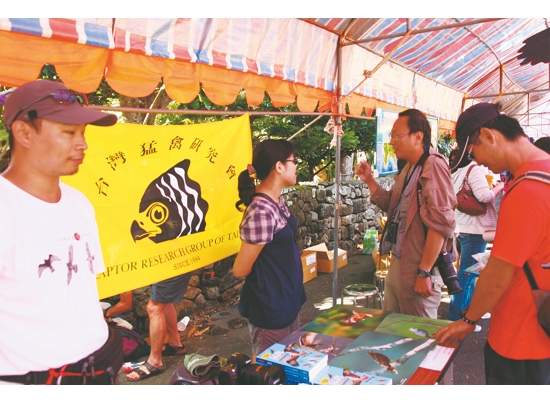
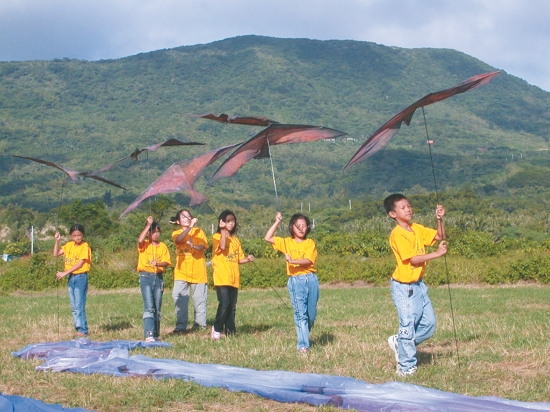
And as all that was happening, Kenting National Park Headquarters began partnering with the Raptor Research Group of Taiwan to expand the scope of the Kenting bird-watching season. Then extending across administrative districts to Manzhou. And when they named the events, they chose the Chinese version of the Paiwan name for the Hengchun Peninsula: 琅 嶠 , which is pronounced Langjiao in Mandarin. This gave rise to the name “Langjiao Hawk-watching Season.” Additionally, they staged the “Hawks Soar" grassland theater performance and implemented specialized marketing strategies. Later on, they even got the image of a grey-faced buzzard featured on the packaging for Gangkou Tea, a local specialty. This made it the country’s first conservation product; and as a result, these conservation efforts were able to yield economic gains that were then distributed among community members.
Hsu lays plain that establishing an economic feedback mechanism was a turning point in the overall conservation efforts. As the media put a spotlight on each conflict event and marketing campaign, the ripple effect grew, resulting in even more response. Hsu notes, “The public began to believe that as long as they carried out effective conservation work, there was no need to resort to illegal hunting of brown shrikes and grey-faced buzzards for the community to benefit. After the enactment of the Wildlife Conservation Act, the majority of people no longer wanted to engage in illegal activities. It was only by implementing law enforcement measures, educational campaigns, and initiatives to foster local prosperity, then amplifying the impacts through media marketing, that local residents’ mindsets gradually changed.That led to the formation of community consensus on conservation.”
Sharing Economic Benefits with the Local Community
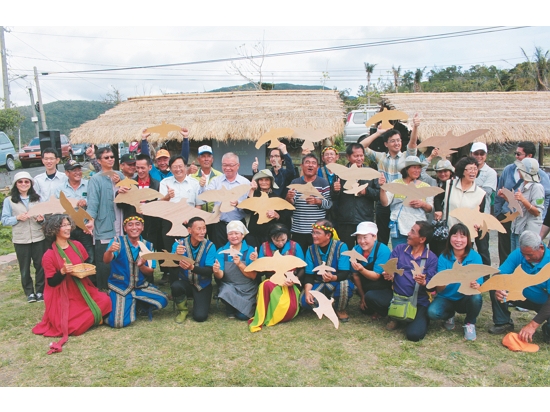
When discussing key elements in the marketing plan of the time, Roger C. J. Wang (then CEO of the Raptor Research Group of Taiwan, and now Secretary-General of Wild View Taiwan) chuckles. “Our strategy was simple: Eat and buy everything from all the shops in Manzhou!” In 2002, the concept of ecotourism wasn’t prevalent and there weren’t many bed-and-breakfast style accommodations. But with Wang’s years of experience in marketing and media, he fully understood the importance of tapping into economic potential driven by consumption. It was essential for the local residents of Manzhou to understand that conservation wasn’t just about bird-watching but also about long-term local development. “So, we developed the Raptor Shop brand; we designed an activity where consumers could collect stamps in exchange for gifts; and we encouraged birdwatchers to patronize local eateries and purchase local souvenirs. All that fostered interaction with the local community and built trust.”
However, if we think about the “4P” framework (product, price, place, and promotion) used so often in marketing, how can that be applied to conservation? How could that even fit within relationships between species and ecosystems? Wang suggests that it must be viewed from a broader perspective: “Humanity only truly began to realize and contemplate the importance of ecological conservation roughly after World War II. And species were the initial focus of attention.” The catalyst for this concern was the degradation of habitats crucial for the survival of many plants and animals. Human overexploitation of natural resources had resulted in significant declines in some species; and after decades of observation, it became apparent that focusing on charismatic species was merely scratching the surface. The overall impacts were vastly larger than we had imagined; they permeated nearly every aspect of the ecosystem, and threatened to finally put biodiversity itself at risk.
Can the 4P’s Marketing Framework Really be Adopted to Achieve Conservation Goals?
Within the 4P’s marketing framework, businesses and suppliers first need to produce products. They must then establish a reasonable price, and identify suitable sales channels (the “place”). Finally, they need to plan effective promotional campaigns.
However, applying the 4P framework to a product is not a “one size fits all” situation. Rather, it necessitates a diversified marketing mix and strategy customized to target specific consumer groups and market portfolios. The marketing mix needs to meet the specific business’ promotional and sales objectives.
But conservation marketing differs from conventional product marketing. It requires an understanding of both the product essence (be it a charismatic species or a conservation concept), and recognizing the distinction between cost/price and value. Only if we transform the inherent cost/price into value, then clearly define the core value we hopes to convey, can we determine the proper marketing approach.

Conservation Products ≠ Charismatic Species
In other words, when we discuss conservation marketing, it’s not just about examining the “promotion” aspect within the 4P framework. We need to explore a holistic marketing framework that encompasses the entire ecosystem behind species conservation. Wang illustrates this point with several charismatic species in Taiwan. “Species such as the black-faced spoonbill, the Formosan black bear or the leopard cat, can be viewed as the ‘product’. And the success or failure of a product is intimately link to the supply chain behind it.”
Take the various migratory birds that visit Taiwan throughout the year as an example. They pass by or temporarily stop in Taiwan every year, and need a variety of habitats. Ensuring their safe migration routes, from south to north and back, is crucial if we want to see them return to Taiwan the following year. Wang continues: “However, while many people may only notice the presence of migratory birds in Taiwan, they often overlook the multitude of conditions necessary for their habitats and migration. We could say those requirements are like the production process for the migratory birds. And those requirements are all part of conservation marketing, but they frequently go unnoticed.” Wang argues that, if we consider marketing as a whole, the factors that enable migratory birds to visit Taiwan are, in fact, integral to the holistic marketing approach. Therefore, Wang takes a critical stance toward certain experts and scholars who draw a hard line between “conservation” and “marketing”; he disagrees with those who see an overemphasis on marketing charismatic species or nature conservation. He challenges the idea that marketing might obscure the focus of conservation, advocating instead for a respectful yet reasoned reflection.
“The issue at hand isn’t excessive marketing, but rather a plethora of gimmicks that fail to address the core issues or aren’ t carried out thoroughly. As a result, what the general public sees are superficial, shallow marketing tactics.” Alternatively, while the ‘promotion’ aspect within the 4P’s is thriving, issues persist with the ‘product’ supply chain, such as unresolved habitat planning for migratory birds. These matters could significantly diminish the effectiveness of such marketing endeavors.


Identifying Product Positioning and Crafting Tailored Messages
What constitutes successful nature conservation marketing? Wang notes, “For matters related to agriculture, forestry, fishing, and animal husbandry, it’s essential to identify product positioning first. In other words, what is the product that’s being marketed?” Concerned that this statement might be too abstract, Wang ponders for a moment and mentions an actual challenge facing Formosan Black Bear conservation. “When we see Formosan Black Bears getting injured when they accidentally trigger hunting traps, we feel genuine sympathy for them. But behind the scenes, two underlying issues emerge: One is the environmental safety of Formosan Black Bear habitats, and the other is discussions concerning human-wildlife conflicts. These two require entirely different strategies.”
Wang continues, “We must have a clear understanding that in nature conservation marketing, the Formosan Black Bear itself is not the product; rather, the issues we need to address and discuss – those are the products. In other words, if we aim to maintain the integrity of forests and restore habitats for the Formosan Black Bear, we must engage and negotiate with landowners or land users. If we seek to resolve human-wildlife conflicts, we need to consider how human activities are managed.”
In the negotiation process, the feedback mechanism involved corresponds to the ‘price’ component of the 4P framework; while identifying the right communication channel can be compared to the ‘place’ aspect. “In other words, as long as you communicate with the right people effectively, there’s no need to address everything to the public at large. The key is to ensure that your target audience understands what benefits they can gain.”
Echoing Wang’s views, Shu-Guo Hsu references the case of the Humphead Wrasse (Cheilinus undulatus) and the Green Humphead Parrotfish (Bolbometopon muricatum), which dominated the headlines at one point. “These are fish species that are extremely rare in domestic waters, yet there are still divers hunting them with spear guns for personal consumption or to sell to restaurants. Therefore, for the conservation of these ‘celebrity fish species, we must adopt targeted marketing strategies that help different audiences understand how conservation can benefit them personally.”
For scuba divers in Taiwan, if these endangered species disappear from Taiwan’s waters, they would have to spend vastly more on airfare, accommodation, diving guides, and other expenses to try their luck abroad for a chance to see them. For businesses, preserving these endangered charismatic fish species is like retaining a source of income, ensuring the sustainability of marine resources, and laying the foundation for the development of marine tourism industry.
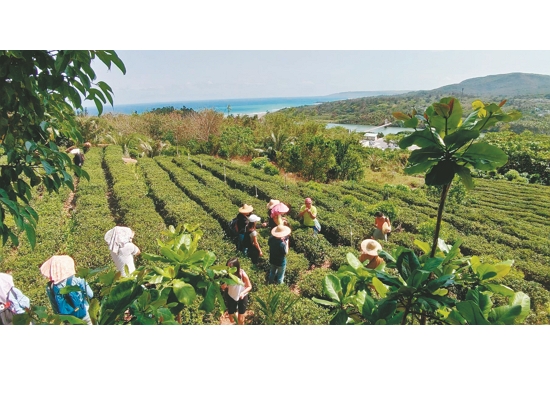
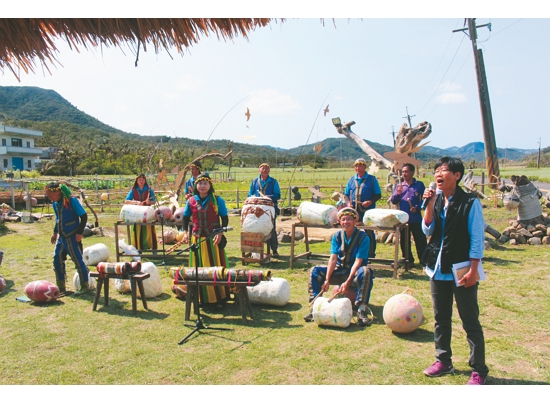
Over the past two decades, the concept of conservation has evolved alongside climate and environmental change, but marketing strategies must also keep pace. Wang continues, “However, we still need to discuss what products need to be marketed at present, and then re-price them, find the places to market them, and, more importantly, determine how to promote them so that the overall value of these products can be understood and recognized.” He cites the Langjiao Hawk-watching Season as an example. Initially met with skepticism from most local residents, this event has now won over the local community for its conservation merits. They not only organize patrol groups and serve as conservation volunteers, but have even come to embrace the idea of “ecotourism” as a delightful revelation. Today, Hawk-watching Season has expanded to offer a variety of activities such as picking tea leaves, listening to Indigenous songs, and picnicking. Hawk-watching Season has solidified its status as an emblematic case study in conservation marketing practices.