
Friends of the National Parks and Corporate ESG | Deloitte Taiwan
Article/ Huang Shih-Ju
Interviewee/ Lee Cathy, Senior Executive Vice President, Sustainability Transformation Services Team, Deloitte Taiwan
Sustainability actions require effort from everyone. When the National Park Service (NPS) has contemplated how to bring in more partners for environmental protection initiatives, interested companies have approached to ask: "How can we help? How can we make the most of it?"
It's at times like these when we need to bridge gaps – gaps in language, goal alignment, and accurate resource allocation. Deloitte Taiwan's Sustainability Transformation Services Team has long played such a bridging role in sustainable operations and risk management for businesses. With its grasp of global trends in nature conservation, the Team creates a platform for dialogue about climate and nature, commerce and the environment.
From TCFD to TNFD: Why Companies Need to Understand Nature
An increasing number of companies have started to ask themselves, "If climate change continues to worsen, how can our company continue operating stably?" Such questions are closely related to the company's risk management and investment decisions. Cathy Lee, Senior Executive Vice President in Deloitte Taiwan's Sustainability Transformation Services Team, shares that she and her team play a part in assisting companies in understanding environmental issues that were once seemingly distant, and to conduct self-assessments in preparation for future operations.
Lee first brings up the Task Force on Climate-related Financial Disclosures (TCFD) recommendations, initiated by the Financial Stability Board (FSB) in 2015. The TCFD recommendations (or TCFD for short) encourage companies to disclose climate-related risks. Says Lee, "The thinking behind the TCFD is for companies to conduct inventories and disclose how they are affected by climate change. This allows investors and financial institutions to examine how companies are responding to climate change."
Building on the positive experience of the TCFD, the Taskforce on Nature-related Financial Disclosures (TNFD) was launched in 2021. Deloitte was involved in developing this framework. The TNFD encourages companies to assess which parts of their business process rely on natural resources; the impacts they have on nature; and to predict how potential future risks and changes may affect their finances. This helps improve the transparency of financial risks related to nature.
Neither the TCFD nor the TNFD requires companies to become environmental experts. Rather, these frameworks help them to identify the tight connections between their business, nature, and climate, and help them prepare as much as possible in advance. This, in fact, is a more stable way to run operations.
In response to the TCFD and TNFD initiatives, Lee observes, the large companies in Taiwan are already leading the way; and more companies will follow suit with guidance from policies and regulations. "Many companies are starting to pay attention to current international trends as they conduct natural risk assessments," says Lee. "They then encounter concepts such as 30 x 30 and OECM, which they try to integrate into their goals and methods for addressing natural risks."
"The sector that's moving relatively quickly," says Lee, "is the financial sector. That's because everyone sees financial power as a crucial element in achieving sustainability." The operations of the financial sector may seem at first to have relatively small impacts on nature, but the parties that these companies have transactions with may potentially – and significantly – impact natural resources. "Add to that the Financial Supervisory Commission's Sustainable Finance Evaluation, which focuses on whether the financial sector is adopting the TCFD in its analyses, and related risk assessments and handling. That's why almost all large financial holding companies in Taiwan are already putting effort into this."
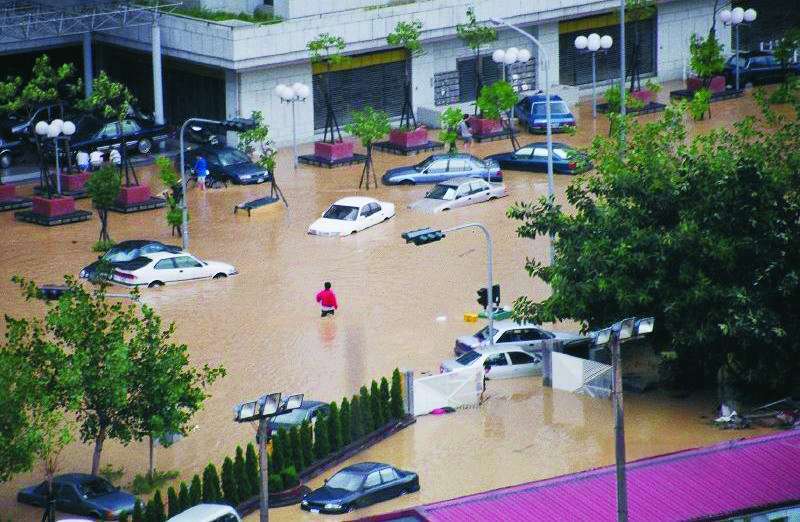
TNFD - Encouraging Companies to Conduct Self-Assessments
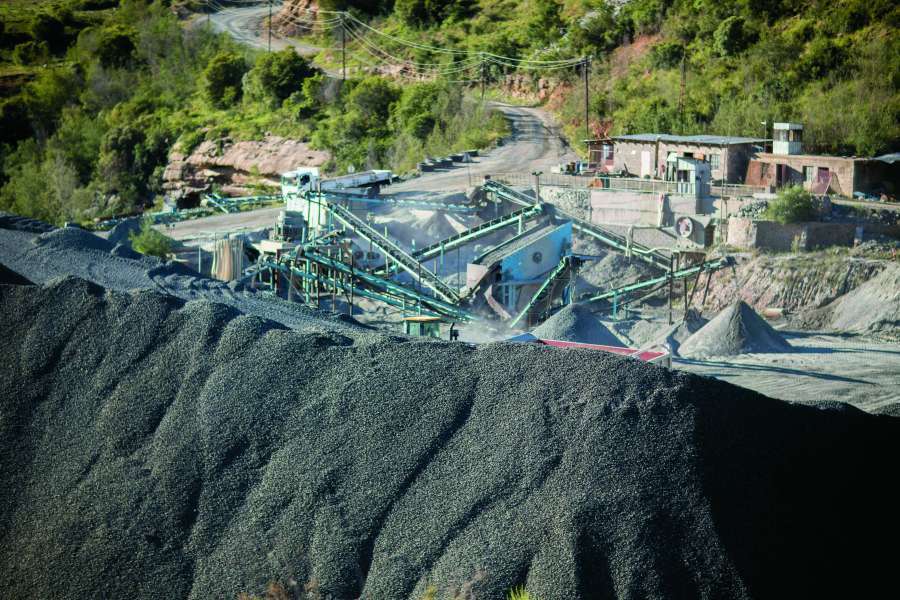
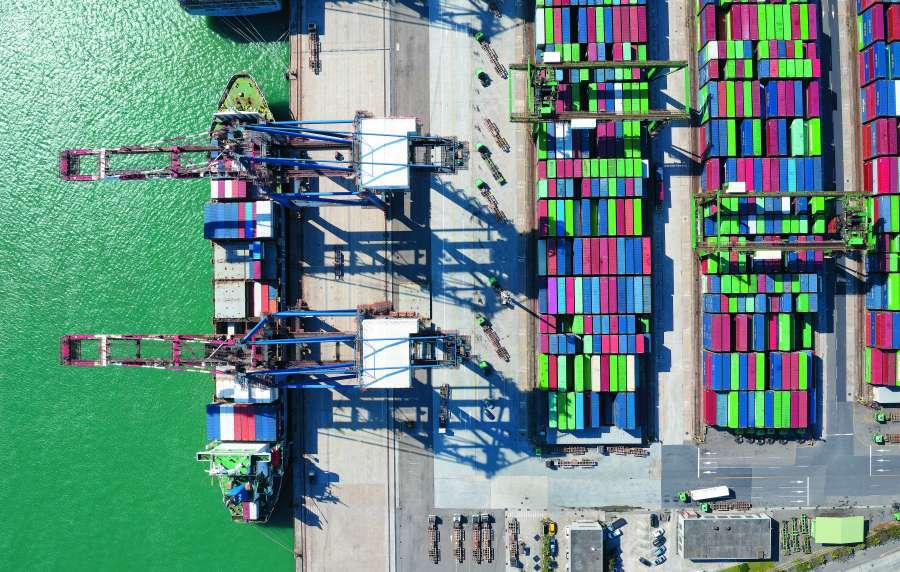


Identification and Assessment: An Ally for Corporate Sustainability
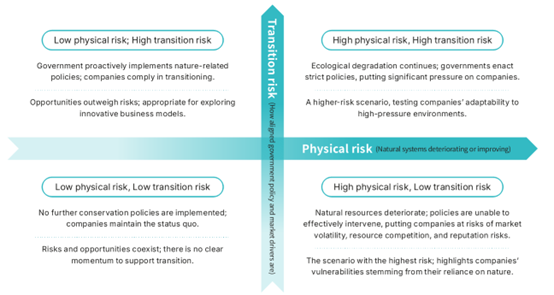
Through disclosure frameworks, international organizations provide companies with guidelines in addressing climate and natural risks. But companies need their own methods and tools. LEAP (a nature-related assessment approach) is just such a suite of tools. Lee notes, "We hope that, when companies address natural risks, they don't only focus on the present, but look also to the future. That's why LEAP is divided into two aspects: Physical Risks and Transition Risks, which are further expanded into four scenarios."
Once companies identify potential risks, they may turn crises into opportunities. Lee explains: "If a company engages in multiple business sectors, rather than focusing solely on one sector, or has strength in innovation and R&D, then that company is more likely to turn risks into opportunities." Lee notes that this is like the company doing a medical self-check. "Our role is to help companies clarify their logic based on their industry characteristics, and develop a narrative that's tailored to their needs. We're also somewhat like a translator, who helps the companies align with international standards and regulations."
LEAP - A Nature-Related Assessment Approach
The LEAP approach helps companies understand their relationship with nature more systematically, through four steps:
- Locate: Identify the geographical location and ecological hotspots of natural resources that the company relies on or impacts.
- Evaluate: Assess the company's level of reliance on natural resources and the scope of its impacts.
- Assess: Use scenario analysis to simulate risks and opportunities that the company may face in different natural and policy development scenarios.
- Prepare: Organize the analysis results, then compile disclosure reports and internal strategy recommendations, for use as a basis for communication with investors and stakeholders.
Four scenarios for scenario analysis

From Disclosure to Practice: Exploring the Possibilities for Sustainability
Not only does Deloitte Taiwan provide a platform for dialogue about sustainability issues, but in August, they also signed a memorandum of intent for the Ecological Habitat Restoration ESG Project with the NPS at Taichung Metropolitan Park. and held a tree-planting event. The Project is a collaboration arising from its participation in the Formosa Tropic of Cancer Sustainability Belt Forum last year. "
Deloitte Taiwan is a member firm of Deloitte Touche Tohmatsu Limited (DTTL)," explains Lee. "And our global headquarters argues that only when carbon reduction 'has value' will it be tangible. For that reason, the headquarters converts the annual carbon emissions of each member firm into monetary value, and requires the members to invest that amount in Beyond Value Chain Mitigation (BVCM). In other words, the funds must be invested in industries that are outside our value chain, which are beneficial to nature, and which produce actual carbon reduction benefits."
Building the Tropic of Cancer Sustainability Belt requires joint efforts between public and private sectors. Lee believes that through the TNFD, companies will be able to identify issues and seek solutions; investing funds to support related projects is one approach. She also encourages service innovation among companies in offering their professional expertise and services, and promoting environmental education and ecotourism is a direction worth exploring. "
For example, conservation work for the Eurasian otters of Kinmen could integrate high-tech companies' monitoring technology. This would help research on the species, while avoiding causing distress to the animals through the monitoring equipment." Chunghwa Telecom, for instance, has recently used an AI ecological monitoring system to identify numbers and behavioral patterns of black-faced spoonbills (*Platalea* *minor*) and monitor their habitats. "A company that innovates in providing services can have a major impact, and even lead to new business opportunities."
Finally, Lee mentions that the future corporate disclosure requirements will not stop at climate risks. The International Sustainability Standards Board (ISSB) plans to launch the International Financial Reporting Standards (IFRS) targeting nature and biodiversity by 2030. This is an important aspect of disclosure that corporations should continue paying attention to.


