.jpg)
Photography Expert/ Liang Shih-Ming, Volunteer, National Nature Park Headquarters
Equipment Reveal

When visiting Shoushan National Nature Park, you can often see volunteers observing the canopy or crouching down to take photos while they walk along park trails. They are conducting plant phenology surveys within the park, to accumulate long-term observation records. This is aimed at documenting Shoushan’s plant diversity, and analyzing the impact of climate and environmental change on its ecosystems.
Discovering the Micro Beauty of Nature with a Phone in Hand
Liang Shih-Ming, leader of the plant phenology survey team, is a senior volunteer conservation interpreter at Shoushan. Over the past decade, he has added more than 13,000 records for over 2,000 species on iNaturalist. He started off taking photos simply to record his observations, but over time, he became captivated by the beauty of plants. This inspired him to share his work with others.
For photography aimed at documenting, cellphones are a very convenient tool. “Plants don’t move, so you can take your time with the shot,” notes Liang. “Modern cellphones have excellent camera functions and resolution, which makes them ideal for recording observations.” Liang says the first step is to take a picture of the whole plant, to determine whether it is a tree, shrub, or herbaceous plant, and then identify its leaf characteristics. “Leaf identification isn’t usually based on leaf size; what's more important is the leaf arrangement, or phyllotaxy: alternate, opposite, or whorled. Other crucial features include characteristics of the leaf surfaces and the petiole (leaf stalk), whether the leaf edges are toothed (serrated margins), and if the leaves are hairy (pubescence). Some plants look identical at first glance, but the presence or absence of hairs can reveal that one is pubescent, while the other is glabrous (hairless). This difference can mean they are actually two completely different species.”
Floral structure is also a key reference for plant identification, and flowers with unique structures are often the focus for botanical photography. “For example,” says Liang, “some flowers only have stamens, while others only have pistils. Some plants, like the Angel's Trumpet (Brugmansia suaveolens), have long, tubular flowers that make photographing the interior somewhat difficult. It is important to find the right angle and light to get a good shot.”
Liang adds that observing plants with tiny flowers is always very challenging: “Some flowers can be as small as a grain of rice, and some grow high up in the canopy of very tall trees. To capture clear images of their structures, photographers have to use specialized equipment and techniques.” Take the Philippine Glochidion (Glochidion philippicum), commonly seen in Shoushan, as an example. “Its flowers are so tiny that are not easily noticed. The flowers are scentless, produce no nectar, and are pollinated by specific species of tiny moths”. It’s almost like the plant and the insect have entered into a mutually beneficial, symbiotic ‘contract’, which allows the Philippine Glochidion to reproduce successfully without the need for showy flowers or nectar. “Once you understand this flower’s structure and pollination mechanism, you’ll find them truly fascinating and remarkable!”

iNaturalist
iNaturalist is a community for nature observers. It allows everyone to document their observations, then share and discuss them with a global community. Every record contributes to biodiversity science. For citizen scientists managing long-term observation records, it’s common to struggle with remembering “Where did I take this photo?” To overcome this, the iNaturalist’s GPS coordinates link observations on a map to create a visual trail of observations, making it easier to recall and retrieve data.
Rooting Observation in Botanical Aesthetics
Slow-growing plants are like works of art created by time. For a flower to go from bud to half-open to full bloom may take a few days, or perhaps several weeks; and a single plant can have a completely different look in different seasons. “If you are willing to spend the time documenting the progression, and then put it all together,” says Liang, “then you can see its dynamic transformation.” And it is for just this reason that it’s important to know plants’ blossoming seasons.
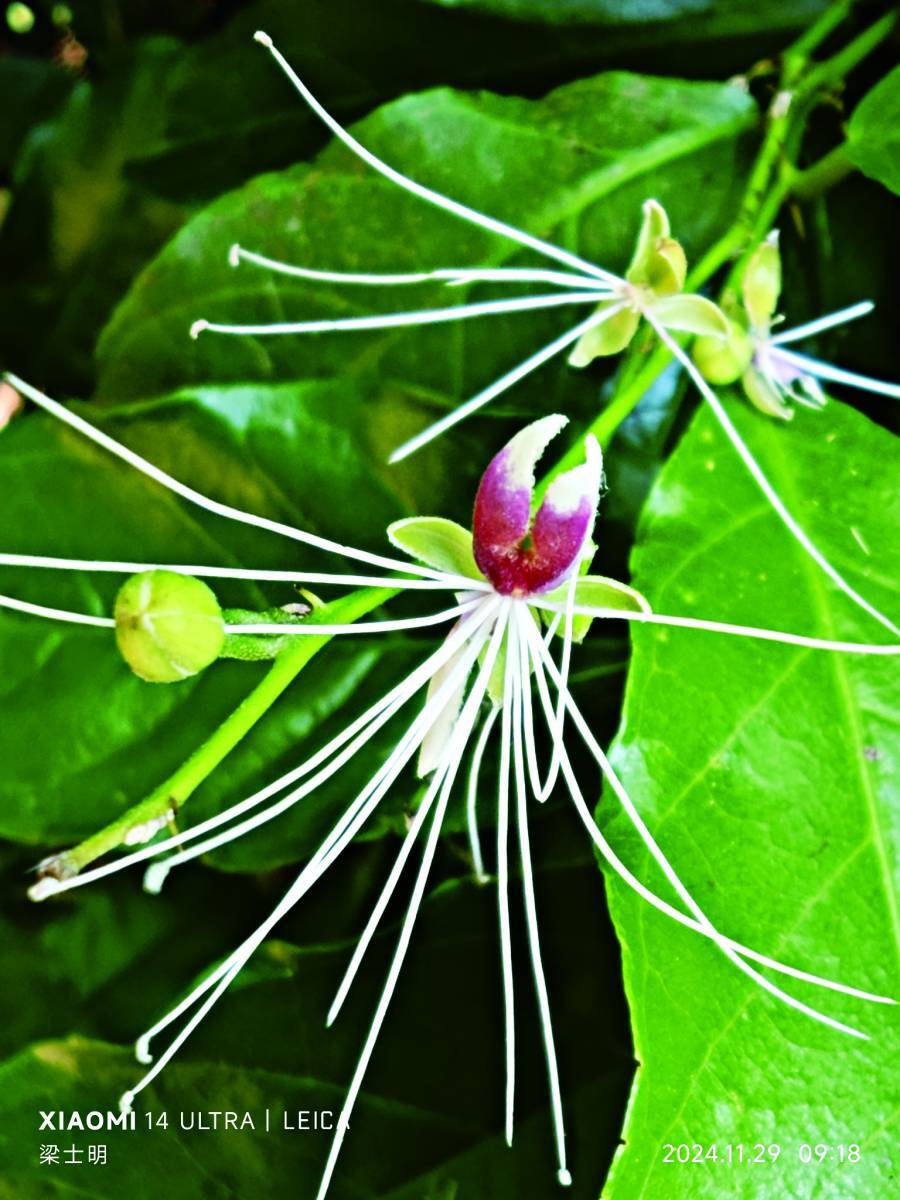
Some plants at Shoushan have longer blooming periods, such as the Caper Thorn (Capparis micracantha var.henryi), which flowers in spring or summer. Liang explains: “The Caper Thorn is a type of shrub that grows in abundance along trails and is easy to spot.” Some plants, like the Taiwan Morning Glory (Argyreia formosana), have flowers that last only a few days. “The Taiwan Morning Glory isn’t commonly seen, even in Taiwan; many people make special trips to Shoushan just to photograph it.” As soon as volunteers spot the white flowers of the Taiwan Morning Glory, they immediately inform each other to capture the moment for documentation.
Photographing plants requires going to meet them where they are. “Unless you know where the plant grows,” says Liang, “you won’t get a chance to see it in person. So, you need to equip yourself with knowledge about the plant, and understand its growing environment, to keep pace with its growth rhythm”. Liang explains that there are no shortcuts when it comes to building knowledge; it can only be accumulated over time. “The essential prerequisites are having the interest in the first place, then sharing and exchanging with fellow enthusiasts.”
When you come across an unfamiliar plant or a species you’re unsure about, sharing ideas with like-minded people or getting verification from iNaturalist community becomes very important. “This is why,” says Liang, “when photographing plants, you should get as many details as possible and try as hard as possible to photograph the plant’s distinct characteristics, so others can help you identify it. Otherwise, you might get answers that are inconclusive, which is as good as having no answer at all.”
Through interactions with others, Liang became inspired to pay more attention to light and composition when photographing: “Beyond just being clear, I hope my photos look beautiful, and I can share them with others.” By observing and studying others' works, he learns new photography techniques, and treats every observation trip as a field for practice.
The Seasonal Poetry of Shoushan
Shoushan features different vegetation landscapes throughout the year. In February, March, and April, a succession of flowers bloom: Stinking Passionflower (Passiflora foetida), Two-flower Nightshade (Lycianthes biflora), Sticky-waxy Ehretia (Ehretia resinosa), Siam Weed (Chromolaena odorata), Taiwan Clematis (Clematis formosana), and Ceylon Leadwort (Plumbago zeylanica). You may unexpectedly come across them while walking on trails or turning a corner.
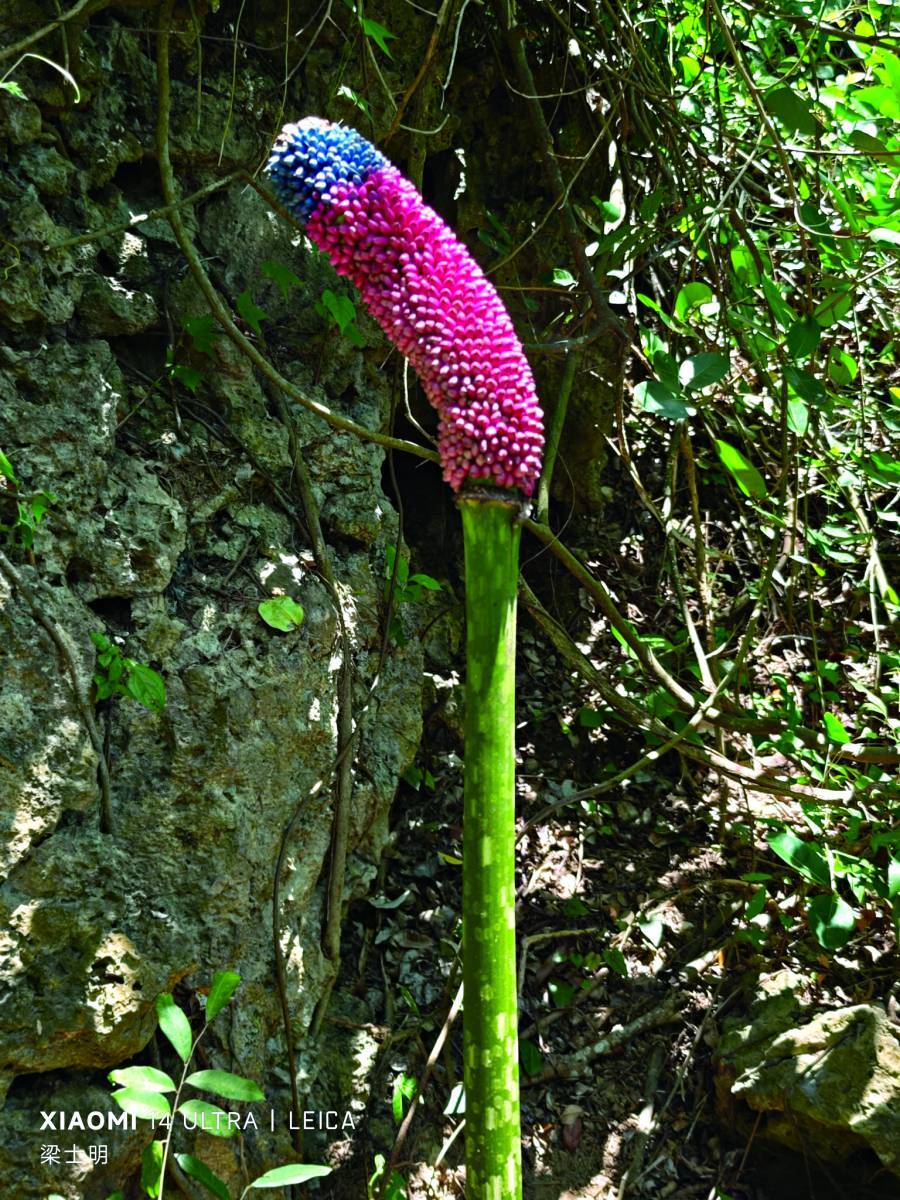
Liang recommends a visit to Shoushan in early summer to appreciate the Amorphophallus genus of plants, which are “stinky but beautiful”. “The Amorphophallus specimen named a century ago actually came from Shoushan. If you visit Shoushan in May, you can see both the Taiwan voodoo lily (Amorphophallus henryi) and the hairy-style voodoo lily (Amorphophallus hirtus).” The Oldham's bellflower (Titanotrichum oldhamii), a plant that thrives on valley rock walls, is also one of Liang’s preferred subjects for summer photography. “The flowers of the Oldham's bellflower are quite unique; they look just like bells. At Shoushan, you can only find them in the area below Zhongxing Pavilion”. When autumn comes, the Taiwan flamegold trees (Koelreuteria henryi) paint the mountain in shades of yellowish orange. As winter arrives, the leaves of the Chinese soapberry (Sapindus mukorossii) trees transform Shoushan into a vista of gold.
As spring arrives, Liang especially recommends that visitors interested in observing plants visit the Xiaopingding Trail. “This section of the trail features an incredible amount of blooming plants. The plants are easy to observe, making it a great spring hike.” As you follow the trail, the view gradually opens up, offering a panoramic view of Kaohsiung city and its harbor. You can also admire Shoushan’s topography, rock textures, and insects moving among the foliage. It all makes for just the right balance between city and mountain.