

Article / Cheng Chih-Ya
Interviewees / Kuo Li-Lun, Volunteer, Marine National Park Headquarters 、Lin Li-Ling, Volunteer, Marine National Park Headquarters
For most people, Dongjiyu, Xijiyu, Dongyuping, and Xiyuping are merely a few tiny dots scattered across the map. But for Kuo Li-Lun, a volunteer with the Marine National Park Headquarters (MNPH), they are living museums upon the sea—museums without walls, holding centuries of wind, earth, people, and stories of endless voyages.
Charting a New Course
“After Kaohsiung’s Qianzhen Fishing Port was established, large numbers of island residents moved to Taiwan proper. Islands such as Xijiyu, lacking electricity and modern harbor facilities, gradually emptied out. The remaining residents were either relocated to Magong with government assistance or moved on their own to Tainan or Kaohsiung, leaving the islands truly uninhabited.
Then, in 2009, Dongjiyu—whose population had also dwindled—was selected as one of the candidate sites for low-level radioactive waste storage. After repeated negotiations between officials and protesting islanders, a consensus gradually emerged: rather than becoming a nuclear waste site, the islands should become a national park.”
In this way, the four distinctive basalt islands south of the Tropic of Cancer became linked together. In 2014, they were officially designated as Taiwan’s ninth national park—the South Penghu Marine National Park.
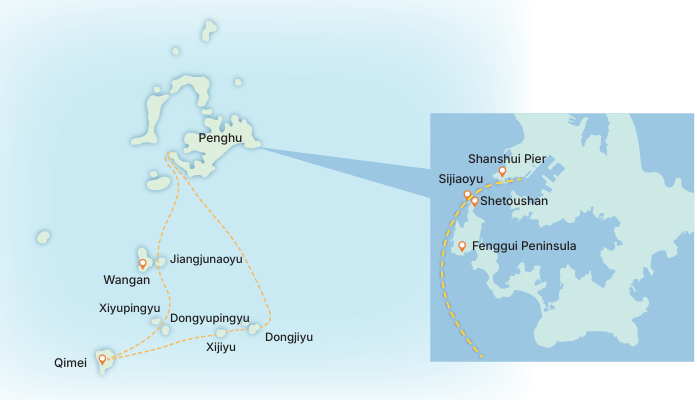
Sailing Through the Islands, Past and Present
Speaking about today’s island hopping excursions, Kuo says the best time to visit is between April and October. During the rest of the year, the northeast monsoon can roughen the seas so severely that visitors may find themselves seasick before they even have a chance to enjoy the scenery, while voyages themselves become far more dangerous.
“After departing from Magong Harbor, you’ll see Fenggui on the left, where Shetou Mountain stands. During the Age of Exploration, the Dutch established a trading outpost there, and remnants of their fortifications can still be found today. Further along is the uninhabited island of Sijiaoyu. Years ago, because there were too many macaques in Shoushan, experts attempted to relocate them there. But when fishermen landed to gather shellfish from the intertidal zone, the monkeys would sneak up and attack them from behind, so the plan ultimately failed.”
Through Kuo’s storytelling, the islands’ winding histories seem to come alive across the open sea. Between moments of humor, he also introduces the unique character of each island: “Toujinyu and Tiezhenyu are important nesting grounds for terns. Every summer, terns migrate northward from Australia and New Zealand, stopping here as schools of anchovies fill the surrounding waters.”
His tone then shifts from lighthearted to serious:“In the past, some tour operators handed visitors buckets of fish to throw into the air, drawing terns into dramatic dives for food as a tourism spectacle. But that was not the right approach. So when we pass through these waters today, we make a point of incorporating environmental conservation into our interpretation—encouraging visitors to explore the islands on foot whenever possible to reduce carbon emissions, carry all trash back with them, use reusable or eco-friendly utensils, and help reduce marine debris.”
.jpg)
.jpg)
Where the Light Leads
Asked about the most captivating views from the water, Kuo smiles and says, “The best-known attraction is Xijiyu’s Blue Cave. The dreamlike photos circulating online have drawn visitors from far and wide.”
He explains that the images are not digitally enhanced. Instead, photographers must wait until noon, when sunlight shines directly into the cave and refracts off the sea surface, allowing the brilliant blue to finally reveal itself.
Xijiyu’s stone towers also tell stories shaped by light. “Although the four islands lie relatively close to one another, even modern motorboats still take more than ten minutes to travel between Xijiyu and Dongjiyu—let alone in the age of sailing vessels. That’s why the islands once relied on stone towers to send signals across the sea.”
The four stone towers along Xijiyu’s shoreline each differed in form and function. One of them, known as the Safety Pagoda, once housed a kerosene lamp at night. But the light was not visible from every direction; it could only be seen through specific openings and from certain angles.“When sailors saw the light, they knew they were on the right course. If the light disappeared, it meant they might be heading toward dangerous reefs.”
Where Grassland Meets the Sky
Asked for his personal recommendations, Kuo answers without hesitation: “The sweeping grasslands in front of Dongjiyu Lighthouse have a quiet beauty all their own when seen through the camera lens.”After a brief pause, he adds with a laugh, “But we always say that if you visit the four southern islands in spring or summer, you’ll encounter three kinds of weather: hot, very hot, and extremely hot. So don’t forget your sun protection while taking photos…”
He also encourages visitors to spend a night on Dongjiyu to fully experience the island’s sunsets, starlit skies, and sunrises. “Especially at daybreak the next morning, when you look out toward Taiwan, you’ll see a long golden ribbon of light stretching between the sea and the distant mountains. Even the famed sea of clouds in Alishan pales in comparison.”
Island-hopping leaves visitors with more than photographs; it carries them into the layered history of these waters— memories of once-thriving maritime trade, the determination of fishing village children who once crossed the strait by boat to attend school, and the longing that draws islanders back each Qingming Festival to honor their ancestors.Come, and let the rhythm of the tides guide you through these island stories, one wave at a time.

Slowing Down on the Islands
The sound of the sea and the islands’ natural surroundings naturally soothe the body and mind. Listening to the waves along the shore, taking in the open views from the cliffs, and immersing yourself in the rhythms of nature, you gradually begin to slow down with the movement of the sea.
Staying a night on the islands and spending time talking with local residents offers another way of encountering the South Penghu islands—one that allows you to begin understanding these islands more deeply.


